


Likes
Comments
Share


@Not_a_tutorial1990
Follow
Non eventful week apart from noticing possible potassium difficiency on my Blue Afghan and planet of the grapes started yellowing on the leaves.


Processing
Likes
15
Share


@Dico29
Follow
They are starting to shoot some pistils. I added some random store fertilizer that is 1-4-7 and put it in the 3 gallon. I poured it in a water bottle and just eye balled it pretty slow and not for long. It seems to help

Likes
46
Share


@Chubbs
Follow
420 Fastbuds Week10
Gorilla Punch Auto
These beauties are about as done as I think they're going to get. Definitely will be chopping them in the upcoming week. They smell super strong so can't wait to see how they'll finish and dry. Being sticky would be an understatement for sure. Both did get a little crispy on a few of the leafs but I think thats do to lowering the lights in the tent. All in all Happy Growing.

Processing
Likes
9
Share


Likes
63
Share


@Wicked_Stix
Follow
Shes big
Shes beautiful
Shes a beast!
Shes my winner. The last plant standing of this run and she is getting flushed with ro water. I have taken late flower clones of this girl because it would be inhumane to let her die. I will reveg them if they root and dose one with silver to make a lot of beans. Beaming her with 720 watts of light her last week of life just because I can.
Ps. If she dont win diary of the month then its rigged🤣🤣


Likes
Comments
Share

@Sakub
Follow
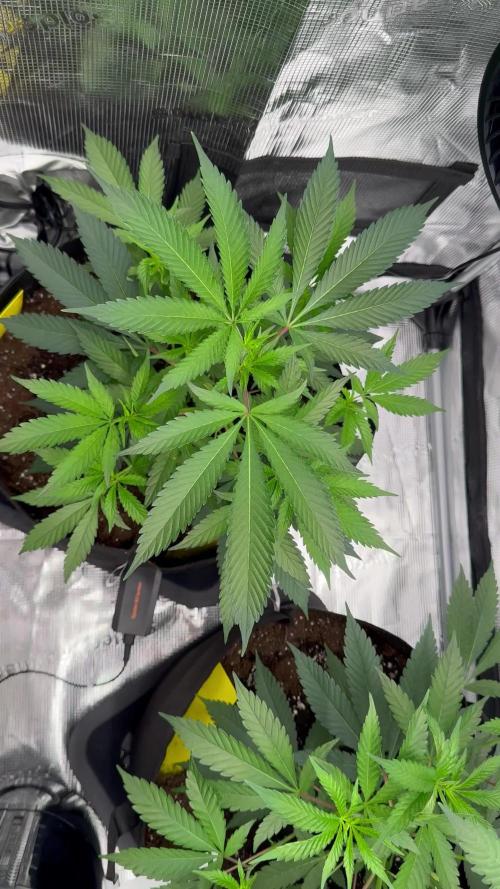
This week, I topped the girls for the first time. They’re still getting just tap water. I went from struggling with low humidity to dealing with high humidity, but the Spider Farmer dehumidifier solved most of the issues. Humidity still spikes for about 20–30 minutes after the lights go off, but after that, it’s all Gucci.

Likes
13
Share


@leithsffs
Follow
I started harvesting 6 days ago. I'll finish it tomorrow.
I was in trim jail Aaaaalllllll day today. I started at 5:30am and finish putting the last label on the jars at 6:30pm. I did, however, take a 1 hour break for lunch.
The results for Sept 21:
Orange Sherbet FF - 188.43 grams, 6.73oz (2 plants)
Gorilla Cookies FF - 86.97 grams, 3.1oz
The results for Sept 27:
Orange Sherbert FF - 104.5 grams, 3.73 oz (2 plants)
One more quick trim day to go.
The results for Oct. 3:
Gorilla Cookies FF - 36.28 grams, 1.3 oz
Not including all of the little popcorn buds I chopped up and threw into the trim, it's 14.86 oz.
That's it for this run.
Take care, gromies!!
Processing
Likes
21
Share


@Pedrojuan
Follow
Bueno, iniciamos bien la 5a semana, con EC y PH ideales, crecen mucho esperemos los cogollos se desarrollen bien... Estoy contento. Mantendremos el EC entre 1.8 y 2.0 por esta semana, la próxima iniciaré a bajarlo a 1.4 y 1.0 hacia el fin de la próxima, para después cambiar la solución y en las últimas 2 semanas el lavado de raíces y agotamiento de los nutrientes absorbidos, usare solo el ripen en esas 2 semanas.
Si alguien pasa por aquí y quiere dejar algún consejo, será bienvenido.

Likes
12
Share


@Naidoo_B420
Follow
7 days since seeds came up from the soil..doing just fine I guess..need to upgrade my lights tho


Processing
Likes
8
Share


@weed_gastro
Follow
Day 42, start of flowering week 3: they are growing nicely, had to do a lot of defoliation on each plant, except the one in the 3L pot.
Day 43, I started to discover that the roots are coming out aggressively from the bottom of the pot. I did not move the ones in the back, but I guess same thing.
The one in the 3L pot doesn't have this problem.
Day 45: getting really excited for these guys! I'm trying to keep the temp and humidity low, and I hope I can achieve some of the purple color :P any advice on that?
day46: defoliaton
Likes
11
Share


@adam_pawloski87
Follow
Let’s Go Day 47 of 🌺!! These girls are looking so amazing for the most part , on the other hand we got a lil bit of a deficiency on one of the Dirtyblondes, hopefully it’s not too much to worry about so probably gonna go ahead an start flush on the 2 Dirtyblondes and one of the pre98 s this weekend cause they are looking pretty close to being done, hopefully they should be fine! I hope you all enjoy an have an amazing productive day as well as a great upcoming weekend! peace love an positive vibes to all y’all Cheers 😶🌫️💨💨💨💨💨🤙🏻

Likes
129
Share


@Mrs_Larimar
Follow
September, 4th.
The Banana Krumble Plants still stretching.
All Plants show small Flowers too
The biggest Plant doing very good, she overgrows her Clone ( planted to close)
The Other Plant sits in the Middle of the new" Bamboo-Cage" against heavy winds etc.
She has a Speedy Cile on the Left, and a Honey cream on the Right
All Plants are wonderful Green and love their Outdoor Life
I made a Video , to try to show the Plant... shes ... Huuge...
and more to come
So stay tuned until next Week
Thank you A.R. for building the Bamboocage. So the Girls are save😘


Likes
17
Share

@DogDoctorOfficial
Follow
Week 13 from seed. Week 9 of flower.
And this one matters.
Not because everything changed overnight — but because this is where the run starts showing its final intentions. One plant came down, one plant keeps going, and both are teaching something different.
This week marks the point where observation becomes more important than intervention. The work is mostly done now. What happens here is less about pushing, and more about reading. Watching. Letting the plant finish saying what it has to say.
From seed to now, this run has stayed simple on purpose.
12/12 from seed, steady environment, minimal overcorrection, and a consistent approach from start to finish. No chasing numbers, no dramatic swings, no last-minute magic tricks. Just stable inputs, careful observation, and letting the cultivar express itself without interruption.
And that is exactly what this week reflects.
One of the two plants was harvested this week — not because she was clearly ahead, and not because the other was behind, but because this stage offers a rare opportunity to compare expression across harvest timing. Same cultivar, same room, same feed, same environment — slightly different finish line. That is useful information, especially when the goal is not just yield, but understanding the medicine at different stages of maturity.
This is less about “ready” and more about reference.
One plant comes down now to show what this cultivar offers at this point in ripeness.
The second stays standing to show what another few days may add, remove, or transform.
That kind of side-by-side tells more than any chart ever will.
The room itself remains unchanged and stable. Conditions are still exactly where they have been: controlled, calm, and predictable. No changes to the environment, no major changes to irrigation, and no attempt to force a finish. At this stage, consistency is the strategy.
Feeding is now reduced to enzymes only.
No base nutrients, no boosters, no extras — just enzymes and water.
At this point, the plant is no longer building aggressively. She is finishing. Enzyme-only irrigation helps break down residual organic matter in the substrate, keeps the root zone active and clean, and allows the plant to continue consuming what it has already stored internally. This is not about “flushing” in the old dramatic sense. It is simply about removing excess input and allowing the plant to finish on what it already carries.
And she is using it beautifully.
This is where the fade begins to tell the truth.
The shifting leaf color isn’t decline — it is redistribution. Nitrogen is being pulled, chlorophyll is breaking down, stored resources are moving, and the plant is redirecting what remains into final reproductive output. That is why the greens soften. That is why purples begin to appear. That is why red tones start surfacing through senescence and cooler expression.
This is the plant using herself completely.
And visually, she is doing it with style.
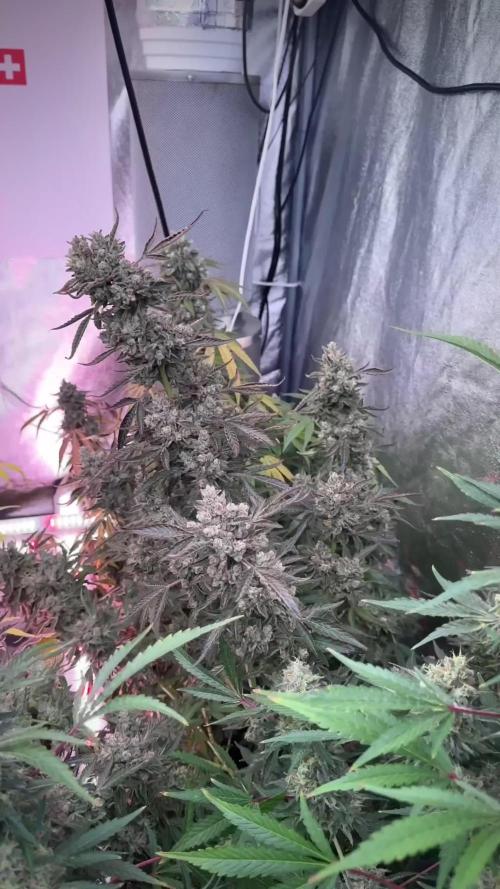
There is color now in every direction — softened greens, faded lime, muted reds, touches of purple, and that late-flower pale glow that only shows up when a plant is actually finishing instead of just aging. The flowers are dense, compact, and fully formed. Resin is heavy. Structure is holding. Light still catches everything.
The room is shining.
Both plants are carrying weight well. Dense tops, compact flowers, strong stacking, and resin coverage from crown to lower sites. No loose finish, no empty tops, no weak lower structure. Even now, late into flower, she still looks composed.
The harvested plant came down thick.
Big structure, strong frame, dense flower, and stems with enough development to show those hollow internal channels that often appear in vigorous, well-fed, fast-moving growth. Frost coverage is heavy, texture is compact, and she carried herself like a proper finisher from top to bottom.
She is now drying in a rack rather than hanging whole — not as a stylistic choice, just a practical one. Space dictates workflow sometimes, and good growing means adapting without romanticizing process. Same plant, same finish, different drying logistics. The important part is controlled handling from here.
And during harvest, she gave a little extra.
Fresh finger resin from harvest always deserves its own note.
What collects on the fingers during live harvest is not the same material as what comes later during dry trim. Similar in origin, different in state.
Fresh harvest resin is live expression — warm, volatile, aromatic, soft, and immediate. It is closer in spirit to charas in the traditional sense: resin gathered from living plant material by direct contact, long before modern processing tried to standardize everything. That matters, because what is collected in that moment still carries a different volatile profile than what comes later from dry trim.
Dry trim finger hash is still resin.
Fresh harvest finger resin is living resin.
They are related, but they are not the same conversation.
And for people who have never paid attention to that difference, this is one of those details worth learning once and never forgetting.
The second plant remains standing, and she is still earning her place.
Still dense. Still shining. Still building.
Not dramatically, not explosively — just quietly continuing.
And that is the point now.
Late flower is no longer about visible daily change. It is about subtle shifts. Trichome maturity. Water behavior. Leaf surrender. Aroma transition. Hidden risk. Final swelling. This is where “not doing much” becomes one of the most active parts of the entire cycle.
Because this is the stage where small mistakes matter most.
Now is when you watch for ripeness.
Now is when you watch for overstay.
Now is when you watch for mold that never comes.
Now is when you watch for trichomes instead of pistils.
Now is when restraint becomes part of the skillset.
She may come down next week.
She may ask for a little more.
That decision will not be made by calendar — it will be made by what the plant says next.
And that is where we leave her.
One harvested.
One still speaking.
Both worth listening to.
Big love to everyone following this run — old heads, new eyes, silent watchers, loud supporters, curious growers, skeptics, believers, and everyone who gave this diary even a second of attention.
To the GrowDiaries platform.
To the community.
To the people who watch closely.
To the ones who question everything.
To the ones who just came for pretty flowers and stayed for the process.
To Zamnesia for the genetics.
To Plagron for the feed.
To the gear keeping the room steady.
To the people behind the brands.
To the growers behind the screens.
And to both plants for doing exactly what they were supposed to do.
Week 13.
Week 9 flower.
One down. One still glowing.
📡 DELETED @ 1K Please stay tuned.we never quit https://www.youtube.com/@TheDogDoctorOfficial NEW 🙏 Thank you for your patience and continued support.
FOR DISCOUNT CODES AND MORE JUST FOLLOW THE LINK https://website.beacons.ai/dogdoctorofficial
📲 Don’t forget to Subscribe and follow me on Instagram and YouTube @DogDoctorOfficial for exclusive content, real-time updates, and behind-the-scenes magic. We’ve got so much more coming, including transplanting and all the amazing techniques that go along with it. You won’t want to miss it.
GrowDiaries Journal: https://growdiaries.com/grower/dogdoctorofficial
Instagram: https://www.instagram.com/dogdoctorofficial/
YouTube: https://www.youtube.com/@dogdoctorofficial Deleted by Youtube - https://www.youtube.com/@TheDogDoctorOfficial NEW
Vimeo : https://vimeo.com/dogdoctorofficial Under construction stay tuned
⸻
Explore the Gear that Powers My Grow
If you’re curious about the tech I’m using, check out these links:
🔆 Lighting & Environmental Control
• Future of Grow — Advanced LED lighting technology
https://www.futureofgrow.com/
DISCOUNT CODE: DOG20
• Lumiflora — Under-canopy LED lighting
https://lumiflorade.com/
• TrollMaster — Environmental controllers and automation gear (past collaboration)
⸻
Genetics
• Zamnesia Seeds — Genetics used in this project
https://www.zamnesia.com/
⸻
🌱 Soil, Substrates, Boosters & Root Support
• Plagron — Substrates, bio mixes, and supportive products
https://plagron.com/en/
⸻
🎒 Storage, Curing & Preservation
• Grove Bags — Curing and storage solutions
https://grovebags.com/
⸻
📸 Photography Equipment & Tools
(Not sponsors, but part of my creative toolkit)
• Sony A6700
• Sony full-frame macro lens + few more
• Stacking photography workflow - learning
• iPhone (for behind-the-scenes shots)
We’ve got much more coming as we move through the grow cycles. Trust me, you won’t want to miss the next steps, let’s push the boundaries of indoor horticulture together!
As always, this is shared for educational purposes, aiming to spread understanding and appreciation for this plant. Let’s celebrate it responsibly and continue to learn and grow together.
With true love comes happiness. Always believe in yourself, and always do things expecting nothing and with an open heart. Be a giver, and the universe will give back in ways you could never imagine.
💚 Growers love to all 💚
📸 P.S. – The Eye Behind the Lens
All photos in this diary (for now — except for the ones showing the camera, which I took with an iPhone) are taken with a Sony A6700 paired with a Sony full-frame macro lens and a few more.
Photography is part of the story — it’s how we share the fine textures, the glow, and the quiet details that words can’t always capture.
I’ve also started experimenting with photo stacking — a technique where multiple images, each taken at a slightly different focus point, are layered together to create one perfectly sharp image from front to back.
It’s not digital enhancement or AI; it’s pure photography — a way to reveal the plant’s beauty in microscopic depth, from trichome to petal.
You’ll even see a few shots of "ghost me" capturing the shots — camera, lens, setup — because every grow deserves not just to be cultivated, but documented like art.
FOR DISCOUNT CODES AND MORE JUST FOLLOW THE LINK https://website.beacons.ai/dogdoctorofficial
NEW DISCORD - Official Server Invite Link : https://discord.gg/ksjAkA5T74


Likes
12
Share


@2Stones1Bird
Follow
Checkout my Instagram @smallbudz to see the Small budget grow setup for indoor use, low watt, low heat, low noise, step by step.
She started germination Monday 14/10/2019 straight into the soil, after 3 days she turned into a little sprout.
23/10/2019 - Struggling a bit to maintain good veg RH (55-65), currently between 45-50, humidifier on the way. PH was also to high about 7.5-8.0, already fix it to 6.5, with a drop of lemon juice.
24/10/2019 - Noticed little flies on the tent, going to add sticky trap.


Processing
Likes
10
Share


@StarletBud21
Follow
Start of week 3 I believe the girls are doing good a few minor worries but that’s at ease for now I think , i have added nutes at a low level and will increase once I see how the plants react to the introduction of the nutes .. Looking into starting lsd on some plants but not too sure wether it’s to early or so . will continue to update the week but for now
Started lst on a few plants day 15 and seen good reactions by day 17 so quite happy with that and will continue this process I will also look into topping my plants as well but not just yet ... they seemed to like the nutes as well so all good week so far
Soo topping done on 4 plants wasn’t as scary as it sounded haha let’s see how they recover ! Going to combine lst as well now
Very good recovery it looks like and the end of week 3 looks promising with the plants
happy growing


Likes
58
Share


@GermanGrow182
Follow
Die automatics: fat banana wachsen alle gleichmäßig und gleich groß. Sweet zz wachsen 3/5wie die fat banana, 2 sind kleiner, wachsen langsamer und etwas krüppelig, aber mit etwas Zeit verwächst sich das erfahrungsgemäß.
Die feminisierten:
1/3 critical Wächst normal, 1keimling wurde von bodenorganismen angefressen,aber kämpft noch ums überleben,1 ist nicht gekeimt. Also mittlerweile 2/3.
Special queen #1 hat von der keimrate enttäuscht. Als Bonus seeds sollten sie besser keimen als 2/5... die beiden, die keimen, wurden auch von bodenorganismen amgeknabbert, eine hat es geschafft, eine kämpft noch.
Wie letztes Jahr hab ich wieder n paar bagseed gezeigt.2 Samen aus meiner letztjährigen Northeim lights auto und 3 aus der letztjährigen fat banana Auto. Mal sehen, was das wird.... i love surprizes stelle mich drauf ein, dass die ruderalisgene sich nicht durchsetzen und es ganzjährige werden. Werden klein gehalten .Will mal testen, ob man mit seeds von Autos was anfangen kann..
Also bisher spielt das Wetter mit(das ist die hauptsache) und warme, sonnigen Tage sollen kommen. So muss das. Bis nächste Woche :)
Likes
44
Share


@Aedaone
Follow
The temperatures, humidity, height, and watering volume(if measured) in grow conditions are all averaged for the week. The pH is soil pH. Any watering done by me is well water which is 7.6 pH and 50° F. Any listed nutrients are ml/gallon of soil spread evenly across the top of the soil. Daylight hours this week will be below 13.5. I can't use halves in the grow conditions, so I'm noting here.
Day 1 we had a high temperature of 85°. Skies were cloudy all day. We had a huge thunderstorm with high winds roll through followed by heavy rain most of the day. I added another 100 ml of feather meal top dressed to each pot.
Day 2 we had a high temperature of 91°F. Skies were partly cloudy. I watered about 5 gallons per pot. I treated with Growers Ally fungicide.
Day 3 we had a high temperature of 94°F. The girls were thirsty. I watered about 6 gallons per pot. I really wet them and the ground under the pots. They're feeding on the runoff in the soil as they've rooted through the pots.
Day 4 we had a high temperature of 94°. It felt like 102°F. Skies were sunny and clear. I watered about 5 gallons per pot twice today. The girls were super thirsty. I added 80ml of Coop Poop top dressed.
Day 5 we had a high temperature of 90°F. Skies were partly cloudy. I watered about 5 gallons each pot.
Day 7 we had a high temperature of 89°F. Skies were mostly cloudy to overcast. We had a lot of rain today so no need to water