





Likes
17
Share


@DETOX
Follow
12ª semana día 82 - 8ª semana de floración día 58.
Llegamos a su fin, ahora a secar y curar.
Es todo, nos vemos en la próxima.
Felices humos.

Likes
48
Share


@Northern_Ent
Follow
Aug 31: Fast. I got home from work today and could see a notable increase on the flowers. Very exciting.
Sep 2: plants are fine but we’re having yet another bad air day due to wildfire smoke. The red tint on the photos is due to smoke. This is pretty bad, but it was worse a few times in May. It’s supposed to clear later this weekend.
Sep 3: still smoky but rained a bit which helps. Gorilla Cookies has the best flowers but also seemed to catch the most rainwater in the buds. Gave each branch a shake to help prevent problems.
Sep 4: soil is holding water since the last compost tea. This reduction in infiltration rate can happen apparently, and the trick is to not overwater it. It’s also cool today so minimal water used.
Sep 5: cool today with gusty winds that blew over Bruce and Gelato. Small footprint of the 5 gallon bag isn’t quite big enough to be stable when plant is this big. Trade off with using a more easily moved size, and that should also help promote early flowering.

Likes
Comments
Share


@Ctrellis90
Follow
Week one after germination and these girls are growing about how I would expect.
Not much to report on in the early weeks but we have started the alfalfa Ferment so they will definitely be taking off!
They still have another week or two before we start the Athena blended but I'm pretty excited to see how well the Athena does....and these seeds of course.
Some of them have some wacky looking growth but I'm sure they'll grow out of it.
That's it for now, thanks for stopping by.


Likes
41
Share

@ZoobZoob_farmZ
Follow
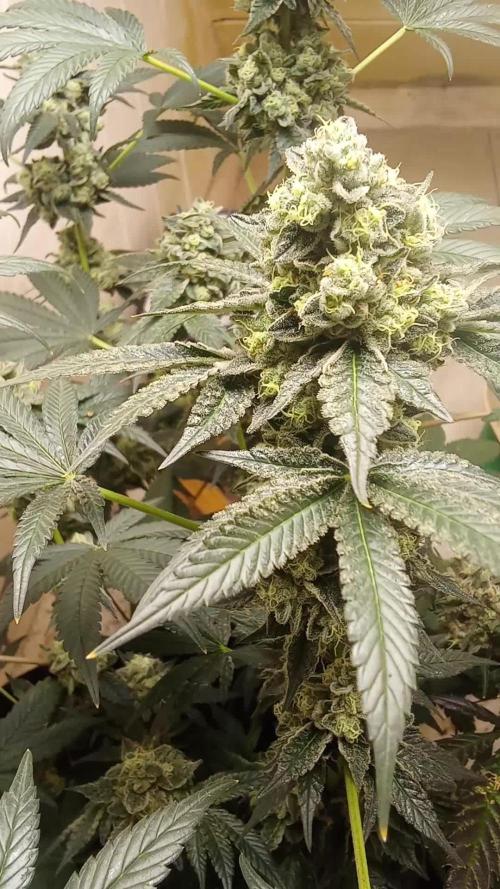
.💪🌱🌲☀️👌Truffle gas #1 × (Animal Cookies x Do Si Dos )
Hi everyone 👋 for the smell 👃 this one verry gas, diesel And earthy And slightly minty
Useful links👇👇👇
https://artgenetix.world/
https://marshydro.eu/products/mars-hydro-ts-1000-150w-led-grow-lights/?lang=fr
https://shop.greenhousefeeding.com/4-bio-nutrients
https://www.royalqueenseeds.fr/47-growing
https://biotabs.nl/fr/produit/bio-pk-5-8/
Likes
18
Share


@valiotoro
Follow
Hello everyone 😎
Week 6 of flower for the Amnesia Zkittlez🍭
Only 1 plant left then finito✔️
Very nice smell super sweet🤤
The buds are super sticky🔥
Likes
7
Share


@100Trillion
Follow
12/12 has been initiated. Girls are looking amazing and filled up the trellis really well over the week. The contrast Pheno in the back right still out growing the others. I got the canopy as even as I could possibly get it even with the height differences. Got the light at 12 inch per spider farmer recommendation and light at 50 percent. Aiming for about 28 DLI for first week and will continue to ramp up as weeks progress.


Likes
5
Share


@ZznPrv
Follow
Wow honesty i didn't think the SpiderFarmer SE3000 are this good and with right soil and nutrution the spark good especially this Purple Punch Auto from Barneys farm, i really look forward to see those buds finished. I defoliated a lot actually ill let the other plant with a lot of leaves but this one i wanted to try to start cutting the big leaves to give less shade and more energy for the buds, i didn't top it aswell.
But then for the mistery pack seed from Fast buds is doing very good. Well for the marking on the thick Indica leaves i am impatient to see what will happen honestly.
So not like the other one she got topped and had a slower growth but now its getting better, ill have 2 indicas ready to cho soon enough !
Now the Purple Punch nutrients will change to bloom and i will add calmag aswell, the other one will still have the veg nutes but now the leds are at 80 percent power which will push into flower so soon i will change the nutes again.
Happy growing !

Likes
22
Share


@shwable
Follow
Harvest Week 24💚
she made it to 300g wet weight after a slight wet trim. The buds are really solid and smelling amazing fruity, gassy and floral.
Now she is drying and I will update the harvest as soon as I know the dry weight.

Likes
31
Share


@MadeInGermany
Follow
Info:
Unfortunately, I had to find out that my account is used for fake pages in social media.
I am only active here on growdiaries.
I am not on facebook instagram twitter etc All accounts except this one are fake.
Flowering day 57
since time change
to 12/12).
Hi all 😀.
The inflorescences have stopped growing and are now starting to swell properly :-).
The next 8-12 days will be harvested :-).
Until then, she will only get the appropriate water and about 3-4 days before the harvest she will be poured a little more for the last flush.
The week was poured three times with 1.2 l each.
Otherwise, as always, everything was assessed and checked.
I wish you all the best until the next update.
Stay healthy 🙏🏻
You can buy this Strain at :
www.Zamnesia.com
Type:
Runtz
☝️🏼
Genetics:
Zkittlez x Gelato
👍
Vega lamp: 2 x Todogrow Led
Quantum Board 100 W
💡
Bloom Lamp : 2 x Todogrow Led
Cxb 3590 COB 3500 K 205 W
💡💡☝️🏼
Soil : Bio Bizz Coco
☝️🏼
Nutrients : Green House Seeds Company Powder Feeding Bio
☝️🏼🌱
Water: Osmosis water mixed with normal water (24 hours stale that the chlorine evaporates) to 0.2 EC. Add Cal / Mag to 0.4 Ec Ph with Organic Ph - to 5.8

Likes
16
Share


@BLAZED
Follow
1-11
At the end of the day i chopped her down, did a small wet trim removing some big leaves, and hang the buds to dry.
2-11
Temps: 19.3 to 20.5 degrees
Humidity: 55% to 64%
3-11
Temps: 17.1 to 20.4 degrees
Humidity: 54% to 66%
4-11
Temps: 18.1 to 19.6 degrees
Humidity: 62% to 66%
5-11
Temps: 17.9 to 20.1 degrees
Humidity: 56% to 64%
6-11
Temps: 17.6 to 19.4 degrees
Humidity: 59% to 67%
7-11
Temps: 17.8 to 19.2 degrees
Humidity: 60% to 66%
8-11
Temps: 17.4 to 19.9 degrees
Humidity: 58% to 67%
9-11
Temps: 17.8 to 20.1 degrees
Humidity: 62% to 64%
10-11
Temps: 18.2 to 20.5 degrees
Humidity: 62% to 65%
11-11
Temps: 18.7 to 20.4 degrees
Humidity: 57% to 65%
12-11
Temps: 18 to 20.1 degrees
Humidity: 54% to 66%
13-11
Temps: 17.8 to 20.2 degrees
Humidity: 61% to 67%
Started trimming today.
14-11
Finished trimming.
I was afraid of finding a lot of budrot, luckily it was only the one cola.
The buds are very frosty, the bottom at the base of the branch looks a bit brownish on some buds, i inspected it with a microscope and didnt find any mold or weird things. There are a lot of amber trichomes tho.
I think that's why it looks brown like that. It smells and smokes good, so i think its fine.
If someone thinks otherwise, let me know!
End results:
Buds: 92 Grams
Small Buds: 18 Grams
Trim: 16.7 Grams
Total weight of the buds: 110 Grams.
I calculated that i used a total of 72.3 watts this grow, that makes it 1.52 grams per watt!
Very happy with the end results, and its by far my personal record hahaha.

Likes
23
Share


@blvckswords
Follow
6/4/21 11 inches
6/6/21 13 inches
6/7/21 14.5 inches
6/8/21 16 inches
6/9/21 16.5 inches
6/10/21 17.5 inches
Just watching the growth I still want to have space just in case it grows more I don't want it touching the light. Other than that everything is going good. 😁
Likes
40
Share


@KingSalomonsWeed
Follow
Hallo Tag 55/29 Blüte.
Sie lebt!
Ich denke der Ertrag wird sich zwischen 1,5-2 kg trocken ergeben.
Die Knospen sind jetzt schon so gross wie Tennisbälle.
Sämtliche Knospen sind so Klebrig, das mein Insektenproblem beendet ist.
Wie Sonnentau fängt sie die Insekten und verdaut sie.

Likes
16
Share

@DogDoctorOfficial
Follow
🌸 BlueBerry – Week 5 Flower Report
Grower’s Journal | Zamnesia BlueBerry
⸻
🌱 The Girls in Full Bloom
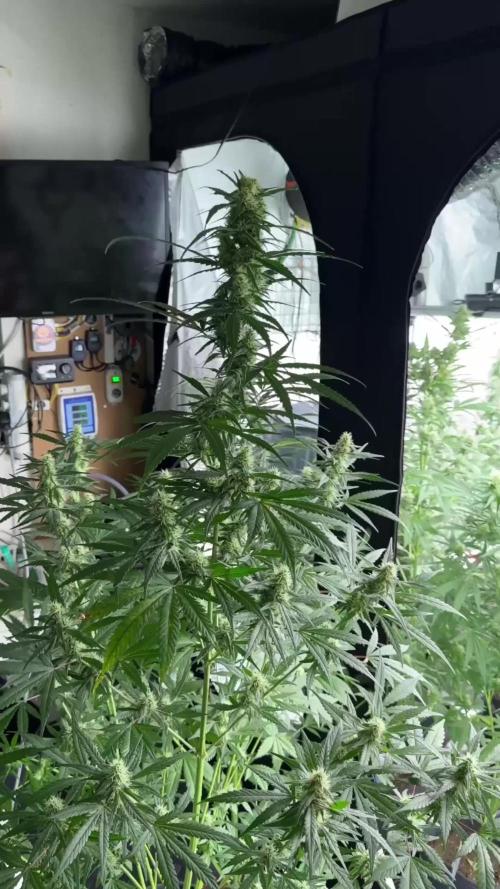
Both BlueBerry #1 and #2 are absolutely stunning this week:
• Size: Towering beauties, full presence in the room.
• Bud Formation: Large, well-stacked flowers building from bottom to top, showing the real effect of the ICL 300 inner canopy lights.
• Pheno Difference:
• Pheno #1 is forming a dominant central cola, reaching tall and thick — a real spear.
• Pheno #2 is slightly more balanced across branches, but still bulking fast.
• Hairs (Pistils): Beautiful white pistils everywhere — vibrant, strong, and reaching out like nature’s way of saying, “I’m ready to bloom.”
This early hair explosion is a promise of dense, resinous flowers soon to come.
⸻
💡 ICL 300 – Fruits of the Light
The inner canopy lights are proving their worth:
• Buds aren’t just forming at the top, but all the way down the structure.
• No wasted shadow zones, no underdeveloped sites.
• It feels like the plant is blooming in 360°, thanks to the way the ICL spreads light deep into the canopy.
The difference between a regular top light and this combination is day and night, and now it’s visible in every flower forming.
⸻
Nutrition Update – Bringing Back All-In-One Liquid
This week we reintroduced the Aptus All-In-One Liquid into the feeding mix. Why?
• To give the plants a broad-spectrum nutritional push right at mid-flower.
• Ensures no deficiency or slowdown during this critical bud development stage.
• Works hand in hand with Top Booster and CalMag to support cell expansion and flower density.
At this stage, the girls are hungry and hard at work, so it’s the right time to fuel them properly.
⸻
🔄 Quick Recap of the Journey So Far
• Cannakan germination → soil prep with Aptus amendments → steady veg → training + defoliation → flower induction.
• Week 4 brought early frost and strong stacking.
• Week 5 now brings real bulk, pistil fireworks, and inner canopy buds rising.
This has been a textbook BlueBerry journey so far — stable, strong, beautiful.
⸻
🔮 What to Expect Next (Week 6 and Beyond)
• More Bud Bulk: Flowers will gain weight and density quickly from here.
• Pistil Transition: Some of those white hairs will start to orange and curl as new sets keep pushing.
• Trichome Explosion: Frost will build across leaves and flowers, giving that snowy BlueBerry look.
• Terpenes Rising: Expect the first real waves of that nostalgic, sweet-fruity BlueBerry scent.
What not to expect: major height gain. The stretch is over, from here, all energy goes into flower expansion and resin production.
⸻
💬 Final Thoughts
Week 5 is the moment where the BlueBerry girls are no longer just “plants” — they are flowering powerhouses. Frost, pistils, bulk, and balance.
With the ICL 300 feeding the canopy from the inside and the All-In-One Liquid giving them the push they need, these ladies are on track to become legends in their own right.
BlueBerry #1’s towering cola and BlueBerry #2’s even structure are both testaments to genetic quality and environmental harmony.
It’s a pleasure to watch them evolve — and even more to share their journey 🌸✨.
📲 Don’t forget to Subscribe and follow me on Instagram and YouTube @DogDoctorOfficial for exclusive content, real-time updates, and behind-the-scenes magic. We’ve got so much more coming, including transplanting and all the amazing techniques that go along with it. You won’t want to miss it.
• GrowDiaries Journal: https://growdiaries.com/grower/dogdoctorofficial
• Instagram: https://www.instagram.com/dogdoctorofficial/ • YouTube: https://www.youtube.com/@dogdoctorofficial
⸻
Explore the Gear that Powers My Grow
If you’re curious about the tech I’m using, check out these links:
• Genetics, gear, nutrients, and more – Zamnesia: https://www.zamnesia.com/
• Environmental control & automation – TrolMaster: https://www.trolmaster.eu/
• Advanced LED lighting – Future of Grow: https://www.futureofgrow.com/
• Root and growth nutrition – Aptus Holland: https://aptus-holland.com/
• Nutrient systems & boosters – Plagron: https://plagron.com/en/
• Soil & substrate excellence – PRO-MIX BX: https://www.pthorticulture.com/en-us/products/pro-mix-bx-mycorrhizae
• Curing and storage – Grove Bags: https://grovebags.com/
⸻
We’ve got much more coming as we move through the grow cycles. Trust me, you won’t want to miss the next steps, let’s push the boundaries of indoor horticulture together!
As always, this is shared for educational purposes, aiming to spread understanding and appreciation for this plant. Let’s celebrate it responsibly and continue to learn and grow together.
With true love comes happiness. Always believe in yourself, and always do things expecting nothing and with an open heart. Be a giver, and the universe will give back in ways you could never imagine.
💚 Growers love to all 💚
Likes
14
Share

@BLAZED
Follow
Week 14 (17-10 to 23-10)
17-10
Temperature: 23.4 degrees (lights on) 17.5 degrees (lights off)
Humidity: 70% (highest) 55% (lowest)
Watering: 400 ml. PH 6.5 EC: 0.6 (without Hybrids & PK+)
18-10
Temperature: 23.6 degrees (lights on) 17.1 degrees (lights off)
Humidity: 70% (highest) 54% (lowest)
Watering: 900 ml. PH 6.5 EC: 0.6 (without Hybrids & PK+)
19-10
Temperature: 24.3 degrees (lights on) 17.8 degrees (lights off)
Humidity: 81% (highest) 59% (lowest)
Watering: 1210 ml. PH 6.5 EC: 1.7 (with Hybrids & PK+)
20-10
Temperature: 25.1 degrees (lights on) 18.2 degrees (lights off)
Humidity: 84% (highest) 62% (lowest)
Watering: None.
21-10
Temperature: 25.6 degrees (lights on) 18.6 degrees (lights off)
Humidity: 99% (highest) 64% (lowest)
Watering: 1200 ml. PH 6.5 EC: 0.6 (without Hybrids & PK+)
22-10
Temperature: 25.8 degrees (lights on) 19.3 degrees (lights off)
Humidity: 89% (highest) 63% (lowest)
Watering: None.
23-10
Temperature: 25.7 degrees (lights on) 19.1 degrees (lights off)
Humidity: 89% (highest) 60% (lowest)
Watering: 1000 ml. PH 6.5 EC: 1.7 (with Hybrids & PK+)


Likes
9
Share

@BlackForestGrower
Follow
It was a great last run.
It’s been a beautiful time.
My time here done now.
BlackForestGrower out. 🌲✌️


