


Likes
Comments
Share


@Onlygrow99
Follow
Empecé la germinación el 23/01/23 en un vaso de agua durante 12 horas, después al taper con servilleta húmeda 24 horas más.
Radícula de 2cm y las planto en maceta de 1L
Actualización estado de germinación 03/02/23:
Meto fotos ya con las macetas rellenas al 10º día y fotos del 7º día comparando las macetas y los tallos.
En cuanto el 2º par de hojas sea mas que evidente empezamos las semanas de crecimiento. Dentro de 2 o 3 semanas quizás, trasplantamos a maceta definitiva de 7Litros. Lo veremos.
Actualización 06/02/23:
Meto unas fotos de las plantas mas grandes, 3 días después para que se vea la diferencia de crecimiento.
Además un video mostrando el cultivo entero, la luminaria y la extracción. Llevamos 13 días desde la germinación.
Actualización 08/02/23:
A partir de aquí voy a empezara a contar ya las semanas de crecimiento. Hemos tenido 15 días desde la germinación.
Venga va, día 10/02/23 meto unas fotos mas, llevamos 17 días desde la germinación

Likes
2
Share
@AbbyCat
Follow
The plants are doing good but I noticed two days ago the ones in the cloth pots and old soil were nut burned. I mixed more dirt up with the Kellogg soil and repotted the four that are showing nut burn. I shook off most of the soil on the roots, too. The ones in the 5 gallon pots are doing fantastic! They are larger and have better leaves. I think I caught the issue with the other four in time, but we shall see. No other changes

Processing
Likes
10
Share


@DudeGrowsWeed
Follow
WOW!!! She's f'ing huge!!! Definitely the largest auto I've ever grown. The bud sites are still in early development but she's beautiful. However, I think she's suffering a little from the heat in the attic (where my grow tent is). I'll be moving her outside in the next week or so in an effort to help her out. Hoping for the best! 🙏

Likes
82
Share


@MrHightimes
Follow
These plants are getting huge!!! I supercropped em down tonight and gave em a full blast of feed! I'm trying to keep leaves on but i did give them a small trim.
they seem to be catching up to each other, I hope they will level out! They are gonna be big plants tho fo sho!
Going to transfer tents this week probably.
____________________________________________________________________________
Moved them into the big tent! its snug, but they should be happy! Getting HUGE!
______________________________________________
I felt like they were in all their glory tonight! I got in there and gave em a big ol haircut and pulled out all the lower garbage.
With the use of several spacers I really feel like I opened em up nicely and primed em up for some big buds to form.
Two plants are def gonna be purple. We'll see about the other 2.

Likes
2
Share

@TowersD
Follow
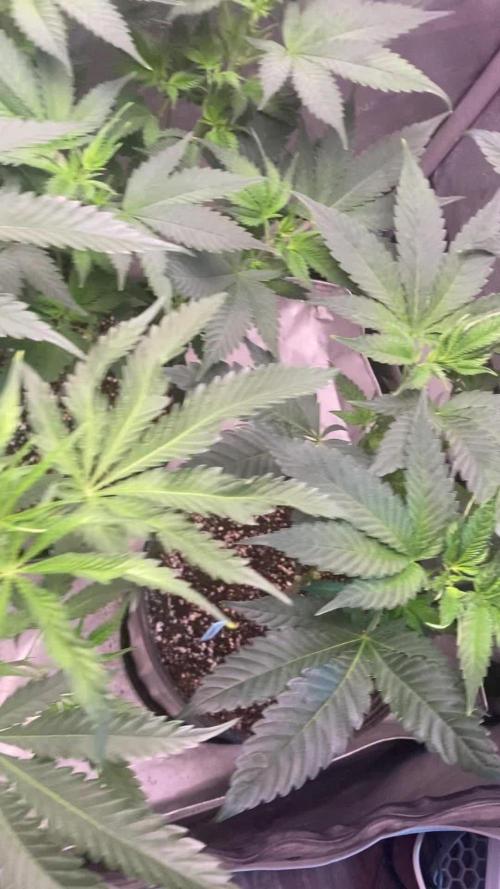
I put the plants under the Electric Sky 180 V2
I kept only 4 plants because one was growing really slow compare to the others and another turned out to be a automatic plant so i took it away as well.
I am keeping 2 phenos of the Nanaz x BBC and 2 ot the Humboldt Headband.

Likes
7
Share


@Greenislandfr
Follow
Je suis vraiment surpris 😲 le tronc a souffert c'est la 2e fois qu'il se fend en 2 cette fois c'est le chat qui a voulu sauter dedans je comprend pas trop il a du kiffer la plante et s'faire un kiff mais bon j'ai des gros dégâts a cause de lui j'ai réparer comme j'ai pu avec de laloe vera en gel pour cicatriser et du propolix (cire d'abeille) pour prevenir d'un état fongique. Dailleur le propolix sa a l'air de marcher je traite par arrosage quand je voit qu'il va pleuvoir +2jour a raison d'1.5ml par litre (entre 69 et 99% d'humidité en général ce mois d'août).
Les têtes sont collante et grossise a fond grâce au bactobloom utilisé avant le propolix bien sur et du Green sensation de plagron. J'ai réadapter l'engrais de floraison j'ai changer pour alga bloom. La plante a eu une mini carence car le top bloom de top crop il est vraiment puissant 😂
L'odeur est légère mais pas oppressante c'est une odeur de Zkittlez/Gorilla glue donc En note de tete le sucre typé 🍬 avec des note de pin/gaz avec un soupçon de café. J'ai aussi installer un filet scrog qui ressemble à rien mais qui est efficace pour le vent et bien aéré les têtes car elle vont être dense et lourde je vais devoir surveiller les attaque fongiques de très près. Pour les nuisibles type thrips j'ai jamais eu une seule piqûre sur la gorilla Zkittlez

Likes
28
Share


@Professor_Chaos
Follow
Beginning of week..
They are happy and healthy.. Feeding every other watering this week with half a dose of CALiMAGic and half a dose of FloraMicro.... Adding in some Floralicious Plus along with the MYCO+.. Not on the nutes list here so I'm just adding it in here..
Mid week...
They are lookin good.. Been watering daily.. Gonna try to see if I can get away with every other day.. They got a good, late watering today so they should be good for 48 hours in between waterings.. This medium has ALOT of Springtails.. Those fuckers are really getting annoying.. They dont seem to hurt the plants (as far as I can tell).. But when you're seeing literally probably 100,000 every day in the runoff.. I'm a little nervous of any issues to arise. But so far the plants are looking great.. Growing.. Happy.. Healthy.. 😁
End of week..
Whoops.. Didnt get a chance to take any pics.. But tomorrow is when the next week begins! Pics there! On to the next week!...

Likes
49
Share


@masterofsmeagol
Follow
IVE MADE MORE VIDEOS BUT THEY JUST DON'T SEEM TO UPLOAD AND IT'S FAR TO SLOW TO DO IT FROM HOME
6/27 Made last week a five day week to get back on track. It's still overcast and rainy. It's not raining a lot bit it's consistent. Despite the weather the plants are doing phenomenal. I'll update later. It's 1pm. It's been raining consistently since 11. Just a sprinkle but it's steady. I'm going to begun uploading the weeks weather on my diary. I may start a new diary for the plants I light depped as they are flowering pretty good. Rain stopped and it's just overcast for now. I looked at some videos and did a comparison of videos one week ago and videos today and HOLY SHIT! WHAT A DIFFERENCE. Especially the light depped 10th planet. Well everything but that was the most significant difference. I'm astonished at the health and growth despite the crummy weather. Continued to rain. Just got harder. Plants are taking it but it's flooding underneath the pallets a little but it will be fine. The light dep however has me concerned. The 10th planet is looking spectacular. The bigger purple punch I'd looking good too. The smaller one though looks to have a pollen sack coming off one of the branches. Considering its not on the otherside I assume it's not just a swollen calyx. I don't mind chucking it especially if that means I don't hurt my other girls so I want to make sure. I sent videos to a few other growers and I'll add a question on here. Those three plants have been isolated from the rest for a few days due to rain. I have the suspect isolated alone until I can confirm. It sucks cause the light Depp was going good and the6ve all got little flowers.
6/28 Well that fucking sucks. ALL THREE plants I tried to light depp hermed on me. I could see male flowers. Luckily I had been keeping a really good eye on them and it was preflowers mostly. At least I caught it. One or two stamines on each plant. Would've been really easy to miss. Only one had STARTED to elongate into a stem so I think I caught it early enough. Plus since all this rain they've been kept in a different location then my big girls. Glad I did that now. Boy the roots looked good on those plants. I just grabbed the stalk and lifted and it came right out of the pot. I held it there admiring it for a minute. This sucks. At least the real plants are doing good. As far as I know. No male preflowers that's for sure. I've got some feedback from other growers and the videos are a little blurry but I had found a light leak and I'm certain these plants hermed. I know I could've tried to save them but I didn't want to risk it. I compared what I was seeing with Google photos and other websites. Aside from the larger ball with its stem, there were also several little bumps besides developed calyxes that were weaving into little buds. Trust me that I wouldn't cut down my plants if I wasn't 110% sure. I might've been able to "save them" but to me it's just not worth the risk.
6/29 I was second guessing myself pretty hard last night due to some responses I got on my light dep and messages I got from other growets. Made my anxiety horrible but I looked on several video's I'd taken again and I know what I saw. I felt better after that. This was after I researched and waited THREE days until I saw the ball on the stem and the groupings of small nubs under a fresh yellow flower. These plants were flowering good and it sucks to lose them. One MAY have been ok but one was a runt and had all the characteristics of a true hermaphrodite. They were only in 3's and I couldn't risk my harvest for an experiment. Still sucks. Oh well. Sun is starting to come out. Plants seem to be doing fantastic. I have one spot on a leaf that looks like a pillar munched on a leaf so I'll probably get the bt out soon as I have a dry day that I can apply it. I'll have to check the weather. I need to start a nute regiment but the plants aren't telling me they need anything yet.
6/30 I fucked up dates or dodnt do it yesterday or it didnt save right so I'm leaving this blank today is the 1st.
7/1 I have still only watered s couple times and I haven't had to feed. This week I'm going to start nutes. I had some external ersonal situations that have kept me from my plants. I'm hoping to get back on track. I noticed some pillar damage so I'll need to dig out the BT. This morning I saw this giant ground hog by my cage. Hated too but had to get rid of him. Of course some of the blowback landed on the leaves of one of my plants. I tried to clean it as best I could. Better than that fat bastard eating everything in one night. I broke a branch either falling around it or bulling through when I was pissed or I LST it the wrong way and the wind broke it against the tomato cage. Nice big branch too on top. I tried to fix it with duct tape but we'll see. The plants need me to spend sometime with them. I need to clean them up. Apply bt and give them their first feeding. I'll update as I go. They don't seem nutrient deficient by any means but I don't think it would hurt to start the nutes.
7/2 Bags were lighter today and if it wasn't going to rain tonight and tomorrow I'd he watering. Plants look great so soil isn't depleted yet I guess. They're growing rather rapidly. The branch I broke didnt make it. Had an idea it wouldn't but I had to try. I waited on the BT on account of the rain. I may go back over and change my mind and water with silica or a mild nute solution or maybe apply the BT. Depends what time I get back. I have some work I need to do over there. There's a few that I need to clean up the bottoms on. Pest damage is minor and limited to one or two plants and a leaf or two only.
7/3 More rain. It was supposed to rain this morning too but it didn't. We got .33in yesterday and through last night so I thought that was ok. Looking back on my previous diaries I'm doing things significantly different than before. I had used a lot more nutes earlier on. This morning I mixed two gallons of 2tsp of big bloom and fed it to the 9 plants in smart pots leaving the container plants as they have much more water in them. Looking back at other diaries I previously had, WPM and septoria by this time not to mention a shit ton of other pests I was fighting by this time. Since I poisoned where the cagexwas multiple times and sprayed the cage before it was moved I luckily don't have that problem yet knock on wood. I'm planning to apply BT tonight to deal with the moth larvae if there are any. I'm looking at plants around this area and im seeimg SOME septoria and pm on raspberry bushes and burdock so it is around. I made sure my cage is not by any other vegetation this year and is sitting on asphalt with the bags on raised pallets. Good thing I did or I guarantee they'd be flooded by now. I've been seeing multiple complaints from maine growers online (AND THEY HAVE HEALTHY PLANTS!) saying this is the worst year ever. Maybe they need a dose of fusarium oxysporum to keep them humble. This is maine. If you don't like the weather just wait five minutes. Meanwhile I'll be doing my sun dance hoping for sun. "Hard to grow cannabis with no sunlight" said another grower on my forum.
Likes
15
Share


@greenhousegrowgirl
Follow
Mar 7 (day 78): Start of week 12.
Mar 11 (day 82): Chopped plant.
Likes
10
Share


@Mr_Ewell
Follow
9 weeks from sprout. Week 3 in flower.
Everything's going smooth.. i think. Had degrees up mid 90s for a couple days and plugged in the ac. My bedroom is cold as fuck now which has my closet ranging from 77 at night to 81 during the day. I really don't want any colder than that. They are starting to smell jus a little more these past three days. At first i didn't smell them unless i touched em for the most part.
Ppms staying between 2000 and 2300...
Playing the damn waiting game.
I got some free time tomorrow. Maybe ill take some of them close up glam-style shots of some buds starting to form.

Processing
Likes
52
Share


@CBD_Sweden
Follow
@MephistoGenetics,
Hi all the happy people here in GrowDiaries.
This is my second cultivation ever and it will be fun to try a bigger space than my closet grow.
First, I'm just going to say I'm done with the construction of my new growroom.
The room is 2.14 meters by 1.7 meters and has a ceiling height of 2 meters.
It provides a floor area of 3.6 square meters.
I use a 54 Watt Lightwawe T5 for germination and 2 Pcs 400 Watt HPS lamps.
I have a channel fan that replaces the room air about 40 times an hour to get a comfortable environment in the room, the air enters a fresh air intake from the outside.
The air is purified through a carbon filter to then leave the room to the rest of the basement.
Then I use that heat to heat the rest of the basement.
I will use 10 pcs 15 liter Autopots to grow with and a 100 liter water tank that supplies the pots of water and nutrition.
I will grow completely organically in soil and will watercure my buds to get the best possible medicine for me.
But there are no cultivation rooms to be displayed here, so I continue with what is most important.
Today I have put my seeds in paper towel and hope the seeds have germinated within a few days.
I am very excited to see how the new growroom will work and how this Stilton Special will turn out.
Strain Name: Stilton Special F1
Genetic heritage - Sour Livers F3 x Northern Cheese Haze F3
Strain behaviour - Stilton grows well from the off, and develops into a stout but branchy specimine that leads to a fine yield of awesome flowers. She's not too stretchy but also is sizeable enough with good growth, to train and shape to your liking. Flowers develop pretty fast and grow to a good size, it may to advised to clear out some undergrowth and if needs be a very gentle defoliation mid-way through the grow, although leaf tucking may suffice well enough.The end product is of top shelf quality and she doesn't lack in yield either.Give your garden, nose, and body a treat and be sure to indulge in a slice of Stilton this year, You won't regret it.
Size - 50 - 70 cm
Structure - Medium height but bushy
Flower Density - 9/10
Indica/Sativa - 65/35
Cycle Time - 65 to 70 days from sprout
Yield - 90 to 140 grams as a single plant
Best Method for overall high yield - 9-12 per 1,2m x 1,2m sq in 10-15 Liter pots (Soil)
Aroma - Very strong, Cheesey/fruity/sour/spicey/ with a dash of coffee.
Taste - Dank berries
Effect - Good hybrid powerful but balanced effect
Medicinal Benefits - TBA
Best Grown - Indoor/Greenhouse
Cannabinoids - TBA
Extract information - Ideal extract candidate - High in resin, oil and terps.
.................................................................................................................................................................................................................................................................................................................................................
2017-08-21. Started to germinate the seed.
.....................................................................................................................................................................................................................................................................................................................................................
2017-08-23. Seed germinated and put in small pot in the humidity dome.
.........................................................................................................................................................................................................................................................................................................................................................
2017-08-27. Slow and steady she grows.
----------------------------------------------------------------------------------------------------------------------------------------------------------------------------------------------------
2017-08-28. Transplanted to the 15 liter autopot.
--------------------------------------------------------------------------------------------------------------------------------------------------------------------------------------------------------------
2017-08-29. New movie of the girl and a new pic of the grow room from now.
-------------------------------------------------------------------------------------------------------------------------------------------------------------------------------------------------------------
2017-08-29.
Hello to you who read my diary, I just want to say that I am pleased that you have chosen to check in with me and in my diary.
I just want to say that I do this for myself and for a steady flow of my medicine.
Everything you read and see in my diary is 100% honest and I will never distort or beautify anything here.
I document my crops so that I can learn from my mistakes and also to look back at those different crops.
I try to update with pictures every day and with text if something special has happened in the garden.
This is my strainhunt for the best medicine and the beginning of my journey with cannabis and the cultivation of it.
-----------------------------------------------------------------------------------------------------------------------------------------------------------------------
2017-08-30. Cleaned the room this morning, just vacuuming and cleaning with chlorine solution. Im testing the fan to control temp and humidity, it works great.
Added a movie. Everything is looking great right now.
------------------------------------------------------------------------------------------------------------------------------------------------------------------------------------------
2017-08-31. 3 new pics.
--------------------------------------------------------------------------------------------------------------------------------
2017-09-01. New pics and a video of the room from today.
-----------------------------------------------------------------------------------------------
2017-09-02. New pic
----------------------------------------------------------------
2017-09-03. Video of the girl this morning.
----------------------------------------------------------------------------------------------------------------------
Likes
6
Share


@Jack22
Follow
What do you think about these first days? The humidity is not much stable but I’m planning to buy a humidifier in the next week.

Likes
14
Share


@playerkiller69
Follow
Allot has been done since the seedling stage 2 week and half so far in veg done top them and lst train them hope you like the info


Likes
17
Share


@Eddjack
Follow
Arrivato fresco fresco dalla Spagna si pianta subito.
12/01 12 h in acqua
13/01 l'ho messo in un tovagliolo di carta umido ed è è uscita la prima parte di radice ed è stato trapiantato in un vasetto.
14/01 e uscito dalla terra sfogliando le prime 2 foglioline tonde. Questa è una super partenza 72 h e già cerca la luce.
Likes
23
Share


@KarlysCannabis
Follow
I love growing with GrowDiaries! It's great to be able too look back at previous grows and compare. Being able to share with the community is a bonus!!
This strain was so easy to grow I found her and her brothers picky on ph, but most are. I'm excited to growing again. @honeycombhydrollc @thefreakoff2021


Likes
48
Share


@S_V_F_O
Follow
I did not want to finish this grove so early, but I thought about it well and decided that it was enough to torment this bush, I found a problem in highlighting at night (6 hours)
And fertilizer is not real from GHE, in my country they make fake unfortunately, you need to buy from official dealers!
And Bubba Kush 2.0 gained very good THC!

Likes
13
Share


Likes
15
Share


@Chubbs
Follow
420Fastbuds
FBT2313
Germination Week
Time has come yet to start another amazing Tester strain from 420Fastbuds FBT2313. Started germination on 2/7 by soaking the seed in just water for 48hrs then planting it directly in the soil (Roots Organic 707) in a 3gal fabric pot. I spray the top soil with my gallon sprayer keeping it moist for the next week. After 48hrs in the soil we have sprouts that emerged that appear to be healthy and happy. All in all Happy Growing
Likes
19
Share


@Grey_Wolf
Follow
FBT011 Northern Lights From Fastbuds 2nd week of flowering 29th December 2019
Well she's shot up a bit since last weeks update and now sits at 54cm from soil to tip. No noticeable aroma as of yet but there is some resin as the buds feel slightly sticky when gently rubbed. I fed her some Mr B's Green trees Bloom mix and a 1/4 tspoon of Great white.
*******As a side note the two cuttings I took have definately taken as they have both started to show their preflowers and have some tiny new growth.
So I mmediately sprayed with my STS Reversing Spray *******
Cheers for looking in and I'll be back next week in 2020.