Likes
Comments
Share
@NONSENSE
Follow
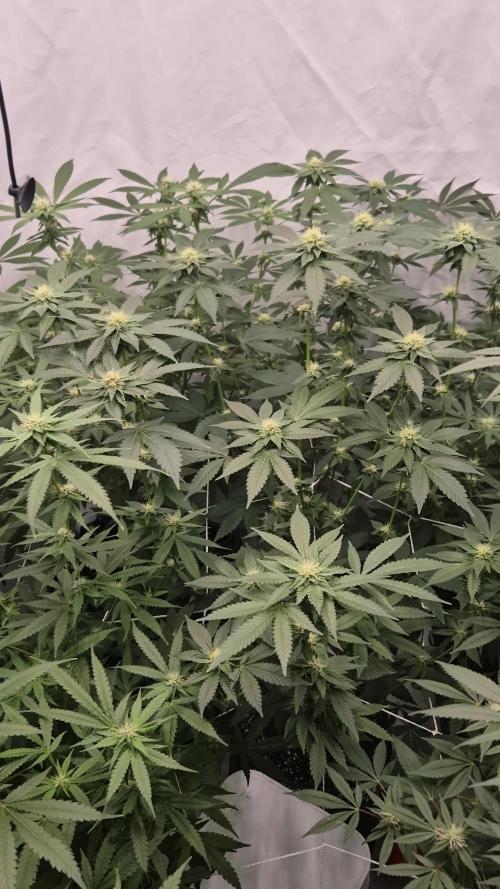
Hi, everyone! The flowering going well. The strain smell nice: lemon, earthy and is sooo sticky. I planning to harvest within 3weeks.
Likes
10
Share
Day 34 this lady is running, I can see flowers getting bigger every day, smell started really really soon this time so I already had to add the Carbon Filter. I’d like to close the cycle in less then 80 days. It would be great First flowering fertilisation Ph 6.2 Ppm 631 Day 37 - 9 of flower 🌸 Started blooming fertilisation, I’m keep Giving all-in one from aptus, i think I lm substitute with super pk and I stop all in one. Ph 6.2 Ppm 731 As I’m growing an solito in a 9.2 lt pots with all mix nutrients I’m slowing down with all in one and just giving base feedings, I ll decide later if I should give super-pk for the next weeks Day 40, tomorrow will be feeding days. Sge’s going really well, resin is already showing up on flowers that are several as and colorfull, smell is already there 🤤 Tomorrow update with feedings parameters. Day 41 feeding day Aptus regulator 0,15ml/1 lt Aptus all in one 1,25ml/1lt Aptus Topbooster 0,3 ml Aptus enzym + 0,5 ml Calmag 0,3 ml /L Ph 6,18 Ppm 756 Let’s see
Likes
45
Share
2nd net is up. Early bud formations are promising. holding up to the extremes pretty well, some leaves taking minor damage, but overall, she is holding up, gave her 1 night at 50F see how she would react, stressful. Not advised as it messes with her metabolism, but I want to see if it triggers any anthocyanin response. Love to see her purp up but no signs yet. Remember, For every molecule of glucose produced during photosynthesis, a plant needs to split six molecules of water. This process provides the hydrogen needed for synthesizing glucose and other organic compounds, while oxygen is released as a byproduct. Homework. If Rubisco activity is impaired and it cannot properly function or regenerate its substrate, the plant's leaves are likely to turn a pale green or lime green, a condition known as chlorosis. Essentially, Rubisco activity is highly regulated and susceptible to various environmental and metabolic factors that can cause it to become inhibited, leading to an apparent failure in RuBP regeneration due to a lack of consumption. Rubisco regeneration is intrinsically linked to nitrogen supply because Rubisco is a major sink for nitrogen in plants, typically accounting for 15% to over 25% of total leaf nitrogen. The regeneration phase itself consumes nitrogen through the synthesis of the Rubisco enzyme and associated proteins (like Rubisco activase), and overall nitrogen status heavily influences the efficiency of RuBP regeneration. RuBisCO is a very large enzyme that constitutes a significant proportion (up to 50%) of leaf soluble protein and requires large investments in nitrogen. Insufficient nitrogen supply limits the plant's ability to produce adequate amounts of RuBisCO, thereby limiting the overall capacity for photosynthesis and carbon fixation. Maintaining the optimal, slightly alkaline pH is crucial for the proper function and regeneration of Rubisco. Deviations in either direction (too high or too low) disrupt the enzyme's structure, activation state, and interaction with its substrates, leading to decreased activity and impaired RuBP regeneration. (Lime/yellowing) Structural Component: Nitrogen is an essential building block for all proteins, and the sheer abundance of the Rubisco protein makes it the single largest storage of nitrogen in the leaf. Synthesis and Activity: Adequate nitrogen supply is crucial for the synthesis and maintenance of sufficient Rubisco enzyme and Rubisco activase (Rca), the regulatory protein responsible for maintaining Rubisco's active state. Nitrogen deficiency leads to a decrease in the content and activity of both Rubisco and Rca, which in turn limits the maximum carboxylation rate, Vmax, and the rate of RuBP regeneration Jmax, thus reducing overall photosynthetic capacity. Nitrogen Storage and Remobilization: Rubisco can act as a temporary nitrogen storage protein, which is degraded to remobilize nitrogen to other growing parts of the plant, especially under conditions of nitrogen deficiency or senescence. Nitrogen Use Efficiency (NUE): The allocation of nitrogen to Rubisco is a key determinant of a plant's photosynthetic nitrogen use efficiency (PNUE). In high-nitrogen conditions, plants may accumulate a surplus of Rubisco, which may not be fully activated, leading to a lower PNUE. Optimizing the amount and activity of Rubisco relative to nitrogen availability is a target for improving crop NUE. Photorespiration and Nitrogen Metabolism: Nitrogen metabolism is also linked to the photorespiration pathway (which competes with carboxylation at the Rubisco active site), particularly in the reassimilation of ammonia released during the process. To increase RuBisCO regeneration, which refers to the process of forming the CO2 acceptor molecule Ribulose-1,5-bisphosphate (RuBP) during photosynthesis, the primary methods involve optimizing the levels and activity of Rubisco activase (Rca) and enhancing the performance of other Calvin-Benson-Bassham (CBB) cycle enzymes. Biochemical and Environmental Approaches: Optimize Rubisco Activase (Rca) activity: Rca is a crucial chaperone protein that removes inhibitory sugar phosphates, such as CA1P (2-carboxy-D-arabinitol 1-phosphate), from the Rubisco active site, thus maintaining its catalytic competence. •Ensure optimal light conditions: Rca is light-activated via the chloroplast's redox status. Adequate light intensity ensures Rca can effectively maintain Rubisco in its active, carbamylated state. •Maintain optimal temperature: Rca is highly temperature-sensitive and can become unstable at moderately high temperatures (e.g., above 35°C/95F° in many C3 plants), which decreases its ability to activate Rubisco. Maintaining temperatures within the optimal range for a specific plant species is important. •Optimize Mg2+ concentration: Mg2+ is a key cofactor for both Rubisco carbamylation and Rca activity. In the light, Mg2+ concentration in the chloroplast stroma increases, promoting activation. •Manage ATP/ADP ratio: Rca activity depends on ATP hydrolysis and is inhibited by ADP. Conditions that maintain a high ATP/ADP ratio in the chloroplast stroma favor Rca activity. Enhance Calvin-Benson-Bassham (CBB) cycle enzyme activity: The overall rate of RuBP regeneration can be limited by other enzymes in the cycle. •Increase SBPase activity: Sedoheptulose-1,7-bisphosphatase (SBPase) is a key regulatory enzyme in the regeneration pathway, and increasing its activity can enhance RuBP regeneration and overall photosynthesis. •Optimize other enzymes: Overexpression of other CBB cycle enzymes such as fructose-1,6-bisphosphate aldolase (FBA) and triose phosphate isomerase (TPI) can also help to balance the metabolic flux and improve RuBP regeneration capacity. Magnesium ions, Mg2+, are specifically required for Rubisco activation because the cation plays a critical structural and chemical role in forming the active site: A specific lysine residue in the active site must be carbamylated by a CO2 molecule to activate the enzyme. The resulting negatively charged carbamyl group then facilitates the binding of the positively charged Mg2+ion. While other divalent metal ions like Mn2+ can bind to Rubisco, they alter the enzyme's substrate specificity and lead to dramatically lower activity or a higher rate of the non-productive oxygenation reaction compared to Mg2+, making them biologically unfavorable in the context of efficient carbon fixation. The concentration of Mg2+ in the chloroplast stroma naturally increases in the light due to ion potential balancing during ATP synthesis, providing a physiological mechanism to ensure the enzyme is activated when photosynthesis is possible. At the center of the porphyrin ring, nestled within its nitrogen atoms, is a Magnesium ion (Mg2+). This magnesium ion is crucial for the function of chlorophyll, and without it, the pigment cannot effectively capture and transfer light energy. Mg acts as a cofactor: Mg2+ binds to Rubisco after an activator CO2 molecule, forming a catalytically competent complex (Enzyme-CO2-Mg2+). High light + CO2) increases demand: Under high light (60 DLI is a very high intensity, potentially saturating) and high CO2, the plant's capacity for photosynthesis is high, and thus the demand for activated Rubisco and the necessary Mg2+ cofactor increases. Mg deficiency becomes limiting: If Mg2+ is deficient under these conditions, the higher levels of Rubisco and Rubisco activase produced cannot be fully activated, leading to lower photosynthetic rates and potential photo-oxidative damage. Optimal range: Studies show that adequate Mg2+ application can enhance Rubisco activation and stabilize net photosynthetic rates under stress conditions, but the required concentration is specific to the experimental setup. Monitoring is key: The most effective approach in a controlled environment is to monitor the plant's physiological responses e.g., leaf Mg2+ concentration, photosynthetic rate, Rubisco activation state, and adjust the nutrient solution/fertilizer to maintain adequate levels, rather than supplementing a fixed "extra" amount. In practice, this means ensuring that Mg2+ is not a limiting factor in the plant's standard nutrient solution when pushing the limits with high light and CO2. Applying Mg2+ through foliar spray is beneficial to Rubisco regeneration, particularly in alleviating the negative effects of magnesium (Mg) deficiency and high-temperature stress (HTS). While Mg can be leached from soil, within the plant it is considered a mobile nutrient, particularly in the phloem. Foliar-applied Mg is quickly absorbed by the leaves and can be translocate to other plant parts, including new growth and sink organs. Foliar application of: NATURES VERY OWN MgSO4 @ 15.0g L-1 in a spray bottle. For those high-intensity workouts when 1 meal a day is just not enough! Foliar sprays are often recommended as a rapid rescue measure for existing deficiencies or as a supplement during critical growth stages, when demand for Mg is high. Application in the early morning or late evening can improve absorption and prevent leaf burn. The plant was getting a little limey yellow in the centre. Shortly thereafter, she was back in business, green mostly regenerated. The starting point [of creativity] is curiosity: pondering why the default exists in the first place. We’re driven to question defaults when we experience vuja de, the opposite of déjà vu. Déjà vu occurs when we encounter something new, but it feels as if we’ve seen it before. Vuja de is the reverse—we face something familiar, but we see it with a fresh perspective that enables us to gain new insights into old problems. Confidence is evidence... nothing more. You are confident because you have driven 10,000 times, you are confident because you have spoken 10,000 times. People think confidence is a feeling, but it's not. If you want more confidence, then you need to create evidence, take more shots, collect more data, build more experiences, take more risks; fail, confidence doesn't come first; it is the reward you get for doing the work. no one else wants to do.
Likes
16
Share
Vamos familia, actualizamos la décima y última semana de floración de estas Panty Punch de Seedstockers, salieron 3, temperatura y humedad dentro de los rangos correctos. Vaya aromas que tiene, ya les doy machetazo esta semana, van repletas de tricomas, se comportaron fantásticas, estas próximas semanas vemos cosecha. Agrobeta: https://www.agrobeta.com/agrobetatiendaonline/36-abonos-canamo Hasta aquí todo, Buenos humos 💨💨💨
Likes
41
Share
Early week 6 update (i'll add more pictures and comments as needed): Unfortunately I hit some challenges! Light got way too close and stunted growth for a day. I noticed it on tips closest to the light only. Raised lamp to 22 inches. Indica bagseed (plant in the center front) got too stacked: stuff like leaves on top of each other with lots of moisture, no light/airflow penetration, etc. I did some basic LST, leaf tucking, net tucking, to open her up and go sideways more a bit at first. It helped a bit. Unfortunately aug 27, had to get more aggressive on this beast and remove 3 shade leaves on the right side. not happy about defoliating, but had to do it. Will see how she takes it and then look at left side on a later day. Growing the first time is educational and actually therapeutic in today's world for me. I've already learned so many lessons for the net time: don't need such a yuge pot, lamp brightness/distance, air circulation!!! Thank you to everyone that responds with positive encouragement/messaging, it really helps. Adding two more fans to help air circulation aug 28. hopefully it reduces the need to desecrate the plants! Meanwhile the plants in back (purple canyon) want to stretch their faces off, esp. the one in back left, so it is a balance. I only have so much vertical height :) aug 29, flipped to 12/12. plants are happy and i want to control the space for first grow. let's see how it goes. updated the humidity for the week to ~ 60. Ida etc has made it miserable, it should get better soon.
Likes
12
Share
Sehr Harzig, riecht nach nem wilden Beerenmix mit Bluedream. Sehr schön.
Likes
12
Share
Likes
5
Share
@Kardo
Follow
Die Blueberry hat es nicht mehr lange sie sieht sehr schön aus und ist voll mit trichomen
Likes
13
Share
The plant has officially outgrown the cabinet. I have a tent on order and will move her in as soon as it arrives. So many bud sites. This strain continues to impress.
Likes
9
Share
Another Week Down – Things Are Moving Fast! Wow, another week flew by and we barely noticed! The plants are growing beautifully and developing nicely. One surprise this week: one of the Monkey Grease plants is definitely not a monkey... it’s a Gorilla Grease! 😄 This one is thriving — strong, fast-growing, and clearly the most vigorous of the whole bunch. It really stands out compared to the others, and we’re excited to see how it continues to develop! This week we also started light feeding: One watering with Fish Mix at 1ml/L (around 280 ppm) Followed by a watering with Alg-A-Mic at the same ratio (around 150 ppm) Both feedings were well-received, and the girls are loving it so far! 🌱💪
Processing
Likes
26
Share
These guys seem to have some stunted growth from being in that shitty rock wool dish setup I had but they are making up for it now that they are in the air pots. I transplanted them into sunshine #4 because my other plants have had problems with N tox in coco loco, the only other soil mix I have...probably won’t ever be using fox farm soil again. Too expensive for what it is and it’s a pain in the ass dealing with nute probs. Day 8: into the new grow tent tomorrow
Likes
136
Share
~_~_~_~_~_~_~_~_~_~_~_~_~_~_~_~_~_~_~_~_~_~_~_~_~_~_~_~_~_~_~_~_~_~_~_~_~_~_~_~_~_~_~_~_~_~_~_~_~_~_~_~_~_~_~_~_~_~_~_~_~_~_~_~_~_~_~_~_~_~_~_~_~_~_~_~_~_~_~_~_~_~_~_ 2/26 2nd week of flower!! These ladies are still in the middle of their stretch, we're feeding mildly with every watering at this point..their color is perfectly uniform and with a few changes to our exhaust system, temps are now perfect around the clock..bud sites are just beginning to form this week and we intend on dropping the MarsHydro a few inches around week 3 after defoliation and removal of lower growth.. or cross (tucked behind the Bangers) are growing fast, no sign of males or hermis yet 🐱🤞... thanks for reading if you made it this far and happy harvests everyone!!❤️💡🌱😽💨 ⚡Mars Hydro/SP-3000⚡ Specifications ⚙️: Diodes: Samsung LM301B / Osram 660nm (960 total!) Driver: Meanwell 300watt 🔌 (300W±5% @AC120V-277V) PPF: 824umol/S ☢️ PPE: 2.8 µmol/j 〰️〰️ Lifespan: 50k+ hrs ⌛ Weight: 10.1 lbs (4.6kg) Veg Coverage: 3 x 5 ft 🌱 Flowering Coverage: 2 x 4 ft 🌼 -The SP-3000 uses an aluminum heatsink (no fan) and the driver can be placed outside the tent 🌡️⬇️ -IP65 waterproof ratings, tolerant to high humidity grow environments 💦 .. -Up to 15 can be daisy-chained together and all controlled from a single light! 💡~💡~💡~💡~💡 ~_~_~_~_~_~_~_~_~_~_~_~_~_~_~_~_~_~_~_~_~_~_~_~_~_~_~_~_~_~_~_~_~_~_~_~_~_~_~_~_~_~_~_~_~_~_~_~_~_~_~_~_~_~_~_~_~_~_~_~_~_~_~_~_~_~_~_~_~_~_~_~_~_~_~_~_~_~_~_~_~_~_~_
Likes
12
Share
@Gram_Solo
Follow
Looks like these are filling out now! Was worries about the look of 1 that wasn't getting any pistils hardly but seems to have kicked on! 💪 Smell is definitely increasing, lemony gassy power! 2 more weeks maybe and then we start some Overdrive and final flushing! Need some sativa Now!!! I am potato
Likes
31
Share
At the start of week 4 she both went into flowering and grew 30 cm... The hight growth has slowed down towards the end of this week... but the is producing nice hairs... everything nice all on water... hope she keeps on like this... fingers crossed👍
Processing
Likes
1
Share
@Ferenc
Follow
Hi! In this diary I will grow 5 Sativa and Indica dominant Auto Feminized Strains: Sour Orange Auto Feminized Seeds (2 seeds.) By The Bakery Seed Co. Sour Orange Auto Feminized Seeds are a cross of the famous Sour Tangie and the Bakery’s in house Ruderalis. Also a 80% sativa dominant strain with 56 to 70 day flower period. Tested at 17% THC this genetic is highly stable and the Bakery are very happy with the results. This Auto Feminized seed can be cultivated indoors as well as outdoors but definitely prefers a slightly warmer climate to gain the best terpene profile possible. An uplifting effect with a sweet and sour aroma of tangerines. This auto flower seed is another great addition to the Bakery Seed Co’s Automatic Range Auto Critical Orange Punch Seeds By Dutch Passion. Auto Critical Orange Punch Seeds are Dutch Passions first Critical Autoflower. A cross of (Grandaddy Purps x Orange Bud) x XXL Auto Kritical Bilbo, creating an easy strain to cultivate. Expect a full life cycle of 75 days from sprout to harvest with impressive XXL yields. She thrives with 20 hours of light and can grow up to 70-100cm indoors. Certain phenotypes can flower for an extra week or so to gain the XXL yields! Sweet skunk aromas with a hint of rich Afghan hash. Sour Stomper Auto Feminized Seeds are an example of what careful selection can achieve with breeding. A fruity style pheno of the Sour Crack female crossed with the Grapestomper OG male from Gage Green then crossed with ruderalis by Mephisto. This 50/50 Indica Sativa hybrid has a great stretch contributing to large yields. Due to cooler conditions late in flower, this dense canopy can produce beautiful blues and purples. A great genetic for indoor and outdoor cultivation and all finished and ready to harvest in just 65 to 70 days. This hybrid is popular with extracts and has Grape aroma in bloom. Auto Lemon Zkittle Feminized Seeds are made from quality USA genetics. It is an Overall Highlife Cup Winner 2018!!! It has won 1st prize in Sativa category and also was awarded the Overall Highlife Winner Trophy. Lemon Zkittle Auto retains its high THC and yields even in automatic form. Due to the lineage, this hybrid is very simple to cultivate and a great choice for beginners. Fruit and skunk aromas combined with citrus flavors and long-lasting effects. 20 Hour light cycle is recommended as well as a minimum of 75 days from seed. Some phenos can take a week longer to produce the massive yields. Outdoors this variety can take up to 100 days from seed to harvest. With THC levels tested 21% as well as minimum yields of 400g/m2, this automatic hybrid is a great addition to Dutch Passion Automatic range. 24 hours light schedule, 90 percent humidity, trigger spray, no fertilization. 15th of August: Girls are ready for germination, tonight I will place the seeds to be in water at least for 12 hours :) 15th of August: I put the seeds in the water. 16 of August 2019: Seeds are placed between damp paper towel :) 17th of Augsut 2019: All good so far, They are ready to be planted tomorrow;) Day 1: They are in the soil. Hopefully they will come out soon :) 60W LED for 5 plants and the humidity is very high 98 percent. I give 5 ml water a day per plant and plus triggering to keep the humidity very high. All the holes are closed. Day 2: Non of them are out yet but I think by tomorrow it will happen:). Day 3: All out :) Day 5: Sour Stomper and Lemon Zkittle a bit slower but all of them grow nicely. Babies ❤️ Day 6: They are coming! Critical Orange Punch is growing very quick she is already 10 cm but the rest of them are 6-7 cm.
Likes
7
Share
@B4nkz
Follow
I harvested plant1 after checking the trichomes, I wasn’t expecting much from it since she was a bit odd since from the beginning and was growing slower than the others 🤷🏻‍♂️ I got 15g dried, trimmed buds from the first one and stored them in a 750ml air tight jar for curing. Of course I couldn’t resist to not smoke before being cured 🤣 From plant2 I got 25g of dried and trimmed buds, could’ve been more but it had budrot on the main cola, so I thrown away a bit of the medicine🙏🏻 From plant3 I got 28g, dried and trimmed Total outcome of the three autoflowers: 68g dried and trimmed. It ain’t much but it’s honest work
Likes
5
Share
Bonsoir à tous Je suis trop content de mes fifilles elles poussent vraiment bien elles grandissent tout les jours, je les mesure tout les 2 où 3 jours. Elles grandissent de 2cm environ par jour je les trouve magnifique mes fifilles. J'ai deux de mes mutantes qui me font quatre branches principales( on n'y voit sur les photos) je suis refait 😊😊😊 je pense qu'elles vont bien donner. Je vous dit bonne soirée à tous les amis 👍👍👍
Likes
6
Share
@Wondrej
Follow
🌸 Flower Power Activated! Entering Week 6 / Flower Week 1 🚀 (Nutrient Update!) What's good, fam! Big news today: We are officially kicking off Week 6 overall and it seems it’s Week 1 of Flowering also! 🎉 The girls finally showed their cards and the first white pre-flowers have officially popped up, giving us the green light to enter the flower phase. I’m stoked to see how fast they stretch now that the flip has happened. They are filling out the net perfectly, and the canopy is looking dense and leveled thanks to the training we did weeks before. However, I clearly messed up my original living soil mix! 🤦‍♂️ I'm seeing signs of a nutrient issue—specifically, some apparent macronutrient excess on the new growth/leaves. To combat this, I added a Floragard Herbi's Living Soil Booster 2+8+4 today to help balance things out. Hopefully, that does the trick! Fingers crossed for a healthy stretch and massive buds! One Love & Happy Harvesting! 💚
Likes
14
Share
As for what I've been doing for maintenance, I've been watching and waiting and just adding water when needed into the reservoir, should be less then 2 or 3 days by now