





@DevilsBud
Follow
Amnesia Zkittlez took a lil longer but i understand with amnesia lineage . She smelling Amazing one of the better ones of fast bud she was fairly easy to grow and got pretty big
More info Tru the week


shorts_status_processing


@MissSolasolita
Follow
End of week 4
No sign of pre flowers yet
Looking healthy and strong


@BeHappyNtoke
Follow
Sour kush a,b, and c are all flowering pretty well critical purple a little bit behind it’s crazy how these girls already stink up the tent without the buds can’t wait to watch them continue to grow going to run on a full 18/6 light schedule I’m thinking of getting a self space for a as she is really starting to take up a lot or room alone. Happy growing growfam



shorts_status_processing


@Bossman
Follow
A few days late with the update but the pics and recording is from day 42 of flower


@Xpie77
Follow
Planten groeien als kool. Wanneer de eerste bloemen vormen, dan ga ik ze ontbladeren.
De planten krijgen melasse- en zeewiervoer en wat lavamolen.
--------------------Durban-----------------
Durban wietzaden komen oorspronkelijk uit Zuid-Afrika en zijn gekruist gedurende vele jaren in de jaren zeventig. Door al deze kruisingen heeft deze soort zich aangepast aan het Europese klimaat. De planten zijn bestand tegen wind, koude temperaturen en schimmels. Ze bestaat voornamelijk uit Sativa en heeft een bloeitijd van 8 tot 9 weken. Voor zowel de binnen- als de buitenkweek kun je een grote oogst met stevige toppen verwachten. Durban kan buiten een hoogte bereiken van 200-300 cm.
Durban is een exclusieve Sativa-soort met een unieke, heerlijke geur. Deze soort staat bekend om zijn kruidige, wazige smaak met sporen van anijs, zoethout, citroen en kruidnagel. Dit heerlijke aroma is een van de redenen waarom zoveel kwekers keer op keer voor Durban kiezen. Eigenschappen van Durban wietzaden Hoog THC gehalte Exclusieve Sativa Hoge opbrengst Sterke soort
Heerlijk aroma Informatie Durban wietzaden Bloeitijd: 8 – 9 weken Genetica: Durban x Original Thai 70% sativa, 30% indica Planthoogte buiten: 200 – 300 cm Oogstmaand buiten: van juni t/m oktober Opbrengst binnen: 450 – 650 gr/m² Opbrengst buiten: 200 – 700 gr/plant THC: 20%
Link naar de shop:
https://seedsgenetics.nl/product/durban-poison-gefeminiseerd/


@GODSGIFT_2005_JM
Follow
🍼Greenhouse Feeding BioGrow
⛺️MARSHYDRO
The ⛺️ has a small door 🚪 on the sides which is useful for mid section groom room work. 🤩
☀️ by VIPARSPECTRA (models: P2000 & XS 2000)

shorts_status_processing


@GrowGuy97
Follow
3 of the ladies are in flush will be cutting them down within the next or 2 & the other 2 probably have another month left! Fingers crossed for harvest!🤞🏼✌️🏼🌱
shorts_status_processing


@LittleBigTrees
Follow
Topped them end of last week, still not given them feed as the farmyard manure they were planted straight into seems to be giving them what they need so far, I've given them rain water when they needed it.
Hopefully the sun will return this coming week 🌞


@Staffedition
Follow
Всем привет друзья!
Решил попробывать фотопереодный, поднять от Барни и не только, смотри профиль.
Это будет мой первый опыт с фотопереодными растенями.
#Smail_Seeds


@MumboJump
Follow
Flowering is starting and i did some defoliation. Watering only with water but the Glookies got just 2 times in 2 weeks some biobizz flowering, top max and growth because it got kind of brighter. Also supercropped some of the to high mains so that the central canopy stays mor or less even.


@SkunkyDog
Follow
Hallo zusammen 🤙.
Das war die letzte Woche für sie morgen werde ich sie ernten habe etwas Angst das sie sonst Schimmel bekommen könnte weil die Buds so hart sind und draußen ein Scheiss Regenwetter ist.
Sie erhalten 25 Prozent Rabatt in unserem Shop
Mindestbestellwert beträgt 75 Euro
https://greenbuzzliquids.com/en/shop/
Code: GD42025


@GermanGrow182
Follow
Bin zufrieden. Die ersten 3 banana wollte ich ohne amber. Die letzten beiden mit viel amber. Knapp 2 Wochen machen den Unterschied bei diesem strain.


@Stevodidge
Follow
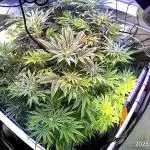
More defoliation and lst adjustments this week. Slows down growth, but doesn't seem to be causing any other problems.



@Ultraviolet
Follow
Gave her a cocktail to help with stress. Added 1st net for lateral support, not so much now, but for later. Blue light is absorbed by photoreceptor proteins called phototropins, which trigger a hormonal response that causes cells on the shaded side to elongate, making the plant bend toward the light. Try and fill this side a little. She is quite big already, just needs to find her stride again after the undue torture.
The mind is constantly working and producing, just like a factory. It's not just a passive recipient of information but an active producer of ideas, attitudes, and beliefs. The "ingredients" in this factory are the information you consume, such as books, conversations, and the media you engage with. The "products" are your thoughts, beliefs, and actions. The quality of the ingredients directly influences the quality of the output.
5 apex stems with 20-30 mini cola, let them develop a little, with the apical dominance shattered, all those 20-30 will all compete with each other as soon as that stretch is initiated. Key to a good stretch is making sure the plant is cycling efficiently, with large ATP conversions occurring lights out.
For now, keeping light intensity high. A plant will slow its vertical growth in very high light intensities, leading to a more compact form with thicker stems and leaves. This response is a protective mechanism against light stress, which can damage the photosynthetic apparatus and lead to symptoms like leaf scorching, yellowing, and brittleness. Instead of growing taller, the plant invests its energy into creating a more robust, stress-tolerant structure.
Providing plants with necessary antioxidants helps protect the photosynthetic apparatus by scavenging reactive oxygen species (ROS) that cause damage from excess light.
UV light exposure can impact the xanthophyll cycle by either enhancing its photoprotective role or causing damage, depending on the intensity and type of UV radiation. UV exposure can trigger the synthesis of more xanthophyll cycle pigments to increase the plant's capacity to dissipate excess energy, but it can also cause direct damage, particularly to Photosystem II, and may lead to a decrease in the de-epoxidation state (DEPS ratio) which indicates a reduced capacity to dissipate excess energy.
Plants can respond to UV stress by increasing the synthesis of xanthophyll cycle pigments, such as violaxanthin and zeaxanthin, to improve their photoprotective capacity. UV-induced changes in xanthophyll cycle pigments can be linked to a plant's overall tolerance to high radiation stress. The xanthophyll cycle helps protect against photoinhibition, which is especially important when the plant is exposed to high levels of both UV and visible light. High doses of UV radiation can directly damage photosynthetic components, including the proteins, lipids, and pigments in the thylakoid membranes. Exposure to UV radiation can have a mixed effect on the de-epoxidation state (DEPS ratio) of the xanthophyll cycle pigments. In some cases, UV can inhibit the conversion of violaxanthin to zeaxanthin, resulting in a lower DEPS ratio and a reduced capacity for energy dissipation. However, the total pool of xanthophyll cycle pigments may increase, and this enhanced pool size could provide a greater potential for photoprotection despite a lower DEPS ratio.
The xanthophyll cycle works alongside other mechanisms, such as the accumulation of flavonoids (UV screens), to protect the plant from UV-induced damage.
Blue light repairs 100% UV-induced damage in plants through a process called photoreactivation, which uses a light-dependent enzyme called photolyase. This enzyme uses energy from blue and UV-A light to directly reverse the damaging pyrimidine dimers in the DNA caused by UV-B radiation, a key mechanism for maintaining the plant's genetic integrity.
After carbon, light, water, temperature, and nutrients, the limiting factor of a plant's growth is often its own internal factors or the amount of a key ingredient. Chlorophyll concentration is one such factor, as the amount of this pigment limits how much light can be captured for photosynthesis. Other factors include chloroplast number, respiration rate, and the concentration of carbon dioxide in the atmosphere, as plants are often in a CO2-deficient condition.
60x60x18=64800seconds x 700 = 45,360,000moles. 45DLI
Exposure to 165 µW/cm² of ultraviolet-B (UV-B) light for 3600 seconds = 1 hour, a extremely high, acute dose triggering stress responses and protective mechanisms.
.
The plant's photoreceptor protein, UVR8, senses the UV-B radiation. This triggers a signaling cascade that activates specific genes to protect the plant from damage. In response to the UV-B signal, the plant ramps up the biosynthesis of protective compounds like flavonoids, phenolic acids, and anthocyanins. These compounds absorb UV radiation and accumulate in the epidermal layers of leaves to shield inner photosynthetic tissues. The plant may increase leaf thickness or deposit more cuticular wax, creating a physical barrier to the radiation. The plant will produce more enzymatic and non-enzymatic antioxidants to neutralize the reactive oxygen species (ROS) produced by the UV-B radiation. The plant activates enzymes, including photolyases, to repair DNA damage caused by the UV-B. These repair mechanisms are critical for preventing permanent genetic mutations.
While protective measures are activated, a high dose delivered over a short period can cause stress that overwhelms the plant's defenses.
Photosynthesis is highly sensitive to UV-B. A high dose can inactivate Photosystem II (PSII), damage thylakoid membranes within the chloroplasts, and reduce chlorophyll content, which lowers the plant's overall photosynthetic capacity. Despite repair mechanisms, high UV-B doses can inflict persistent damage on the plant's DNA. The overproduction of reactive oxygen species can cause oxidative stress, leading to the oxidation of lipids and proteins and disrupting cellular function.
I am playing in the enchanted forest. A shift in perspective is what changes perception over time. By deliberately considering a situation from another point of view (perspective), you can challenge your initial, knee-jerk interpretation (perception). This is a valuable skill in both personal and professional life for fostering empathy, improving problem-solving, and making more informed decisions.
Move the mind off perception into perspective.
Thank you.


@Ecogeek
Follow
Increased the feeding I've been measuring with the cap so it's 2capfuls each of the trio pack. Buds starting to get nice developing frost and sugar leaves can easily be seen. Since the start of the grow I've started I had 4 plants but down to 2 which have been coming along fine. Can't wait to see what these ladies taste like 😋


@TricoGhost
Follow
Para ser la primera vez que cultivo no puedo quejarme, pero si alguien me pudiese ayudar


@Uneasy
Follow
one of the plants could not stand the heat any longer. I cut almost all of its branches, I will cut it completely. Others struggle with the heat, but there's nothing I can do.


@CannaIGrow
Follow
This plant seems to have grown much denser and better than my first plant. I just got the ac infinity ventilation setup with controller 69 for my 2x2, still trying to learn, hopefully grow #3 goes even better. Stay tuned
shorts_status_processing


@AbbyRose
Follow
Autos are doing great under the new light hopefully it will increase the yields