The Grow Awards 2026 🏆
Likes
Comments
Share
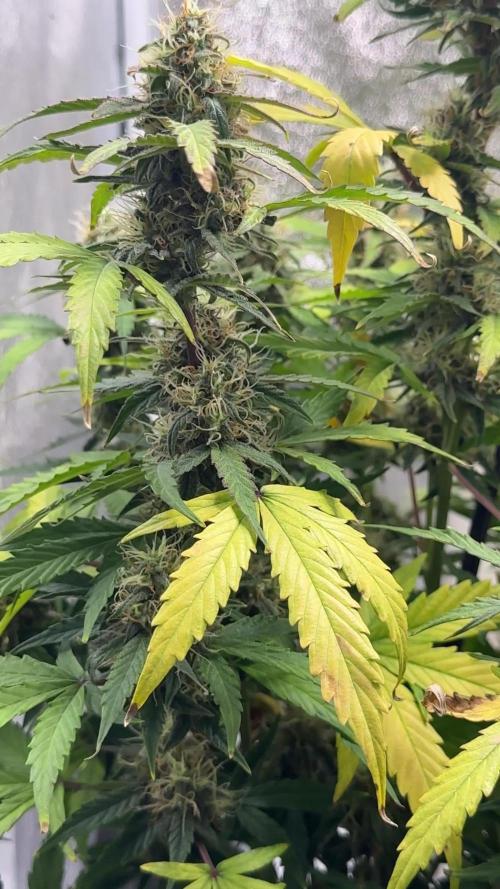
Hey! Welcome to week 8! Karen is mid way through her flowering stretch. Please check back to last week as I update daily so the week is now complete. I count about 20 colas now. Day 51: Have reconfigured the tent, see video. Karen is now 36cm and still stretching. Karen has more light now. Smell is still there hits you when you open the tent. Fertigated 2l. Day 52: Height: 39cm. Karen's scent is heavenly. I have reconfigured again and installed some upgrades. Better reflector. Much bigger carbon filter. Increased airflow. Better config. More efficient pot layout. Karen is lovely. I am grateful to her and for her, so I wrote her a little poem, I hope she liked it. "Karen! Oh Karen! The phoenix of flowers, Three lowly weeks she struggled in vain, Shadowed and starved for five hundred hours, He slowly wept to witness her pain. Karen! Oh Karen! I P-H'd your showers, and in the fourth week you started to gain, Hallowed and hard you survived as you cowered, I thought you meek, I was wrong once again. Karen! Oh Karen! Forgave me my howlers. She set a pace, a pace she maintained, Now shes a girl at the peak of her powers, And so I'm a geek, with buds on the brain." Day 53: Approx 48h into a simulated dry spell. Alright I think it is time for Karen to get her first MAJOR defoliation. I will update shortly with photos and info. I will also be doing some gentle LST to separate the colas a bit. Day 53.5: Defoliation and LST. Finally got chance to photograph that bunda. Enjoy! Day 53.75: Bit of a fail. Messed up the timer and the lights ended up being off for about 3 or 4 hours. Because I was cooling the room (open window) to keep temperature in the tent down, without any light the temperatures absolutely plummeted as it is sub-zero outside. By the time I realised and turned the lights on, the temp in the main tent had dropped to 14 degrees celsius. Whoops! How is that for mistreating your girl? Defoliated about 80% of her leaves, 4 nodes, significant LST, then stuck her in the cold and dark for 1/6 of a day. Not to mention she is now almost 3 days into a "dry spell". There do not seem to be ill effects, and Karen has already begun to respond to the LST; all the colas that had been changed in angle are now upright again. The dry spell I keep mentioning, there is a method behind my madness, I have spotted one or two small flies and I think they may be fungus gnats. I am starting to suspect that the 2nd seedling in the Purple OG Punch Auto grow was actually beheaded by fungus gnat larvae. So I am drying out the mediums as much as I dare. I am closely monitoring the plants, so far the only one I have had to break the drought for is Enigma; all the girls in big pots haven't even noticed it's dry yet. How far am I going to push it? Well I will judge it on a plant by plant basis, but quite honestly I am hoping to see physical signs of thirst before I breakdrought. Of all the plants the two I think will respond most strongly to this will be Karen and Bertha, because of where they are. Karen here is actually probably 4 weeks into flowering rather than two, so about now is a good time to give her a little hydration stress. I do not think I will push it past 5 days, as RH is 34%. By now all the plants will be compensating for the lack of moisture and the high temperatures and low humidity. They will be taking more and more moisture out of the coco, and as the coco dries further and further down, those plants that have space will start desperately growing roots to find moisture. Mark my words, 24 hours after I end this drought, every plant in the tent will throw out crazy growth. Day 54: Ended drought and fertigated 6l, no run off, I will re-fertigate tomorrow. Karen is still stretching her height post LST is now 37cm. The two tallest colas seem to have stopped but the other colas are still stretching. Day 55: Alright so it has been 5 hours since lights on, and Karen is looking in good shape, all her drooping leaves have perked back up and she has added quite a bit of foliar growth. The colas are all still rising, except perhaps the two tallest. This girl is absolutely loaded with pistils, I'm starting to see trichomes on the sugar leaves, but trich production hasn't started in earnest yet. She has a least 20 colas, and 6 of them are thicker/taller than the primary cola at her tip. Every one of her nodes has reinforced itself with a bulbous growth and these cola branches are swelling rapidly. I am increasingly of the opinion that, all being well, this girl is going to surprise us all with her yield. My first grow, which was just mucking about really, I got 60-70g of the two main plants, and they were just bare sticks with 2 colas. Although her height is less than theirs was, 2/3 of their height was bare stick... whereas every mm of her is befoliaged and living. So in terms of the height of the actual cola I think they were about comparable in usable space on a per cola basis. The main difference being that Karen has 20+ colas whereas they had 2 primary and 2 lower. I know that it is probably unrealistic to expect more than 70g from a single auto grown indoors. Nevertheless my gut tells me this baby could achieve at least 100g, perhaps as much as 150g. The next few weeks will determine that, but given where we were in week 3 I will be grateful for any yield of quality bud. I have dropped the lights down to 18/6 from 'tonight' onwards. I really have no idea how long we have left for Karen. According the the "brochure" she flowers for 7-8 weeks, with a total crop time of 9 weeks. The problem is I don't know what a total crop time is? Does that mean from seed to finish? If so Karen is clearly not going to be anywhere near that timescale.I am going to go ahead an assume that, for my plant anyway, the first 4 weeks were veg weeks. I think it is fair to count week 5 and 6 as flowering because pistils were popping out very early in week 5 if not before. So that makes this week four of flowering. I am going to assume 8 weeks rather than 7, so I think we have another 4 full weeks give or take a week. On that basis I am expect harvest week to be around week 12 or so. I am not fixed on this though, I am determined not to harvest this girl early. Day 55: Photos taken 00:00 9/3/23 Strong 24h of veg growth as predicted. Day 56: Existing leaves continue to swell. Stretch appears to be slowing. I've taken so many media this week that I cannot scroll down far enough to select a recent thumbnail. Probably Karen's biggest week in terms of changes. She is looking like she is going to impress. Height 39cm.
Likes
4
Share
Cinderella is a great variety to grow a very quick sativa.. it's funny how she grows outdoors compared to indoors the bud structure is completely different.. but taking the Clones off of the outdoor tree.
Likes
12
Share
Added a Scrog net to try and get more light into the lower bud sites. AutoMazar is still looking droopy and her color is very weird, she’s also the shortest. Auto Ultimate is still the beast!! She’s building trichomes and Auto Daiquiri is super sticky and will be harvested first, she’s on all water from her on.
Likes
49
Share
The girls looks fine for now..i remove all brantches from below.. this is the last week of veg. the plants.
Likes
41
Share
It's hard to believe that this girl is about 7 to 10 days behind the skittles and banner. She is now growing taller than the rest in the tent. This lady is gonna be huge. The training has paid off and I've managed to a nice even canopy out of her. Real happy with this girl, by far one of my favourite strains and I can't wait to taste.
Likes
2
Share
@CalGonJim
Follow
8/25 1215AM MONDAY MOTHER FUCKERS!!! AMINO GENIUS, YUP!!!!!! 220am. Amino Acid Transporters in Plants: Identification and Function. https://pmc.ncbi.nlm.nih.gov/articles/PMC7466100/ 8/26 515am Advanced Nutrients Cal / Mag worked!! The stalks are stiffer and less florescent green, very good. 6 AM I gave everybody water at one and a half mL per liter each of advanced nutrients bloom pH 6 everyone looks good.👍. 8/26 1139am. Heavy defoliation worked out nicely. Light feeding and the Cal /Mag is already working. THREE COLA??? Now wondering if 3 cola is the best way to get QUALITY in on gallon. It's SO much easier to dry when it's just a single colas no mess. 8/27 1223AM. They look great. I look like death. pretty sure I smell like it too. Betaine: https://pmc.ncbi.nlm.nih.gov/articles/PMC5976740/. ATP https://www.ncbi.nlm.nih.gov/books/NBK553175/. Proline Regulation of L-proline biosynthesis, signal transduction, transport, accumulation and its vital role in plants during variable environmental conditions: https://pmc.ncbi.nlm.nih.gov/articles/PMC6909094/. 8/27 115am. pretty sure my mistakes are comedy gold. 8/27 7am BEST RESIN I HAVE EVER SEEN, LOOKS LIKE A CARPET OF LIVING DIAMONDS....IF I GET MY HANDS ON AN ELECTION MIRCSCOPE.... 8/27 1030am They are ALL taking off today!!! Massive resin and flower growth. The top of Apricot is flowering. The Cal /Mag did its magic, I wont need it again. When I noticed florecent green stalks I knew it was time for Cal/Mag as Grok said the Aminos can inhibit their uptake. 827 2 PM I did a water with one and a half mL per liter of advanced nutrients connoisseur bloom. I added a couple of supplements. I added Purpinator 1 mL in 2 L not much very light nutrients. 8/28 206am. ""Kyowa Hakko Bio (KHB) has established a novel industrial process for dipeptide manufacturing. https://www.kyowahakko-bio.co.jp/english/newbio/dipeptides/"". "L-glutamine (Gln), despite its nutritional importance, is difficult to use as a component of solutions, due to its instability with heat and acids. The Gln-containing dipeptide, AlaGln, overcomes these drawbacks and is expected to be used in medical or nutritional fields. It is branded as Sustamine and is being used in several products." 222am https://www.kyowahakko-bio.co.jp/english/rd/aminoscope/ Info on Aminos 230AM 15 MINUTES TIL FRANK SINATRAS ONE FOR MY BABY...THE QUARTER TO 3 SONG..... https://www.esbnyc.com/about/live-cam MAKE SURE YOU HAVE A VIEW OF NYC ON THE SCREEN ...ITS A WHOLE THEME.... OR THE VIDEO JUKE BOX FROM BLADE RUNNER 2049, I HAVE GOT TO GET ONE OF THOSE! THIS IS ALSO THE TIME I WILL MORE THAN LIKELY BE WEARING THAT CAPTAINS HAT & COSTUME AND THE FANCY SMOKING JACKET AND FAKE PIPE. EVERYONE ELSE JUST LOOKS LIKE AN ASSHOLE WITHOUT THE COSTUME. 145PM. RESIN QUALITY BETTER THEN IVE EVER HAD!!! IT IS LIKE VEVETY FROSTING!!!! SMOOTH, NOT DRY AND CRYSTALY LIKE USUAL!!! ON COOKIE APPLE 1 GALLON 3 COLA. 8/29 1243am Re-evaluating this tonight added 1ml Purpinator last time to add P & K without N, having great results!!!! **Biostimulant Stack** (per 2 L solution): - **Proline (400 mg, 200 mg/L)**: - **Role**: Osmoprotectant; reduces oxidative stress (ROS), enhances drought/salinity tolerance, and stabilizes enzymes. Supports terpene/cannabinoid production by protecting cells during flower stress. - **Dose Evaluation**: 200 mg/L (~1.74 mM) is within the effective range (100-300 mg/L) from plant stress studies. Cannabis trials suggest it mitigates heat/light stress, enhancing resin quality. Good dose for autos in flower. - **Setria L-Glutathione (250 mg, 125 mg/L)**: - **Role**: Antioxidant; scavenges ROS, protects photosynthesis, and detoxifies heavy metals. Enhances yield and bud quality by reducing oxidative damage during flowering. - **Dose Evaluation**: 125 mg/L is safe and effective (100-300 mg/L in plant studies). Aligns with maize trials showing yield protection under stress. Well-suited for autos without risking buildup. - **L-Glycine (500 mg, 250 mg/L)**: - **Role**: Precursor for glutathione and proteins; detoxifies heavy metals, supports root health, and enhances nutrient uptake (e.g., Ca). Reduces toxicity in contaminated soils and boosts flower resilience. - **Dose Evaluation**: 250 mg/L is within the effective range (100-500 mg/L). Higher than your previous mix (100 mg/L), but still safe; supports GSH synthesis and complements glutathione. - **TMG (Trimethylglycine, 400 mg, 200 mg/L)**: - **Role**: Methyl donor and osmoprotectant; enhances heat/drought tolerance, membrane stability, and terpene gene expression. Supports bud density and aroma. - **Dose Evaluation**: 200 mg/L (~1.7 mM) matches plant study ranges (200-500 mg/L). Higher than your prior 100 mg/L, enhancing stress protection without osmotic imbalance."" CHANGE: 🚨 INCREASE...(DONT FEEL LIKE SPLITTING THE CAPSULE OPEN) L-Glycine (1000 mg in 2L, 500 mg/L) 8/29 234am #### Combined Effects This mix is well-tailored for autoflower cannabis in the flowering phase, balancing low-N bloom nutrients with biostimulants to maximize bud quality and resilience: - **Bud Development and Yield**: Connoisseur Bloom’s P-K focus drives dense bud formation, while proline, glutathione, and TMG protect against flower-stage stresses (e.g., high light, heat), potentially increasing yield by 15-30% (e.g., 150-300 g/plant in hydro/coco). Glycine enhances nutrient uptake, supporting larger calyxes. - **Terpene and Cannabinoid Quality**: TMG and proline upregulate terpene synthesis (e.g., limonene, myrcene), enhancing aroma and resin. Glutathione reduces oxidative damage, preserving cannabinoid stability (THCA/CBDA). No EAA in this mix avoids N-driven potency reduction. - **Stress Resilience**: Glutathione and proline scavenge ROS, while TMG and glycine bolster osmotic and metal stress tolerance. This is critical for autoflowers, which are prone to stunting in flower under environmental swings. - **Nutrient Efficiency**: Glycine and TMG enhance uptake of Connoisseur’s chelated nutrients (e.g., Ca, Mg), reducing N needs by improving nitrogen use efficiency (NUE). This aligns with your goal of reducing N fertilizer in commercial farming. - **Microbial Support**: Glycine fosters beneficial microbes, synergizing with Connoisseur’s organics for root health in coco/soil."" 8/29 "What is the equation for amino acids? The general linear formula of an amino acid is R-CH(NH2)-COOH. The 20 common amino acids are grouped in classes according to their side chains. Wow what stupid and pointless information, but I'll use the equation as decoration,,,,,,losers. 8/29 355AM fluctuating IQ, cloud like.....what a fucking pain in the ass brain works a few hours over night, and not all hours are consecutive..........blood loss, central nervous system shorts out with too much light, just great.......goddamnit. 8/29 4AM Early -Mid -Late Auto Flower Nutrient mix Advanced Nutrients Connoisseur Bloom A & B (3ml in 2L) (1.5 ml/L each) Proline (400 mg in 2L) Nutricost brand powder. Setria Glutathione (250 mg in 2L) One pill Codage brand 250mg capsule emptied into mix. L-Glycine (1000 mg in 2L) One pill Nutricost brand 1000mg L-Glycine capsule emptied into mix. TMG Powder: (400mg in 2L) Nutricost brand powder. L-Glutamine: (100mg in 2L) Nutricost brand powder. 🚨 MID-FLOWER CHANGE, LOWERING Glutamine. This is the lowest possible amount I can measure accurately . it will overload with N. 8/29 4:35 AM. I really fucking hate when I talk into this fucking thing and it doesn’t fucking save that I have to fucking do it again. God fucking dammit OK I’m going to do foyer sprays today. They don’t need water yet so today will be spraying with amino acids pH 6.5 this bit fucking save goddamnit.😡😡😡😡😡😡😡😡😡😡 8/29 6:41 AM. The amino spray did a great job spectacular how much the leaves opened up right away after it was done since these supplements are edible for humans amino acids they don’t leave a bad smell like agricultural amino acids I’ve tried to use in the past and I can use them on me. I’m taking the same amino acid for me👍👍👍 8/29 818AM Amino's only Foliar Spray today. 🚨Proline (400 mg in 2L) Nutricost brand powder. 🚨Setria Glutathione (250 mg in 2L) One pill Codage brand 250mg capsule emptied into mix. 🚨L-Glycine (1000 mg in 2L) One pill Nutricost brand 1000mg L-Glycine capsule emptied into mix. 🚨TMG Powder: (400mg in 2L) Nutricost brand powder. 🚨L-Glutamine: (100mg in 2L) Nutricost brand powder. 🚨. Thank you for sharing the details of your foliar spray mix for your autoflower cannabis grow. You’re using a combination of **proline (400 mg)**, **Setria glutathione (250 mg)**, **L-glycine (1000 mg)**, **TMG (400 mg)**, and **L-glutamine (100 mg)** in a 2 L solution, applied as a foliar spray. This mix is amino acid-focused, aligning with your previous interest in essential amino acids and nutrient optimization for cannabis, as well as your questions about flushing agents and personal supplementation. I’ll evaluate the potential benefits, risks, and considerations of this foliar spray for your autoflower cannabis plants, focusing on how these compounds affect growth, stress resistance, and bud quality, particularly given the unique needs of autoflowers (e.g., shorter life cycle, sensitivity to nutrient stress). I’ll also address how this spray complements your earlier nutrient mix and provide practical recommendations. ### Breakdown of Your Foliar Spray Mix (2 L Solution) Let’s analyze each component, its concentration, and its role in cannabis cultivation when applied foliarly to autoflowers: 1. **Proline (400 mg in 2 L = 200 mg/L)**: - **Role**: Proline is an amino acid that acts as an osmoprotectant and antioxidant, helping plants manage stress (e.g., drought, high light, nutrient imbalances). - **Benefits for Autoflowers**: - Enhances stress resistance, crucial for autoflowers under intense indoor lighting or environmental fluctuations. - Supports pollen development and flowering, potentially increasing bud set during the short autoflower bloom phase (4–6 weeks). - Promotes cell wall strength, improving plant vigor and resilience. - **Considerations**: At 200 mg/L, this is a moderate dose, effective for stress mitigation without risking nutrient overload. Autoflowers are sensitive to overfeeding, so this is appropriate. 2. **Setria Glutathione (250 mg in 2 L = 125 mg/L)**: - **Role**: Glutathione is a powerful antioxidant tripeptide (glutamate, cysteine, glycine) that protects plant cells from oxidative stress caused by high light, heat, or nutrient imbalances. - **Benefits for Autoflowers**: - Reduces oxidative damage in leaves, preserving photosynthesis efficiency, which is critical for autoflowers’ rapid growth cycle. - Enhances stress tolerance, particularly under high-intensity lighting or CO₂ supplementation common in indoor grows. - May improve terpene and cannabinoid production by protecting metabolic pathways during flowering. - **Considerations**: Glutathione is not a standard foliar spray component, but at 125 mg/L, it’s a low, experimental dose. Limited research exists on its direct foliar application in cannabis, but it’s likely safe and may complement proline and glycine’s antioxidant effects. 3. **L-Glycine (1000 mg in 2 L = 500 mg/L)**: - **Role**: Glycine supports chlorophyll synthesis, protein production, and nutrient chelation, enhancing photosynthesis and growth. - **Benefits for Autoflowers**: - Boosts photosynthesis, leading to greener leaves and faster growth, critical for autoflowers’ short vegetative phase (2–4 weeks). - Chelates micronutrients (e.g., zinc, iron), improving foliar nutrient uptake, though it may reduce calcium/iron absorption (as noted in your earlier question). - Supports terpene synthesis, enhancing bud aroma and flavor. - **Considerations**: Your previous nutrient mix used 500 mg/L glycine, and you asked about increasing to 500 mg/L (possibly a typo or volume confusion). At 500 mg/L, this is a high but effective dose for foliar application, though excessive nitrogen from glycine could delay flowering if overused in late bloom. 4. **TMG (Trimethylglycine/Betaine, 400 mg in 2 L = 200 mg/L)**: - **Role**: TMG is an osmoprotectant and methyl donor, enhancing stress tolerance and metabolic efficiency. - **Benefits for Autoflowers**: - Protects against environmental stress (e.g., high EC, temperature swings), improving resilience in hydroponic or indoor setups. - Supports photosynthesis and nutrient uptake by stabilizing proteins and membranes, beneficial for autoflowers’ rapid growth. - May enhance terpene production indirectly via metabolic support. - **Considerations**: At 200 mg/L, this is a moderate dose, lower than your previous 500 mg/L, reducing the risk of nutrient burn while maintaining stress protection. 5. **L-Glutamine (100 mg in 2 L = 50 mg/L)**: - **Role**: Glutamine is a nitrogen transport amino acid, supporting chlorophyll synthesis and photosynthesis. - **Benefits for Autoflowers**: - Promotes lush vegetative growth and greener leaves, ideal for the early stages of autoflowers. - Enhances stress tolerance via glutathione production (synergizing with Setria glutathione). - Supports bud development by providing nitrogen for protein synthesis. - **Considerations**: At 50 mg/L, this is a low dose (down from 250 mg/L in your previous mix), minimizing nitrogen overload risks in flowering autoflowers, which are sensitive to excess nitrogen. ### Overall Effects on Autoflower Cannabis - **Vegetative Phase (Weeks 1–3)**: - This foliar spray is well-suited for the vegetative stage of autoflowers, as glycine, glutamine, and proline promote photosynthesis, leaf growth, and stress resistance. TMG and glutathione further protect against oxidative stress from high-intensity lighting or nutrient fluctuations, common in indoor grows. - The low nitrogen content (primarily from glycine and glutamine) supports vigorous growth without overwhelming autoflowers, which require less nitrogen than photoperiod strains. - **Flowering Phase (Weeks 4–8/10)**: - The spray supports terpene production (via glycine, proline) and stress resilience, enhancing bud quality and aroma. Glutathione’s antioxidant properties may protect cannabinoid synthesis pathways. - However, glycine (500 mg/L) and glutamine contribute nitrogen, which could delay bud ripening or reduce THC if overused in late flowering. Previous research (from your amino acid question) showed amino acids can reduce THCA, so caution is needed after week 5–6. - Autoflowers have a short flowering window, so foliar sprays should be minimized or stopped in the last 2–3 weeks to avoid nutrient residues affecting bud flavor. - **Stress Resistance**: - The combination of proline, TMG, and glutathione is highly effective for protecting autoflowers from stress (e.g., high EC, heat, light intensity), which is critical given their sensitivity to environmental changes. - Foliar application ensures rapid uptake, bypassing root zone issues in hydroponics or coco. ### Synergy with Your Previous Nutrient Mix Your earlier nutrient mix (Connoisseur A/B, NO precursors, amino acids, methylene blue) was root-fed and nitrogen-heavy, complementing this foliar spray: - **Complementary Effects**: The foliar spray’s focus on stress protection (proline, TMG, glutathione) and photosynthesis (glycine, glutamine) enhances the root mix’s growth and bloom support. Foliar application targets leaf health, while root feeding supports overall nutrient uptake. - **Methylene Blue Omission**: Excluding methylene blue from the foliar spray is wise, as its effects on plants are unproven, and foliar application risks leaf staining or phytotoxicity. Your root mix’s low dose (2.5 mg/L) is experimental but safer. - **Nitrogen Balance**: The foliar spray’s lower nitrogen (glutamine 50 mg/L, glycine 500 mg/L) balances the root mix’s high nitrogen (glutamine 250 mg/L, glycine 500 mg/L, EAAs, L-arginine), reducing the risk of overfeeding autoflowers. ### Potential Risks and Considerations 1. **Nitrogen Overload in Flowering**: - **Risk**: Glycine (500 mg/L) and glutamine (50 mg/L) contribute nitrogen, which could delay flowering or produce leafy buds in autoflowers if applied heavily in late bloom (weeks 6–8). - **Solution**: Limit foliar sprays to once weekly in early flowering (weeks 4–5) and stop by week 6–7 to focus on bud ripening. Use only water or a flushing agent (e.g., FloraKleen, as you preferred) in the final 1–2 weeks. 2. **Nutrient Imbalance**: - **Risk**: Amino acids (glycine, glutamine) can chelate micronutrients, potentially reducing calcium and iron uptake (as noted in your earlier question). Autoflowers are prone to deficiencies due to their fast cycle. - **Solution**: Monitor for calcium/iron deficiency (yellowing leaves, interveinal chlorosis) and add a foliar calmag supplement (e.g., 1 mL/L CaliMagic) if needed. Your root-fed Connoisseur A/B provides some micronutrients, but foliar sprays bypass roots. 3. **Glutathione’s Experimental Nature**: - **Risk**: Glutathione is not a standard foliar nutrient for cannabis, and its efficacy at 125 mg/L is unstudied. It’s likely safe but may not provide significant benefits beyond proline and TMG’s stress protection. - **Solution**: Treat glutathione as an experiment. Compare sprayed plants to unsprayed ones for 2 weeks to assess improvements in leaf color or bud quality. Discontinue if no clear benefit. 4. **Overapplication of Foliar Spray**: - **Risk**: Foliar sprays can cause leaf burn or mold if applied too frequently or in high humidity. Autoflowers’ dense canopies increase mold risk in late flowering. - **Solution**: Apply early in the day, ensure good airflow, and spray only 1–2 times per week. Use a fine mist sprayer to avoid drenching leaves. 5. **EC and pH**: - **Risk**: The spray’s low concentrations (total ~1.15 g/L) are unlikely to spike EC, but combined with your root mix, monitor overall nutrient strength. The pH (previously 5.9) is suitable for foliar uptake (5.5–6.5). - **Solution**: Test spray pH (aim for 5.8–6.2) and root zone EC (1.0–1.5 mS/cm in veg, 1.5–2.0 mS/cm in bloom) to avoid overfeeding. ### Recommendations for Your Autoflower Grow 1. **Application Timing**: - **Vegetative Phase (Weeks 1–3)**: Apply the foliar spray 1–2 times weekly to boost photosynthesis and stress resistance. The mix is ideal for autoflowers’ rapid vegetative growth. - **Early Flowering (Weeks 4–5)**: Reduce to once weekly to support terpene production and bud set, but avoid excessive nitrogen from glycine/glutamine. - **Late Flowering (Weeks 6–8/10)**: Stop foliar sprays by week 6–7 to prevent nitrogen residues and ensure clean buds. Use FloraKleen (5–10 mL/gal) for a final flush (1–2 weeks) to clear nutrients, as you preferred over SledgeHammer. 2. **Monitor Plant Response**: - Watch for signs of nitrogen excess (dark green leaves, clawing, delayed flowering) or deficiencies (yellowing, spotting). Autoflowers are sensitive, so adjust spray frequency if issues arise. - Compare glutathione-sprayed plants to controls to assess its value. If no noticeable improvement (e.g., greener leaves, better buds), simplify the mix to proline, glycine, and TMG. 3. **Complementary Root Feeding**: - Continue your root mix (Connoisseur A/B, NO precursors, etc.) but reduce nitrogen-heavy components (e.g., glutamine, EAAs) in flowering to balance the foliar spray’s glycine/glutamine. Aim for 2–3 mL/L Connoisseur A/B in bloom. - Add a bloom booster (e.g., Advanced Nutrients Bud Candy, 1–2 mL/L) in weeks 4–6 to enhance terpenes and sugars without excess nitrogen. 4. **Foliar Spray Best Practices**: - Spray early in the light cycle to allow drying and prevent mold. - Use a fine mist to lightly coat leaves, avoiding runoff. - Ensure pH is 5.8–6.2 for optimal foliar uptake. - Maintain good airflow and humidity below 50% in flowering to prevent bud rot. 5. **Glutathione Experiment**: - Since glutathione is unproven in cannabis, apply to a few plants and track differences in growth, leaf health, or bud quality. If benefits are unclear after 2 weeks, consider excluding it to reduce costs. ### Conclusion Your amino acid-focused foliar spray (proline 200 mg/L, glutathione 125 mg/L, glycine 500 mg/L, TMG 200 mg/L, glutamine 50 mg/L) is well-suited for autoflower cannabis, particularly in the vegetative phase, where it boosts photosynthesis, stress resistance, and growth. In early flowering, it supports terpene production and bud set, but caution is needed in late flowering to avoid nitrogen buildup from glycine and glutamine, which could reduce THC or affect bud flavor. Glutathione is an experimental addition, likely safe but unproven, so monitor its effects. Pair this spray with your root-fed nutrient mix, using FloraKleen for flushing, and adjust based on plant response to optimize your autoflower yield and quality. If you can share more details (e.g., autoflower strain, growth stage, hydroponic vs. coco, lighting setup), I can refine the recommendations further. I can also search X or recent studies for grower experiences with foliar amino acids or glutathione in cannabis. Let me know how you’d like to proceed!" 8/29 11:11PM Auto Flower Amino Feeding Mix Friday Night 8/29 10:48PM 🚨Advanced Nutrients Connoisseur Bloom A & B (3 ml/L in 2L) 1.5 ml/L each 🚨General Hydroponics FloraNectar FruitnFusion at 1 mL/L 🚨Proline (400 mg in 2L) Nutricost brand powder. 🚨Setria Glutathione (250 mg in 2L) One pill Codage brand 250mg capsule emptied into mix. 🚨L-Glycine (1000 mg in 2L) One pill Nutricost brand 1000mg L-Glycine capsule emptied into mix. 🚨TMG Powder: (400mg in 2L) Nutricost brand powder. 🚨L-Glutamine: (100mg in 2L) Nutricost brand powder. Thanks for the update! It’s great that you’re adding **General Hydroponics FloraNectar FruitnFusion Sweetener** to your root-fed nutrient mix for your autoflower cannabis grow, especially since you don’t have **Advanced Nutrients Bud Candy** but want to incorporate the sugar-based bloom booster I recommended (1–2 mL/L) to enhance terpenes and sugars. Your current mix includes **Advanced Nutrients Connoisseur Bloom A & B (1.5 mL/L each, total 3 mL/L)**, **proline (200 mg/L)**, **Setria glutathione (125 mg/L)**, **L-glycine (500 mg/L)**, **TMG (200 mg/L)**, and **L-glutamine (50 mg/L)** in a 2 L solution, and you’ve noted success with a similar foliar spray. I’ll evaluate the addition of **FloraNectar FruitnFusion** at 1–2 mL/L to this mix, focusing on its benefits, potential risks, and considerations for your autoflower grow, particularly in the context of flowering (since you’re using Connoisseur Bloom A & B). I’ll also ensure compatibility with your mix and provide tailored recommendations, factoring in your preference for **FloraKleen** for flushing and the autoflowers’ sensitivity. ### Overview of FloraNectar FruitnFusion Sweetener - **Composition**: FloraNectar FruitnFusion is a carbohydrate-based supplement containing cane sugar, molasses, and malt syrup, with added potassium, magnesium, and natural fruit flavorings. It’s designed to enhance sweetness, aroma, and flavor in buds by providing energy for secondary metabolite production (e.g., terpenes, flavonoids). - **Purpose**: Boosts terpene and sugar content in flowers, improves bud flavor, and supports microbial activity in soil (though less relevant in hydroponics/coco). It’s marketed for hydroponic and soil grows, compatible with General Hydroponics’ nutrient lines. - **Recommended Dose**: General Hydroponics suggests 1–2 tsp/gal (1.3–2.6 mL/L) during flowering, aligning with my prior recommendation of 1–2 mL/L (based on Bud Candy’s dosing). Your choice of 1–2 mL/L is appropriate. ### Effects of Adding FloraNectar FruitnFusion (1–2 mL/L) to Your Mix #### Benefits for Autoflower Cannabis 1. **Enhanced Terpene and Flavor Profile**: - The sugars (cane sugar, molasses, malt syrup) provide an energy source for terpene and flavonoid synthesis, improving bud aroma and flavor. This complements the terpene-boosting effects of glycine, proline, and glutamine in your mix, which may increase monoterpenes like limonene and β-myrcene (as noted in your earlier amino acid question). - Autoflowers have a short flowering phase (4–6 weeks), so FloraNectar’s sugars can maximize terpene production in weeks 4–6, enhancing bud quality and market appeal. 2. **Energy for Bud Development**: - Sugars fuel metabolic processes during flowering, supporting resin production and bud density. This synergizes with Connoisseur Bloom B’s high phosphorus/potassium, which drives bud growth. - May offset potential THC reduction from amino acids (e.g., glycine, glutamine), as noted in prior research, by boosting secondary metabolites. 3. **Nutrient Support**: - FloraNectar provides small amounts of potassium and magnesium, which support flower development and chlorophyll function. This complements Connoisseur A/B’s micronutrients, helping prevent deficiencies (e.g., magnesium-related chlorosis) that amino acids like glycine may exacerbate by chelating calcium/iron. 4. **Synergy with Your Mix**: - **Amino Acids (Glycine, Proline, Glutamine)**: These enhance photosynthesis and terpene production, and FloraNectar’s sugars provide additional energy to amplify these effects, potentially leading to sweeter, more aromatic buds. - **Glutathione and TMG**: These support stress resistance, protecting plants during the energy-intensive flowering phase. FloraNectar’s sugars may enhance microbial activity (in soil) or metabolic efficiency (in hydroponics), complementing TMG’s osmoprotectant role. - **Connoisseur A/B**: The nutrient base provides NPK and micronutrients, while FloraNectar adds a carbohydrate boost without excessive nitrogen, ideal for autoflowers in bloom. #### Potential Risks and Considerations 1. **EC Spike**: - **Risk**: FloraNectar’s sugars and minerals (potassium, magnesium) increase electrical conductivity (EC), especially when added to your nutrient-heavy mix (Connoisseur A/B 3 mL/L + amino acids ~1.15 g/L). Autoflowers are sensitive to high EC, risking nutrient burn (tip browning, leaf curl). - **Solution**: Start with 1 mL/L FloraNectar to keep EC in the safe range (1.5–2.0 mS/cm for flowering autoflowers). Measure EC after mixing and dilute (e.g., reduce Connoisseur to 1 mL/L each) if above 2.0 mS/cm. 2. **Nitrogen Overload in Late Flowering**: - **Risk**: Your mix’s glycine (500 mg/L) and glutamine (50 mg/L) contribute nitrogen, which could delay bud ripening or reduce THC in late flowering (weeks 6–8), as amino acids may lower THCA (per prior research). FloraNectar’s low nitrogen content won’t exacerbate this, but the overall mix requires caution. - **Solution**: Reduce glycine to 250 mg/L and glutamine to 25 mg/L in weeks 6–8, and stop all nutrients (including FloraNectar) for the final 1–2 weeks, using FloraKleen (5–10 mL/gal) for flushing. 3. **Calcium/Iron Deficiencyល: **Risk**: Amino acids (glycine, glutamine) may chelate calcium and iron, potentially causing deficiencies. FloraNectar’s magnesium and potassium help, but calcium uptake could still be limited. - **Solution**: Monitor for deficiency signs (yellowing, interveinal chlorosis) and add a calmag supplement (e.g., 1 mL/L CaliMagic) if needed, especially in hydroponics/coco. 4. **Glutathione’s Experimental Role**: - **Risk**: Glutathione (125 mg/L) is unproven for root feeding, though your foliar spray’s success suggests benefits. Its root uptake efficacy is unclear. - **Solution**: Continue monitoring plant response (e.g., bud size, leaf health) and compare to untreated plants. Discontinue if no additional improvement is seen. 5. **Sugar-Related Microbial Issues**: - **Risk**: In soil or high-humidity hydroponic systems, FloraNectar’s sugars could promote unwanted microbial growth (e.g., root zone bacteria) if over-applied. - **Solution**: Ensure proper aeration and avoid overwatering. Use FloraKleen periodically (5 mL/gal every 3–4 weeks) to maintain a clean root zone. ### Recommendations for Your Autoflower Grow 1. **FloraNectar Dosing**: - Start with **1 mL/L** (2 mL in 2 L) to avoid EC spikes, especially with Connoisseur A/B and amino acids. Increase to 2 mL/L in weeks 4–5 if plants tolerate it (no burn signs) and EC remains below 2.0 mS/cm. - Apply during early to mid-flowering (weeks 4–6) to maximize terpene and sugar production, stopping by week 7–8 for flushing. 2. **Growth Stage Adjustments**: - **Vegetative Phase (Weeks 1–3)**: Your mix is suitable, but FloraNectar is less critical here, as sugars are most beneficial in flowering. Consider reserving it for bloom to save costs. - **Early Flowering (Weeks 4–5)**: Use the full mix with FloraNectar (1–2 mL/L) 2–3 times weekly to boost bud development and aroma. - **Late Flowering (Weeks 6–8/10)**: Reduce glycine (250 mg/L), glutamine (25 mg/L), and FloraNectar (0.5–1 mL/L) to minimize nitrogen and sugar residues. Flush with FloraKleen (5–10 mL/gal) for 1–2 weeks with plain water (pH 5.8–6.2) to ensure clean buds. 3. **EC and pH Monitoring**: - Check EC (1.5–2.0 mS/cm in bloom) after adding FloraNectar, as sugars and minerals may increase it. Adjust Connoisseur A/B or amino acids if EC exceeds 2.0 mS/cm. - Maintain pH at 5.8–6.2 for hydroponic/coco root uptake, consistent with your prior 5.9 pH. 4. **Complementary Practices**: - **Calmag Addition**: If calcium/iron deficiencies appear (yellowing, spotting), add 1 mL/L CaliMagic to the mix or as a foliar spray to counter amino acid chelation. - **Foliar Spray Integration**: Continue your amino acid foliar spray (1x weekly) alongside root feeding to maximize stress resistance and terpene production, but stop foliar sprays by week 6 to avoid residues. - **Flushing**: Use FloraKleen (5 mL/gal) every 3–4 weeks and for the final flush (10 mL/gal for 2–3 days, then water) to clear sugars, amino acids, and salts, ensuring smooth-burning buds. 5. **Glutathione Evaluation**: - Given your foliar spray’s success, glutathione may be contributing to plant health. Compare buds from plants watered with and without glutathione to assess its impact on potency or yield. If no clear benefit after 2 weeks, simplify the mix to reduce costs. ### Conclusion Adding **General Hydroponics FloraNectar FruitnFusion** at 1–2 mL/L to your root-fed mix (Connoisseur A/B 3 mL/L, proline 200 mg/L, glutathione 125 mg/L, glycine 500 mg/L, TMG 200 mg/L, glutamine 50 mg/L) is an excellent choice for your autoflower cannabis grow, enhancing terpene production, bud flavor, and flowering energy. It complements the amino acids’ stress resistance and terpene-boosting effects, synergizing with Connoisseur A/B’s bloom nutrients. Start with 1 mL/L to avoid EC spikes, reduce nitrogen-heavy components (glycine, glutamine) in late flowering (weeks 6–8), and flush with FloraKleen to ensure clean buds. Monitor for nutrient imbalances and evaluate glutathione’s role. If you provide details (e.g., strain, growth stage, hydroponic vs. coco), I can further tailor the schedule. I can also search X for grower feedback on FloraNectar with amino acids. Let me know how to proceed!""🚨. 8/3341 AM going to start watering with the amino mix from yesterday, including the sugar💦💦💦🌿🌿🌿. 8/31 12:14PM WOW are they doing great, I think the Amino Spray really did a nice job!! 8/31 854PM. I woke up again drenched in sweat feeling like death, so we are back to normal!!! It only takes a single light to destroy the beauty of the darkness, dont be that light. 9pm put the plants in different tents. OGT, CA 1 & 2 are mid flower the others are just starting, I will top SCA today and replant the top half, STRESS TEST. Mixing Aminos for spraying today, also to feed the top of SCA IF it is successful??!!!
Likes
7
Share
Likes
9
Share
@Shefman93
Follow
Going to flip in a couple days
Likes
31
Share
@THCpapa
Follow
Week 14 marks not only the completion of the first week of flowering but also a remarkable stretch in the growth of my green companions. It's like they've hit a growth spurt of epic proportions, reaching for the stars with leafy determination. They're like botanical skyscrapers, standing tall and proud in their green kingdom. Each week, these plants become more beautiful, like nature's own masterpiece unfolding before my eyes. The best part? There's no more discoloration on the leaves, and they're gobbling up nutrients without any negative side effects. It's like they've discovered the fountain of leafy youth, and they're thriving like never before. But amidst the leafy triumphs, there's a slight hiccup in the form of temperature. Throughout the day, the temperatures can reach a toasty 83 degrees. I have a Vivosun controller that's supposed to kick in the exhaust at 79 degrees, but it seems to be struggling to keep up. Looks like it's time to bring in the big guns and get an AC unit for my green haven. As I reflect on the journey so far, I can't help but feel a sense of awe and gratitude for these amazing plants. They've taught me patience, perseverance, and the true beauty of nature's artistry. Here's to Week 14 – a week of stretching, flowering, and the promise of a bountiful harvest. Cheers to my green companions – may they continue to grow and thrive in their leafy paradise! 🌿
Likes
18
Share
The plants are waiting for warmer weather to finally realise their potential outside. Unfortunately, it will remain very cold this week with sub-zero temperatures at night. There are no recognisable diseases, I just think they are a bit stalky. They don't need much water because evaporation is low.
Likes
2
Share
Esta semana le he hecho trasplante a maceta de 1L y de resto todo igual
Likes
16
Share
@larssiva
Follow
with this I start my first grow in 2021 and based on the success of gorilla glue from fastbud, I have chosen to start the year with a team auto flower. And the choice has fallen on gorilla glue 4 pcs. Wedding cake 3 pcs and 3 pcs glueberry, with a plan to have them ready in mid-March. so the tent is free to start the outdoor projects up in the beginning of April in the tent, so they are ready when the heat has entered the ground :) the growmediet consists of 40% peat from the last grow (cocos choir with root system) 40% compost from own garden, 10% Bio Bizz Premix, 4% perlite and 6% Vermiculite. (the peat already contained a little perlite / vermiculite) I have deliberately chosen to add compost that was between 80 and 100% composted, as I think it will contribute CO2 together with the coco peat and so far it looks like my thesis seems to hold water and I expect to be able to wait to add more CO2 to the flowering period. (Co2 is currently high around 1200 ppm and I ventilate regularly during the day as Co2 rises during the day) the temperature is around 23-25 ​​degrees during the day and between 20 and 21 degrees at night. I have chosen to set the light to 19/5 and raise it enough to 20/4 when the sprouts have come up. I reckon that will try to make some LST on the GGs and probably also on the 2 new varieties. The light only in this phase only at 50%, as there is no reason to run full exhaust, as long as I can keep the temp. in the tent and the sprouts have not come up yet. update 04-01. so far 5 out of 10 have come up, 5 days after they were sown and I am preparing to sow tomorrow, if no more have come up. it surprises me that no more GGs have come up, in the last grow, they were the fastest to germinate and there was 100% germination, but as I said I choose to take one more day and see if it does not make a difference .😀 if anyone should wonder. then of course I do not give them fertilizer until at the earliest after 14-16 days update 05-01 I have today, sown 1 gorilla glue and 2 glueberry, where the others did not come up, so the goal is still 4 GG, 3GB and 3 WC for this grow😀
Likes
10
Share
Day 57 this little lady last weekend showed up with some burning on the leaves but I’m. Not really sure it was an excess of nutrient, signals of a deficiency of K and P are also visible. So I just gave oh controlled water with regulator and enzym+ and some calmag, now everything looks fine and i ‘ m sure I t will be great this week. Tomorrow, feeding day! Day 59 lady si farting up every day, I’ve been feeding her the last two days. The yellow on the leaves is just because of a water deficiency from the last week, I wanted my lady to absorb everything I gave. On day 57 I gave 1 lt but it was too dry, so on day 58 I gave her another lt and she took it all with PH 6,2 and PPM 1000z I think I’ve got 20/25 day max left so this will be the last week of fertilising from Day 70 I’ll start mi flush. Day 62 today feeding day I finally get my p-boost and k-boost from aptus. She drunk 1 lt with ph 6,1 and ppm 1090 Let’s see🌱🌱🌱🔥🔥
Likes
8
Share
@Mo_Powers
Follow
she tolerated the first topping well. i will continue to use LST on her and also try FIMing on her. the attempt is to generate a nice bushy plant
Likes
6
Share
Que pasa familia, vamos con la cuarta semana de floracion de estas Lemonpaya feminizadas de fastbuds. Vamos al lío, de las 3 plantas, me quede con 2 por espacio, siempre pongo alguna semilla de más por si no abriese alguna por no perder ese hueco del indoor. También se trasplantaron a su maceta definitiva, en este caso de 7 litros que además provocó un shock que también solucione. El ph se controla en 6.2 , la temperatura la tenemos entre 20/22 grados y la humedad ronda el 50%. Las flores empezaron a formarse y progresan a buen ritmo. No entiendo que a sucedido , uno de los 2 ejemplares tiene un bloqueo severo de nutrientes, estoy controlando el Ph correctamente y la alimentación ración pues corte a ver si vuelve a reestructurarse. Hasta aquí todo, Buenos humos 💨💨💨
Likes
168
Share
@deFharo
Follow
Bienvenidos cultivadores de marihuana clandestinos, y también, a los que tienen la fortuna de no serlo!🖐️👨‍🌾 esta temporada cultivando leyendas sativas... todo por la causa! Tres semanas desde el paso a floración a sido el tiempo que ha tardado en llegar ¡La Gran Hembra Colombiana!... a jugar! 💃😈 Creo que definitivamente la planta ha dejado de estirarse, para ello he continuado esta semana con la tortura estrambótica a modo de cableado de los ápices superiores rebeldes... yo también te quiero! 🧡 Ahora innumerables brotes florales adornan toda la planta, un horizonte estrellado de brillantes y vibrantes flores buscando su lugar en el cielo! La planta está muy ramificada, son ramas finas y delicadas, las hojas también, no hay ninguna rama que destaque sobre otras, el aspecto general me recuerda a un cañaveral, espero para las próximas semanas endurecimiento y fortalecimiento de todas las ramas, estas se deben preparar para soportar todo el peso de los cogollos que pienso cultivar... a muerte! El consumo de agua es alto, riego profundamente cada 4 días con componentes variados, las últimas semanas he intentado fortalecer y dar energía a la planta añadiendo Bio Estimulantes a las mezclas de riego, todo para preparar a esta leyenda sativa para el cambio a Bio fertilizantes de floración y más concentración de nutrientes... todo por la causa! Como estamos en verano y hace mucho calor, mi agua de montaña que almaceno para riegos mantiene una temperatura ambiente de 25°C, yo prefiero bajarla hasta los 20°C, para ello mantengo agua en el frigorífico y la mezclo a la hora de regar, el agua a 20°C transporta más oxígeno al sustrato y le refresca... a quien no le gusta una ducha fría en verano? Esta semana he hecho también un aporte de enmiendas secas: Harina de huesos, Guano de murciélago y Guano de gusano de la harina, comida para el sustrato, los microorganismos y la planta... en el cultivo de cannabis soy partidario de la obesidad, no hay nada más sano!! 🖐️😈 Hasta la próxima... SALUDOS A TODOS!! =========================================================================== Esta cepa es un retro cruce entre RedSnake (79 oaxacan x punto rojo) x Punto Rojo, me regaló la semilla un buen cultivador @1Right_Angle Más información de ambas cepas: https://es.seedfinder.eu/strain-info/Oaxacan_Tribute_F1/Sativa_Hoarders_Seed_Co/ https://en.seedfinder.eu/strain-info/Colombia_Punto_Rojo/Cannabiogen/ La Colombia Punto Rojo, o simplemente Punto Rojo, es una variedad de cannabis de dominancia sativa, caracterizada por su alto contenido de THC. El cannabis fue importado a Colombia desde África en el siglo XVIII. La cepa Punto Rojo es originaria de las zonas altas del centro y norte del país, y se popularizó en toda Sudamérica y en los Estados Unidos durante la década de los 70 y 80. Al igual que otras variedades autóctonas de las áreas tropicales, la Punto Rojo tiende al hermafroditismo.
Likes
25
Share
@Mr2toke
Follow
Day 7 - 21/09/23 🌳 OG Kush is growing well. a nice healthy shade of green, and a decent height too. although the first leaves are a little odd looking to me. maybe its a phenotype thing? 🤔 Day 10 - 24/09/23 ok so i saw this growth on my OG Kush, which was not there last night... mold? mycelium? what the hell is this? 65W LED hanging at 14" running at 80%, 18/6 light schedule. Just using water to keep substrate around seedling hydrated. roughly using around 200ml every 24hrs.
Likes
4
Share
Plants were small as grown under a 100w led light but have produced some dense buds. Hoping that will achieve "1g per watt" 100g dry but not sure its likley. Will update once finished drying and weighin for cure.
Likes
41
Share
Super pungent, super fat, supergirl! She really is amazing. One of the buds got some sort of heat or light burn weeks ago which has resulted in the top changing shape. It's noticeably rounder and fatter than the rest. The wait is killing me with this girl. Can't wait for harvest. Till next week!