The Grow Awards 2026 🏆
Likes
Comments
Share
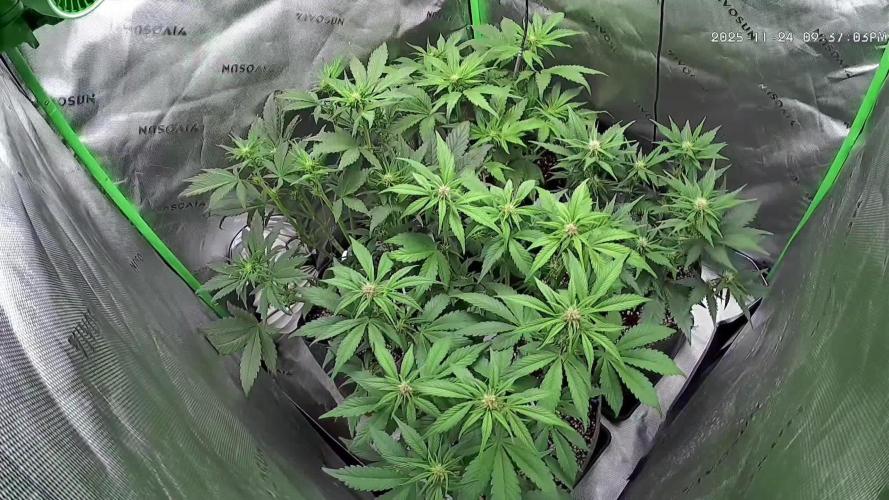
Well not much to say this week, no defoliation, no top dressing, just watching the plants filling in and get frosty!! ❄️😁. All four girls are looking pretty darn happy with life. Although #3 is a lighter color they're all fed and watered the same so I'll just chalk it up to different pheno. Two of the girls are starting to show purple on the leaves and a pinkish hue on the bud sites. 🤞For some awesome colors! Still watering every 3 days but now 14L instead of 12L. No drooping on water day but soil nice and dried out so timing is working 👍. Picked a few leaves (maybe a dozen or so each) off #1 and #2, but they didn't get defoliated quite as well so not surprised. Just leaves that were really bunched up or below canopy with no light. Here's hoping for another good week!
Likes
85
Share
Seed sat in glass of luke warm rain water till it sank , then moved to paper towel for total 24 hrs till sprouted then planted in its main soil medium 45L, popped less then 24 hours ... First time using CANUKSEEDS Idea , decided to try my hand at growing an autoflower to learn it's traits , as I having a feeling it will suit my grow style👌 ((( Who the hell is TropiCannibis Todd😎......... Well this is not only my First AutoFlower but my First Grow in over 11-12 Years😳 I Grew from 2002-03 TO 2010-11 , I'm back nahnahnahnahnah , LETS DO THIS 😎😁 )))
Likes
12
Share
@BlaKX
Follow
Gorilla Punch Auto 🦍 🥊: 22.6 - 30.6 = 34,5 cm Mimosa Cake Auto 🍹🍰: 22.6 - 30.6 = 52,5 cm Nothern Light Auto 🌌🌠: 22.6 - 30.6 = 63cm Sie sind förmlich explodiert was das Bud Wachstum und Harz Produktion angeht!!! Ich habe leider die Mimosa Cake und NL tauchen müssen weil das Substrat zu trocken war und ich grade in der wichtigsten Phase ein anständiges feuchtes Substrat habe ohne Salz ansammelung am Topf Boden. Die Hitze macht an sich keine Probleme mehr dafür aber mittlerweile die Luftfeuchtigkeit und zwar von draußen wenn das Licht für 6std. Ausgeht mittags um 12uhr-18uhr herrscht oft eine Luftfeuchtigkeit von 50-60% aber ansonsten so 45%-50% RLF. Hab nur PK13/14 zusätzlich verwendet und den booster 1ml erhöht. Ansonsten bin ich wirklich zufrieden und stolz auf meine 3 Autoflower:)💚💜🍀🏻
Likes
25
Share
Replaced nitrogen with omina, omina has 14.0.0. Stretch almost over, growth almost switched to full flowering. Increasing phosphorous and potassium, beauty of nature is it only takes what it needs. Started to remove some weights as stems starting to show solid reinforcement and are ready to hold fat cola. Fingers 🤞. Decreased hours of light to 10. Extended hours of cold @ night from 2 to 6 hours @59 Farenheight with 2 hours both sides @ 70&77 respectively.
Likes
29
Share
Welcome back at the first week in vegetative stage of my Sensi Amnesia. As you can see, she got repotted in a bigger pot with new BioBizz LightMix soil. So far the growth of this lady is good. I started my Honeywell ventilator to give very slight wind in my tent. Also my Sanlight LED is now running on 60% with 40cm distance. This week she gets time to comfort herself in the new environment. Hopefully she will get some new leafs. Day 12: gave her the first water after repotting and added BioBizz Bio Grow with 0,75ml/L Day 14: gave her 0,5l water with 0,5ml BioGrow per liter. End of week 1 without any trouble. It’s nice to see the progress over the last 7 days. Will keep this strategy next week I noticed, that my tab water has a pH level of 7,8. I mixed it with filtered water to get between 6 and 7 Keep in touch ! Cheers HighZenBerg
Likes
2
Share
@Ninjabuds
Follow
Not a lot to update the seedlings have came up out the soil at this point they are still to small to tell any visible differences. I started all the seeds from all 10 packs and and I put 26 of them in soil I now have about 20 of them left I still have atleast one left if every strain. I just kept the 20 plants that all started off at the same time it’s so much easier when there is not some plants behind from the rip. In a few days I will pick out the best one from each of the 10 strains and toss the rest so sad there is a plant count here.
Likes
45
Share
2nd net is up. Early bud formations are promising. holding up to the extremes pretty well, some leaves taking minor damage, but overall, she is holding up, gave her 1 night at 50F see how she would react, stressful. Not advised as it messes with her metabolism, but I want to see if it triggers any anthocyanin response. Love to see her purp up but no signs yet. My homework. Rubisco regeneration is intrinsically linked to nitrogen supply because Rubisco is a major sink for nitrogen in plants, typically accounting for 15% to over 25% of total leaf nitrogen. The regeneration phase itself consumes nitrogen through the synthesis of the Rubisco enzyme and associated proteins (like Rubisco activase), and overall nitrogen status heavily influences the efficiency of RuBP regeneration.Structural Component: Nitrogen is an essential building block for all proteins, and the sheer abundance of the Rubisco protein makes it the single largest storage of nitrogen in the leaf. Synthesis and Activity: Adequate nitrogen supply is crucial for the synthesis and maintenance of sufficient Rubisco enzyme and Rubisco activase (Rca), the regulatory protein responsible for maintaining Rubisco's active state. Nitrogen deficiency leads to a decrease in the content and activity of both Rubisco and Rca, which in turn limits the maximum carboxylation rate, Vmax, and the rate of RuBP regeneration Jmax, thus reducing overall photosynthetic capacity. Nitrogen Storage and Remobilization: Rubisco can act as a temporary nitrogen storage protein, which is degraded to remobilize nitrogen to other growing parts of the plant, especially under conditions of nitrogen deficiency or senescence. Nitrogen Use Efficiency (NUE): The allocation of nitrogen to Rubisco is a key determinant of a plant's photosynthetic nitrogen use efficiency (PNUE). In high-nitrogen conditions, plants may accumulate a surplus of Rubisco, which may not be fully activated, leading to a lower PNUE. Optimizing the amount and activity of Rubisco relative to nitrogen availability is a target for improving crop NUE. Photorespiration and Nitrogen Metabolism: Nitrogen metabolism is also linked to the photorespiration pathway (which competes with carboxylation at the Rubisco active site), particularly in the reassimilation of ammonia released during the process. To increase RuBisCO regeneration, which refers to the process of forming the CO2 acceptor molecule Ribulose-1,5-bisphosphate (RuBP) during photosynthesis, the primary methods involve optimizing the levels and activity of Rubisco activase (Rca) and enhancing the performance of other Calvin-Benson-Bassham (CBB) cycle enzymes. Biochemical and Environmental Approaches: Optimize Rubisco Activase (Rca) activity: Rca is a crucial chaperone protein that removes inhibitory sugar phosphates, such as CA1P (2-carboxy-D-arabinitol 1-phosphate), from the Rubisco active site, thus maintaining its catalytic competence. •Ensure optimal light conditions: Rca is light-activated via the chloroplast's redox status. Adequate light intensity ensures Rca can effectively maintain Rubisco in its active, carbamylated state. •Maintain optimal temperature: Rca is highly temperature-sensitive and can become unstable at moderately high temperatures (e.g., above 35°C/95F° in many C3 plants), which decreases its ability to activate Rubisco. Maintaining temperatures within the optimal range for a specific plant species is important. •Optimize Mg2+ concentration: Mg2+ is a key cofactor for both Rubisco carbamylation and Rca activity. In the light, Mg2+ concentration in the chloroplast stroma increases, promoting activation. •Manage ATP/ADP ratio: Rca activity depends on ATP hydrolysis and is inhibited by ADP. Conditions that maintain a high ATP/ADP ratio in the chloroplast stroma favor Rca activity. Enhance Calvin-Benson-Bassham (CBB) cycle enzyme activity: The overall rate of RuBP regeneration can be limited by other enzymes in the cycle. •Increase SBPase activity: Sedoheptulose-1,7-bisphosphatase (SBPase) is a key regulatory enzyme in the regeneration pathway, and increasing its activity can enhance RuBP regeneration and overall photosynthesis. •Optimize other enzymes: Overexpression of other CBB cycle enzymes such as fructose-1,6-bisphosphate aldolase (FBA) and triose phosphate isomerase (TPI) can also help to balance the metabolic flux and improve RuBP regeneration capacity. Magnesium ions, Mg2+, are specifically required for Rubisco activation because the cation plays a critical structural and chemical role in forming the active site: A specific lysine residue in the active site must be carbamylated by a CO2 molecule to activate the enzyme. The resulting negatively charged carbamyl group then facilitates the binding of the positively charged Mg2+ion. While other divalent metal ions like Mn2+ can bind to Rubisco, they alter the enzyme's substrate specificity and lead to dramatically lower activity or a higher rate of the non-productive oxygenation reaction compared to Mg2+, making them biologically unfavorable in the context of efficient carbon fixation. The concentration of Mg2+ in the chloroplast stroma naturally increases in the light due to ion potential balancing during ATP synthesis, providing a physiological mechanism to ensure the enzyme is activated when photosynthesis is possible. At the center of the porphyrin ring, nestled within its nitrogen atoms, is a Magnesium ion (Mg2+). This magnesium ion is crucial for the function of chlorophyll, and without it, the pigment cannot effectively capture and transfer light energy. Mg acts as a cofactor: Mg2+ binds to Rubisco after an activator CO2 molecule, forming a catalytically competent complex (Enzyme-CO2-Mg2+). High light + CO2) increases demand: Under high light (60 DLI is a very high intensity, potentially saturating) and high CO2, the plant's capacity for photosynthesis is high, and thus the demand for activated Rubisco and the necessary Mg2+ cofactor increases. Mg deficiency becomes limiting: If Mg2+ is deficient under these conditions, the higher levels of Rubisco and Rubisco activase produced cannot be fully activated, leading to lower photosynthetic rates and potential photo-oxidative damage. Optimal range: Studies show that adequate Mg2+ application can enhance Rubisco activation and stabilize net photosynthetic rates under stress conditions, but the required concentration is specific to the experimental setup. Monitoring is key: The most effective approach in a controlled environment is to monitor the plant's physiological responses e.g., leaf Mg2+ concentration, photosynthetic rate, Rubisco activation state, and adjust the nutrient solution/fertilizer to maintain adequate levels, rather than supplementing a fixed "extra" amount. In practice, this means ensuring that Mg2+ is not a limiting factor in the plant's standard nutrient solution when pushing the limits with high light and CO2. Applying Mg2+ through foliar spray is beneficial to Rubisco regeneration, particularly in alleviating the negative effects of magnesium (Mg) deficiency and high-temperature stress (HTS). While Mg can be leached from soil, within the plant it is considered a mobile nutrient, particularly in the phloem. Foliar-applied Mg is quickly absorbed by the leaves and can be translocate to other plant parts, including new growth and sink organs. Foliar application of: NATURES VERY OWN MgSO4 @ 15.0g L-1 in a spray bottle. Foliar sprays are often recommended as a rapid rescue measure for existing deficiencies or as a supplement during critical growth stages, when demand for Mg is high. Application in the early morning or late evening can improve absorption and prevent leaf burn. The starting point [of creativity] is curiosity: pondering why the default exists in the first place. We’re driven to question defaults when we experience vuja de, the opposite of déjà vu. Déjà vu occurs when we encounter something new, but it feels as if we’ve seen it before. Vuja de is the reverse—we face something familiar, but we see it with a fresh perspective that enables us to gain new insights into old problems. Come walk in the enchanted forest.
Processing
Likes
20
Share
3/16: Rain let up for half the day, but more tonight...damnit... They are due for a watering tomorrow, but with the high RH, maybe not... 3/17: They weren't ready for water yet, so I slept for a few bonus hours! (rare) The tall one's biggest 3 colas are starting to thicken...they'll range from 14" to 18" in length. I'd like to see them get to 10" in circumference or better...👈 Rained for most for the day....again... 3/18: I watered them with about 1/2 gallon each including terpinator, signal, sweet & sticky, cal-mag, armor si, endoboost, humic acid, and a little cha ching. It rained all night again..and most of the day today. I took some photos with the qb's turned off and a 135w 5500k CFL on.. 3/19: It rained all night and several times again today...ffs....I've started building an Ark in my free time 😁 3/20: Rained again on and off today..RH still too high... 3/21: Rained again tonight.. I had to pick up a couple of them while removing a couple of other plants, and they are still heavy. I might be able to wait until Monday to feed again, which might be enough time for me to get the RH back down a little bit. 3/22: Rained again last night several times...and again today for a couple hours...ridiculous. Woke up with RH at 65%!!! Been chatting with other FFT growers and they all seem to be losing a lot of produce to botrytis...I'm starting to freak out..😳
Likes
7
Share
@FrostyB
Follow
I experimented with this as it was a free seed and I wanted to see what would happen if I removed any additional nodes and just kept focus on the man node/ cola. She weighed in a solid ounce dry maybe less give or take a few days of curing/ drying. Smoked really nice and packed a punch which kinda made me regret using this beautiful strain in my experiment as I would have loved more from her but at the same time she taught me a lot with regards to nutrient levels and how plants react depending on which way they're trained or defoliated which has really helped me with future grows so for that I will certainly be running this strain again! Thanks Barneys ... Awesome genetics as per usual 👏
Likes
74
Share
@Hou_Stone
Follow
Cette semaine commence avec le topping des plantes retardataire que j'ai mise à germer plus tard. Puis elle se termine tranquillement pour accueillir la floraison. J'arrose avec environ 1L d'eau chaque pot tout les 5 jours. J'ajoute une fois sur 2 du bioenhancer Venez me voir sur instagram ! 🤩👨‍🚀 https://www.instagram.com/hou_stone420/
Processing
Likes
46
Share
This week went well I am continuing to harvest buds as they become ready. The leaves are yellowing more and more letting me know that she is almost complete. I think the lower bids have about one more week until they are ready and that will complete the harvest for Big Girl. Little girl is now declining, she has not branches out or grown new tops.
Likes
34
Share
This update is after 70 days of flowering. I switched off the light and left the girls for 2 more days in the dark tent. The remaining fan leaves i cutted already some days before and it looks like that the buds will be easy to trim.
Likes
2
Share
@KEVS_BEST
Follow
Woche 3 - Tägliches Gießen und weitere Düngerzugabe In der dritten Woche wurde die Wassermenge weiter angepasst, um dem kontinuierlichen Wachstum der Pflanzen gerecht zu werden. Ab dieser Woche wurde jeden Tag gegossen, wobei die Menge bis Ende der Woche auf 0,45 Liter pro Tag erhöht wurde. Es ist nach wie vor nur ein Ventilator im Einsatz, um die Luftzirkulation zu gewährleisten. Die Luftfeuchtigkeit wurde weiterhin durch Tücher und Teller reguliert, indem täglich 500 ml Wasser verwendet wurden. Am 27.04.2024 wurde die zweite Düngerladung verabreicht, diesmal mit einem Verhältnis von 30 ml Canna Terra auf 10 Liter Wasser. Das Wasser hatte einen EC-Wert von 1,28 und einen pH-Wert von 5,9. Die Pflanzen zeigten keine Anzeichen von Nährstoffmangel oder -überschuss. Am Ende der dritten Woche hatten die Pflanzen bereits fünf Noden entwickelt und wuchsen mittlerweile täglich um knapp 1 cm. Die Pflanzen sahen weiterhin sehr gesund aus und waren auf einem guten Weg, kräftig zu gedeihen. ENGLISH Week 3 - Daily Watering and Continued Nutrient Feeding In the third week, I further adjusted the water amount to support the plants' consistent growth. From this week, the plants were watered daily, with the amount increased to 0.45 liters per day by the end of the week. There was still only one fan in use to provide air circulation, and humidity continued to be regulated manually using towels and plates, with 500 ml of water daily. On April 27th, 2024, the second dose of nutrients was applied, with a ratio of 30 ml Canna Terra per 10 liters of water. The water had an EC of 1.28 and a pH of 5.9. The plants showed no signs of nutrient deficiency or excess. By the end of the third week, the plants had developed five nodes and were growing about 1 cm per day. They remained very healthy and were thriving.
Likes
8
Share
Hallo zusammen 🤙. Sie wächst sehr schön und macht keine Probleme. Rabattcode für den BIOTABS-Webshop https://biotabs.nl/en/shop/ GDBT420, damit erhalten Sie 15 Prozent
Likes
26
Share
Cruising right along into week 5 of flower nothing to crAzy to report but stretch has finally stopped and focus is into bud development. Smell is getting stronger as the days go along. Just dropped a video on the channel it’s uploading right now, but other than that we chilling see y’all next weekend 5TH WEEK OF FLOWER FANTA SEA RBX AND GLUE BERRY OG https://youtu.be/kgcvqlGLw84