


Likes
Comments
Share


Likes
3
Share


@TTerpz
Follow
Fade colors are really starting to push through
Fed with nutrients: 5/7/25
Fed with ph water at 6.5 : 5/11/25
Fed with nutrients 5/12/25

Likes
38
Share


@Dmars
Follow
7/1 Day 92 from sprout, day 37 of flower. Worth mentioning I started counting day 1 of flower from the day I switched the lights to 12/12. I guess some people count days of flower differently than that, but that’s mine. Buds have been packing on the frost over the past few days and slowly getting fatter. I know I won’t be getting any massive buds just because I topped multiple times and have a good amount of lower bud sites growing but that’s perfectly fine with me. Generally it looks like I’ll be getting golf ball sized buds all around. I also noticed I had 1 top bud site that was getting a lot more light than the others. Well I happen to be able to move that bar around away from that bud site in order to better disperse the light and even out the PAR map a bit. So I slid that over which allowed me to safely stay under 1000 PAR at that top while increasing my light up to 75%. This should result in more light for the lower parts while staying essentially the same up top.
7/5 Day 96 from sprout, day 41 of flower. I gave the light a small nudge past 75% yesterday and I haven’t seen any light stress yet. I’ll keep nudging it higher until I see something, but I gotta be near the limit. Most of my top sites are sitting around 900 PAR, but I have two sites that spike up to around 1050 PAR. I do have two CO2 bags resting on top of my light but it’s impossible to know how much that helps, if at all. Growth has been great though; buds remain frosty and are slowly getting bigger still. The top half of the buds will be of respectable size, no monsters but good solid bud. I’ll still have some larf way down in the lower half though, an unfortunate consequence of the insane stretch and being unsure how much to hack off in that scenario. I debated trimming them all off now but I’m thinking at this point in flower I should just leave her alone and grow.
7/6 It’s possible I found my upper limit on light intensity. I started to see some faint yellow areas appear on some leaves and there’s an increase of dry crispy leaf tips. So at least for this grow I think I’ve established that 75% power is the max I can do. For now I’ve backed off the lights to the last hash mark before 75%, which has most tops sitting at around 750 PAR and a few others at 850 PAR for a max DLI of 36.7. I’ll probably go back up to 75% next week.

Likes
10
Share


@ScottShelby
Follow
Lst training for a while now . I just got new led grow light for very cheap , I know it wont do the best but lets see

Likes
10
Share


@MedicinalGrower
Follow
Germination was very simple, paper towel for 40 hours. I always use a few sprinkles of Mycorrhizal Inoculant to boost the first stage of the growth when they are moved to the cups.Every 6 hours i check for water and humidity.

Likes
14
Share


@J_diaz420
Follow
Mucha humedad vía foliar
primer riego con fertilizante día 8 dosificación muy leve 👍🏻


Likes
10
Share


@Sunofa420
Follow
Here we are day 15 from sprout 🌱 the seedling seems to be doing well showing growth every day im eager to see how much growth will happen this week
Likes
7
Share


@Genussmittel420
Follow
no more than that one pollen sac found yet. still searchin every day
purplematic going purple!
Processing
Likes
5
Share


@GaiaGreenGiant
Follow
New weekly uploads for a glimpse of what’s happening in the Cabbage Patch!
She’s loving life!
Day 38 - Wanted to rid her of some lower growth so I decided to make a lil video. Cheers 🍻

Likes
7
Share


@hooolian
Follow
07/01/22: Pre Flower week - lights have been switched to 12/12 and are at 80% still. The plants are really showing their sativa genes with huge growth. plants are average 70cm although two are 90cm. bud sites have finally started to show growth and lightening of the green toward the end of the the week. humidity is low - the carbon bag seems to have done a good job also.

Likes
4
Share

@Simba732
Follow
Week 6 Complete.
Everything is going well
She started giving out a citrus smell, it’s lovely
She drinking a bit more and don’t seem to be stretching much.
Onto week 7
Likes
12
Share


@BigDripFelgo
Follow
Girl Scout Cookies is growing fast and healthy, with big wide indica leaves. Thinking of topping soon but also want to take clones so I’m not sure which one to do first?!

Likes
21
Share


@Esoteric_growing
Follow
Flushing nicely, leaves fading to purple and yellow. Will be flushed for a total of 12-14 days and then hung.

Likes
6
Share


@AutoCrazy
Follow
Things are humming along. The Red Hit Cookies and the Lemon Orange are starting to ripe up. The Mimosa has a few more weeks to go vs the other two plants. All are heathy and they smell great. The Lemon orange has a sweet citrus smell which is just amazing!!!


Likes
459
Share


@Ju_Bps
Follow
Hello my friends 👨🌾👩🌾,
This 4th flowering week was good, girls are sweets and healthy, leaves turm a bit to purple 💜, Buds continue to be along and start to bump.
I've found some thrips and lot of flyer 😑😑, several month I was without this fkg bug, but they're back..
I don't know if I do a treatment this week or if I wait the harvest to clean...
And daily fighting with leaves to kick off them under.
💦 2 Watering this week 1.5l/plant .
Water + Terra Flores + Canna Boost
Water + Cannazym + Sugar Royal
PH@6
Lamp @100%
Thanks community for follow, likes, comments, always a pleasure 👩🌾👨🌾❤️🌲
See you next week 👊👊
Mars Hydro - TS 1000
https://www.mars-hydro.com/ts-1000-led-grow-light
Mars Hydro - FC3000
https://www.mars-hydro.com/fc-3000-samsung-lm301b-led-grow-light
Mars Hydro - SP3000
https://www.mars-hydro.com/sp-3000-samsung-lm301b-greenhouse-led-grow-light
The High Chameleon - Vannila T
https://www.thehighchameleon.com/shop/vanilla-t-5

Likes
10
Share


@Cronic
Follow
Week 7 - The end's in sight.
Some unseasonal hot days here, 29° to 34° this week so, the shade cloth has come out and they're placed in an area with the most airflow. Aphids keep on appearing so I contiune to check and spray with water on infected areas to keep the pop as low as pos; so far i'am on top of them.
The pineapples are really packing it on and the smell is getting stronger every day. I've upped the nutes close to Biobizz's recommened and so far, there seems to be no negative feedback. Due to the heat I can't help but be a little concerned though humidity has dropped to during the day to about 50 and 80 at night for a few hours. I hope they're as resilient as their reputation suggests.
The lemonade contiunes to chunk up, though I think she's as tall as she's going to get. The smell continues to increase in intensity which actually compliments the pineapples nicely. Again the weather's abit of a concern, even more for this girl as Fastbuds recommened cooler temps for this strain; I wasn't banking on temps like this for another month or so yet. I'am thinking I should start a few weeks earlier next season because if the Lemonades smoke as good as they look and smell i'll be growing them next season for sure. Fingers crossed.
Processing
Likes
8
Share


@Buck5050
Follow
All growth on track at the begging of the week so I defoliated the fan leaves and left the growth shoots. Everything took the haircut in stride and now is moving forward and on track for clones to be taken on schedule.The temperature is on the rise at times for a few hours. With the new humidifier installed the plants don't seem to stress with the increase.Plenty of good VEG growth this week. I have already inspected for healthy growth shoots for clones. A few more days and they will get a good trim.
Likes
29
Share


@Ultraviolet
Follow
Hope you are well. Thanks for taking the time.
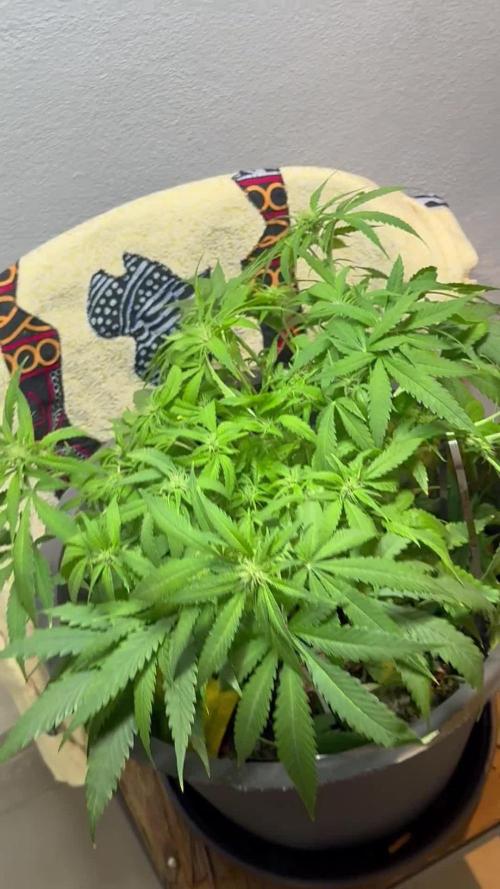
Little main line defoliation to focus growth.
A cell is a quantum measuring device for light’s frequency to make order from the chaos that light frequencies bring from our environment. A cell performs mechanical resonance, where its intrinsic structures vibrate at specific resonant frequencies when exposed to external mechanical stimulation. Cells possess the ability to sense and respond to mechanical cues from their environment, a process known as mechanosensing. This can involve the activation of signaling pathways and changes in gene expression. Cellular resonance is a component of mechanotransduction, the process by which cells convert mechanical force into a biochemical signal that triggers a cellular response.
Plants perceive mechanosensory stimuli, such as vibration and touch, through structures like trichomes (hairs) and specialized ion channels embedded in their cell membranes. Plants are sensitive to frequencies ranging from ultrasound to lower sound waves, such as 250 Hz. The perception depends on various factors, including the stiffness of the underlying tissue, which can be tuned by the plant to perceive specific frequencies associated with environmental cues like insect herbivory.
While the exact molecular mechanisms are still being explored, scientists have identified several potential pathways that may be affected by acoustic vibrations in this frequency range: 4000-5000 Hz. Enzyme activity: Sound waves can increase the activity of certain enzymes, such as amylase, and elevate the content of soluble sugars and proteins. Increased stomatal opening in response to specific frequencies can optimize photosynthesis by increasing the plant's absorption of water and CO2. In addition to enhancing drought tolerance, sound vibrations can strengthen plants' overall resistance to stress. Studies have shown that some genes related to stress response can be activated by sound stimulation.
The Emerson effect is a phenomenon where the combination of red and far-red light increases the rate of photosynthesis beyond the sum of the two wavelengths used separately. This synergy is important for understanding Extended Photosynthetically Active Radiation (ePAR), which includes the far-red spectrum, because it means a more comprehensive measurement is needed to fully understand light's effect on plant growth. ePAR meters measure light up to 750 nm, which is necessary to capture the far-red light that participates in the Emerson effect.
The human eye can detect more shades of green than any other color due to a combination of our cone cell sensitivity and evolutionary history. Our eyes are most sensitive to the yellow-green part of the spectrum, which is the peak of our visual sensitivity, and a large part of our ancestry was spent needing to distinguish subtle variations in greenery for survival. or our primate ancestors, being able to discern subtle differences in green was crucial for survival. It helped them identify edible plants and avoid poisonous ones, as well as detect predators hiding in foliage. This constant need to distinguish shades of green drove the evolution of our color perception to become most sensitive to it.
S-cones: Detect short wavelengths, perceived as blues and violets.
M-cones: Detect medium wavelengths, perceived as greens.
L-cones: Detect long wavelengths, perceived as reds and yellows.
The primary reason for our enhanced sensitivity to green is that the peak sensitivities of the M-cones and L-cones are very close together in the green-yellow region of the visible spectrum. This overlap means that green light stimulates both the M-cones and L-cones, creating a more robust and detailed signal for the brain to interpret. In contrast, the S-cones are more isolated and respond to a much narrower band of light, leading to less sensitivity for blues.
The brain's visual processing pathways also play a role. Our visual system processes color differences through "opponent channels," which compare the signals from different types of cones. The opponent channel that processes red versus green has a more precise and intricate system than the blue versus yellow channel, leading to finer discrimination in the green part of the spectrum.