


Likes
17
Share


@JonnyKush
Follow
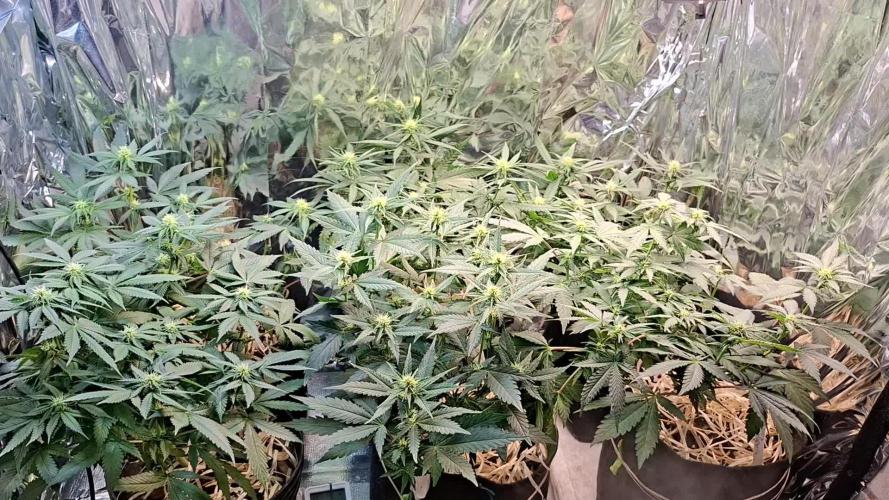
day 73 I was not ready for all this! 🤣🤣 they literally exploded and I started seeing purple on these buds I had to tie them up so the weight of the flowers didn't break the branches. compared to El Patron that I also have in my tent, Purple is much fatter and shorter. they have a very sweet scent and I can't wait to taste it, but alas I will go there a little longer. I have to say that 6 photoperiods are too many for my 1m x 1m x 2m tent. in addition to this I have noticed that they are very hungry. like me and give me some advice. thanks for stopping by, have a nice day and happy cultivation

Likes
11
Share


@TheDankBankGC
Follow
12 hours max soaking before directly going into 18ltr pots. Amazing germination speed and rate as always from the guys @ 420FB

Likes
9
Share


@bigolebuds
Follow
Week 4: We are officially one month into our grow! things have been going pretty smooth so far and that’s exciting!! Yesterday we picked up our Gaia Green 4-4-4. With that and the topping done, we plan to give them the week to recover and then start LST and feeding. You’ll notice a large number of plants were moved outside… those were all auto seeds that we got for free from Seedsman and Perry’s Magic Beans (Northern Lights, Critical + 2.0, M+M, and High C) shout out to them!!

Processing
Likes
20
Share


@GrimbolTheDruid
Follow
Grow Specs:
Breeder: Mephisto Genetics
Strain: Cosmic Queen F4
Nicknames: Timantha - CQ1
Genetic heritage: Spacedawg From TGA Seeds x Chemdogging F4
Indica/Sativa: 30/70
Est. cycle time: 65-75 days from sprout
Medium: CQ1 = Soil, Mephisto Genetics Super Soil, Worm Castings. CQ2 = Soil, home made Subcool Super Soil variant, worm castings
Lights: 132W actual LED
Update schedule: I will try to send out the updates every Saturday or Sunday.
For more frequent updates, add me on Instagram @grimbolthedruid
Grow Schedule to Date:
Sprout: 3/1/17 (Full moon)
Age: Day 25 as of 3/25/18
Updates/Observations:
- Water only for this last week and next. Soil is very hot so I don't need to cycle any of those nutrients down right now.
- Plants showing light burns on lower foliage but nothing serious yet.
- Trying to keep the soil always slightly moist and never let it dry completely to keep microbes (and by extension the soil) at optimum health.
- CQ1 is still miniaturized and has shown sex so I think she is going to finish very small, if she makes it at all. I am worried the hot soil will burn her down because she wont ever get big.
- CQ2s leaves show a very strong Sativa expression and I love it.
- CQ2 is growing very vigorously.
- All plant showing sex (F).
Worm Feeding:
- This week I fed my worms about a pound or so total of: Banana, mango, dill, tomatoes, carrots, strawberries, aloe filet, green beans, covered in a dash of oyster shell and alfalfa meal.
- I layer down some canna leaves, layer diced up worm food, sprinkle dry amendments (kelp, oyster shell, neem, etc.), layer canna leaves, then replace bedding and they are happy!
- Creating the food layer protected by the green manure gives the worms a nice buffer zone to move freely through eating as much as they want.
- This method is inspired by HerbinFarmer on Youtube. I really enjoy his videos so if you have time, check him out!
Cheers!
G



Likes
2
Share


@SebastianFastBuds
Follow
As you can see now I am batteling crazy hot temperatures. She is already crazy sticky and has this typical Guava smell. Strwaberry with Pear. I am proud of this plant which has been moved around all over the place and she still will give me a nice yield of yummy Nuggets.
Likes
14
Share


@555ABKY555
Follow
finally the scorching sun came having moved the plants from under the canopy outdoors a downpour created a bit of mold in a small part of the skywalker and also to the little cherry i later removed it and sprayed the plants with garlic infused water now i'm the bomb i'm fertilizing with long awaited organic vermicompost, the plants are perfect, i think i will delay the harvest for the cherry to make it gain a little more weight at the expense of the flavors the flavors are amazing absurd...i ordered some clones by freakshow humbolt seeds I also made new transfers with old seeds tried to germinate and they went splendidly.honey cream and special queen by royal queen seeds


Processing
Likes
1
Share


@Zanto
Follow
Day 26 of flowering
They started to produce trichomas and rosin very early as last time. Now I can imagine the big colas this baby is going to produce.
Finished with Delta 9 applications, now only NO Stress and guano
Likes
5
Share

@Grow4meds20
Follow
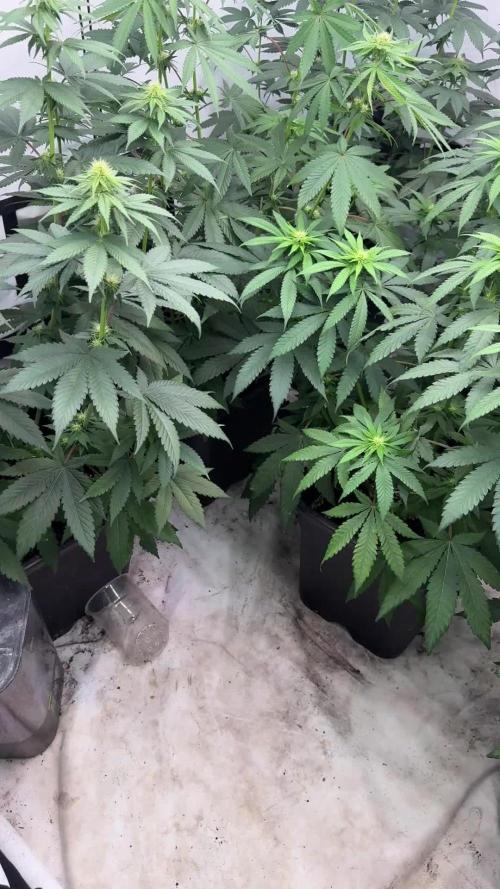
All going good flower in full swing. Trycombes starting to come through smells are starting to come through pick a few leaves of here and there when they are needed and shading other places. Plenty of flowering and kolas site. It’s all looking superb and is coming along very very well. Feeding twice a week every other watering no deficiency I did have some trouble with some nanners on one plant but have picked them off as I see them it was one of the cherry poppers to far to leave it alone.but no more structures and all going well flowering development powering along !


Likes
15
Share


@DRO420
Follow
Just repotted these clones ... They have amazing roots... Looking very healthy

Likes
7
Share


@Marihuanacali89
Follow
Bueno familia aquí estamos otra semana más..ya la segunda de floración de estas niñas ...que ya están en 85 cm y el foco lo pude subir por última vez porque ya no sé cómo subirlo más ...
Esta semana les daré un último repaso de defoliacion para que cojan fuerza


Likes
12
Share


@BlackForestGrower
Follow
We’re approaching the finish line — the top buds are already nearly perfect. I’m just giving the lower ones a few more days before putting her into a 48-hour dark phase.

Likes
31
Share


@KushReloaded
Follow
Rotated the pots to help get better light and lst on a few other spots overall looking pretty good for my first grow I would say


Likes
4
Share


@DogDoctorOfficial
Follow
💙 8×8 Adventure – Week 14 🌿
Blueberry Muffin – Pheno B
🌸 A Little Further Ahead, Still in No Hurry — The Compact Girl Follows Her Own Clock
Welcome back to another chapter of the 8×8 Adventure! 🌱💚
And here we are again...
Blueberry Muffin Pheno B.
😂💙
Still compact.
Still taking her time.
Still looking at the rest of the room as if everybody else is running around for absolutely no reason.
And honestly?
I think she might have a point.
😂🌿
She's moving forward, she's developing beautifully, and she's actually a little further along than her sister.
But let's not get carried away.
We're not talking about a sudden transformation into the fastest girl in the room.
Nope.
She's still taking the scenic route.
She's simply a little further down that road than Pheno A.
And when I look at her now, I really like what I'm seeing.
The flowers have their own character.
The structure is beautiful.
She's continuing to evolve.
And despite her slower pace compared with much of the room, she's giving us plenty of reasons to keep watching.
💙🌸✨
So this week, we're keeping things simple.
No dramatic changes.
No new environmental strategy.
No attempt to force her to catch up with her neighbours.
We're letting her continue at her own pace while we observe the differences between these two sisters.
Because if the 8×8 Adventure has taught me anything, it's that the plants don't always follow the schedule we imagine for them.
And Blueberry Muffin Pheno B?
She's following hers.
Let's give this little lady her spotlight!
────────────────────────
🌱 THE 8×8 ADVENTURE — ONE ROOM, MANY DIFFERENT CLOCKS
For anyone discovering this diary for the first time, welcome to the 8×8 Adventure!
The idea behind this project is simple.
We're observing different genetics and phenotypes sharing the same general growing environment.
Same room.
Same lighting ecosystem.
Same 12/12 schedule.
Same general nutritional approach.
Same grower.
But very different plants.
Some stretch.
Some stay compact.
Some develop quickly.
Others take their time.
Some become giants.
Others seem perfectly happy keeping their feet on the ground.
😂🌿
And then there are plants like our Blueberry Muffin sisters.
Both compact.
Both progressing more slowly than much of the room.
Both beautiful.
But still following their own individual timelines.
That's what makes this experiment interesting.
We're not trying to make every plant behave identically.
We're watching what happens when different genetic expressions share the same general conditions.
And Pheno B is giving us another little piece of that puzzle.
💙🌱
────────────────────────
💙 STILL COMPACT — BUT A LITTLE FURTHER ALONG
Let's talk about the difference between the sisters.
Pheno B is a little more advanced than Pheno A at the moment.
Not dramatically.
Not enough to make us forget that both girls are progressing more slowly than many of their neighbours.
But it's noticeable.
And I like documenting those little differences.
Because when you look at the cultivar name alone, it's easy to imagine that both plants should behave in roughly the same way.
But plants aren't copies of one another.
Even when two plants share the same genetic background, individual phenotypes can express themselves differently.
They can have different structures.
Different growth patterns.
Different rates of development.
And different finishing timelines.
Here, Pheno B is just a little further along.
She's still compact.
Still taking her time.
But she's showing us her own version of Blueberry Muffin.
And that's exactly what we want to document.
💙🌸
────────────────────────
🐢 NO HURRY, NO PANIC, NO RACE
I swear these girls have their own calendars.
😂💙
The rest of the room keeps moving, and these two Blueberry Muffins seem perfectly comfortable doing things at their own speed.
And you know what?
That's fine.
We're not running a race.
We're not handing out prizes for the fastest plant to reach the next stage.
And we're certainly not going to assume that every difference in timing means something needs to be changed.
Pheno B is developing.
She's progressing.
She's looking beautiful.
She's simply taking longer than many of the other girls.
That's the observation.
And that's what we'll continue to document.
The important thing is to distinguish between a plant that is progressing slowly and a plant that is showing signs of a problem.
Those aren't automatically the same thing.
So rather than making assumptions based on the calendar alone, we're watching the actual plant and how she develops.
No unnecessary drama.
No imaginary deadlines.
Just Blueberry Muffin doing her thing.
😂💙🌿
────────────────────────
🌸 THE FLOWERS DESERVE THE ATTENTION
Now, let's leave the calendar aside for a moment.
Because I don't want this report to become entirely about how slowly she's moving.
There's much more to this girl than her timeline.
She's developing beautiful flowers, and her structure is worth appreciating on its own.
When I look at her, I don't just see a plant that's behind the others.
I see a plant with her own expression.
Her own structure.
Her own visual character.
And that is what makes photographing individual phenotypes so rewarding.
The whole-room view tells us one story.
Getting closer tells us another.
And when we compare those observations over several weeks, we begin to appreciate the small changes that might otherwise go unnoticed.
That's why we're here.
Not simply to count weeks.
Not simply to compare heights.
But to document what each individual plant actually does.
And Blueberry Muffin Pheno B?
She's still giving us something beautiful to look at.
💙📸✨
────────────────────────
🌿 TWO SISTERS, TWO INDIVIDUAL JOURNEYS
I know we're going to cover some of the same subjects in Pheno A's diary.
And that's completely fine.
Both reports need to make sense on their own, because someone might be following only one of these plants.
But the interesting part is how the same general story expresses itself differently in each diary.
Pheno A is moving at her own pace.
Pheno B is a little further along.
Both are compact.
Both are slower than much of the room.
And both are beautiful.
The differences aren't necessarily dramatic.
Sometimes they're small distinctions in timing or development.
But those distinctions are exactly what makes following individual phenotypes worthwhile.
We're giving each girl her own record rather than treating them as one generic plant.
And when the run is complete, we'll have two individual stories to look back on.
Same family.
Same room.
Different clocks.
💙🌸🌱
────────────────────────
💡 SAME ARTIFICIAL SUN — SAME PHOTONS
The lighting setup remains unchanged this week.
Our Future of Grow Black Series LEDs continue providing the main lighting, with the two additional Black Series 600W fixtures remaining part of the upgraded room setup.
After introducing the extra fixtures, we reduced the output to approximately 59% from the plug rather than simply running everything at maximum.
Our working reference remains around:
☀️ Approximately 1,500 PPFD across the upper canopy.
Actual intensity varies according to plant height and position, so that figure is a reference for the upper canopy rather than a claim that every flower receives exactly the same amount.
And Pheno B?
She's sharing the same lighting environment as the rest of the room.
Same artificial sun.
Same general lighting strategy.
Different genetic expression.
Some plants respond by building large structures.
Some stretch.
Some remain compact.
And some take their time developing their flowers.
The photons are available, but each plant has its own biology and its own way of responding to the environment.
That's one of the things that keeps this experiment interesting.
💡🌿💙
A huge thank you to Future of Grow for supplying the additional fixtures and allowing us to expand the lighting capability of the room.
────────────────────────
❤️ A LITTLE RED LIGHT BEFORE THE NIGHT
We're also continuing with our 15-minute red-light period after the main lighting period.
This is an additional part of the lighting routine we're exploring, and it's worth explaining what we mean by it.
Plants respond to different wavelengths of light through several photoreceptors.
Red and far-red light are particularly relevant to phytochrome signalling, which helps plants interpret changes in their light environment.
However, red light and far-red light are not interchangeable terms.
Their wavelengths differ, and the effects depend on the spectrum, intensity, duration, timing, and the plant's physiological response.
So, for our setup, the extra 15 minutes of red light is something we're documenting as part of the lighting routine.
We're not assuming that it automatically improves flowering, increases yield, or guarantees a better transition into the dark period.
We want to understand the science behind what we're doing rather than simply repeat claims we've heard.
❤️💡🌱
────────────────────────
🔬 QUICK SCIENCE BREAK — THE EMERSON EFFECT
Since we're talking about light, let's take a moment to revisit the Emerson effect.
The Emerson effect is a real phenomenon discovered through research into photosynthesis.
In simplified terms, photosynthetic activity can increase when certain wavelengths of red light and far-red light are provided together, beyond what would be expected from their separate effects under the conditions studied.
This helped scientists understand that photosynthesis involves two cooperating photosystems:
🌿 Photosystem II (PSII)
🌿 Photosystem I (PSI)
These systems work together in the photosynthetic electron transport chain.
Different wavelengths can contribute differently to their activity, and under suitable conditions, their combined contribution can enhance photosynthetic performance.
That's the fascinating part.
But here's the important distinction.
The Emerson effect is not simply another name for giving a plant a short red-light treatment after the main lights switch off.
The classic effect concerns photosynthetic responses under particular illumination conditions. An end-of-day lighting treatment is a different situation.
We therefore shouldn't assume that our 15-minute red-light period automatically triggers the Emerson effect or guarantees an improvement in plant performance.
The actual spectrum and conditions matter.
And that's why I prefer to keep the explanation honest.
We can explore lighting.
We can test ideas.
We can learn from the science.
But we shouldn't promise results that we haven't established.
🔬💡🌱
────────────────────────
🌙 THE DARK PERIOD STILL MATTERS
Our main lighting schedule remains 12/12.
The additional red-light period is a separate part of the lighting routine, and it doesn't mean plant responses to darkness can be reduced to a simple on/off switch.
Plants have internal rhythms and respond to changes in their light environment.
Photoreceptors, signalling pathways, and the timing of the light-dark cycle all play roles in how plants respond.
So we're keeping the distinction clear.
We're documenting the lighting treatment we're using.
We're keeping the rest of the room consistent.
And we're observing the plants rather than assuming that one small adjustment will explain every aspect of their development.
That's the approach I prefer.
Curiosity, observation, and a little bit of science.
💚🔬
────────────────────────
🌱 NUTRITION — NO CHANGES THIS WEEK
On the nutritional side, we're keeping the same general program as the rest of the room.
No new recipe for Pheno B.
No attempt to force her to catch up.
No changes simply because she's developing more slowly than some of the other plants.
The current recipe remains:
🌱 Plagron Pure Zym — 1 ml/L
⚗️ Plagron pH Plus — 0.03 ml/L
🍋 Plagron Lemon Kick — 0.03 ml/L
🌸 Plagron Terra Bloom — 2 ml/L
🌱 Plagron Power Buds — 1 ml/L
🍯 Plagron Sugar Royal — 1 ml/L
🌿 Plagron Green Sensation — 1 ml/L
Current solution readings are approximately:
⚗️ pH — 6.04
⚡ EC — ~2.05 mS/cm
The general nutritional approach remains unchanged.
We're keeping things consistent and observing the individual plants rather than assuming that slower development automatically calls for a different feeding program.
Pheno B is progressing.
She's a little further along than her sister.
And we're continuing to let her show us how her own story develops.
────────────────────────
🌡️ WEEK 14 — ROOM OVERVIEW
🌸 Flowering: Week 14
💡 Main lighting schedule: 12/12
❤️ Additional end-of-day red-light period: 15 minutes
💡 Lighting system: Future of Grow Black Series LEDs
🔌 Approximate fixture output: 59% from the plug after adjustment
☀️ Upper-canopy PPFD reference: approximately 1,500
🌱 Pot size: 15 L
The general room setup remains unchanged.
We're keeping the environment and overall approach consistent while observing the differences between the plants.
────────────────────────
✂️ THE BEST THING WE CAN DO IS NOT INVENT WORK
At this stage, we're not trying to create tasks just because we feel we should be doing something.
😂🌱
The plants have established their structures.
The flowers are developing.
And the room continues along the same general path.
So we're observing, documenting, and making changes only when there's a genuine reason to do so.
Pheno B doesn't need us constantly interfering with her just because she's moving more slowly than some of the other girls.
She needs us to pay attention to what she's actually doing.
And that's exactly what we're doing.
Sometimes growing involves plenty of hands-on work.
Sometimes it involves stepping back and allowing the plant to continue.
Right now, this girl is giving us plenty to observe.
So we're letting her get on with it.
💙🌿
────────────────────────
📸 THE VALUE OF KEEPING INDIVIDUAL RECORDS
This is where the separate phenotype diaries really come into their own.
When we document Pheno A and Pheno B individually, we can look back and compare their development rather than relying on memory.
We can see which plant was a little further along.
We can compare their structures.
We can follow their individual timelines.
And we can appreciate how two plants sharing the same general environment can still express themselves differently.
That's useful information for the diary, and it's part of what makes this project enjoyable.
Not every observation has to be dramatic.
Sometimes it's simply:
"She's still moving slowly, but she's a little further along than her sister."
And that's a perfectly worthwhile observation.
Because this isn't about inventing differences.
It's about documenting the ones we actually see.
💙📸🌱
────────────────────────
😂 BLUEBERRY MUFFIN IS NOT CHECKING THE CALENDAR
If this girl could talk, I suspect the conversation would go something like this:
Me: "You know the rest of the room is moving a little faster, right?"
Blueberry Muffin Pheno B: "And?"
Me: "Nothing. Just checking."
Blueberry Muffin Pheno B: "Good. Now leave me alone."
😂💙🌸
And honestly, fair enough.
She's not here to satisfy my curiosity on a schedule.
She's here, she's developing, and she's doing things at her own pace.
The job is to observe her actual progress rather than decide in advance where she should be.
So, little lady...
take your time.
Just don't be surprised when I come back with the camera again.
😂📸
────────────────────────
💙 FINAL THOUGHTS — A LITTLE AHEAD, STILL COMPLETELY HERSELF
Week 14.
Blueberry Muffin Pheno B.
Still compact.
Still slower than much of the room.
Still taking her time.
But a little further along than her sister, and still looking beautiful.
💙🌸✨
We're not changing the general setup this week.
The lighting remains the same.
The nutritional approach remains the same.
The room continues along its established path.
And we're keeping the additional 15-minute red-light period as part of the lighting routine we're documenting.
We've also taken a moment to discuss red and far-red light, along with the Emerson effect, because understanding the science behind our equipment and routines matters.
The Emerson effect is fascinating, but it shouldn't be confused with a guaranteed benefit from a short end-of-day red-light treatment.
We'll keep the explanation grounded, keep observing the plants, and let the evidence guide what we conclude.
And as for Blueberry Muffin Pheno B?
She's doing her thing.
She's a little further along than Pheno A.
She's still taking the scenic route compared with much of the room.
And she's continuing to show us her own expression.
That's what I want to celebrate this week.
Not a race.
Not a competition.
Not an arbitrary deadline.
Just another chapter in the life of this beautiful little plant.
So let's give her the spotlight.
Let's appreciate her flowers.
Let's appreciate her structure.
Let's appreciate the differences between the sisters.
And let's remember why we started documenting these individual phenotypes in the first place.
Same room.
Same general conditions.
Different plants.
Different personalities.
Different timelines.
And a whole lot to learn along the way.
💙🌱🌸
Keep doing your thing, Blueberry Muffin Pheno B.
You're a little further along than your sister, but you're still in no hurry to join the fast lane.
😂💙
And that's fine.
We're watching.
We're documenting.
And we're letting you write your own story.
────────────────────────
🙏 THANK YOU
A huge thank you to Zamnesia for the Blueberry Muffin genetics and for giving us the opportunity to discover these individual phenotypes. 💙🌸
Thank you to Plagron for supporting the nutritional side of the 8×8 Adventure. 🌱
A massive thank you to Future of Grow for the Black Series lighting and especially for supplying the additional Black Series 600W fixtures that have expanded the lighting capability of this room. 💡🙏
Thank you to LumiFlora for helping illuminate the deeper parts of the canopy.
Thank you to TrolMaster for helping maintain the environment behind the scenes.
And, of course, thank you to everyone following along on GrowDiaries.
Every comment.
Every question.
Every observation.
Every photograph.
Every week spent following these different plants and their individual journeys.
It all becomes part of the story.
And Blueberry Muffin Pheno B?
She's still here.
Still compact.
Still beautiful.
Still progressing.
And still doing things at her own pace.
💙🌸✨
I'm looking forward to seeing how her story continues to unfold alongside her sister and the rest of the room.
Until then, keep growing, little lady.
Keep developing.
Keep shining.
And keep reminding us that not every plant needs to follow the same clock.
Growers Love, my friends, and happy growing! 🌱💚💙
See you next week in the 8×8 jungle...
where the faster girls keep moving,
the Blueberry Muffin sisters continue taking the scenic route,
the photons keep flying,
and we're still learning something new from every plant.
Let's grow, observe, and let every phenotype tell her own story. 💙🌱✨
Likes
6
Share


@rvabudman
Follow
The buds are forming! Changed to a nicer light recently, light is great, although my mars hydro 600w did me justice. This new one I got of amazon for under $100 is 1000 watt led and crushing it. It has increased temps significantly which is a bit tough for me to control given my tent is in a closet. Also it is starting to getting less humid outside, so I reduced airflow in the tent to keep the humidity at 50. I have a small humidifier coming soon (oddly a Corporate work gift lol).
Likes
3
Share


@MrMayhem1134
Follow
This week went good. They are on day 16 as of this post, pics were taken on day 15. They filled out the net about 85%, some plants branched out more then other or were topped more so that is one thing my partner could work on. Cover crop didn't do too well for him as he let the medium dry out a little too much these last few days, and the middle section has yellowed up a bit due to being a little more hungry then the outside (mainly in the Mando). We will see how they finish the stretch and then we get to stacking and packing weight!

