


Likes
Comments
Share


@Unkraut
Follow
got hermies in flower week 2...tried to remove most but it seems they spread their love already....found seeds on all other plants :( plant still looked great and got a great yield!


Likes
82
Share


@BigBadLion
Follow
Another fast update! 😃
Hey guys! I hope everything is going well for everyone. This is the 2nd week of flower and I'm here again to share what happened last week!
My babies now get thirsty really easy, nothing like how it used to be (and you can actually see them stressing over it in my photos) but gladly nothing that some water can't fix. The main colas are also starting to grow more and they are full of small developing flowers (they look super pretty! 😍)
Some side stems are also outgrowing the main branches... and I'm kinda unsure what I want to do (or if I should do anything). Maybe LST or supercrop them? (I might screw things up by doing it in flower and I have never done it before 😭) I don't know. I also want to trim some leaves away since the foliage is very dense but I fear I might end stressing them! I will probably make a grow question to know what others think.
I'm back on a normal nutrient schedule. I'm no longer "overfeeding" them and I water them 4 times a week (but with little water). Next week I'll try doing 3 but with more water and see if they like it more that way.
So far I love how the plants are developing! The small flowers look great and they look bigger everyday! 😃
Thanks everyone! See you all next week! 👋

Likes
50
Share


@00110001001001111O
Follow
Room setup rundown, examples of bud, et al in pictures...
Seedlings/Clones lights - Viparspectra XS1500.
Vege lights - Mars Hydro FC-4800
Flower Lights - 650w 3400K 1900umol/s PAR, (3) 226w DIY 2900K 630umol/s PAR (678w and 1890umol/s),
Substrate - 50/50 sphagnum peat moss and vermiculite in 5-gallon pots
Climate Control - Luckily, the lights, winter and normal furnace use all equate to a decent temperature, though a bit on colder side in in vege phase, sadly. Humidifier is needed early and later a dehumidifier is needed when canopy develops. I only grow in the winter months.
Irrigation - do not use the emitters in this diary. They suck a big fat dick to skip a line to suck a bigger dick. Use the pressure compensating type. https://growdiaries.com/diaries/232811-strawberry-cookies-og-r1-cherry-diesel-bbgs-ego-epg-ebg-grow-journal-by-001100010010011110/week/1366923 -- use something similar to those. They come in different shapes, too.
Basic process
The little light takes care of seedlings in 2.5" wide seedling pots until first up-pot. The 1-gallon pots fit well under the FC4800 in a 4x4 tent until day 21 after sprout. I plant 150% or more of what i need, so i can kill the weak without concern. The goal is for every plant that makes it to the 5-gallon up-pot being capable of producing a minimum of 160 grams with a maximum of a 35-40 day vegetative phase.
Third up-pot is into 5-gallon nursery pots and now under the 3 DIY lights and the 650W light in the big tent for a couple more weeks of vege. An irrigation system in the big tent saves a lot of time. One scrog for training and another for support, just in case. Reverting back to a more systematic approach to canopy composition moving forward. About 2.3 colas per sq ft and 8 primary colas per plant.
Yields were similar when over-crowding and being less systematic, but the proportion of less dense nugs is greater and trim time is needlessly elevated because of that fact. I was very controlling about this the first couple years but got away from it for far too long at this point.
Drying / Curing - Into mesh racks for 9 days. I wet trim and cut down to similarly sized buds for even drying. Temps are controlled around 68F and RH is set to 60%. Then into some 5-gallon buckets with gamma seal lids and (3) 2-way 67g boveda humidipaks (58% or 62%) in each bucket - 1 at bottom, 2 at top. Temp/RH probe confirms that they hold the RH steady at 60-63%.
Cost - 0.33 cents (USD) per gram produced. This includes an accelerated depreciation expense for all equipment used, fertilizer, water, electricity for all equipment used, new filters and other yearly purchases - bti, ph strips, sticky traps, etc. I'm a finance guy, so these numbers are comprehensively accurate and purposely err slightly on high side of cost. The only facet not included is the cost of my labor.
Likes
6
Share


@NiBaMeCa420
Follow
Hi fellow growers,
another week and a half has passed so this diary update is a bit over due.
As i said in my last update that i was growing on 24 hours of light and thinking about switching them to 18-6, right after writing last weeks diary i made the switch to 18-6 and left it for the past week and a half and that made a huge difference in growth the plants where nice and bushy from the 24 hours of light and they are now stretching towards the light just like we want to see yesterday i made the switch to 12-12 so the next update will be in flowering fase.
The day before i made the switch to 18-6 we topped the plants and did a little defoliation but that is hardley noticable in the pictures i added because the new fan leaves developed quick and now they are nice and bushy again, enough leaf surface to take in a lot of light.
I think i will be taking out my scrog net somewhere in the next week or so to train them a little but no full on scrog.
lighting is now on full power 330 watts full spectrum but is still hanging on 50 cm above the canopy.
I give them a little more water every day they get half a liter with hy-pro nutes and rootbastic (the amount added is in the nutes section above)
That is all for now.
Cheers,
Nibameca

Likes
81
Share


@LockDownGrow
Follow
Last week of feed for this lady :)
Update end of week nine ,
Well the bud production this week has been absolutely crazy ,
She has now slowed right down on her feeding too , so the flush begins , she still needs too cloud up and go amber but she will have enough nutrients in her and the soil too last her until she ripens , she really has been a joy too watch grow and develop ,
I would not think twice about growing this strain ,

Likes
3
Share


@Lovemabud
Follow
Good growing week, updates in the video. Audio is a bit shit at the start but does get better. Didn't mention in the vid but I did give them a small defoliation a few days ago, just leaves impeding undergrowth and nothing crazy, 2 or 3 of each plant
Likes
16
Share


@PigBearMan
Follow
Hey there,
as the clones are almost ready and I will transplant them in the aeroponic system tomorrow, I allowed myself to get the pH and EC ready and stabilize it over a night. 😏
August, 20th:
23 of the 30 clones made it to the system and are now growing fine. Guess those 7 clones that didn‘t make it were old ones from below the mother plant.
SanLights at 40%. ☀️
Likes
3
Share

@grimm420
Follow
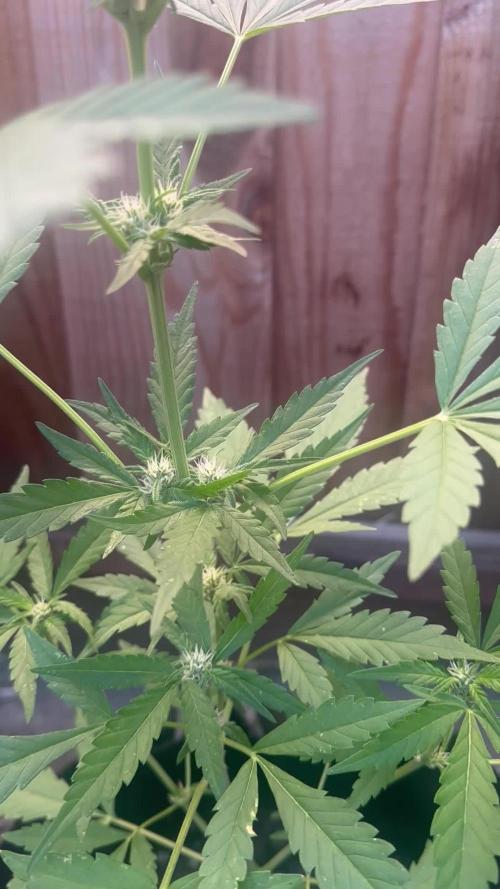
Damn, this plant is different from all the other FB autos I grew, smells nice, buds look like they will be stupid frosty. Gave it another bit of flower girl, and only r.o water for the rest of the grow!
Likes
13
Share

@Green_Zyphoria
Follow
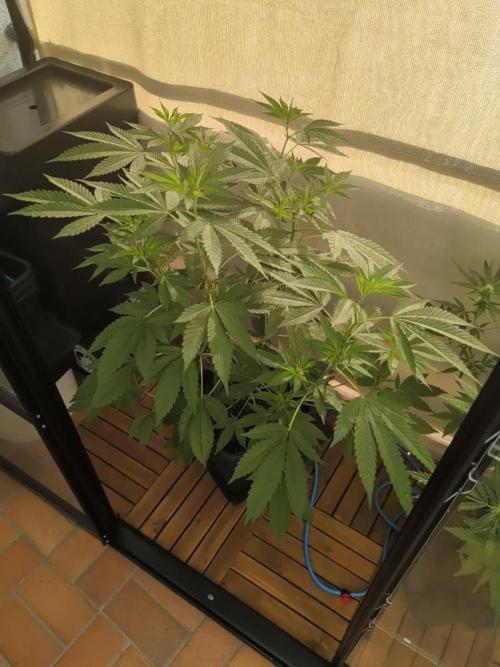
Day 56 update, and man, the summer heatwave is officially pushing us to the limit! Inside the greenhouse, it’s getting incredibly hot, but the Gorilla Melon is handling it like an absolute champ. No real signs of heat stress yet, though you can tell she is working hard. Honestly, the AutoPot system is the real MVP this week; with these soaring temperatures, the constant water supply from below keeps her perfectly hydrated without any scary dry spells.
To keep the canopy nice and even, I went ahead and did some more topping on the taller shoots to balance out the height before she gets any bigger. On the pest front, we had a little drama: the ChrysoCards unfortunately baked in the intense heat and didn't survive. Lesson learned! To fix this, I released a fresh batch of live green lacewing larvae instead. I just put them right onto the main branch junctions on the plant. It’s working beautifully—the thrips are visibly retreating, and I’ve barely seen any new damage on the big fan leaves this week. Slowly but surely, we are winning this battle!
Likes
2
Share


@Viccrazyweed
Follow
Saturday 25 February;
The big one keep growing nice and healthy, the tiny has started growing but its like a week delayed, if both born at the sane time maybe the tiny one is gonna produce less, the shock of repotting has punished her a lot… in still worried about her…
Anyway im still super excited with this project
Custom 0.8 m2 tent, x2 Solux 50W LED, Canna profesional soil 5% perlite
Thank you Super Sativa Seed Club
To create Auto Purple OG Punch we crossed our feminised Purple Punch with an autoflower OG Kush. The original Purple Punch is a cross between Larry OG and Grandaddy Purple, illustrious and stable indica dominant THC-rich heavyweights!
The total grow cycle from autoflower seed to harvest is a short 9 weeks. You will be rewarded with a large yield of sticky resinous buds, up to 600g/m2 indoors. If you’re looking to grow a high quality indica auto made with cannabis cup winning genetics you will love Auto Purple OG Punch. THC content is always up-to/around 20%. Auto Purple OG Punch effects are intense, euphoric and relaxed. She also contains around 1% CDB which contributes to the very smooth, chilled smoke. Expect a mouthwatering blend of sweet tasting candy, dark fruit and hints of spice. A real connoisseur cocktail with powerful effects!
She normally reaches around 1m tall. But in optimised conditions with LED grow lights you can see occasional monster plants up to 2m tall with XXL yields. Auto Purple OG Punch is easy, potent and heavy yielding indoors. She also delivers well outdoors - such as the balcony or garden.
Auto Purple OG Punch is a perfect, powerful strain for a quiet relaxed day. The calming indica body effect is very satisfying and de-stressing.

Likes
5
Share


@Krissci
Follow
Didn't realize I didn't start a diary for this.
Very lazy...
Overall plant seems happy..
This week and going forward mostly LST and light fan leaf defoliation.
Likes
8
Share


@imSICKkid
Follow
Watching her get frosty as hell. Besides her great structure, the trichome production this girl has is insane. She would be a great plant to press.


Processing
Likes
13
Share


@Grownewgenetics
Follow
we love to open a new diarie for the Epic Genetics seedbanks, we are growing on week 4 two Strains for these company
epical widow and spigol field the two are the oldest on these round and i have to say a really slowly Grow comparated to all the seedbank tested on these round.
we have topping the two , one for each strain and we let another two growing natural, we will do a lst and let's see how they Grow.
Likes
2
Share


@Ign33l
Follow
Had to strip her to get to know where she was growing.
Cut some branches that were overlapping and also tried to shape her a bit. Still i think there are many branches growing so i have to wait for it to grow; now it is 3 months with:
- Veg lights
- grow nutrients
The pot i think it is 1 litter; but will feed her with 1 litter every week.
All Veg phase will last 4 months - 16 weeks
Will feed with water only for 1 week in:
- week 5
- week 10
- week 16
Then on week 17 you will start grow phase.
Grow phase will last 8 months - 32 weeks.
I will water water only in weeks:
- week 21
- week 26 - Flush
- week 28
- Week 33 - Flush
If she grows too much: re-pot on week 17


Likes
175
Share


@love_2_grow
Follow
Day 1 Flower (Day 43)
Wooohoooo! First day of flower! I decided to flip both plants after all. The thing is that I will be fully vaccinated against Corona by mid-July, and when that is done, I'm off on vacation. After 1,5 years of this pandemic crap, I'm more than ready to travel again, to see the world, meet new people, and have new experiences.
So yeah, this strain is supposed to be a fast flowering strain (45 days!), so mid-July should do it.
I switched to the Flower Induction light recipe in my main tent, and I will let that recipe run for some days before I switch over to the regular Flower recipe. The tiny tent has nothing so fancy and was switched to a regular 12/12 schedule.
Speaking about lights. That cheap budget light that I bought for my veggies when I moved in my ViparSpectra light into the tiny tent broke down after only two days. So much for trying to save a bit by buying something cheap. I've already sent it back and won't get another light as I think the tomatoes and chilis are ready to move outside. I'll wait and buy this fall instead, but I won't go for the cheapest light I can find then. lol
I was foliar feeding the girls with filtered compost tea while they were still sleeping. I only spray when the lights are out to avoid any leaf burns.
A few hours later, after the girls woke up, I gave them each around 3 liters of unfiltered pH 6.2 compost tea. I FINALLY remembered to pH the compost tea. Woooooo!!!
That was all today.
Day 2 Flower (Day 44)
Today was a really busy day. I opened the tents, took pics, closed up the tents. Phew! Exhausting.
Day 3 Flower (Day 45)
Alright, today was a bit more work than yesterday but still fairly relaxed.
I watered the girls; the left one got 3 liters, and the right one got 4.5 liters of pH 6.0 water.
I noticed a bit of light bleaching on the girl in the small tent, so I turned down the light a bit and increased the distance to the canopy.
It is very tight in there, but that is expected with such a small tent.
I will need to raise the light more in the future, and I'll probably have to resort to a bit of MacGyver-ism to make it work but that's a problem for a later day.
The girl in the main tent has a bit of an uneven canopy where the left side is taller, so I raised the left light as the light level was around 1300 PPFD.
I also super-cropped half a dozen branches to slow them down and let the rest of the canopy catch up. It's probably the last training I do before the girls go into flower.
Finally, I did a bit of defoliating by removing a few leaves that weren't getting any light low down on the girls.
Day 4 Flower (Day 46)
Fuck. Disaster struck. I opened the main tent today and found that the CO2 bag had fallen down and broken one of the main branches. That one branch is responsible for about a quarter of the canopy, so losing it would suck.
I got busy right away taping the broken branch and used some old chili stalks to support the branch further. I also watered it with around 1.5 liters of pH 6.5 water hoping that it will be beneficial.
Now, all I can do is wait and hope for the best.
For those of you who have been following this diary, you already know that I dislike this CO2 bag because it smells like shit. Literally. Now though, I really hate this friggin shit bag and its weird hanging contraption that is as shitty as the smell from the bag.
Day 5 Flower (Day 47)
So far so good. Last night, I checked in on her a couple of hours after I taped the broken branch and the left side of the canopy was already back up with no drooping leaves or branches. YES! However, it was still nerve-wracking to open the tent today but she looked just fine. Fingers crossed that it holds.
Naturally, I don't want to disturb her much right now so all I did today was to water her and carefully LST a couple of branches that got messed up yesterday. I gave her 2 liters of pH 6-0 water and 1 liter of water to the girl in the small tent.
Speaking of the small tent. There's some light bleaching on the tips of the leaves closest to the light so I turned down the dimmer even further down to 40%. I need to try to raise the light but can only gain another 5-7 cm. The tent is soo tiny lol. Will be interesting to see if she will even fit in there after the stretch is done.
I also raised the lights in the main tent as the canopy was getting a bit close.
That was it for today.
Day 6 Flower (Day 48)
Chill day today. All I did today was to water the girls 3 liters each of pH 6.5 water.
Day 7 Flower (Day 49)
Today was the end of a rather tumultuous first week of flower. It looks like I got lucky, though, and that the branch on the right girl will survive. She is growing strong and loving life. I am hopeful.
She is a big girl and drinks a lot, so I'm watering her every day (around 10% of pot volume), and I gave her 3 liters of pH 6.4 water today. The left girl didn't need any, so I just measured both girls, snapped some pics and videos before zipping up both tents.
The left girl is 50 cm tall (12 cm increase in a week), and the right girl is 77 cm tall (31 cm increase in a week!)

Likes
13
Share


@russrahl
Follow
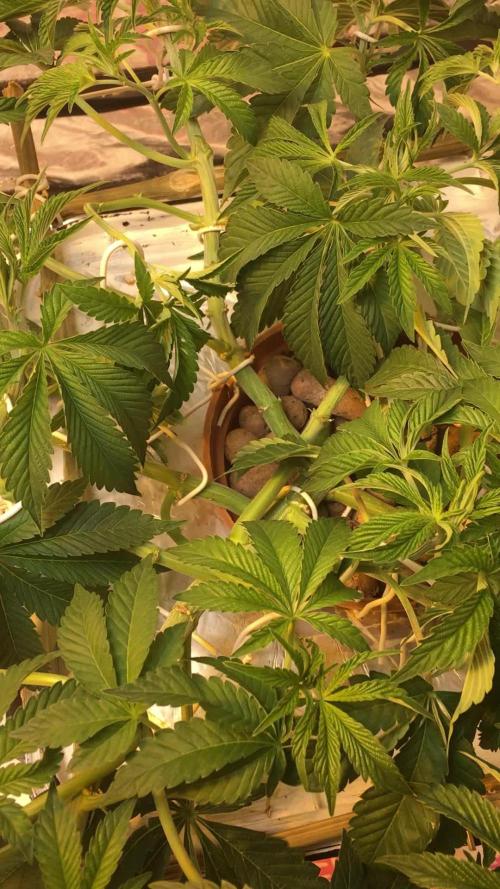
Everything went good this week, having trouble keeping the humidity up but I got some plans to rectify that soon. Lol roots are all down into the buckets now except the runt of the litter in the back corner. But we are only a week in so it’s still early for her. Just been feeding plain water ph’d at 5.8 with some UC Roots added. Been scooping a cup of water daily from there bucket and pooring it over the rock wool and pebbles back into the bucket just to keep things wet and the roots moving. They are sitting around 5000 lux and seem to be enjoying it. I’m just using a phone app with a paper diffuser to test it but it seems to be pretty good and didn’t cost much. Well that’s about it for this week, be back again next week, Cheers💨


Likes
96
Share


@MrCOCO
Follow
Hi... Everything is going very fast which makes me happy of course🍃🍃🍃 ... This week there was defoliation and LST training... 🍃🍃🍃 Happy growing 🍃🍃🍃