


Likes
Comments
Share


@Bak2Blk
Follow
Yall see the yellowing of the leaves closest to the top? I've since switched my nutes over to Tiger Bloom and I've thrown in some Cal-mag into the mix. They'd gotten kinda droopy but since I changed their nutes up a bit, they've been perky af even tonight as it's getting close to lights out. I switched them over to flower on Sunday. They're already starting to stretch in just a few days which tells me that they're feeling much better. My last video... even though it's not loaded correctly is from tonight. It's 11pm, lights are out in an hour and they're still perky. Love it!! 😍😍😍
4/6/23: Yall.... the plant in the back right hermied!!! OMFG. The 2 tallest branches had seeds on them... just popped up because they weren't there yesterday or at least I didn't notice. The seeds were concentrated at the top, I didn't find any on the rest of the plant but with as bushy as they are, there may be more. I cut those 2 tallest branches down to below where the seeds were but I will be watching that plant and the rest like a hawk for more seeds. I didn't find any on the other 3 plants but still I'm saddened. Unsure of why this one plant is hermie'ing. Smh

Likes
1
Share


@Ertomid
Follow
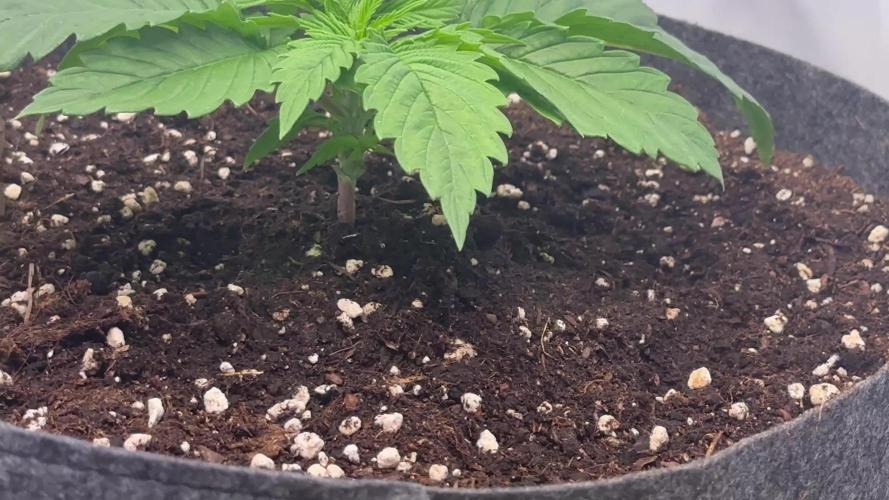
Pistils are becoming orange. I lower the temperature to test if the buds will turn purple/darker.

Likes
Comments
Share

@CHEF-KOCH
Follow
Danach habe ich leider vergessen Fotos zu machen beziehungsweise auch Videos deswegen folgt nach Woche zwei Woche vier

Likes
17
Share


@Chucky324
Follow
Hello. This is the end of week 7 and the beginning of week 8 of flowering.
I'm a bit bummed about this grow. I've read that you just need to force a plant to flower, that's 12 hours of light and 12 hours of dark for the first 3 weeks (I had a tent inside the greenhouse) and then put it outside and it will continue to flower. I thought that was amazing, so I wanted to give it a try. Well, here we are at the end of the 7th week and it looks like the plants are going back into veg. Last year I didn't do up the tent for the last 2 weeks and everything was fine so I thought I would give this keeping it open after the 3rd week a try. Now I know. I can always turn it into hash, maybe dry ice hash.
Here's another reason I'm bummed about this grow. I've got spider mites. I'm doing my best to knock them down with my hypochlorous acid. I'm spraying twice a week, but had some yellowish looking leaves, I reread the article (I put up a pic of it a few of weeks ago) and found I had to rinse the indoor plants. So after I sprayed the 1/2 strength acid I waited 10 minutes and rinsed with water. Today I can see more mites than when I sprayed before. So next time I'll wait till the 1/2 acid mix is dry before I rinse the leaves and see if that knocks them down more.
If you don't try new things you don't learn. That's what this grow is about, to see if the plants can still keep flowering at my latitude and now that I have mites, to see if the hypochlorous acid will work without killing the plants. Yes, I'm 60 something and still learning. 😃
Be Great.
Chuck.


Likes
29
Share


@TheCannaProphet
Follow
------------------------------------
~SEEDSMAN PEYOTE GORILLA~
------------------------------------
Peyote Gorilla is a cross of Gorilla Glue #4 (Chem Sister x Chocolate Diesel) and Peyote Purple, a colorful phenotype of Bubba Kush. The potent, medicinal effect of the Gorilla meets the stimulating and uplifting high of the Peyote Purple.
With a flowering time of around 70 days Peyote Gorilla has a typically Indica structure, medium-sized with large, broad leaves. Yields are exceptionally good; indoors growers can expect to yield between 500 - 650 gr/m2 while outdoors as much as 1500 gr/m2 can be realized. Resin levels are very high and this means that it is very suitable for making extracts and concentrates with.
This strain's scent is sour with lemon, petrol, earthy and woody notes and these properties are reflected back in the taste. THC production is very high at between 22 - 26% with CBD at just 1%. The effect is a very potent, uplifting high which gradually evolves into a physically relaxing state that will be almost certain to ease any aches and pains.
__________________________________________________________________________________________________________________________________________________________________________________________________________________________________________________________________________________________________________________________________________________________________________________________________________________________________________________
-Strain Characteristics-
BREEDER/BRAND: Seedsman
PRODUCT TYPE: Seeds THC
GENETICS: Gorilla Glue #4 (Chem Sister x Chocolate Diesel) x Peyote Purple (Bubba Kush purple pheno)
VARIETY: Mostly Indica
FLOWERING TYPE: Photoperiod
SEX: Feminised
THC CONTENT: 22 - 26%
CBD CONTENT: 1%
YIELD: Indoor: 450-600 g/m2; Outdoor: 1500 gr/plant
PLANT HEIGHT: 80-160 cm
GROWS: Indoors, Outdoors
FLOWERING TIME: 70 days
HARVEST MONTH: September
MEDICAL CONDITIONS: Fatigue, Insomnia, Pain, Stress
TASTE / FLAVOR: Berry, Earthy, Fruity, Petrol, Sweet
EFFECT: Euphoric, Powerful, Relaxing, Uplifting
_________________________________________________________________________________________________________________________________________________________________________________________________________________________
_________________________________________________________________________________________________________________________________________________________________________________________________________________________
THE SETUP:
~Planted into Jiffy Peat Pellets that were hydrated with de-chlorinated water with SuperThrive added then ph'd to 6.0 @ 80℉
~Grown 100% organic in 10g fabric pots with Mother Earth 70/30 Coco/Perlite medium amended with 2tbs/g of Down To Earth 4-4-4 / 2 cups/g of Earthworm Castings / 1tbs/g of Dr. Earth Flower Girl 3-9-4, 1tbs/g of Dr. Earth Bat Guano, 3/4 cup of Down To Earth Azomite and 1 tsp/g Down To Earth Fish Bone Meal.
~24hr light cycle during Germination / 19/5 light cycle for Vegetation and 12/12 for Flower
~Straight water ph'd @ 6.2-6.8 when needed and weekly Compost Tea's.
__________________________________________________________________________________________________________________________________________________________________________________________________________________________________________________________________________________________________________________________________________________________________________________________________________________________________________________
Weekly Updates:9/20- 💥BOOM!💥 Week Six of flower is here and my girl's in high gear, stacking her flowers and pumping out trichomes!
Today I watered her with 1.5g de-chlorinated water with 5ml/g of Botanicare CalMag+ added, then ph'd to 6.2 @ 72℉. I turned her pot and plucked a couple of yellow shade leaves...the basic daily maintenance.
9/22- I didn't water her yesterday as she looked great and was 'praying' hard. Today she was given 1.5g of de-chlorinated water which was ph'd to 6.2 @ 72℉ which I gave her through her drip pan (bottom chuggin) and I also gave her pot a turn.
She continues to pile on the trichomes and is taking on a exquisite purple hue to her flowers! She is definitely one of the most photogenic cultivar's I've grown and is looking lovelier by the day! 😍
9/24- We're getting close to wrapping up Week Six of flower in a couple of days and she'll be around four more weeks from finishing, with the most exciting weeks yet to come!
I didn't water yesterday and today I went ahead and Top Dressed her with 2 tbsp/g Dr. Earth Flower Girl 3-9-4, 1 tbsp/g Dr. Earth Gold Premium 4-4-4, 1/2 cup Down To Earth Bio-Fish, 1/3 cup Down To Earth High Phosphorus Bat Guano and 2 cups of Worm Castings.
I watered in the Top Dress with 1.5g of de-chlorinated water which was ph'd to 6.2 @ 72℉ and let her enjoy her meal! 😜
9/26- After her heavy watering on the 24th I didn't water yesterday and when I checked her today at 'lights on' and she still had some weight to her pot and her leaves were praying hard so I held off on watering today and will hit her tomorrow with her usual 1.5g watering.
~Thanks for stopping in! Things should be getting a lot more interesting in the coming weeks...Stay lifted and be Blessed! 😎🙏~

Likes
43
Share


@Jack_Greenstalk
Follow
I made a few big mistakes. most notably not flipping early enough. I vegged til 13 inches hoping theyd stretch to 26-30 inches and have adequate space away from light, well I underestimate them way too much! despite stretching a ton, these girls were both amazing to grow. bounced back to every training, with a lot of lst and topping and defol, they never stayed down long. they eat a lot, and once i got my feed dialed in they grew healthy and strong thru harvest. i chopped at all milky trichs, decided to harvest all in one go. so lowers have a tiny clear trich but mostly milky, tops are fully milky and after dry have a tiny touch of yellow or amber at tips. effects are ranging from 70-30 sativa (on lowers with clearer trichs) its high energy. very distinct feeling of relaxation all thru body from neck down feel loose in joints and relaxed. in mind i feel very sharp, focused and productive. at the same time i noticed i was more creative. i teach tennis classes and i was better able to describe what I was trying to convey to my student who is a teen, creativity helps. both our games improved, definitely a nice productive smoke, tastey as hell in vape or bowl. grinds up and smells like blueberries soaked in gasoline, topped with a big squeeze of lemon and dash of spicey red chili peppers! ooooh eeee! this stuff is amazing, and the bubble hash i spun looks like its going to be top quality once it dries! will post more pictures of buds once they cure up a bit more. should mention as a hash / rso maker, i also pulled over 1,000 grams of wet fan leaf, and a few hundred grams of trim which yields great medicine not accounted for in harvest #s00


Likes
4
Share


@weed_gastro
Follow
day 42: LOTTA leaves, had to defoliate 2-3 times.
they started to show their first pistils a couple days before the Ayahuascas, hope I can do a harvest before May,(the Peyotes) but it seems really tricky..unfortunately I need to leave them for a week in April. I'm pretty scared to leave them alone at the end of flowering...
Day 43: do you think the leaves on 2 plants might be too dark green? Thanks!
day 46: defoliating
Processing
Likes
68
Share


@Tazard
Follow
Beginning of the 10th week of flower. Shouldn’t be too much longer now. I will add some bud and trich pictures this week.

Likes
28
Share


@SmokingTiki
Follow
No fertilizer this week. I harvested the Apricot and the Pound Cake. I will wait one more week for the Orange Sherbet because it doesn't seem ready even if it's in the Fast Buds harvest range. This week should be the last "flowering" week, next ones will be the harvests. I don't want to add another flowering week just for the Orange Sherbet, there will be nothing to see that will not be included in the harvest.
During half of the grow, the weather was really bad, especially for the summer period. The worst weather was during the vegetative phase. The plants didn't receive enough light which resulted in poor roots and leaves development. Because of that, the plants didn't have the chance to grow nice buds even if the sun was there during most of the flowering phase. Last summer, I grew a Tropicana Cookies (also from Fast Buds) in a tiny pot at the exact same spot and had better results despite the smaller pot. I didn't record the sun for that year but the weather was better from what I remember. I'm disapointed by the weather but cannot blame the plants. You cannot expect beautiful plants and buds if they don't have light 😞 In the end, my summer grows are more like bonus grows (my main grows are under a light in the winter) and I make them just for fun and to be able to taste new weeds without too much investment. So, mission accomplished 😎
Parameters :
-------------------------------------------
Humidity range : 30-70% depending on the sun
Temperature range : 22-30°C depending on the sun
SUN Average : sunny
Likes
27
Share


@KanOrganics
Follow
We made it to curing!
I chopped her about 1.5 weeks ago, she dried well, and has been curing for a few days now.
She could have went a few more days, but due to a PM outbreak in another tent, I wanted to get the whole grow room bleached for the next round, and wasn't taking any chances. We had a little bit of amber on non-leaf flower trichomes, so good enough!
This plant was a beast. The second best producer out of the a lineup of 9 this round. That would likely be the Kush genetics in her, and to top it off, she smells wonderful. Sweet and floral. We haven't sampled any yet, and infact, I had to quit smoking, so we'll see what my father has to say in a couple weeks when done curing.
After drying and partway through curing, we have approximately 19g of flower. We did a quick and rough trim with a machine trimmer, as we had 9 plants to take care of all at the same time, and didn't want them exposed to dry too long.
I give this plant the highest rating out of any indoor plant I've grown over the 2 years I've done indoor, from a growing aspect. I'll post the smoke report when it is done cured, but for now, 10/10 -- would recommend!

Likes
73
Share


@LazLow
Follow
Halfway through week 3. Both the girls have been transplanted to their final 5 gallon smart pot home. Soil medium is no longer a Light Warrior/Ocean Forest blend; it’s just Ocean Forest now. I don’t think that soil will be too hot at this point. Both plants are on their 4th node, I want to top at the 6th node so hopefully next week. Plant 2 has far more internode spacing even though both plants the same distance from the light. Plant 1 is developing 4 leaves so the fan isn’t symmetrical. Otherwise healthy. Leaves were droopier than usual today which might be transplant shock or I might have overwatered their new homes. Will add more to this week at the end. Love feedback!

Likes
85
Share


@Tropicannibis_Todd
Follow
Start of day 28 ...... Nov 6 Flowering
Check out the full grow video on latest weekly update
Super Exceptional Growth Daily
Still adjusting LST when needed and leaf tucking.......
Water Only when needed but its drinking more every otherday and adjusting lights when needed......
Rain Water Only .......
( DAY 33 AND IT SHOWS ZERO DEFICIENCIES ) IM ALSO DOING VERY LITTLE, SLIGHT DEFOLIATION
Sidenote : Being that's it's my first autoflower I'm super happy with it overall growth and surprised on how quick they are going from veg to flower , NL 2 on day 21 and NL 1 on day 26 .... I will say this, i really am liking the speed and vigorous growth of this northernlights autoflower in general and becoming a huge fan....
Hope you enjoy my growlog .......

Likes
57
Share

@squalino
Follow
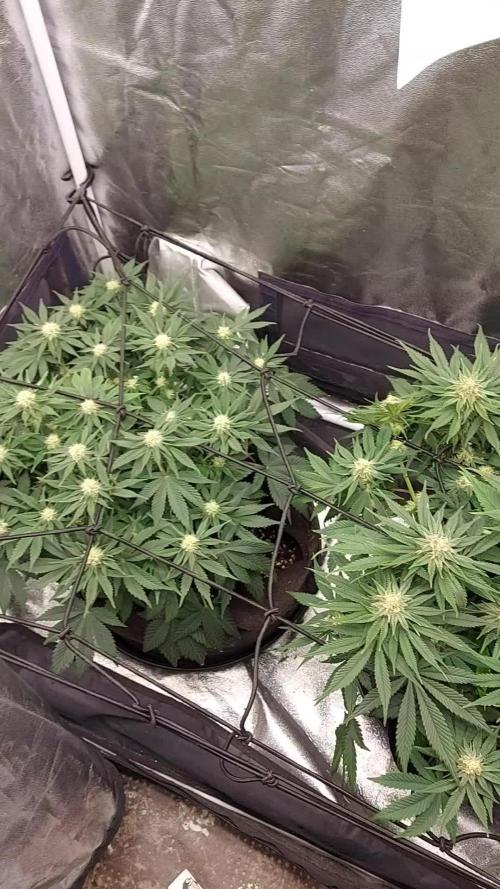
🌿 Journal de Culture : Cherry Cola (Auto)
Date : 18/03/2026
Âge : 55 jours (Semaine 8)
Phase : Pleine floraison (Explosion des trichomes)
📊 Paramètres de mon espace
Température : 24,5°C (Jour) / 20°C (Nuit).
Humidité : 50%.
Éclairage : Pure LED 240W réglé à 75% d'intensité, positionnée à 73 cm.
💧 Nutrition & Arrosage (pH 6,3)
Plante #1 (La Grande - 40 cm) : 1,5 Litre d'eau + 5 ml de PK 5-8 (BioTabs).
Plante #2 (La Petite - 30 cm) : 1 Litre d'eau + 2 ml de PK 5-8 (BioTabs).
📏 Travaux & Évolution (SCROG)
Retrait du LST : J'ai enlevé les fils rouges de palissage. Les branches sont maintenant bien rigides et la structure est parfaitement fixée. Le LST est une réussite totale.
Mise en place du filet : J'ai installé le filet (type SCROG) pour bien soutenir les têtes qui commencent à s'alourdir et homogénéiser la canopée.
🔍 Mes observations
C'est là que ça devient sérieux ! En manipulant la Plante #1 pour l'installer sous le filet, j'ai été surpris : mes doigts ressortis complètement collants. La production de résine est massive.
Niveau odeur, c'est un régal : ça sent déjà très fort le sucré, comme un bonbon. On a bien envoyé le profil terpénique de la Cherry Cola qui se met en place. La santé est au top, les feuilles sont d'un vert parfait et les têtes commencent à prendre une belle densité.
on peut remarquer que quelques feuilles commencent à perdre un peut de vert foncer très bon signe cela veut dire qu'elle puise l'azote des feuilles .et quelques légères pointes brûlées mais rien d'inquiétant cela me le fait a chaque fois lors de la transaction. mais à surveiller quand même.
22/03
ddonné 9,5 litres d'eau PH 6,3 .surface très sec .
merci à tous et à bientôt MUSIQUE DIAPO FAST BUD
Likes
59
Share


@Jsammy09
Follow
8-26 (Day 70)- Have the feeding corrected from last week now and everything has been pretty stable. Not had any real issues with the temps or RH, the dehumidifier is keeping things perfect. I have been checking the back left plant to see where the trichomes are and they are still all pretty much clear. That plant seems to be a bit ahead of the others, but will just continue to monitor and feed regularly (Around 4-5 gallons a day to the res). Monday will be switching to the full tilt instead of the bulky b. These girls are so sticky and sweet smelling. I am super excited for these girls to finish and see how I've done quality wise with my first grow and already looking forward to the next run and correcting some mistakes ive made this run.
As always any tips and recommendations always welcome!


Likes
33
Share


@Roberts
Follow
Cali crasher is coming down next update. She is under the Hortibloom Solux 350 at 50 percent right now. She is waiting her turn in the cannatrol. Everything is looking good. She has some nice big frosty colas on her. See you in a week for the harvest. Thank you Hortibloom, and Doctor's Choice Seeds. 🤜🏻🤛🏻💪🏻❄️🌱
Thank you grow diaries community for the 👇likes👇, follows, comments, and subscriptions on my YouTube channel👇. ❄️🌱🍻
Happy Growing 🌱🌱🌱
https://youtube.com/channel/UCAhN7yRzWLpcaRHhMIQ7X4g

Likes
8
Share


@CanabisLoverHobbyGrower
Follow
Been quite busy so missed a week on here... everything is looking great both responded really well to being topped not much else to say,.. defoliated abit of the bottoms after this video but yeah other than that roll on next week 👌