


shorts_status_processing


@Reforced
Follow
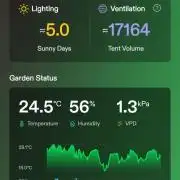
Been trying to keep the humidity between 40-60%. Likely going to purchase a humidifier.
Plants seem to be loving the Elite Nutrients though.



@Chubbs
Follow
420Fastbuds-Week 10
Cinderella Auto
What up grow fam weekly update for these two stinky girls. Did a defoliation taking off almost all the fan leafs and let them swell up and rippen before giving them the chop this week. Seeing 70/30 clear to amber trichs. They smell super super pungent and sticky as all get out. Excited to get the trimmed,hung to dry and start this curing process. All in all Happy Growing


shorts_status_processing


@Greenthumbguru
Follow
First grow
running three
autos in a 2x2x4
in 3 gallons
prolly should only did two
but i plant on heavy lst. As much as possible so wish me luck yall


@Tropicannibis_Todd
Follow
💩Alrighty then Growmies We Are Back At it 💩
Well folks we just finished up the last run and so we are back to do it all over again 😁
So what do you say we have some fun 👈And what we got here folks is a Strawberry Blast 🍓 🍓 🍓 🍓
Strawberry 🍓 Gorilla , Strawberry 🍓 Banana 🍌 and there new release 🍓 Ztrawberriez 🍓 from FastBuds
And we also got Strawberry 🍓 Cola from Exotic Seeds
👉 Well we are now around day 28 and well growmies its been a ruff week 👈
We had a huge storm roll in and we lost power for 4 days , this is where I had to get creative 😳 it's wasn't the best but they all came out out of it pretty good 👍
So 2 out of the 4 are preforming really well into the preflowering , where as the other 2 are taking there time 👈
So this week I've started her nutrients regiments 👌Just need to remind myself to take it easy 🤔
FC4800 from MarsHydro Lights being readjusted and chart updated .........👍I've added a RU45 to the mix 👍
www.marshydro.ca
👉I used NutriNPK for nutrients for my grows and welcome anyone to give them a try .👈
👉 www.nutrinpk.com 👈
NutriNPK Cal MAG 14-0-14
NutriNPK Grow 28-14-14
NutriNPK Bloom 8-20-30
NutriNPK Bloom Booster 0-52-34
I GOT MULTIPLE DIARIES ON THE GO 😱 please check them out 😎
👉THANKS FOR TAKING THE TIME TO GO OVER MY DIARIES 👈
Would you like to hang with the growdiary community 👉 https://discord.gg/gr4cHGDpdb 👈


@nonick123
Follow
Día 43 (24/02) Riego con 400 ml H2O EC 0,45
Está reaccionando muy bien al Lollipopping y poda de bajos 😁
Día 44 (25/02) Riego con 350 ml H2O EC 0,45
Se empieza a formar los tricomas! 😍
Día 45 (26/02) La altura está sobre 60 cm.
¿Debería haber reducido en 1 una semana el vegetativo? Yo quería plantas pequeñas en SOG 😂
Riego con 400 ml H2O EC 0,45
Elimino algunos brotes de la mitad inferior de la planta que no van a formar buenos cogollos
Día 46 (27/02) Riego con 350 ml H2O EC 0,45
Floración a todo tren formando los erizos 💥💨😁
Día 47 (28/02) Riego con 350 ml H2O EC 0,45
Día 48 (01/03) Riego con 350 ml H2O EC 0,45
Preparación del PK Booster Compost Tea
Día 49 (02/03) Damos el stretch por terminado ya que estamos en día 21 de floración
Lollipopping y defoliación del día 21 para potenciar la floración!
Aplicación de 0,5 Litros de PK Booster Compost Tea de nuestros increíbles amigos de BIOTABS
🚀 FastBuds 15% DISCOUNT code "NONICK" 2fast4buds.com @fastbuds.official
💦 BioTabs 15% DISCOUNT code "GDBT420" biotabs.nl/en/shop/ @biotabs_official
🌱Substrate PRO-MIX HP BACILLUS + MYCORRHIZAE @promixmitch @promixgrowers_unfiltered
💡2 x Mars Hydro FC1500 EVO Led Grow Light (2024 NEW FC 1500-EVO Samsung LM301H 150W LED) - https://marshydro.eu/products/fc1500-evo-led-grow-lights/ - https://www.amazon.de/dp/B0CSSGN5D8?ref=myi_title_dp


@Budha420
Follow
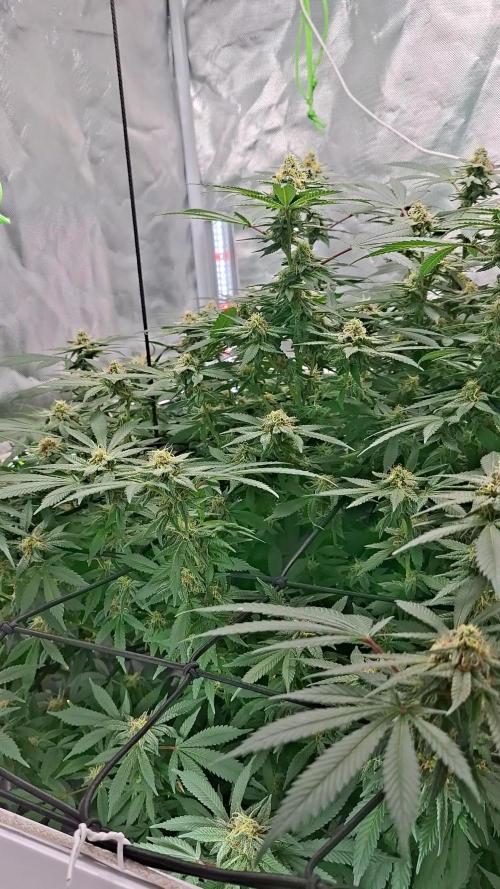
Day 56 for runtz, gonna give bloom overload since the girls loves it so much, nothing much else to report. Very late flower considering these have 30-40 day veg🤔
nts, left to right. ppm5.5 ph6.3 ppm 3.5 ph 6.4 ppm 3.2 ph 6.4 -> drop nutes n ph



@Kirsten
Follow
17.3.25:
So I watered with 2ltrs of dechlorinated water PH'd to 6.4 with 4ml Xpert Nutrients Cal-Mag amino acids.
I have really overdone the nutrients, I got carried away 😅
To try and rectify the situation, I've cut everything out except Cal-Mag amino acids.
I will try to just stick to this with some Biosys, but I'm running out of that now, too.
Anyway, with Or Without, I'm sure it'll balance out. Fingers crossed 🤞🌱✌️💚
21.3.25:
The plants are all getting plain water PH'd to 6.4.
I have removed all nutrients and water every plant 1-2 litres daily.
I would probably have continued using the Xpert Nutrients Cal-Mag amino acids.
However, the NPK is 4-0-0. So, whilst it's great stuff, I don't need the extra nitrogen.
I add Ecothrive Biosys to some of the waterings.
Unfortunately, I have very nearly run out. So I'm using it on selected plants, which I think could use a bit of TLC.
I checked the soil PH of all pots, and it was bang on 7.0 for each one.
Substrate temperature was 19°C across the board.
The soil moisture meter said the soil was dry in every pot: I chalk that up to being my medium, as it's very aerated and of low density. Also, I never water to run off. So I'm unconcerned about that.
All being said, I'm hoping to see some of the plants stored nutrients be tapped into and try to balance things back out.
They definitely have had a little too much feed. It does seem like apart from the leaves, they are all looking great!
The plants are drinking heavily, and I watered 4ltrs to Do-sì-dos, 2ltrs to Pink Mist, 3ltrs to Bubble Kush, and 3ltrs to Gorilla Cookies.
The pots had already completely dried out. So I'll definitely have to up my waterings.
The colas are getting fatter, and ripening up slowly.
Thanks for hanging out 🍃 ✌️ 💚 🙂


@SkunkyDog420
Follow
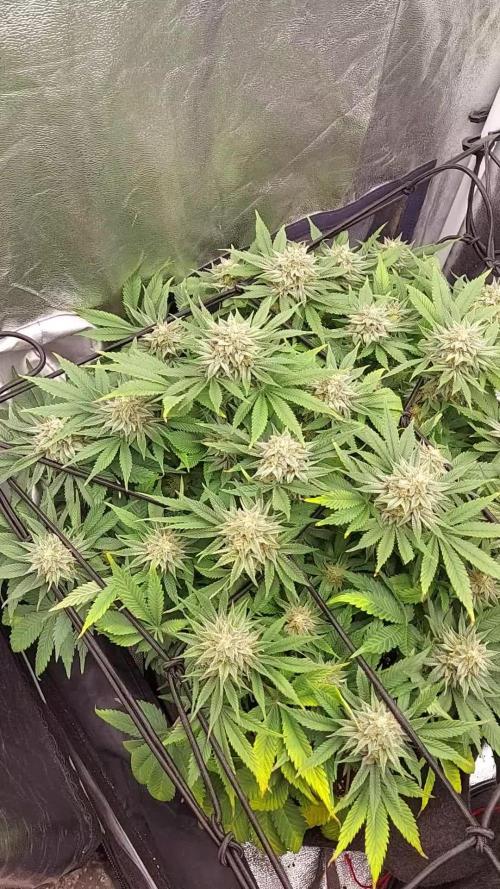
Hallo zusammen 🤙. Habe heute das letzte mal gedüngt ab Tag 78 nur noch Wasser 2 Wochen lang.


@squalino
Follow
🌿 Journal de Culture : Cherry Cola (Auto)
Date : 06/04/2026
Âge : 74 jours
Phase : Séchage (Plante #1) / Maturation finale (Plante #2)
? Plante #1 (La Grande) :
Le moment de vérité
Chronologie : Mise dans le noir total le 4 avril pour stresser la plante et booster la résine, puis coupée et mise en séchage le 5 avril.
Résultats à l'humide : 150 grammes (nettoyée). J'estime finir à environ 40 grammes sec.
Mon avis honnête :
Je ne vais pas mentir, je suis encore déçu par la Cherry Cola niveau production. C'est la deuxième fois que je la tente et le constat est le même : elle fait énormément de sites de têtes, mais elles ne prennent pas de masse, elles ne "gonflent" pas.
Qualité vs Quantité :
Le ratio temps passé / rendement n'est pas au rendez-vous. Par contre, la résine est là en abondance. C'est du givre pur, elle va sûrement mettre une sacrée claque.
Arôme :
Super agréable. Ce n'est pas une odeur agressive, c'est juste ce qu'il faut de sucré avec des notes de baies. C'est vraiment réussi sur ce point.
Note provisoire :
7/10. J'attends le test de goût la semaine prochaine pour trancher définitivement.
📏 Plante #2 (La Petite) : La relève
Taille : 35 cm.
Paramètres : Inchangés (24,5°C jour / 21°C nuit, 50% humidité, LED à 100%).
Arrosage :
0,75 L d'eau aujourd'hui, juste pour rafraîchir la terre en surface et maintenir une légère humidité.
Observations :
Elle est magnifique visuellement. Les têtes ont l'air un peu plus gonflées que sur la première, et niveau résine, c'est encore un cran au-dessus de la n°1 (ce qui paraissait pourtant difficile !). Je reste réaliste : même si elle est superbe, elle ne fera pas de miracles sur le poids final.
🔍 Analyse de l'Éleveur
Structure des têtes :
Sur les gros plans, on voit bien que les fleurs sont composées de calices très "aérés". C'est ce qui explique le manque de poids : il n'y a pas ce cœur dense qu'on trouve sur d'autres variétés. C'est une structure très "Sativa" dans l'âme malgré le côté compact de la plante.
L'abondance de trichomes :
Les photos montrent une plante qui semble avoir été saupoudrée de sucre glace. C'est exceptionnel pour des extractions, mais frustrant pour ceux qui cherchent de grosses "collas" bien lourdes.
La sénescence finale :
On voit bien sur les photos de la n°1 avant la coupe que les feuilles étaient arrivées au bout de leur vie (jaunissement propre). Le rinçage a été parfaitement exécuté.
La n°2 et sa résine :
Le fait qu'elle soit encore plus résineuse que la n°1 est bon signe pour la puissance. Elle profite bien de ses jours sous la Pure LED à 100%.
08/04
apport de 1 litres d'eau avec 0,4 ml pk 5-8 biotabs PH 6,3


@NONSENSE
Follow
Good day to every one.
The plant feeling like it should be, flowering without any problem.
I really like the genetic.
Hope to finish within 2 weeks.
Look at these beautiful and long inflorescences, which are covered with crystals every day and pull their antennae to the sides.
trichomes change color.
The aroma is tolerable and I am not using the filter yet.


@smoking_hills9
Follow
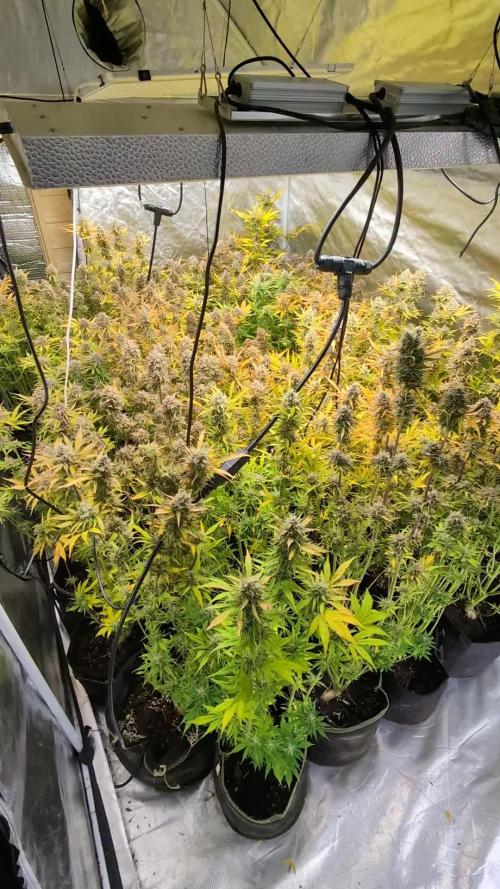
Fantastic grow. Very happy with all 3 strains, all just perfect. Super stinky, very frosty, and as always tones of buds . Now time to cut and dry.



@Jmaninthemidde420
Follow
Plants are all transplanted. Lost a couple to rodents but these were all free seeds and clones so I’m not too worried


@GoldenWeedGrower
Follow
Legend
Timestamp: 📅
EC - pH: ⚗️
Temp - Hum: 🌡️
Water: 🌊
Food: 🍗
pH Correction: 💧
Actions: 💼
Thoughts: 🧠
Events: 🚀
Media: 🎬
D: DAY, G: GERMINATION, V: VEGETATIVE, B: BLOOMING, R: RIPENING, D: DRYING, C: CURING
______________
📅 D36/V32 - 21/05/24
⚗️ EC: 1.0 pH: 6.0
🌡️ T: 20°C H: 70%
🌊
🍗
💧
💼 LST
🧠
🚀
🎬 1 TL in her new home and one TL of LST job
______________
📅 D37/V33 - 22/05/24
⚗️ EC: 1.0 pH: 5.4
🌡️ T: 20°C H: 70%
🌊
🍗
💧
💼 LST
🧠
🚀
🎬 1 TL video and one TL of LST job
______________
📅 D38/B01 - 23/05/24
⚗️ EC: 1.0 pH: 5.3
🌡️ T: 20°C H: 70%
🌊 2L
🍗
💧
💼
🧠 As I saw clear signs of blooming, I need to pass to bloom phase so I put B01, in the header.
🚀 Clearly she's starting flowering
🎬 1 TL video and 1 LST video
______________
📅 D39/B02 - 24/05/24
⚗️ EC: 1.1 pH: 5.3
🌡️ T: 20°C H: 70%
🌊
🍗
💧
💼
🧠
🚀
🎬 1 TL video and 1 LST video
______________
📅 D40/B03 - 25/05/24
⚗️ EC: 0.2 pH: 5.3
🌡️ T: 20°C H: 70%
🌊 15L
🍗
💧
💼 Flush for two days and then flowering nutes
🧠 I think no more LST, she's now full blooming
🚀
🎬 1 TL video
______________
📅 D41/B04 - 26/05/24
⚗️ EC: 0.2 pH: 5.3
🌡️ T: 20°C H: 70%
🌊
🍗
💧
💼 Flush for two days and then flowering nutes
🧠 I think no more LST, she's now full blooming
🚀
🎬 1 TL video
______________
📅 D42/B05- 27/05/24
⚗️ EC: 1.1 pH: 6
🌡️ T: 20°C H: 60%
🌊 15L
🍗 Calmag - Bloom A-B - Bud Candy - B52 - Big Bud - Seaweed
💧
💼 👉👉👉 Changed res and added nutes
🧠 I think no more LST, she's now full blooming
🚀
🎬 1 TL video




@Ultraviolet_
Follow
We become aware at such times of man's wonderful ability to bring seemingly unrelated elements into harmonic balance, and receive a glimpse into a world where everything exists in conscious sympathetic attunement to everything else. When we listen to a piece of music that seems to strike a beautiful chord somewhere inside us, or view a painting that simply glows with harmonic awareness well executed, we probably do not spare much time to contemplate the wonderfully intricate combination of vibrations that our sensors make it possible for us to perceive. We tend to appreciate the relationship between the parts of something by an awareness of the harmony or dissonance of the whole. This ability enables us to say "what a beautiful house!" instead of "analysis has proven that this collection of building materials exhibits certain elements of harmonic proportion." While this ability to instinctively appreciate the beauty of true harmony has an important role to play in evolution, a more analytical understanding of the laws involved can be most useful. This is especially so if we wish to create works of art where each part exists in true harmony, not only with the other part of that particular whole, but with the universe within which the creator and the created exist.
Everything vibrates. From the most dense matter to the most subtle cosmic rays, everything which our senses allow our thoughts to become aware of, can be specified in terms of wavelength or frequency of vibration. These two terms define the same thing, but from different points of view.
The following are the approximate wavelengths of various energy carriers:
Cosmic rays 0.000,000,001 mm
Gamma rays 0.000,000,1 mm
X rays 0.000,500 mm
Ultraviolet rays 0.003 mm
Visible light 0.006 mm
Infrared 0.01 mm
Sound waves 1 meter
Radio waves 300 meters
Violet light 400 nm to 450 nm
Blue light 450 nm to 500 nm
Green light 500 nm to 570 nm
Yellow light 570 nm to 590 nm
Orange light 590 nm to 610 nm
Red light 610 to 700 nm
1 nanometer (nm) = 0.000,000,1 cm = 1/10,000,000 cm
If a guitar string is plucked and we hear a sound, it is not too difficult for the human mind to associate this sound with the vibration of the guitar string. With color it is quite different. It is difficult for us to conceive that the color of a substance is not an inherent property of the substance itself, but an indication picked up by our senses of that substance's ability to absorb or reflect the light which happens to be shining on it at that moment. Neither the matter nor the light is colored. What happens is that the brain learns to differentiate between the frequencies reflected or transmitted by the substance the eyes are focused on. The same thing happens with sound. When we say "Oh! Listen, they're playing my favorite song," what we really mean is: "My brain has stored within it a particular pattern of frequencies. I have compared the new information being received with this stored pattern and have deduced the answer that the two patterns are similar within certain specified tolerances." The 'pleasure' involved could have something to do with our running the pre-recorded pattern at the same time, in 'sympathy' with the new pattern as it is received.
The word sympathy describes very well our ability to appreciate color and sound. It also describes the reason behind certain elements of harmony. For instance, if a substance vibrating at 100 cycles per second (tone 1) is in the proximity of another substance vibrating at 200 cycles per second (tone 2), we could perceive, if we had the right equipment, a certain sympathetic relationship between the two.
We will see from this that there is a uniform doubling of the first tone seen in the second. At various points along the waves, the two are the same in amplitude. At other points, they are at opposite poles to each other. This doubled frequency has more points of similarity to the original than any other frequency except the original itself. If the equipment we had available for measuring these two frequencies was a soundboard amplifier and a pair of ears, then we would hear what would sound to us like one tone. If we had the opportunity to hear one at a time, we would hear that although they sound the same, one is higher in pitch than the other. This characteristic of 'the same but different in pitch', musicians have called the octave. Any two tones produced where one has exactly doubled the frequency of the other is called an octave. Speaking in ratios, an octave would appear then as the ratio 2:1 or 1:2, depending on whether we are talking of an octave up or down.
A single note produced by almost any instrument will contain more than one wavelength or frequency. It will have a dominant frequency, the wavelength of which we would call the note's 'fundamental' or 1st harmonic. It will also have a varying number of upper harmonics, gradually fading in intensity into infinity or silence.
Natural harmonics always have the same pattern of intervals between them. The interval between the 1st and 2nd harmonic is a perfect octave; between the 2nd and 3rd a perfect fifth; between the 3rd and 4th a perfect 4th; and so on, the intervals becoming smaller and smaller until they lose any relationship with the western 12 tone scale as it exists at the moment. Just as an octave has certain elements of sympathy with its fundamental, so some intervals have been noted to be more perfectly in sympathy with the fundamental than others. The ratio of the 'perfect 5th' or interval of 7 semitones, as it occurs in the harmonic series, is 3:2 or 2:3, while that of the 'perfect fourth" is 4:3 or 3:4. All the tones in the western 12 tone scale can be expressed in terms of the ratio between the upper tone and its fundamental. This would seem to be an ideal way of generating a scale from any given fundamental and several attempts have been made to do this, the Pythagorean system being probably the most well known. Although when working with a single tone instrument playing on its own, the Pythagorean formula works wonderfully well, if we had several instruments tuned this way together and asked them to play almost any western music, we would find that at times they sounded quite out of tune to each other.
The lack of flexibility of the various scale systems based on the harmonic series has led to what is known as the 'tempered' scale. This uses as its primary unit of interval the ratio of the octave or 2:1. It then proceeds to divide the interval between any fundamental and its upper octave into 12 smaller intervals by applying the ratio: two to the one-twelfth power, to one (21/12:1). This equals 1.059463094, so by multiplying any frequency by this number, we will obtain the tempered semitone next up from our fundamental. We will also find that any tone twelve semitones up from any other tone, in a scale generated in this way, will have exactly double the frequency.
If we took the note middle C on a piano and halved the wavelength, we would have the note C one octave above. If we halved this, we would have the C above, and so on. However, within about 6 octaves, we would find that although a 'sound' was being produced, no human ear could perceive it. If we kept on going, halving and producing upper octaves of our fundamental C, we would proceed through the infrared band, into the visible light spectrum. If we happened to be outside during the day, we would, for one octave only, see the note C with our eyes. The next octave above would already be in the ultraviolet band, and outside the eye's sensitivity range. If we can think of color as being an indication of a substance's vibratory rate or wavelength, we may begin to see a relationship that could exist between the color and sound spectrums.
The logical extension of what has so far been said is that there exists a scale in the color spectrum that corresponds exactly to the scale in the sound spectrum, each color tone being an octave of the equivalent note in the sound range.
This is not the end of the story but only the beginning. If we can for the moment accept that any wavelength in one band has upper and lower octave stretching out to infinity, then the next question is 'fine, but what shall we use as our fundamental? A particular color? A particular sound frequency?' The musicians among us will probably say 'A 440'. This means that the note A should vibrate at 440 Hertz, or 440 times per second. They would tell us that this is standard pitch has been adopted by most orchestras around the world; pianos are tuned to it, instruments are constructed to formulas based on it, and so to them it would probably seem the most appropriate place to begin. Some of these musicians may know of the battle that is still raging with regards to this being the standard, but few would know why A = 440 Hz was chosen except that it worked when it was set to be a suitable compromise between the many different pitches in use at the time.
432 Hz is said to be mathematically consistent with the patterns of the universe. Studies reveal that 432 Hz tuning vibrates with the universe’s golden mean PHI and unifies the properties of light, time, space, matter, gravity, and magnetism with biology, the DNA code, and consciousness. When our atoms and DNA start to resonate in harmony with the spiraling pattern of nature, our sense of connection to nature is said to be magnified.
Another interesting factor to consider is that the A=432 Hz tuning correlates with the color spectrum, while the A=440 Hz is off. Audiophiles have also stated that A = 432 Hz music seems to be non-local and can fill an entire room, whereas A=440 Hz can be perceived as directional or linear in sound propagation.
Once you adopt the idea that sound (or vibration in general) can have an equalizing and harmonizing effect (as well as a disturbing effect), the science of harmony can be applied to bring greater harmony into one's life or tune to specific energies. There is a form of absolute and relative harmony. Absolute harmony can, for example, be determined by the tuning of an instrument. The ancients tuned their instruments at an A of 432 Hz instead of 440 Hz - and for a good reason. There are plenty of music examples on the internet that you can listen to in order to establish the difference for yourself.
Attuning the instrument to 432 Hz results in a more relaxing sound, while 440 Hz slightly tenses up the body. This is because 440 Hz is out of tune with both macro and micro cosmos. On the contrary, 432 Hz is in tune. To give an example of how this is manifested microcosmically: our breath (0,3 Hz) and our pulse (1,2 Hz) relate to the frequency of the lower octave of an A of 432 Hz (108 Hz) as 1:360 and 1:90.
It is interesting to note that 432 Hz was the standard pitch of many old instruments and that it was only recently (19th and 20th century) the standard pitch was increased. This was done in order to be able to play for bigger audiences. Bigger audiences (more bodies) absorb more of the lower frequencies, so the higher pitch was more likely to “cut through”. One of the oldest instruments of the world is the bell ensemble of Yi Zeng (dated 423 BC), tuned to a standard F4 of 345 Hz, which gives an A= 432 Hz. The frequency of 345 Hz is that of the platonic year! Similarly, many old organs are tuned in A=432 as well; for example, St. Peter’s Capella Gregoriana, St. Peter’s Capella Giulia, S. Maria Maggiore in Rome.
Maria Renold’s book “Intervals Scales Tones and the Concert Pitch C=128 Hz” claims conclusive evidence that 440 Hz and raising concert pitch above scientific “C” Prime=128 Hz (Concert A=432 Hz) disassociates the connection of consciousness to the body and creates anti-social conditions in humanity.
The difference between concert pitch A=440 Hz and Concert A=432 Hz is only 8 cycles per second, but it is a perceptible difference of awareness in the human consciousness experience of the dream we share called existence.


@GYOweed
Follow
Not a great selection. Low yield. Hopefully it will taste and smoke great as it looks.
