


Processing
Likes
8
Share


@Chronicbastard
Follow
These girls are doing great.they are very healthy and growing vigorously,there are two distinct pheno types.the taller have alot more trics and they are about a foot taller.the small ones barely have any right now and are about 18 inches,I'm sure that will change pretty quick though.there isnt very much of a smell yet,probably a 2 out of ten right now.

Likes
95
Share


@DogDoctorOfficial
Follow
Week 4 day 2 since i start germination, and i think they are evolving quite ok. CS1 is for now the queen in all aspects, shes the stronger, the most beautiful formation with no problems what so ever , CS2 is following and CS 3 also but with mutant leaves all over her, i will however keep giving her love and dedication, mb in the end she compensate with some beautiful flowers 🤞
As for the Tropicannas, TP2 its an amazing girl, no mutations and growing as it should, TP1 is recovering fast from her accident 😅🤞 and she is on the way to become a strong and beautiful girl.
They are adapting super well to the new ligth 😅 one less solution to find 👌
Day 27 veg And I’ve been kind off busy, sorry i miss 2 days of updates, but between this 5 girls, my veg room and harvesting my flower run, time only stretches so much since one still have a life beyond the love gardens 😅 but non or less here we are and they look fantastic 🤩😆 all showing strong genetics and i thing i will have different phenotypes on the Chocolate department lets see😁 so far the strongest CS still is number one and number three still mutating her self from day one 😆 but she will take all my love till the end ( we never know ) on the Tropicana department, both looking amazing, number one completely recovered from the led accident 😅 end growing in a way t hat i start to think that she will catch up with the rest pretty soon 🤞TP2 is now the tallest plant of them all With 16cm high 👏
Day 28 veg No updates , all going as it should 😅🤞
Little battle between Topicanna Poisen from @sweetseeds vs Chocolate Skunk from @00Seeds (just for fun)
TP = Tropicana Poison
CS = Chocolate Skunk
All i grow is medecine for myself, nothing to sell, dont even ask !!!!
Stay safe and do it with love for the love ❤️ 🙏


Likes
96
Share


@CBD_Sweden
Follow
Euphoria is a superior blend of selective heredity between the popular cannabis strains of Royal Medic and Shark Shock. Royal Medic is a strain of cannabis that owes the majority of its genetics to the Juanita la Lagrimosa and is recognized as one of the high CBD strains and those genetics have been passed on to Euphoria.
THC: 9%
CBD: High
Yield Indoor : 450 - 500 gr/m2
Yield Outdoor: 450 - 500 gr/plant
Height Indoor: 60 - 100 cm
Height Outdoor: 120 - 150 cm
Flowering: 8 weeks
Harvest month: Early October
Genetic Background: Great White Shark x CBD dominant plant
Type: Sa 20% In 80% Ru 0%
Effect: A motivating and inspiring feeling
Climate: Mild
--------------------------------------------------------------------------------------------------
Week 19 Day 7 Now I definetly have realized the importance of right pH-level, my old pH-meter clearly didn't work. The new pH-meter showed 8.1 in my regular tapwater, way too high. So now the buds has started to grow again, they were purple earlier and now since she got water and nutes with right pH-level, the buds are turning back to green. And I also added some more nutes to her menu,
2018-02-03 Added some pics of the grow room after I cleaned the floor and putting the girls back in, and also added a video of the reality of a grower having some problems with too high pH-level. Since I'm still a novice growing cannabis I learn new things everyday, and hopefully the next round will be more or less perfect - perfection needs practice.

Likes
62
Share


@OwlGang_Uk
Follow
Happy 2 Months To These Lovely Ladies. I Will Be Harvesting The Purple Purple On Friday, I Wanted To Harvest It Today But The Soil Is Not Fully Dry Out And I Don’️t Want To Harvest It When The Soil Is Still Wet. I Bought A Pocket Microscope To Check The Trichomes And Although There Are Only Literally Only 1 Or 2 Amber Trichomes On The Purple Power Some Of The Upper Buds Are Showing Signs Of Overripe By Getting Dry & Crispy And Stretching Apart. I Will Be Taking Off Most Of The Fan Leaves On The Girls Scout Cookies (5gal) And The Gorilla Glue For Better Light Penetration. The Flowering 5 Have Such Lovely Scents Coming Off Them From Sweet Berries And Pine To Different Types Of Lemon I Just Love When I When The Tent Is Close Up And I Open It And All The Flavours Just Hits Me All At Once. The Lemon OG From MSNL Is Now Over The 100cm Mark It’️s Now At 104cm(Proud Moment).
Height Chart:
Purple Power: 28 1/2 inches
Girls Scout Cookies: 31 1/4 inches (3gal)
Stardawg: 34 1/2 inches
Girls Scout Cookies: 39 1/2 inches
Gorilla Glue: 28 1/2 inches
Lemon OG: 41 inches
How Much Do You Guys Think The Purple Power Will Yield?
How Much Longer Do You Think The Girls Scout Cookies(3gal) & Stardawg Has Before It Is Time To Harvest?
Please Take Time Out To Like My Grow Diary, Have A Crazy Amount Of Views And Not Enough Likes To Correspond.
Peace, Love And Guidance.


Likes
54
Share


@MarsHydroLED
Follow
new grow started by @polasekplants 😁
This time there are blue dream, girl scout cookies, forbidden fruit, and white kush seeds started in a peat moss soil with about 60% already pop.
Mars hydro tsw2000 is set at 25% power and at 36in above the seedings.
Likes
7
Share


@winn420
Follow
So im retroactively uploading this after some phone issues the weeks may not be 100% accurate but the content is!
did some cloning a while back (round1) and i got a little too comfortable with minimal roots showing and only 8 of the 15 survived. about 2-3 were very small and objectively should not have been attempted
one will not survive due to a stoner error in leaf cutting.
i've learned in this field patience is key and learning is essential. I made some mistakes, and dont plan on making again


Likes
4
Share


Likes
31
Share


@BudXs
Follow
Super busy with a move and a big garden reno. Sorry, this is the only update for this week

Likes
Comments
Share

@XanHalen
Follow
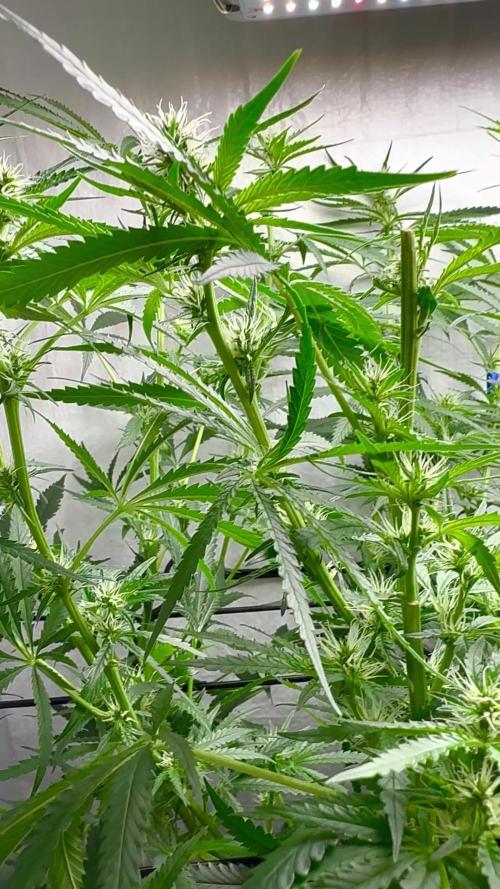
Weekly update: August 6th
Looking great, major spurt of growth on both girls, #1 (sativa leaning girl) had major final stretch to end off stretch in 3 days (hopefully). And #2 (stockier indica leaning pheno) has had a big increase in flower size in 3 days which is promising, and is also producing a very sweet and tropical fruity gas smell, this is TCP after all!
Oh yea and I’m running about 1700 center 500 outer ppfd and tapering down if I see anything but nothing so far all good nice genetics, may drop in the next week even if no signs or symptoms, to prevent and not be too greedy.
Now for the not so good… been getting 10% runoff almost every feed, but my runoff of #1 was 3500ppm and pH 4.5 and #2 at 5000ppm and pH 4.5. Been giving around 850 ppm input at pH 6.0, never went over 1000ppm input. So I have to correct with 25% increase in feed volume, 300-400ppm input at pH 7.0 for what I infer to be 2-3 feeds until runoff ppm is significantly lower, and pH is at least 5.5.
UPDATE Aug 8:
To address the toxic/locked-out root-zone I did a regular feed with runoff (1.5 gal total volume per pot @ 820ppm bloom focus), runoff consisted of pH 4.2-4.5 and 4000-6000ppm... OUCH. I then fertigated with 0.5 gal plain pH 6.5-7 dechlorinated tap water each. I repeated this a total of 3 times, to which the last flush had 3 ml/gal cal-mag. final runoff ppm @ 1000-2000, pH 5.3-5.5. To conclude, I more than likely wasn't achieving enough runoff per scheduled feed, and did not cycle a few plain pH adjusted waterings. I had almost the same thing happen last run with autos, except they were showing signs of lockout, these photo girls are not. I must do a regular watering every 3 feeds, achieve 20% runoff with high ppm feeds, and 15% runoff at least with mild to moderate ppm's. Lesson learned, I hope I get a full run in the future without hiccups like this.
UPDATE Aug 9:
Big thanks to @00110001001001111O for suggesting i omit the light hanger and hang from the carabiner, I thought I was out of vertical space until this was pointed out. Check him out, he always has well informed answers to grow questions: https://growdiaries.com/grower/00110001001001111o
Processing
Likes
5
Share


@O_GrowTom
Follow
WEEK☆7 J•1 Premier jour de la semaine, les branches latérales rattrapent bientôt la tête centrale. J'attends encore que ça se développe avant de penser à la floraison.@++
WEEK☆7 J•4 La progression continue, j'ai commencé un peu à défolier le bas du plant. J'attends encore pour la floraison.

Likes
5
Share

@BudXs
Follow
Dear Diary
Autos are looking good. Suffering from low RH and im doing all that I can, but winter is a bitch.
Plants are healthy and female, so all is good. These girls will start to rock as the natural RH picks up over the next few weeks
xoxo, BudXs


Likes
8
Share


@Qaggy
Follow
Great growth from all the girls this week.
Stretched massively.
I have done a major defoliation to let more light to bud sights. 95% flowers are in light now. I will do another Small defoliation next week.
Dry amended top soil with bat guano, worm castings and bio life. Should be enough to bring them into mid flower.
I had a slight fungus knat issue but got some nematodes and they are starting to clear along with sticky traps.
I have also taken cuttings from a few of the girls to cross a few of the stronger strains and create my own strain. First time I will be doing this so excited to see how it turns out.

Likes
21
Share


@Rap_a_cap
Follow
Today is the harvest day of this wonderful girl. Plucked off all the main colas, the rest will mature for another week.
She's ripened very well, totally defoliated, in a sunny and hot end September. In a better position she would have yelded at least twice as much. These branches will turn into super premium buds, rich of colours. This strain is simply amazing.
See U ASAP for a great harvest
Good luck Growmigos
Likes
1
Share

@A-C-H
Follow
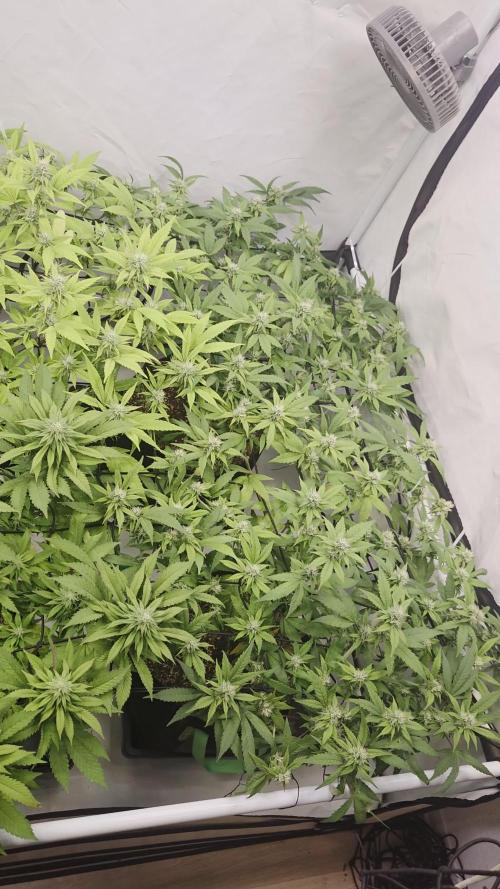
Die Blüte schreitet gut voran, auch wenn es etwas kühl ist...
Einige meiner ICE rink Pflanzen fangen bereits an, ihre Farbe zu verändern, und bei einer Pflanze auf (wild cherrie) der rechten Seite stelle ich immer noch dasselbe Problem fest


Likes
8
Share

@World_Breeders
Follow
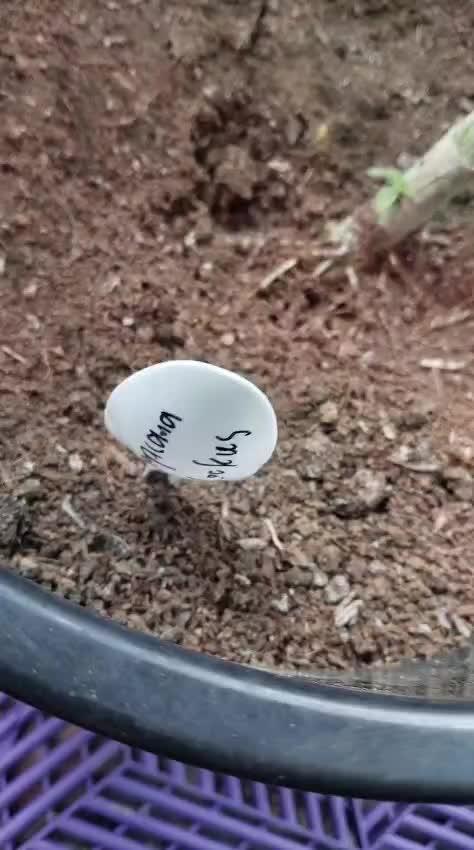
Tropicana Cookies — Week 3 Flowering
Tropicana Cookies reaches week 3 of flowering with a well-developed canopy and a large number of active flower sites. The stretch phase is slowing down, while flower formation becomes increasingly visible across all main branches.
Its trained structure continues to provide excellent light penetration and airflow, allowing for uniform development throughout the plant. Bud sites are stacking consistently, and the overall vigor remains strong, with healthy foliage and balanced growth.
This phenotype stands out for its efficient canopy, strong branching, and high production potential, showing all the signs of a very promising flowering cycle in the weeks ahead. 🌱🔥🍊
Seed: World Breeders
Grower: Piperoots 🇲🇦


Likes
143
Share


@PapaNugs
Follow
Did some slight training on one plant. Defoliated a couple lower points but overall just letting them do their thing. Got everything locked in at this point. I've got to water daily. Half of the girls already have some color in their pistols!
Thanks for stopping by.


