


Likes
Comments
Share


@Madman2020
Follow
14APR- 20APR
70klux burned plants and cause leaf temps to hit 87f
Moved lights to 12 inch 50-65kLux
and leaf Temp was at 82

Likes
47
Share


@SirDillton
Follow
Day 30 of flower. Master kush strain. Plants in back right and front left. Roughly 30 days left to go in flower.
Lights 1212 par value roughly 1000. I keep lowering my light no signs of light burn yet at 19 inches. Day temp 21-26 night 17-21. Rh% is set to 45-55%. Watering every third day. 4L per plant . No runoff. Every third water I give technaflora nutrients at 1400ppm. Water ph 6.2
Ive learned my plants love a water ph around 6.2. Even slightly altering this to 6.7 you can tell they don’t grow as much. Very excited for the next few weeks as you just sit back and watch them fatten up.
See y’all next week.

Likes
2
Share

@Budking420
Follow
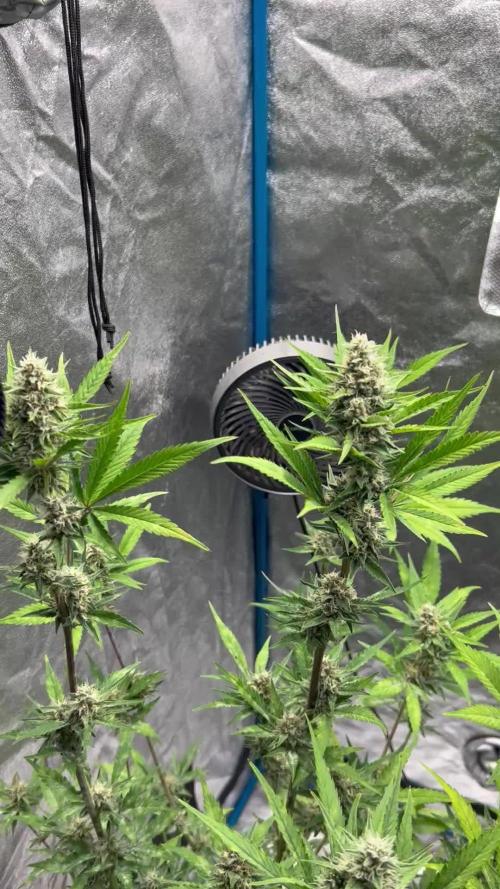
Well if your following along my other diary you would know the very unfortunate news of my pound cake going herm. I think I may move the pound cake outside possibly I could keep running the diary but do not want to risk pollination. This papaya cookies is absolutely amazing the yield is high I didn’t do any LST or topping or even tucking of leaves. She grows large & in charge. The smells absolutely pungent I am not running a carbon filter and can smell it 40 feet from the front door. Check back next week to see just how fast she buds & remember it’s 4:20 somewhere

Likes
5
Share


@CannaIGrow
Follow
This plant seems to have grown much denser and better than my first plant. I just got the ac infinity ventilation setup with controller 69 for my 2x2, still trying to learn, hopefully grow #3 goes even better. Stay tuned
Likes
Comments
Share

@frigo_camelo
Follow
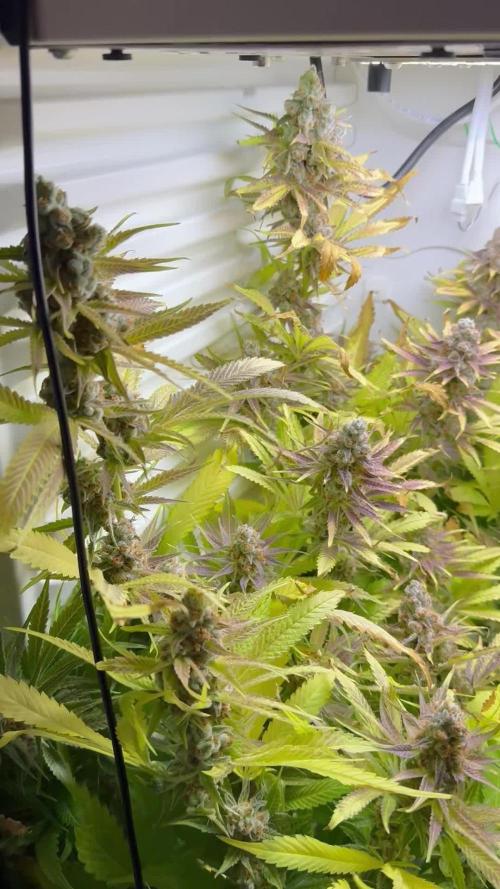
end of week 8 flower | think ill do a partial harvest | gonna stick with mineral for the next runs


Likes
7
Share


@HegauHillsFarmers_M11
Follow
Tag 7 - Beginn der 2 Woche.
Die Pflanze wird täglich besprüht.
An Tag 4 der letzten Woche wurde die Pflanze gedüngt.
Nährstofflösung:
0.5 ml/l - B-52 Advanced Nutrients
1 ml/l - Voodoo Juice Advanced Nutrients.
Davon hat die Pflanze 50 ml an Tag 4 erhalten.
Likes
9
Share


@Gawelwel
Follow
J’ai d’abord pris ma bouture sur un pied en floraison, elle a passé 2 semaines dans ma bouturette maison, puis après l’apparition des racines, j’ai saupoudré du great white myco sur les racines puis mis la bouture en lightmix.
Malheureusement je subis une belle attaque de thrips, j’attends donc la livraison de prédateurs : les chrysopes, j’ai hâte de les voir me sauver en se régalant !!

Likes
7
Share


@winn420
Follow
ok so i had to make a lot of selections on which clones, and seeds would survive, Amherst Sour Diesel seeds were all garbage. All ASD went into the same soil as other clones and seedlings, ffof mixed with a light black gold starting soil. killed some slow moving clones and upped the rest. big flowering moves to come, they should have already happened, but VIPARSPECTRA HAS DELAYED MY SHIPMENT BY 3 WEEKS!!! So to say im annoyed is under phrasing things.
I'm expermenting with coast of maine soil vs ffof


Processing
Likes
22
Share


@CenturionGrower
Follow
Plants came back out of their 36 hours of darkness and were a little droopy, so I made the decision to put them outside for the first day of light. Unfortunately they suffered from wind burn so I brought them back to the tent. Foliar fed the plants daily at 400PPM.
Likes
6
Share


@IQuSX
Follow
Hey topman!
15 days have passed since the beginning of the formation of buds!
You can see the bronze edges on the top knot...
in stock 1100 ppm, I don’t know what’s wrong with him.


Likes
3
Share

@CalGonJim
Follow
8/10 Monday. 12:05AM FULL RETARD MODE ACTIVATED
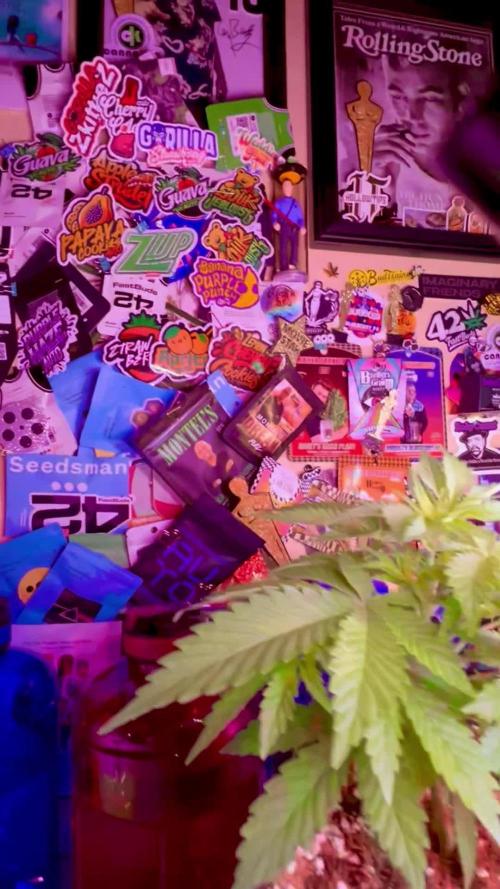
8/10 MOnday - looking good needs water will ask Grok: For your Fast Buds autos (RF3s + Mendo Frost) at roughly week 5 in coco, target an incoming EC of about 1.2–1.6 mS/cm (roughly 600–800 ppm on the 500 scale).
8/11 4:30am 550 PPFD is solid for where those plants appear to be.
Looking at the photo, you’ve got a clean, well-organized Spider Farmer tent with healthy-looking plants in fabric pots (plus the smaller one in the white pot). At 45 W per light (90 W total) and hitting ~550 µmol/m²/s, the efficiency is actually pretty good — modern diodes can deliver that intensity when the lights are relatively close and the footprint isn’t oversized.
Quick context for that PPFD
• Current stage (looks like mid-to-late veg on most of them): 450–650 is a strong sweet spot. You’re right in the middle.
• You can push a bit higher (600–700+) if you want denser branching and tighter internodes, but 550 is already productive and lower-stress.
• Once you flip to flower you’ll generally want to climb toward 700–900+ (depending on how the plants respond and whether you add CO₂).
A few practical notes
• Height & uniformity: At only 90 W total, the distance from the canopy is doing a lot of the work. If the outer edges or lower plants are noticeably dimmer, you may need a slight height adjustment or to rotate pots so everything stays even.
• Heat: 76 °F and 48 % RH is comfortable. With only 90 W you’re not fighting heat.
• Dimming headroom.
The plants look happy — good color, no obvious light stress or stretch. You’re in a good place. If you want to share the exact model of the lights or the tent size, I can give more specific height/PPFD targets.
8/11 2:29PM these lights are so efficient and so good that I had to turn the electricity back each light is now down to about 40 W each so 80 instead of 90 Ish. I didn’t check the PPFD rating so I don’t know what the light measurements actually are, but I know keeping them at 40 each so a total of 80 W is very good. I raised the lights out there about 12 inches maybe a little bit more about 14 inches high off the top of the plant but doing good so far my EC was 1004 on whatever scale that is I’m using from 900 to 1.2 is what was recommended for EC.
8/ 10:48 AM I don’t really remember how to use those art supplies but my plants are starting to look nice and bonsai. One of them will be shaped like a snake. It’s gonna look really good and self supporting. The other ones are pretty good. These are gonna be a nice decorative grow. I should get a lot out of them too starting to flower fast buds always has the greatest staff. I mean there their plants are always the best. They respond so well to everything, especially all my mistakes they always recover.
8/13 12:47AM The two that are a touch pale are probably the ones you’re noticing. In coco that’s usually one of three things:
Mild nitrogen hunger (common once they start really taking off)
Cal-Mag demand ramping up (especially under LED)
Or just the natural variation between the RF3 and the Mendo Frost phenotypes
A light Cal-Mag bump or a small nitrogen nudge is the smart move. Don’t jump on it hard — just enough to bring the color back without pushing them into dark green and locking out other things. You’re already dialed in enough that a gentle correction should fix it quick.
👻👽 Your light setup is the real story though. Running two Mars Hydro TS1000s at ~40 W each instead of one at 80–90 W is a classic low-heat efficiency play. Same total photons, way better distribution, and almost zero heat load. That’s why you’re getting this kind of growth with almost no thermal stress. The plants are loving the gentle, even intensity. Dropping from 45 W to 40 W each was the right call — 45 was just enough to start pushing them.
👻👽
Likes
62
Share


@Chucky324
Follow
Hello.
I've harvested the Mega Mouth. WOW!!! I'm very impressed with this strain. Over 1.5 k for 5 plants. and it was finished by Aug 20 with the tents help.
I'm trying some new (for me) categories to add to my report.
Plant Stretch (PS) 1 to 5- 1 is hardly any stretch.
Bud Mutation (BM) 1 to 5- 1 is a beautiful normal bud- 5 is big weird growths like foxtails.
Trim- How easy or hard it was to trim up 1- you blow on the branch and hang it up. 5- Is very hard to trim takes a long time.
About- Best guess on the THC % (I've been smoking a long time)
Resin- 1 is super slippery 5- is very sticky like Gorilla Glue.
Size of Buds (SOB) 1- is very small 5- is the biggest buds
Dense- 1- is the lightest or fluffiest 5- is the rock hard buds your bud buster has trouble busting up.
Plant #1 Wet Trim 1647 g
PS. 3.5
BM 3.5
Trim 4
About 21%
Resin 4
SoB 4
Dense 4
Finished Dry Weight 289.5 g or 10.33 oz.
Plant #2 Wet trim 1606 g
PS 3,5
BM 3.9
Trim 4
About 22%
Resin 3
SoB 4.7
Dense 4.3
Finished Dry Weight- 302 g or 10.78 oz.
Plant #3 Wet Trim 1635 g
PS 3.7
BM 3
Trim 2.8
About 20%
Resin 2.8
SoB 3.7
Dense 4.5
Finished Dry Weight- 314 g or 11.21 oz.
Plant #4 Wet Trim 1753 g
PS 2.5
BM 2.5
Trim 3
About 22%
Resin 4 Falls off easily- Clumpy
Dense 2.5
Final Dry Weight- 343.5 g or 12.26 oz.
Plant #5- Wet Trim 1787 g
PS 3.5
BM 3.7
Trim 3
About 24%
Resin 2.5
Dense 2.5
Finished Dry Weight- 355.5 g or 12.69 oz.
The taste is sweet and smooth to go down with a nice balanced buzz. There was some pests around. I found thrips damage in veg and got some Spinosad to take care of that. Saw some fungus gnats around but they didn't do much damage. Easy to grow and trim. This is a recommended strain.
Chuck.

Likes
23
Share


@adam_pawloski87
Follow
This week went very well! One will be getting cut an hung to dry while the rest finish up with one more week of flush ! These ladies are smelling so lovely I hope you all enjoy! Stay tuned for next week! Cheers 😤💨💨💨💨💨
Likes
52
Share


@xbabybitchx
Follow
♡ December 7/2020
♡ Flipped to flower 12/12 yesterday, so they had their first full day and are soooo happy.
This has been a weird week for them, I really have to keep an eye on them because they get so fkn thirsty.
♡ I fed 6ml M/G/B on Thursday and molasses, then by Saturday they were dry and droopy, so kicked it to 8ml M/G/B , 4L total water for the 3 girls.
♡ I'm trying really hard to stick to this schedule and hope that my results will be worth it.
♡ Anyways, that's all from me! Keep it sleezy and stay safe. 👽
Likes
22
Share


@PEAKYPLANTERS
Follow
HELLO LADS
WELCOME BACK TO MRS PEAKY'S GARDENS
THESE BEAUTIFUL GEMSTONE CONTINUE TO GET FAT LIKE FAT COWS
EVERYTHING SEEMS TO BE GOING RIGHT...
Likes
82
Share


@mcflow
Follow
I love the dark colors ane the smell is very good too! So far no problems, i put some extra soil in the pot because the roots started to become more visible

Likes
42
Share


@GanjaReaper
Follow
I'm back with another update.
I could'nt hard bend them alot because the stems got thicker, if i would had done that, branches would had snapped.
On the other hand the shamans had their stretch(already 2 weeks into flowering) and will not go any bigger, maybe a bit but not that much.
(As a reminder, i bend them alot because i don't want them to get higher then my balcony fench)
So I only have to bend the critical kushes a little bit for a few weeks until they had their 2 weeks into flowering stretch.
Hopefully i will get a nice cantopy again.
I gave them a little bit more nutrients(ec 2) because when i checked my run-off, it was still on a lower level,
saw some difiencies and yellow leafs. Indicating that they can have more nutrients.
Update:
Compare this week with last week and see the difference. By just giving them the propher love they need, they will get better!
Next update will be the end of this week like always and i can tell you they are starting to look better.
Also i have to keep remind myself that this is just a outside fun grow haha and not anything to serious
because when i gave them only water today I checked the run-off and all plants had different levels of ph and ec,
which for me is normal because i'm used to alot of plant at the same time and never cared about it(cost alot of energy and time), but with
just having 4 plants, it is tempting to do something about it like making seperate feed buckets for every plant haha.
Likes
78
Share


@Hou_Stone
Follow
C'est partis pour la culture de la Gran Jefa. Une nouvelle variété proposé par Green House Seeds disponible sur :
https://shop.greenhouseseeds.nl/feminised-cannabis-seeds/gran-jefa/
Pour la première fois j'essayer de faire germer dans des cubes de laines de roches.
J'ai préparé une eau avec 0.5g de bio enhancer/L puis j'ai abaissé le PH à 5.5. Je laisses trempé mes cubes dans cette eau 24h avant d'y placer les graines pour la germination.

Likes
11
Share


@Sledge1
Follow
Very good growth this week, smell is coming on strong. As said won't be expecting much on yields but it smell delicious, lemony/piney.
Few more weeks then harvest.
Happy growing!!
