


Likes
Comments
Share


@Manoa2211
Follow
I brougt them outside when the weather Was good enough. Sie stams got mutch more resistent. Will transplant them to soll in a few days. Night temp. is not lower than 7 degree Celsius. Got a little smell when you put your nose very close to the top leaves, but nothing to intensive.

Likes
46
Share


@Daweed83
Follow
I was worried because the buds had a very different aspect compare to the other plants but I guess its their genetics that makes them buds with more pistils. they getting very fat now so I’m not worried anymore ! Please let me know if there anything wrong 🖖🏽🖖🏽

Likes
16
Share


@Ziocannabis
Follow
Oggi, lunedì 22/01 ho cambiato una 40 ina di litri di soluzione nuova e fresca...ho notato che verso la fine, l'acqua/soluzione era più "limpida" rispetto alla prima ventina di litri ... credo che la pietra porosa con aggiunta di ossigenatore sia stata utile nel secchio "Sistema" per evitare eventuali depositi sul fondo
Il problema maggiore è la temperatura stessa ossigenata... è impossibile tenerla a 19/20° senza l'uso di un raffreddatore(Chiller)...costa un botto!
Ora è a 21.3 ma sicuramente salirà....di solito è intorno ai 22° ...La luce led dimmerabile è all'80%... È vero che ci saranno le foglie a fare ombra al vaso....ma non so se al 100% ,che metterò ad inizio fioritura e l'abbassero in altezza a 40 cm dalla cima,cosa accadrà alla temperatura,in generale
Per ora andiamo avanti e proviamo a risolvere una cosa la volta 😉
Oggi topping o FiMing, vediamo cosa riesce😂
Crescono ma... credo che abbiano preso il Mosaico del tabacco..una malattia che deforma le foglie,si piegano le punte in su e in giù, alcune foglie appunto presentano una specie di mosaico con macchie giallognolo
Sembra bene...oggi 2 febbraio defogliazione e da lunedì si passa alle 12 ore..... credo che farò così...o farò poi fatica a gestire le altezze e l'area...ho notato che le foglie e il tronco sono molto più grossi rispetto la terra con lo stesso periodo di 3 settimane piene...


Processing
Likes
76
Share


@ThrashedTV_BakedByGlaze
Follow
MID-WEEK UPDATE:
Gave the twins their second last feeding today. A few nights of 14-16 Hour Dark periods as well due to plans/not having timers but as I said before I think the longer Dark periods have really sped up the flower development.
PURPLE IS STARTING! Some very nice purple is starting to come into the cals and sugar leaves 😈 Going to push some lower temps in week 8 to get as much colour out of them as possible.
Arnold still heavy fan leaf fading. Ran straight water through the medium before todays feeding incase any build up nute locked it. Never fully bounced back from the last feed but also getting near the end. I have a feeling I'll pull Arnold first in week 8 then maybe let Danny go for a more couch lock.
Danny: GRAPE SMELL. Holy, I don't know if it's more of a Grand Daddy Purp pheno or what but holy is the grape smell off of Danny insane. Almost like a different strain compared to the smells off Arnold.
WEEK 6! HOME STRETCH OF GLAZED GROW #1!
The smell is insane. What started as a premature musk has slowly evolved into sticky ass chocolate goodness, fresh mint/herb, and even some grape/fresh fruit smell on the fingers after defol and mold checks. Noticing a hint of that GASSS too as we start to enter the final ripen.
This will also mark the final week of Nute feeding. Fed today and probably two more Weds/Sun. Then will switch to Molasses/Water for Week 7 and plain water for first half of Week 8 before the dry out.
As you can see, Big Arnold is showing cal/mag and PH problems. Always bounces back after PH perfect feedings and I've been defoliating the faders as we go to save bud energy. It's been rootbound since mid-flower and I'm sure the whole root zone is a mess. The extra work I've had to put into a soilless peat-based medium like ProMix with a photoperiod plant has been great practice and experience but I'm looking forward to a few round of autoflowers and soil grows to dial back the difficulty settings through the winter months.
Broke out the good camera for some shots since we're getting to the good stuff 😎
- Canon EOS 760d
- 75-300mm
- 50mm
Have the twins hanging out with the SoundLink again for those good vibrations 👊
PLANT PLAYLIST:
Kendrick Lamar - To Pimp A Butterfly
Sublime - Sublime
Shad - TSOL

Likes
3
Share


@Chubbs
Follow
Week 6 update:
What up Grow family. These testers are growing fast and strong. Where in week 6 now and the swelling and ripening of flowers are going amazing. Still feeding 500ml/16oz daily as I've found that's the sweet spot for 3gal fabric pots for these. I'd say these probably have about 2 weeks left until they'll be finished.
All in all Happy Growing.
Likes
87
Share


@Roberts
Follow
Auto Banana Kush is growing good under the Medic Grow Mini Sun-2. She was a pain to get started, but is off and running now. I did have a minor ph swing but I corrected it over last day or two. She got her first lst today, and her root tips pruned. Thank you Medic Grow, Athena, and Weed Seeds Express. 🤜🏻🤛🏻🌱🌱🌱
Thank you grow diaries community for the 👇likes👇, follows, comments, and subscriptions on my YouTube channel👇. ❄️🌱🍻
Happy Growing 🌱🌱🌱
https://youtube.com/channel/UCAhN7yRzWLpcaRHhMIQ7X4g

Processing
Likes
3
Share


Likes
16
Share


@eldruida_lamota
Follow
Que hay familia, recta final de estas xupet y haribo de Rkiem seeds, la verdad que los esquejes de mi colega e flipado, Los 8 ejemplares han salido muy bien, tienes unos tonos y aunque no sean muy grandes se ven flores muy prietas y repletas de tricomas, espero se puedan apreciar bien en las fotos y el vídeo.
Ya e practicado un lavado de raíces que era necesario para proceder a seguir regando sólo con agua unos días más.
Sin más dilación , me despido hasta el año que viene 🤣 buenos humos y feliz año 💨💨💨🎉🎊.

Likes
8
Share

@DimJesus
Follow
Elas crescem tão rápido 😅
Ainda estão esticando um pouco mas somente os top buds. A da estufa pequena está aparentemente mais gorda e os pistilhos são maiores, já a que tá mais perto do zíper na estufa grande parece ter buds menores só que mais densos e mais bonitos, com muitos botões, já a que tá atrás dela parece ter buds mais alongados, bastantes pistilhos igual a outra só que muito mais alongados.
A da estufa menor tá mostrando sinais de exceso de potasio, Acho que é isso por conta da cor das manchas nas folhas, acredito que seja da última rega que fiz pq eu coloquei bastante astro flower e o regulados de PH também é potasio, a última rega que fiz foi sem ferts e a próxima também, já consegui diminuir bastante a concentração de nitrogênio, acho que o verde já não está tão escuro e as pontas das folhas dobrando para cima de volta, acho que eu poderia ter colocado menos fertilizantes na última rega mas eu queria muito atingir os 1.000 ppm, as da estufa grande parecem estar gostando bastante da concentração e até agora não tem sinais claros de toxidade, somente a que tá sozinha tem manchas meio roxas em algumas folhas, fora algumas queimaduras amarelas por causa do nitrogênio que já resolvi.
Eu acho que a diferença de tamanho nos buds é por causa da altura que o painel tava, então preferi sacrificar a temperatura e descer o painel até um palmo de altura e aumentar a potência, espero que valha a pena, acredito que o PPFD tá batendo 1.000 no ponto mais alto, o painel da estufa pequena sempre esteve baixo e na verdade eu tive que subir uns 8 cm mas o driver fica fora da estufa e por ser de apenas 65w ele não esquenta tanto assim, já o da estufa grande é um painel de 180w (funciona a aproximadamente 80% da potência pq é muito quente e gasta bastante energia 😭) que esquenta bastante e o driver fica dentro da estufa e faz ficar mais quentes ainda. Acho que o painel estar perto foi uma vantagem que a outra sempre teve mas não consigo saber pq ela tem tanto sinal de toxidade e as outras não, mesma água e quantidade de ferts, enfim, continuo aprendendo bastante com essa safra e planejando melhor o que farei nas próximas, ter 3 plantas da mesma genética e todas serem diferentes uma da outra é muito bonito, não somente a diferença aparente como também a diferença de necesidades. 💚🌱
Likes
41
Share


@GermanGrow182
Follow
Super Woche, warm, sonnig, nur ein kleiner Schauer.
Was soll ich sagen..? Es läuft prima. Bei den ersten Damen zeigen sich vorblüten. Habe jetzt alle mindestens 1 mal getoppt. Nur die 2 fat banana noch nicht. Die werden so schön buschig.
Wenn die automatics in Kürze fallen, wird erst einmal umgestellt... dann bekommen sie mehr Sonne am Ende der vegetativen Phase. Das ist zumindest der Plan.
Es läuft gut.Bis nächste Woche ✌️


Likes
1
Share

@SolitudeCorners
Follow
📓 Cultivation Diary: The 12/12 Flip & Transition Week
📅 June 5, 2026 (Veg Day 17)
Irrigation/Reservoir: Prepared a full 100L reservoir refresh.
Nutrients: Kept the feeding aggressive with a double dose of vegetative nutrition (x2 Nutrient formula) to ensure the root zones and plant tissues are fully stocked with elements before the transition.
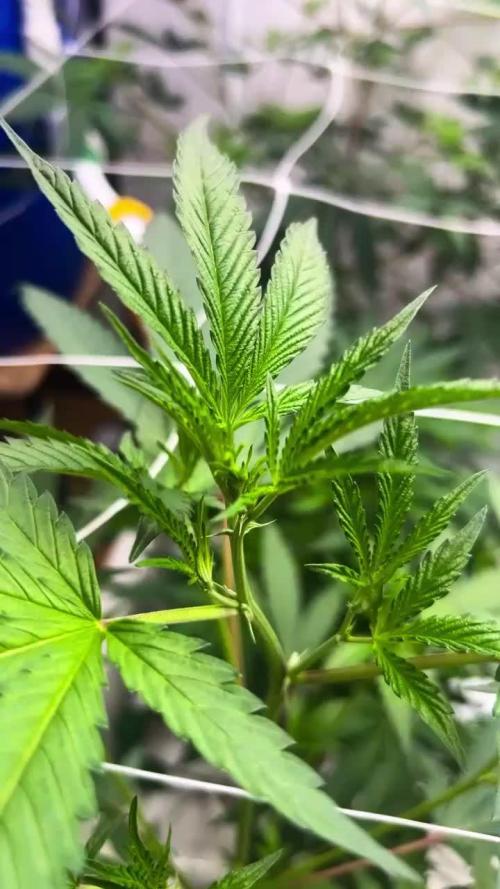
Canopy Observation:the canopy is thick, uniform, and fully occupying the table space. The trellis net is officially filled out, and the lower branches are strong and rigid.
📅 June 6, 2026 (Day 1 of Flower / Bloom Week 1)
The Flip: Officially switched the timers to a 12/12 photoperiod (Lights ON at 6:00 PM / Lights OFF at 6:00 AM).
Schedule: First irrigation shot triggers exactly 1 hour after lights on (7:00 PM), followed by a shot every 1.5 hours.
Volume: Configured the drip stakes to run for 1 minute per shot, delivering 5 shots total per day. This provides roughly 450ml per plant per day, creating excellent target dry-backs overnight to force vigorous root searching.
📅 June 11, 2026 (Day 6 of Flower / Bloom Week 1)
Irrigation/Reservoir: Bumped reservoir capacity up to 110–120L to keep up with increased transpiration as the plants begin their post-flip stretch.
Nutrient Recipe (TargetingpH 6.0 EC 2.5
Water: 110–120L
Athena Cleanse: 120ml
Silica: 220ml (Essential for stem strength during the stretch)
CalMag: 10ml
Athena Bloom: 600ml (Adjusting base to target 1.2–1.3 EC from Bloom component)
Athena Core: 400ml
Irrigation Adjustments: Increased the shot duration slightly to 1 minute and 15 seconds to match the accelerating growth pace.
The early flowering stretch has officially begun. The tops are noticeably pushing past the trellis net layers, and the node spacing remains tight and stacked. Leaf color is an excellent dark green with healthy, bright yellow-green shoots driving upward at the growth tips. No signs of stress or stalling from the schedule shift.

Likes
21
Share


@NSABND
Follow
Hi there start of week 11 today 😏
today (Day 78) the weather is cold and very high humidity because of rain 😲😩😕
Day 79 same shit weather then yesterday with very high humidity and rain 😵😲😵😲😵
Day 80 autumn has arrived 😱😨😰 cold with rain and high humidity 😲😵😭
Day 82 there are no Updates sorry 😵
Processing
Likes
47
Share


@KilgoreTrout
Follow
Everything going great. Five plants all female. But they should be with feminized seeds.
No issues or problems. Just the slow wait.

Likes
10
Share


@Archieballs
Follow
All in flower Banana #1 is just starting to put on a bit of weight and showing some amber. Banana ! Will be the first to harvest I think Banana #2 and Skywalker are 1 week behind her. As the end is in site starting to prepare the next grow which will be All Dutch Passion again Auto Ultimate, Auto Daiquiri Lime and Auto Mazar.

Likes
79
Share


@JUNGLE_B4RNS
Follow
-Sensi Seeds Research:
The Sensi Seeds Research breeding project has created eleven cannabis seed varieties.
How? By combining new cannabis cultivars with a selection of strains from their long-established cannabis gene bank. For the first time in thirty-six years, they are opening the doors of the Sensi Seeds Research and Development Department.
Week #13, week 5 of Flowering.
Well well well... everything is going well 😄 Or should I say, swell swell swell... everything is going to swell 😉
As I said in previous week, they started to drink like maniacs ( 2 liters more in the week ), meaning swell is starting now (👈 the tip is free bro, just hit the like and subscribe if you want some more 😎), flowers opening is over. Dehumidifiers are set on 55% and will decrease 5% by 5% each weeks now. I will keep an eye on the buds, particularly the new genetics, as I never grow them before I don’t know their resistance to mold, but I believe these strains should be tough enough as everyone is in perfect condition and all healthy.
I have finally found a better lightening solution for the middle of the room. You can really see the difference between Pictures A and B. The Mars Hydro SP 250 is definitely the best LED solution for its price, you can get a serious LED light which is bright enough to be able to grow some serious buds like a pro, and I can tell just by seeing the quality and the intensity of the spectrum from my experience.
This LED light will make you say WOW when you plug it in and each time you will see it turning on, for sure 👍 Before receiving this baby, I’ve read the driver becomes hot, but in my definition something hot, is something that you can’t handle more than a few seconds... to be honest, for me this driver becomes a bit warm and you can handle it with no problem. And one last thing about this driver, it is removable, in case if you personally think it’s too hot for your growing area.
So I would definitely recommend the SP 250 for anyone who has understand that serious buds grows under serious lights, without spending one month of salary in one light just to impress the galleria 😊
Enter in de dance, plug it in an we begin
Crowd up in de center, they watch fi de rydim
Watch the way we drop it in a mix timin’
Rise and amplifyin’ when we come in wit de swing
Just followin the back and naturally harmonizin’
Climb into position wit synchronized things
Live from out a ghetto, we maximazin’
We superstylin’ lin’ lin’ lin’... 😎
(I’m looking for a job in the Cannabis industry as Master Grower, Mineralogist, Quality Control 🐞)

Likes
19
Share


@AutoDevilHQ
Follow
Strap yourselves in this is gonna be quite the revelation update.
Day 33 - Northern Lights
This girl is fast becoming the pride and joy of the tent showing no signs of flowering yet still well and truly in Veg mode without the female indicators about to end week 5 so she will be getting another round of LST this weekend to maximise freeing up access to light for the parts that otherwise without a Defol wouldn't get chance to blossom.
She wants the full tent to herself at this point and the next update is going to help her with that.
20210219_103956.jpg
I mean just look at her. She's a monster!
Now onto some slightly less satisfying news and an admission of another noob fail.
Day 28 - Chemdawg #1
This girl is abnormal. She has already made it perfectly clear she's not far off going into flower so whilst I did tie this girl down for some LST upon inspection from @autobeast he recommended we leave this stocky girl to try and get a bit of height without LST.
Now for the admission....
When this girl was topped I cleaned out the top 2 Colas in the process so the top node was literally just two big fuck off Fan Leaves sucking all the good stuff away from the rest so off they came last night leaving this girl with only 6 branches to grow from instead of what should have been 8 had I topped her properly. In a way I'm glad this has happened and I spotted it myself and managed to understand why she wasn't flourishing as much as her cousin. Granted they are different Genetics but you only need to look at the next girls update to see that something just doesn't seem right with this one.
20210217_222845.jpg
Here's what she could've won but instead we are going to be leaving her to her own devices. I am a little gutted about this as I've only been able to observe the Defol and training on one plant before I'm let loose with my own little lady that you're about to see next. Here's how Chemdawg #1 is looking today.
20210219_104008.jpg
Don't get me wrong she is very healthy and happy and already kicking out that dank stardawg aroma and she may surprise with some fat nugs but I expect her to be having a shorter life span than the Northern Lights and with this in mind I'm going to apply that insight to the 3rd girl.
Day 19 - Chemdawg #2
With the mistake in mind from the previous Topping I double checked with AutoBeast on where to top this and I'm kinda happy that he just stayed silent and said top it where you want its your baby. So being careful not to cut the top cola off too I chopped her head off and cheered her up with 1L of Water with 2ml BioBizz Fish. I've also been adding a foliar spray to her of the biobizz FishMix.
Once the leaves reach the edge of the pot I'll be starting with 4ml of Parts A and B of Monkey Nutrients Grow Feed and 1 tablespoon of Blackstrap Molasses every 3 days.
This is my favourite 6 days of growth I've witnessed so far as the plant tries to decipher which of its Colas is dominant.
20210219_104018.jpg
Summary
Don't top your main cola off when you realise what you've done it'll hurt like hell.
Approaching 2nd week of feed keep a closer eye on the water levels in your plant they get thirsty sometimes but other days not so much so there is no one size fits all in those weeks 4-5 in my experience so far in Organic.
Not all plants have the same life span so if growing a variety in one place understand that they will all veg and flower at different ages so while it's nice to have rules of thumb ie no earlier than x to top or no later than day x to start feed there will always be flex between days and that applies even to the same genetics although perhaps not so prominently variant.
Every day growing is a day learning.
Ok so it's end of week 5 for this @fastbuds_genetics @fastbuds_backup_account @420fastbuds Northern Lights Auto and well just fucking look at her.
She's taking over the tent with her canopy dwarfing the 2 Chemdawg Autos and only just showing signs of Preflower.
A vast contrast from the 2 Chemdawg but the aerial view gives an idea of the incredible amount of Bud Sites formulating on the upper canopy.
I've been leaf tucking twice a day this week for around 15 minutes each time talking to my girls about what I'm doing to free up light to the lower canopy and its bearing fruit for sure.
I knew this week was going to be an eventful one for this staggered tent but having thought the Chemdawg had fallen behind she is in fact further ahead in her life so adjusting the feed schedule for the baby accordingly.
Every day growing is a day learning.
Likes
18
Share


@StickyFingah420
Follow
Planta resistente, de estructura mayormente indica, con una producción importante de resina.
Planta de rápido desarrollo que tolera bien el estrés provocado por el topping, LST y frío.
Altura media, con flores realmente densas y duras, tal como prefiero, avanzando en la floración dejará ver colores rojizos que deslumbrarán.
Se desarrolló muy parecido a una Gelato que crecí del mismo banco.
Un desarrollo fuerte y rápido para terminar brindando hermosos brotes que desprenden sabrosos aromas dulces y lucen una apariencia de dispensario innegable!.
Sin duda buen trabajo de Fast Buds en estas genéticas.