




Likes
40
Share


@valiotoro
Follow
Helloooo everyone👋
This is the last week all the girls are ready for harvest🤩✂️
Im very happy with the result for my first outdoor photoperiod session!
It was challenging but i had a lot of chance with the weather,this year was exceptionnal😎☀️
Absolutely different to grow outdoor
If you want to skip the rain & the cold weather you can force the plants to flower,it works but you have to remove the plants every day at the same hours⏰
If you have the time to make your Homemade nutrient 100% bio its really easy you can find everything in nature feel free to ask me👌
In love with the beautiful purple color of the Biscotti from zamnesia😈


Likes
21
Share

@ThatsmyGrow
Follow
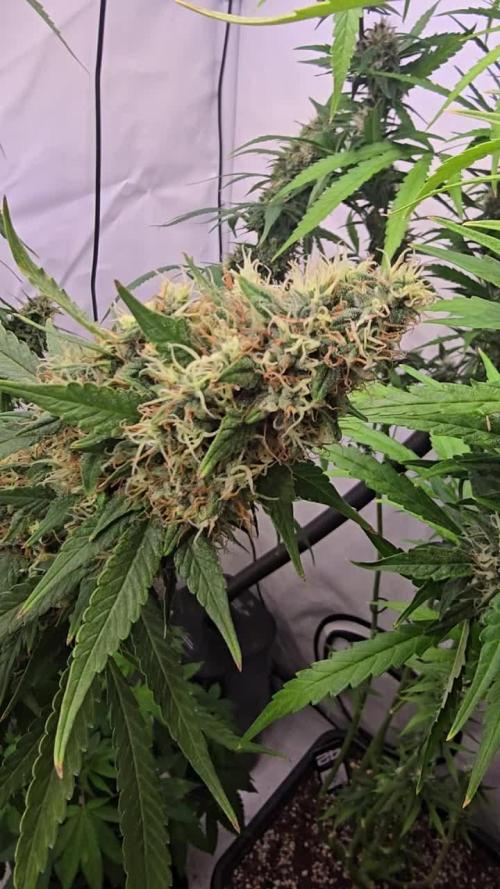
🌸 Week 12 – Gorilla Cookies Auto Pheno Hunt
Another week has passed, and we are finally reaching the end of this pheno hunt. It has been an exciting journey with plenty of highs, but unfortunately also a few setbacks during the final weeks.
📈 Current observations:
Unfortunately, Pheno #1 didn't make it to the finish line. Several buds developed bud rot, and rather than risking further contamination, I decided the best option was to remove and dispose of the entire plant.
Pheno #3 never fully recovered after I had to remove multiple main colas earlier in flower because they were growing into the SANlight fixture. That stress significantly reduced its flower production, and in the end it simply wasn't worth keeping until harvest.
Pheno #4 and #5 have now been harvested and are hanging to dry. Unfortunately, Pheno #4 accidentally snapped during handling, so I had no choice but to harvest it immediately. Luckily, it was already mature enough for harvest.
That leaves Pheno #2 and Pheno #6 as the final two plants still standing in the tent. They are continuing to finish their flowering cycle, and I'm expecting Pheno #2 to be ready for harvest sometime next week.
📊 Current environment:
Temperature: 31°C
Relative Humidity: 63%
VPD: ~1.66 kPa
SANlight fixture at maximum height
Light intensity: 90%
🌿 Final thoughts:
Even though not every phenotype made it to the finish line, that's exactly what a pheno hunt is about. Every plant tells a different story, and every run teaches something new. Some phenos exceeded my expectations, while others showed weaknesses under the exact same conditions.
Now the focus shifts to the final harvests, drying, curing, and, of course, the smoke test. I'm especially excited to compare Pheno #4, #5, #2, and #6 once everything is properly cured to see which one truly deserves the top spot.
💬 Which remaining pheno do you think will finish as the winner of this Gorilla Cookies Auto pheno hunt?

Likes
26
Share


@UkDank420
Follow
Shinning silver haze start of week 8 really starting to stink now :) can’t wait to taste it growing really well with no problems will definitely grow this strain again :)


Likes
6
Share


@Ninjabuds
Follow
Just like the other strain from weedseedsexpress.com there starting really strong pushing the shell off without any help. Also they have some purple hue to then already always a good

Likes
12
Share


@Chamed33
Follow
Second time flushing it.. I’m also running out of time before harvest I should’ve been flushing it a week earlier.. she’ll be ready in 2 days for chop


Likes
24
Share


@Doubleb84
Follow
Great harvest! Ended up a little shy of 12 ounces from the two plants, all super dense sticky top buds!! It’s smooth, flavorful and strong! Love it!

Likes
12
Share


@kkkkkkkombo
Follow
Probably not gonna last much longer. Smell incredible. Bud structure amazing. Over all a solid plant. Hopefully will get 1 to 1.5 oz. Next time I do an auto flower ill pump more nutrients in the early soil. Growth looked slow. After reading some post's seems most auto flowers want a more nutrients during the whole cycle, not just in late veg through flower.

Likes
Comments
Share

@Weedbuddy420
Follow
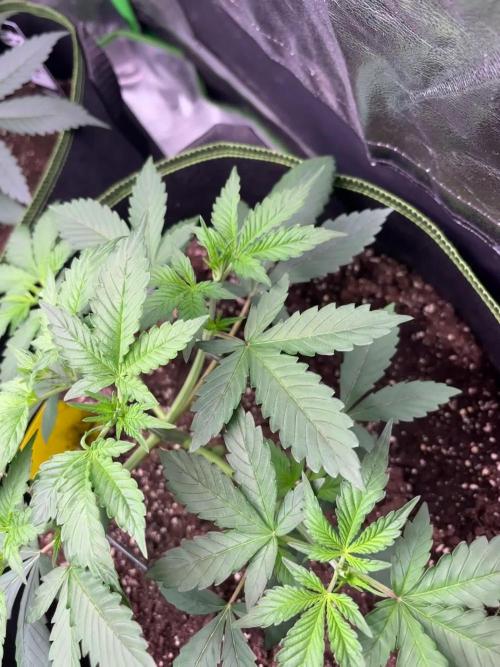
Ich habe an der Pflanze Low Stress Training und getoppt, damit ich maximal Ertrag erreichen kann und wie bisher immer keine Probleme

Likes
26
Share


@pifflestikkz
Follow
Day 29
29/07/24 Monday
Nice feeding today with De-chlorinated tap water pH 6.
Gave her 300 ml and she had a small run off.
Getting chunky in the stem now 💪💚
Day 31
31/07/24 Wednesday
De-chlorinated water pH 6 today with Plagron pk13-14 5ml to 5L
Plagron power buds 5ml to 5L
Used 300ml of the 5L solution.
I will be using these on water days from now on as they are advised to be used every irrigation.
We'll see how they perform 💪💚
Day 32
01/08/24 Thursday
Another feed today using de-chlorinated tap water pH 6, there now taking 300ml every evening.
Day 35
04/08/24 Sunday
END OF WEEK 😁
De-chlorinated tap water pH 6 today with Plagron products. 300ml each.
Had a issue with leaf invaders this week, I have treated and am checking every 48 hrs so far seems ok and not progressive.
All plants look great, very healthy, one of the Overdose is way behind and due to space maybe culled at flower I'll see how she gets on.

Likes
18
Share


@Scottishgrower710
Follow
Been so busy lately no had the chance to do catch up but am back and would like some tips if u can not sure if I should chop all the fan leaves off Done a bit of defoliation topped 6 and kept the 2 to the top right without topping but topping seemed to be the one a lot new potential bud sites because of topping and lst when should I go into flower and got new SPIDER FARMER 2000 what dim should I use thanks troops 😎happy growing
Likes
18
Share


@TheGreenLeopard
Follow
Thai chocolate the champion of this diary. Really amazing structure. Love the fan leaves - real classy. Has great hues through the bud. It’s has looked like a super model from seed all the way to here. A modern version of a classic. Give it a go

Likes
3
Share

@DogDoctorOfficial
Follow
🚂 Cash Express – Pheno B
Week 6 | Elegance in Every Leaf
Welcome back to another chapter of the 8×8 Adventure!
One of the greatest joys of a phenotype hunt is discovering that every plant has its own personality.
Some demand attention with explosive growth.
Some race toward the finish line.
Others quietly develop into something special without ever asking to be the centre of attention.
Cash Express Pheno B belongs to that last group.
She isn't the tallest plant in the room.
She isn't the fastest.
She isn't trying to compete with anyone.
She's simply growing exactly as she wants to—and every week she becomes a little more beautiful because of it.
🌿 A Plant That Speaks Through Her Leaves
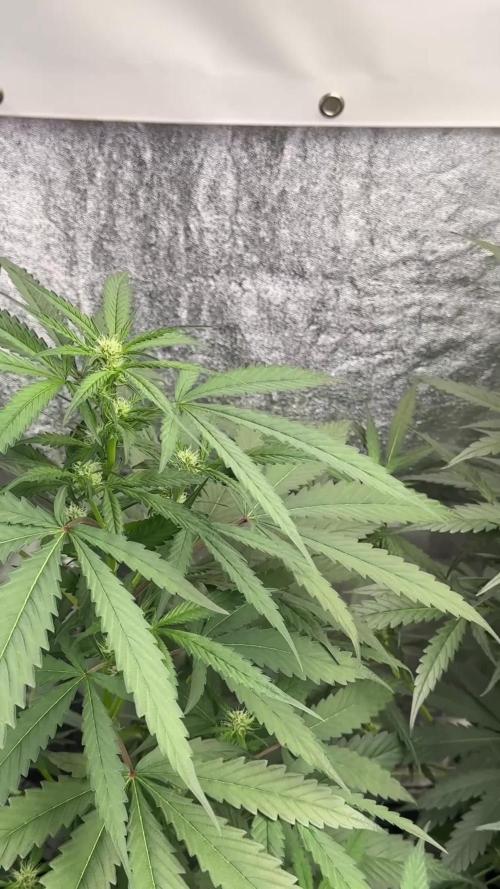
One of the first things that catches my eye every time I visit this lady is her foliage.
Large, perfectly formed seven-finger fan leaves stretch confidently toward the light, creating one of the cleanest leaf structures in the entire room.
They're deep green.
Healthy.
Symmetrical.
Every leaf almost looks like it was carefully drawn before nature decided to build it.
For me, leaves tell an important part of a plant's story.
Long before the flowers reach their full potential, healthy foliage tells us that the engine driving everything underneath is working exactly as it should.
And this engine is running beautifully.
🌼 The Flowering Story Begins
Flower development is now becoming more obvious throughout the canopy.
The first clusters of white pistils continue multiplying, and what were small pre-flowers only a week ago are now beginning to resemble true bud sites.
This is one of my favourite stages of cultivation.
Every day the changes are subtle...
Yet when you compare photographs from one week to the next, it's amazing how quickly those tiny flowers begin stacking into something much more impressive.
She's still directing a good portion of her energy toward the final stretch, but you can already see that her priorities are changing.
Less focus on producing new branches.
More focus on building flowers.
Week by week, she'll continue shifting her energy away from growing taller and toward creating the dense blooms we're all waiting for.
🍃 Sometimes the Best Training Is No Training
This week has been wonderfully uneventful.
No defoliation.
No heavy training.
No major adjustments.
Just a little gentle leaf tucking whenever a fan leaf decided to shade a developing flower site.
I've learned over the years that these early flowering weeks are often best approached with patience rather than scissors.
The plant is making enormous hormonal changes during this transition, and I prefer disturbing her as little as possible while she settles into her new rhythm.
Sometimes growers feel the need to do something every day.
Sometimes the smartest decision is simply to observe.
This week, observation was more than enough.
🍽️ Feeding
The nutrition program continues supporting both the final stretch and early flower development.
This week's feeding included:
• Terra Bloom – 1.9 ml/L
• Pure Zym – 1 ml/L
• Sugar Royal – 1 ml/L
• Power Buds – 1 ml/L
Along with small pH adjustments using Lemon Kick and pH Plus whenever necessary.
Unlike some of her sisters, Pheno B isn't asking for much more just yet.
A few older leaves have begun naturally giving back some stored nutrients, but nothing suggests she's under stress.
It's simply another reminder that plants recycle energy where it's needed most.
For now, she's happy.
And so am I.
🌡️ Environment
The flowering room continues running exactly as planned.
• Day temperature averaged 29°C
• Night temperature remained around 25°C
• Relative humidity averaged 60%
• Solution temperature stayed close to 24°C
• Root zone remained near 21°C
• Atmospheric CO₂ averaged 639 ppm
With stable environmental conditions and consistent feeding, the plant can dedicate nearly all of her energy to flower production instead of constantly adapting to changing conditions.
Consistency is often the secret ingredient behind healthy gardens.
📸 Behind This Week's Photos
This week's photographs highlight something I absolutely love about this phenotype.
The architecture is incredibly elegant.
The internode spacing is balanced.
The branching remains clean and open.
And those beautiful seven-finger fan leaves frame every developing flower site almost perfectly.
The close-up shots reveal fresh pistils reaching confidently into the light, while the full-plant photographs show a structure that should provide excellent airflow throughout flowering.
There's a calm confidence about this plant.
She isn't trying to impress anyone.
She simply looks comfortable being herself.
Sometimes those are the phenotypes that surprise you the most by harvest day.
🔍 Looking Ahead
Next week should mark another exciting step in her journey.
I expect the stretch to begin slowing as the flowers take over as the plant's primary focus.
Those small clusters of pistils should begin stacking together, giving us our first glimpse of the colas she'll eventually produce.
We'll continue with the same philosophy:
Minimal interference.
Gentle leaf tucking when necessary.
Careful observation.
And letting the plant decide the pace.
Sometimes the best growers aren't the ones who do the most.
They're the ones who know when to simply watch nature do what it has perfected over millions of years.
💚 Thank You
A huge thank you to everyone following this adventure.
Whether you've been here since Germination Week or you've only just joined the journey, your encouragement, conversations and shared experiences continue to make these diaries incredibly rewarding to create.
Special thanks to:
💚 GrowDiaries for bringing growers together from every corner of the world.
🌱 Zamnesia for providing the Cash Express genetics that continue revealing a unique personality with every passing week.
? Plagron for supplying the nutrition program supporting every stage of this grow.
💡 Future of Grow LED for delivering powerful, consistent lighting throughout the flowering room.
🌿 TrolMaster for maintaining the stable environment that allows every phenotype to perform at its best.
And finally...
Thank you to every grower, supporter, silent reader, friend and curious visitor who stops by these diaries. Every comment, question and discussion makes this project even more enjoyable to share.
I'll see you all next week as Cash Express Pheno B continues writing her own story—one leaf, one flower and one beautiful week at a time.
Growers Love, and happy growing everyone. 🌱🚂💚
Likes
3
Share


@BudBeat
Follow
Die Kabul leitet langsam aber sicher die Blüte ein. Sie wächst schön buschig und gleichmäßig. Find ich echt stark 🤘🏻Sie riecht auch schon schön. Bisher gibt es nichts negatives zu berichten und das ist auch gut so. Die Palette an Dünger hat sich natürlich erweitert und BioBloom und TopMax sind jetzt auch dabei. Die Kabul nimmt den Dünger gut auf und verwertet ihn ordentlich. Bis die Tage ✌️
Likes
12
Share


@DrShotzUK
Follow
Week 10 / 11
Starting the flush smells absolutely amazing
Big thanks to 420 fast buds for the seeds.
DRSHOTZUK💚💚🍀🍀
Likes
17
Share


@rockbo47
Follow
SUMMARY: Last week of early bloom nutes this week. She's flowering but slowly and I wonder if its due to the stress I caused with the big defoliation on Sunday 14/02 where I removed most fan leaves and all lower shoots of which the bud sites would not receive enough light and just create larfy poor quality low strength buds.
She smells very strong now as well.
DAY 51
--------
Friday 12th February 18:30
I fed Jesus 3L of early bloom nutes which produced 570ml runoff (19%).
DAY 52
--------
Saturday 13th February 18:00
I fed Jesus 3L of early bloom nutes which produced 610ml runoff (20%).
DAY 53
--------
Sunday 14th February 11:45
I made 10L of early bloom nutes with dechlorinated tap water (no rain water left), 5L at a pH of 5.7 and 5L at a pH of 5.6.
Sunday 14th February 18:00
I fed Jesus 3L of early bloom nutes which produced 800ml runoff (27%). [24°C/46%]
I did a second defoliation on Jesus which was supposed to just be removing some fan leaves and inner foliage I missed last time but I ended up getting carried away again. Every bud site has plenty of light now so hopefully shell bounce back quick.
I also raised the light again so that it is 16" above the canopy of Jesus as it was too close now Jesus has grown.
DAY 54
--------
Monday 15th February 18:30
I fed Jesus 3L of early bloom nutes which produced 1350ml runoff (45%).
DAY 55
--------
Tuesday 16th February 11:30
I made 10L of early bloom nutes with rainwater, 5L at a pH of 5.8 and 5L at a pH of 5.9.
I forgot to turn the heat down over night and the humidity is at 56% currently. [22°C/56%]
Tuesday 16th February 18:30
I fed Jesus 2.9L of early bloom nutes which produced 1250ml runoff (43%). Shes still not back to her usual intake after the defoliation 2 days ago.
I turned the dehumidifier on and set it to 45% as the RH had climbed to 62%. [22°C/62%]
DAY 56
--------
Wednesday 17th February 12:00
I made 10L of early bloom nutes with dechlorinated tap water, 5L at a pH of 5.7 and 5L at a pH of 5.6.
Wednesday 17th February 18:30
I fed Jesus 2.5L of early bloom nutes which produced 590ml runoff (24%).
DAY 57
--------
Thursday 18th February 18:30
I fed Jesus 2.5L of early bloom nutes which produced 800ml runoff (32%). At the wknd I think I'm going to try and bend the 2 tallest shoots down in the centre as they are taller than the rest by a bit now. I adjusted a couple of ties to expose more bud sites.
I had to move the light up again by 2 inches to accommodate for growth as it was sitting at 14" above the canopy. [24°C/52%]


Likes
18
Share


@thenotillwizard
Follow
Harvested at day 76, after 72h of darkness.
Very good yield!
3.3 pounds of dry buds + 1 pound of trim
The 2 keepers yielded 366 and 342g of premium quality smoke.
Very uplifting and energizing high :) Love it!