


Likes
Comments
Share


@Unkraut
Follow
i accidently bought some unbuffered coco and mixed it with my ussual earth, had major calmag problems in mid-flower but i´m still pleased with the results...also had a little trouble with mold at the end due to bad weather and high humidity in the final weeks of the grow, had to remove a few buds and harvest early @ day 55 of flower....but there's still alot of great looking buds left for me to enjoy and all look mostly done...
Just harvested and hung them upside down, currently drying them at constant 19.5-20.5°C and 50-60% RH..will update as soon as they are dry

Likes
2
Share


@Indy4
Follow
-Sunday September 8 switch to 12 12
-Defolition on the bottoms at F1, re-shave at F6.
-Hung up a charcoal filter and exausting via a window -RLF down @50%
-Light is up to 80% to reduce stretch and we are at around 1000 PPFD at canopy level now.
60x60cm tent used for my cuttings (I hope they survive, my cuttings have a high mortality) + a male in there that I don't want to flower while I have the Kalis flowering.
The lights are just 4x e27 at around 30W total. The idea is to keep plants in veg there. Needs a fan to stay cool but fairly cheap solution.

Likes
2
Share


@eldruida_lamota
Follow
Que pasa familia, vamos con la cuarta semana de vida de estas Gorilla Cookies Fast Flowering, de FastBuds.
Agradezco a Agrobeta todos los kits obtenidos de ellos 🙏.
Vamos al lío, el ph se controla en 6.2 , la temperatura la tenemos entre 22/24 grados y la humedad ronda el 50%. El Tetra 9 fue añadido de manera foliar, cambiamos el fotoperiodo a 12-12 desde que actualizó esta semana.
Estás próximas semanas veremos cómo avanzan.
Agrobeta:
https://www.agrobeta.com/agrobetatiendaonline/36-abonos-canamo
Hasta aquí todo, Buenos humos 💨💨💨


Likes
35
Share


@PapaBlob
Follow
04/08 Bon, bien ça y est. Elle est mure, et prête à se faire cueillir, et passer en séchage. Pour cette fois 3 semaines de plus on sufi à avoir un résultat qui me parait correcte. Demain je la coupe. 😁👍


Likes
52
Share


@UnorthadoxDude
Follow
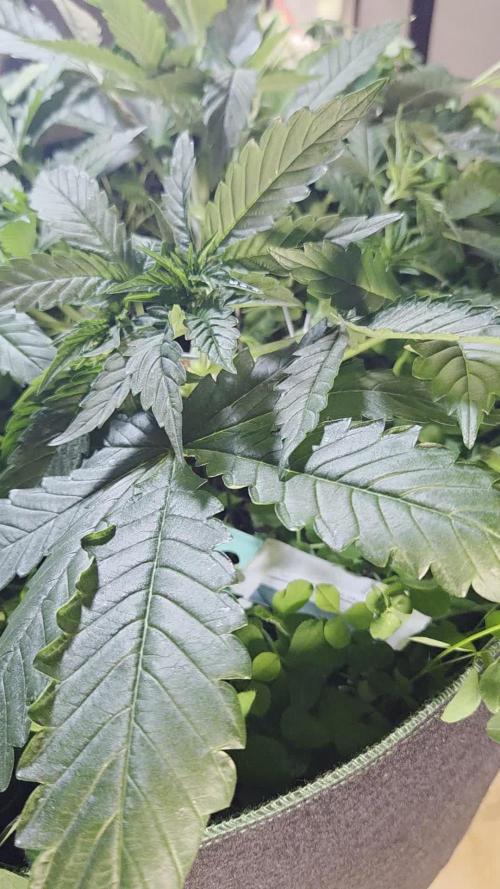
Hello and welcome to week 2 of veg phase for these five Epsilon F1 Hybrid ladies.
Last week is now complete with daily updates and media so please check it out.
For this week well frankly I am expecting massive growth. I have taken 3 fingered leaves from Normani today and five fingered from Ally.
It takes more time to photo and diarise but it is rewarding to look back on! See you tomorrow!
Day 9: Nothing to report. Sorry for lazy photos. Oh... I joined twitter @UnorthadoxDude
Day 10: Fertigated 5l. Loving Ally's party hands 👈👉
Day 11: Normani has overtaken Ally as the tallest and largest plant. Dinah has overtaken Lauren in a similar fashion. All girls kooking good except for some odd marks here and there (see video). Today after the photos and video and when she was back in the tent. I took about 4 or 5 leaves off each girl. You'll see tomorrow.
If you're here from Twitter, where I am also @UnorthadoxDude, please say hello in the comments! I've just joined and want to gauge if it is worth the time.
Day 13: Heights: Ally 23cm Normani 28cm Lauren 24cm Dinah 19cm Camila 17cm The girls have begun stretching it seems.
Day 14: Fertigated 5l and performed LST and defoliation. Normani height was 32cm.
End of week summary: Huge week of growth and these ladies are only just getting started. The pheno difference of Dinah is stark but super interesting.


Likes
9
Share

@n33bgr0w
Follow
Just chopped it down – hanging to dry.
I'll et back with more info after the dry!
Some harvest stats:
Afghan #1:
- Harvest weight = 181g
- Cola = 104g
- Wet-trimmed weight = 166g
Afghan #2:
- Harvest weight: 145g
- Cola = 44g
- Wet-trimmed weight = 128g

Likes
2
Share


@Bwright_315
Follow
Praying the warm weather holds out until October. I was told this strain take about 60 days in flower before harvest
Likes
9
Share
@HomeToGrow
Follow
Moin,
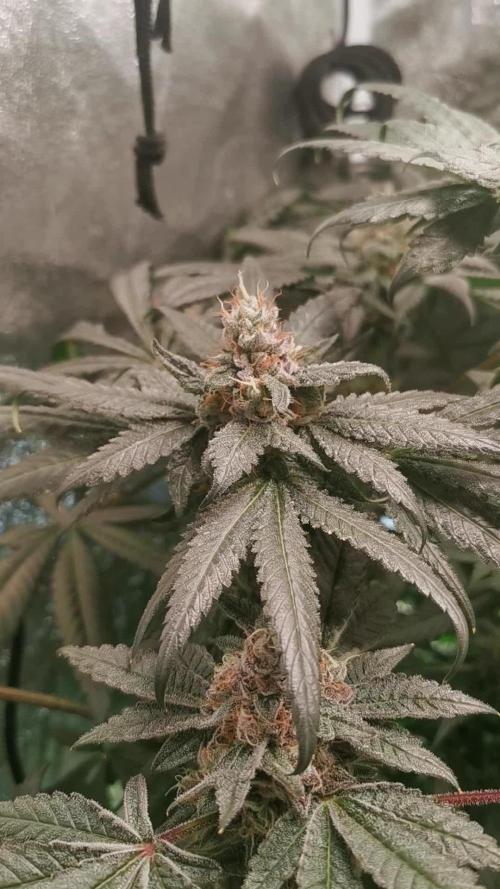
Die 8. Blütewoche ist fast durch und die White Sweet Candy OG geht weiter ihren Weg. Die süßen kushigen Blüten verströmen mittlerweile ein wirklich intensiven Geruch und in den letzten 7 Tagen ist noch mal mehr Masse dazu gekommen und die Buds gehen in die Abreife über.
Bis auf darauf, daas 2 Tage etwas zu wenig mit Drain gegossen wurde und somit leichte Adlerkrallen gebildet wurden gab es keine Auffälligkeiten.
Beim Düngen reduziere ich nun langsam den Stickstoffanteil, Silizium wird spätestens zum Ende der 8. Blütewoche ganz aus dem Düngeschema entfernt, Calcium und Magnesium wurden noch leicht erhöht, da die Z leichte Anzeichen eines Cal-(Mag) Mangel anzeigte, die White Sweet Candy OG hatte es eigentlich nicht gebraucht, da beide aber über den gleichen Tank laufen hatte ich hier keine wirkliche Wahl. Ziel ist ein EC Wert von 1 bis 1,2 Ende der 10. Blütewoche.
Sonst wirken die Trichome relativ sandig und ggf. werden ich endlich mal dazu kommen ein bisschen WPFF Hash zu waschen.
Likes
37
Share


@Roberts
Follow
Candy has been growing good. I switched h her light times today. So her flower adventure is getting started. I will likely be doing a solution change next update for blooming nutrition. I trimmed some of the under growth, and some defoliation in the rest. Everything is looking good, and she seems ready to go. Thank you Spider Farmer, Athena, and Divine Seeds. 🤜🏻🤛🏻🌱🌱🌱
Thank you grow diaries community for the 👇likes👇, follows, comments, and subscriptions on my YouTube channel👇.
❄️🌱🍻 Happy Growing 🌱🌱🌱
https://youtube.com/channel/UCAhN7yRzWLpcaRHhMIQ7X4g.

Likes
47
Share


@Smithsgrow420
Follow
I feel like this is week 7 of flowering not week 6 I think I may of missed a week at the beginning of flowering.
I have been feeding her a 25l mixture of feed a week. 3.3 ltr a day. It has been taking this really well, been doing for 2 weeks now.
Going to start my flush on 20/10 and also planing to drill her on the same day. Will take photos.
She is really starting to fatten up now, can see them buds get bigger and bigger everyday!!!
Still keeping the feeds up trying to get as much as I can in her!!!!
Still keep the comments coming in!!!!
Is she amazing or what!?
Start the flush when!?
When to harvested her!?
Would love to know what everyone thinks!!!


Likes
Comments
Share


@BIXXIE
Follow
Its very small for week 4 compared to my other plants. But this phenotype is sneaky. It'll fatten up soon.


Likes
86
Share


@Hawkbo
Follow
Day late on the update, pics/vids were taken on time tho just been a crazy week of harvests and trimming and keeping up with these. I linked up with Rain Science Grow Bags on Instagram and got them to offer all my followers and friends a discount of 10% off entire order from their site with the code ' bangdang ' so if anyone is in the market for a pot upgrade use that code. I got them in the mail 3 days after I ordered. Reason I went with Rain Science is because they offer identical air flow for rapid growth as the radicle bags, just using a different material and a tighter knit so water doesnt flood out the sides during feeds and when you pick these up when the coco is dry, it wont fly all over the tent like with the radicles. They're the optimal bag for autoflowers especially.
These 2 are doing great should get interesting in the next few weeks. I actually ran 3 of these in 1 gallon pots a few months ago and 2 atleast came out pretty good so the bus shots are from the 2nd pheno of those.


Likes
34
Share


@SalocinSpecial
Follow
D68 (28/01/2021): First official day of week 6 in bloom and first official day (second in reality) of pre harvest flush. The smell is strong when I open the tent! It does not take long for the whole room to smell dank and even outside the room.
- temp: 24-25C light ON ; 20-22C light OFF
- no water
- RH: 49-52% light ON ; 49-50% light OFF
D69 (29/01/2021): I did a first proper flush today by running approximately 2.5 gallons of water trough the medium. There is still a lot of nutrients in the medium. I might do the exact same flush tomorrow. The PH of the run off is high (around PH7-7.1). This is an other reason to flush again tomorrow. I also reduced the light ON schedule by two hours. So now 18h hours ON and 6 hours OFF. I will continue reducing the ON period until they are ready for a complete dark period. I also try to reduce the air temperature.
- temp: 24-25C light ON ; 19-20C light OFF
- water: PH6.4, 135PPM, 2.5 gallons each
- run off: PH7 and 680PPM for Glue Gelato ; PH7.1 and 560PPM for Banana Kush
- RH: 47% light ON ; 48-53% light OFF
D70 (30/01/2021): I did a second flush since I was not satisfied with run off PPM of yesterday. Today, the run off PPM is under 300 which is what I wanted. The run off PH is still high with 7.1. Banana Kush is ripening with the pistils slowly turning brown. Glue Gelato look sooooo yummy and I can't wait to harvest it. There is a small color change in some leaves but I'm expecting more in the next days.
- temp: 23-24C light ON ; 19C light OFF
- water: PH6.4, 125PPM, 2.5 gallons each
- run off: PH7.1 and 260PPM for Glue Gelato ; PH7.1 and 250PPM for Banana Kush
- RH: 46% light ON ; 46-48% light OFF
D71 (31/01/2021): Glue Gelato is changing color. I'm checking trichomes everyday on both girls and no amber yet.
- temp: 23-24C light ON ; 19C light OFF
- no water
- RH: 45% light ON ; 49-50% light OFF
D72 (01/02/2021): Well well well...the clock is ticking for those girls. Glue Gelato is now having a couple of amber trichomes. Banana Kush don't have any. Overall Banana Kush has less trichomes and fluffier buds. This girls is not ready yet but I will need to chop her down at the same time has the Glue Gelato because my drying space is the tent I'm growing in. I will try to push the Banana Kush to ripen faster by lifting up the lamp at 16 inches from top bud and by reducing of 2 hours the day period for a 16 hours light ON and 8 hours light OFF. But at least all Banana Kush trichomes looks milky.
- temp: 23-24C light ON ; 18-19C light OFF
- water: PH6.2, 123PPM, less then a gallon each
- run off: PH7.4 and 200PPM for Glue Gelato ; PH7.4 and 287PPM for Banana Kush
- RH: 45% light ON ; 40-45% light OFF
D73 (02/02/2021): I gave water probably for the last time today. Trichomes on Glue Gelato are starting to amber on top buds. Not a lot of amber but you can see that all the trichomes are starting to degrade by curling down slowly. Trichomes on Banana Kush are not amber at all but they all look milky. Glue Gelato is ready to harvest but Banana Kush need more time. It's tough to make a decision to chop or not since they are not at the same stage of growth. I want to place them in a complete 48 hours of darkness before harvest. 1h less light today for a 15h light ON and 9h light OFF. The lamps are now at 20 inches.
- temp: 23-24C light ON ; 18-19C light OFF
- water: less then a gallon each
- RH: 45% light ON ; 40-45% light OFF
D74 (03/02/2021): Glue Gelato is ready for 48h of darkness. I will take her out of the tent and place her in an other room without light. I will try to maintain a proper environment in this room and if it smells to strong or if the condition are not good I will replace her in the tent and both will start the 48h darkness. The idea is to give Banana Kush 2 more days to ripe and swoll more. After 48h, I will chop Glue Gelato and place her in the tent to start drying. Banana Kush will then start her 48h darkness. I don't know if this strategy is good but I will monitor everything closely and react if something is wrong.
- temp: 22-23C light ON ; 19C light OFF
- no water
- RH: 47% light ON ; 43-45% light OFF


Likes
19
Share


@MadeInGermany
Follow
Hi all 🤗.
Wonder Pie did the topping very well :-).
She grows nice and bushy, and hopefully becomes a monster 😍👍.
This week will be topped again. I wish you all a nice week, stay healthy 🙏🏻 and let it grow 🌱
Type:
Wonder Pie
☝️🏼
Genetics:
Wedding Cake x OG Kush
👍😍
Vega lamp: 2 x Todogrow Led
Quantum Board 100 W
💡
Flower Lamp : 2 x Todogrow Led
Cxb 3590 COB 3500 K 205 W
💡💡☝️🏼
Earth: Canna Bio
☝️🏼
Fertilizer: Canna Bio
☝️🏼🌱
Water: Osmosis water mixed with normal water (24 hours stale that the chlorine evaporates) to 0.2 EC. Add Cal / Mag to 0.4 Ec Ph with Organic Ph - to 6.0

Likes
Comments
Share


@TexasJack0418
Follow
Day 30; Both plants showed signs of going into bud stage so I top dressed & feeding. 1st, 24hrs before I prepared worm tea. I put 3tbsp Molasses, 5ml/gal Cal/Mag, 10ml/gal Seaweed/Fish extract, .5ml/gal Orca, 2-packs Green Tea, 1-1/2cups worm castings. aerated 24hrs. 2nd, Prepare coir for top dressing, remove all LST ties & stakes, Scoop out cedar chips from surface. Add 1/4cup Dr. Earth Organic 4-6-3, 1/4cup Bone Meal, 1/8cup Bat Guano, 1/2cup Coffee Chaff, 1/2cup Worm Castings to surface. Hand mix in dressing into top 2" of coco coir. Re-apply Cedar chips, do LST. 3rd, Top Feed 3/4gal per plant, Bottom Feed 3/4gal per plant. By day33 plants had doubled in size so I re-LST & light leaf removal, sprayed Neems Oil on both ladies, the stretch was on... Day35, watered 1-1/2gal ea. 5mil/gal Cal/Mag, 5ml/gal seaweed/fish extract. Lil LST and light leaf removal.

Likes
38
Share


@TrueNorth
Follow
Growth is phenomenal , scent is starting to get stronger. Looking super healthy noticeable growth daily. That bud candy from advanced nutrients is really coming into work now. That makes me super excited. THICCCC 🍭 trim in full force or i think anyways lol. Advanced nutrients Bud Ignitor introduction this week!
