


Likes
Comments
Share


@Spliffing_Around
Follow
We continue to mix our own nutes, but I started also testing Nutra Hydro . One rack only for now. Next project is upcoming for organic beds or huge pots. STAT TUNED BROTHERS ANS SISTERS ! Grower love ❤️❤️❤️!!!!


Likes
4
Share


@Soskar69
Follow
Hello!!
Too bad I only found this site now and didn't take too many photos during the first month.
About the plant, it was the smallest of my plants at first, but then it grew very weel and now is the biggest of my girls. She entered in flowering a week later than expected, but beacuse of that she could grow more than the others. I've done only some LST and the plant just loved it, now i have like 11-12 main stems. Today I also have done some lollipopping but very cautiously because it was my first time doing it, and I didn't want to mess up.

Likes
89
Share


@Zurban_Poison
Follow
Hello friends, everyone!
I would like to inform you that this report is being held within the framework of the local growing championship in which the winners will appear in 4 categories ..
Our girl will compete for the title in the Best Hibrid category! wish us good luck!
And by the way! I have interesting plans for this girl!) do not miss the report!


Likes
3
Share

@BlaKX
Follow
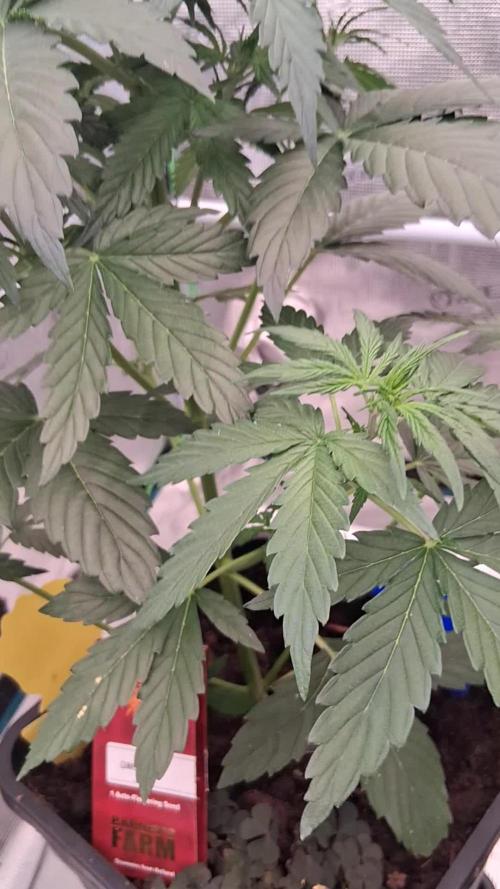
Es ist wirklich erstaunlich wie gut sie sich in diesen 7 Tagen entwickelt hat! Sie hat 45cm höhe und gute verzweigungen entwickelt. Sie hat ihr Geschlecht schon gezeigt und die Vorblüte beginnt. Ich werde in 7 Tagen sehen wohin die Reise gehen wird.
Falls Sie die Dr.Ziaus OG ersetzen wird weil eine leichte mutation gegen genetischen fail.📈 Current Conditions
🌡️ Day: 24,0-26°C
🌡️ Night: 19-20°C
💨 Humidity: 60-65%
🌬️ VPD = 0.9-1.2 kPa
🔦 PPFD: 400 µmol (20/4 light cycle)
💡DLI:28,5

Likes
15
Share


@Springbokke
Follow
Доброго времени суток
Сегодня конец первой недели перевода на цвет. Перед переводом поставил сетку, от верхушки растения до сетки было 20 см(нужно было ставить не выше 10см от верхушки растения), девочка моя выросла за неделю 19-20см, что оказалось не достаточным и мне пришлось поднять сегодня горшок на 4-5см. Так же я сегодня поставил железный хамут у основания, но я еще не стал сильно зажимать его. а так сказать подготовил для дальнейшего зажима(и за сетки мне бы было проблематично в будущем это сделать). Планирую зажать хамут где то через недели 3-4, не раньше. Яркость лампы 3500К увеличил до 75%, а 5000К до 100%, через неделю планирую убрать 5000К и поставить 200вт 3500К, и 200вт 3000К.
Поливать стал каждый день, сегодня девочке моей 68 дней жизни.
Полил ( 980ppm )-3л Cal-mag Xtra - 0,5мл/л; Bud Candy - 2мл/л; 1-й день предцвета
Полил ( 919ppm )-3л 2-й день предцвета
Полил ( 903ppm )-3л Bud Ignitor - 2мл/л; 3-й день предцвета
Полил ( 754ppm )-3л 4-й день предцвета
Полил ( 936ppm )-3л Bud Candy - 2мл/л; 5-й день предцвета
Полил ( 872ppm )-3л Bud Ignitor - 2мл/л; Piranha - 2мл/л; VooDoo Juice - 2мл/л; Tarantula - 2мл/л 6-й день предцвета
Полил 3л 7-й день предцвета
До харвеста 9-10 недель, не думаю чтоб заняло больше.

Likes
5
Share


@PortkeyCannabis
Follow
New light 150w led. Also did one light feeding with bad results. Got nute testing kit tested the super living soil is more then holding up. Sohum soil. Fit new text a3x3 she seems more happy with more space. I have been using lst. Just water dechlorinated

Likes
21
Share


@Fullmeltalchemist
Follow
01.09 - d0
Had 30/30 seeds germinate - solid. My solo cups are bottom 1/3 Nature's Living Soil Super Soil and top 2/3 ffof
Topped as soon as node 3 growth tips we visible.
01.16 - d7


Likes
Comments
Share


@Maxximillia420
Follow
14.01.2020
Day. 30
Plant is exploding and growing steadily!!
This week Iam gonna cut some cuttings and in about 1- 2 weeks time it’s gone go into the big box !! Nothing exiting happing till now but that’s gonna change soon

Likes
21
Share


@24Gamez
Follow
Wow a long week, experiment definitely started showing differences but also mistakes were made. First I missed a watering a let them get too dry soil starting to stay a dark color and threw me off... But watered and fed anyway but I think because I was using pH drops to test water (didn't know how easy it is to break the meters) I may have made concentration too acidic or soil turning acidic. I don't think there is any nutrient burn just deficiencies (calcium and phosphorus) but I could be wrong. Ordered cal-mag just in case. One thing I've noticed not sure if it is only because 5 gal pots but plants 1 nd 2 looking massive. I may only use 5 gal pots next time but still early to tell. If anyone wants more info on what I'm trying to test or see something I'm doing wrong plz comment. PS soil is waaaay different than hydro lol


Likes
17
Share


@BioGrowKing
Follow
Nun bin ich in der siebten Woche sie ist in der letzten Woche und gute 10 cm gewachsen die Blätter sind sehr schön Und grün auch so macht sie einen guten Eindruck die Seiten arme kommst sehr schön heraus und sie wächst und wächst, heute am 24. September habe ich sie gedüngt mit Green House Bio Grow empfohlen werden 3-5g Substrat pro Liter da mein Topf 2 Liter hat habe ich heute 6g als öbeeflächendüngung einmassiert.
Außerdem habe ich enhancer benutzt und auch hier als oberflächendüngung. Es sind 0,5 Gramm pro Liter da ich 2 Liter habe benutze ich ein Gramm heute jedoch habe ich ca 0,5 g auf die Oberfläche gestreut und dann nach gegossen noch schaue mal ob sich das bewährt.

Likes
151
Share

@Zurban_Poison
Follow
Harvest took about 3 hours! The buds are big, firm and covered in gluey trichomes! harvest of the highest class!

Likes
6
Share


@Naveplanet
Follow
I transplanted first time in last day of first week. Let's watch about coming week 😊



Likes
46
Share


@J4kpvp
Follow
Hello:) I finally harvested today. It all went well, they barely fit in the tent so I had to get a bit creative.
Sadly, I actually found mold in the bud that I was suspecting. The big main bud from the sangria in the back right…. I lost about 40g wet but I‘m still happy that I saw it now.
Now they have to dry for at least a week, so i‘ll be back with dry weight and stuff like that:)
Likes
5
Share


@SimonLorem
Follow
This week brought some challenges—I discovered thrips on the leaves of my plant. Thankfully, the infestation isn’t too severe yet, and I acted quickly to address the issue:
1. Sprayed the plant with plain water to knock off any pests.
2. Removed the top layer of soil.
3. Applied BioBizz Leaf Coat as a protective measure.
I really hope this will help. After reading up on these nasty pests, I learned that they can completely devastate the leaves if left unchecked.
Unfortunately, I have only myself to blame for their appearance. Due to the cold weather, I’ve been using a heater in the room with my growbox, which has caused the humidity to drop significantly. It sometimes dips as low as 30%, and it rarely goes above 50%. Most of the time, the humidity hovers around 35-40%, which is an ideal breeding ground for thrips.
To answer the obvious question—yes, I do have a humidifier. However, my growbox has a very powerful exhaust fan (315 m³/h for an 80x80 space), so the air is refreshed too quickly for the humidifier to make a lasting difference.
Aside from fighting thrips, I also made some adjustments to my grow this week. On Day 20, I did a little LST. Honestly, I wasn’t planning on using any training techniques in this grow, but I decided to give it a try anyway. One thing I can say for sure—I want to skip LST in my next grow. It’s quite inconvenient to water the plant when the leaves are practically touching the soil.
Additionally, I defoliated the first two sets of leaves. I felt this was necessary to improve airflow around the plant and reduce the risk of pests spreading further.
Watering:
Day 17: 400 ml
Day 20: 500 ml
I’m keeping a close eye on the plant and hope to overcome these challenges successfully.
Likes
69
Share


@Natrona
Follow
FRACTAL
*****DIVINE SEEDS *****
*****FRACTAL*****
SPONSORED GROW
Week 11 6/16-22 Fractal
Hot, Hot, Hot Temps in the 90’s with high humidity, watering daily and feeding 2xper week. All the gals are in flower.
6/16
TPS1 15ml/gal @4 gal =60ml
Signal
1.25 ml
Cal mag 10ml @4 gal
Recharge ½ tsp/gal =10ml
Kelp & fish GS plant foods 1/4c /gal @ 4 gal =1c
Neem ½ tsp (for Japanses beetles)
Ph5.7
PPM 1120
Solution Temp 85
Outside temp 92f
Feeding on 6/19 was the same but the PPM was higher at 1220. A bit heavy handed on something.6/19 was a big defoliation day. Fractal had a haircut. I took off all the fan and several feeder leaves. Fractal is average height 3.5’ very indica structured. Very bushy and multibranching. She has one mane stalk with branches unevenly set. The branches have side branches which I cut off.
============
Germination April 6.
Vegetation
Week 1 water only
Week 2 water only
Week 3 added recharge and TPS1 increased ppm to 570.
Week 4 continues with recharge and TPS1. I added Fox Cal mag increasing ppm to 685 - 805.
Week 5
TPS1 9ml/gal
Recharge 5 ml/gal
Fox Cal-mag 5 ml/gal
Week 6 5/12-19 Moved outside in 5 gal air pots receiving rain and well water.
Week 7 5/19-25
Opium received only rainwater for the last 2 weeks. Since I was in Colorado last week, I feel very behind on my diaries. Despite my absence, my outside gals did just fine. Opium loves the outside sun, breeze, and frequent rain.
Week 9 6/2-6/8 Now at the start of week 9, my outside gals, except L. Cake are now in flower.
Several pics show the very narrow new leaves and small white hairs evidence of flower formation. 6/7 This is the first time I’ve had to add nutrients to her feeding. Some lower leaves were yellow. Since I’ve been using amended soil, this indicates Fractal is a heavy feeder. Nutrients in soils are used up and she is starting to use her own food sources
6/7
5 gallons well water
TPS1 60ml used 1 gallon per plant =12ml
Cal-Mag 25ml used 1 gallon per plant =5ml
Recharge 5ml used 1 gallon per plant =1ml
Signal 1.25ml
PPM 1414, PH 6.93, Temp 82.5
Note I do not have to PH adjust my well water. However, our city water comes out of the tap at 8.2 ph so I must PH down using the city line hose and my inside grows.
Week 10 6/9-15 Fractal loves the outside. She bushy and 3 1/2feet tall. All are showing yellowing leaves so everyone is now getting nutrients with feedings.
I saw a Japanese beetle on my Lemon Cake and some small holes in the leaves so I added 1/2 tsp neem to the feed solution 6/12. Also started using fish & kelp. I'm still watering 1 gal per plant when I feed 2x/week. With the heat and humidity, I water daily but do not feed daily.
Nutrients:
TPS1 15ml/gal @4 gal =60ml
Signal
1.5 ml
Cal mag 10ml @4 gal
Recharge ½ tsp/gal =10ml
Kelp & fish GS plant foods 1/4c /gal @ 4 gal =1c
Neem ½ tsp (for Japanses beetles)
Ph5.7
PPM 1260
Solution Temp 85
Outside temp 92f
They love the natural rain and sunshine evidenced by vigorous growth.
Thank you @DivineSeeds
Thanks for the visits, likes and comment, I appreciate all the plant love💚.
Have fun & love what you grow 💚
Sending you good vibes of love, light, and healing 💫
💫Natrona 💫
Sending you good vibes of love, light, and healing 💫
💫Natrona 💫
***FRACTAL***a
Rating:
Fractal is an especially psychedelic strain that Divine Seeds developed for esoteric and mystical experiences, meditation and creativity. A potent and vivid landrace variety from Southern India was crossed with a sticky leaning Indica (mostly Afghani), then Skunk #1 joined this company. Their progeny underwent multiple selection experiments, until its massive built, resin concentration and hypnotizing powers reached an ultimate level. The result is now known as Fractal – resinous, spicy and productive. Best choice for commercial growing: a compromise between bigger yields and fast ripening! A great source of hashish that has something incense-like to its musky smell.
Indoors expect 170 сm height, out of doors plants grow up to 200 сm. Fractal fits for all types of growing environment: grow boxes, hydroponic or aeroponic setups, outdoor plantations, balconies, terraces and green houses. For more weight it is recommended to train Fractal plants to broaden their structure and limit their vertical growth. For that purpose use ScroG or SoG, LST, FIM or topping, supercropping or mainlining – there are no limitations for the strain itself, but certainly low-stress methods are recommended to smaller samples. Fractal has an inherent immunity to molds and insect pests, but since its colas are thick, protect your plants from stale air. Also during rainy weeks your plantation may need to be covered. Ready for outdoor harvesting in October. Big and dense buds the color of olive, hunter green heavily coated with crystals.
Whole Fractal buds smell hashy and earthy, while cedar and fruity hints are noticeable on breaking. Measure your portion carefully: the potency is above average! With Fractal you experience an overall stoning that either keeps you put or slows your motion down, also vertigo is possible. However, in moderate dosage the impact is described as a pleasant sensation of well-being and placidity. Perfect for spending a night by a bonfire without talking, therefore is more often enjoyed as a solo smoke. Efficiently relieves muscle spasms and seizures, inflammations, combats insomnia and increases your appetite. Up to 3 hours of altered state of mind can be expected. Best consumed at night time.
Pots: 5gallon Air pots
Soil Fox Farm Happy Frog Amended with worm castings, dolomite lime and mychorihiza
Seeds provided by Divine Seeds
Divine Seeds breeding company
The link to Fractal Feminized Seeds
Fractal - Divine Seeds breeding company
The link to Fractal Auto Seeds
Auto Fractal - Divine Seeds breeding company
=================================

Likes
11
Share


@BalconyWiTCH
Follow
Week 12 9th of may:
I cut off the main cola of the Green Gelato and left smaller buds to grow more.
Hulkberry is Sativa dominant so I will give her more time
Royal Gorilla is almost ready


Likes
4
Share


@Growedbypepper
Follow
Meseta planta se ve péqueña aún debido al proceso que llevamos del esquejé que la ha retardado un poco pero ya se empieza a notar un desarrolló más rápido podría tener un par de semanas más de vegetación y de ahí podría pasarla a floración hasta ahora todo muy bien ninguna Plaga vista y un manejo de plagas por jabón potásico para insectos durante esta semana solo una aplicación y para fungicidas un poco de fungical también solo una aplicación con un día por medio de distancia en tiempo 1 cm por litro
Likes
10
Share


@tontodedoverdee
Follow
8/4
Already 4 days passed since the beginning of the week and the Runtz grow so much, she's becoming really tall as you can see, the top bud it's increasing yield and growing new pistils every day, the lower branches looks a bit late flowering, from this week I'm gonna add also extra 200w led and some extra nut