


Likes
Comments
Share


@KeemBboomin
Follow
So where I live we had a really bad storm it had knocked out my power for a full 24 hrs so I had to give them some extra attention to insure there was no mold or any pest with no fan rotation. Then I also had to put them back on there proper timer to get things back on a roll so far so good they still look and smell amazing wish me luck
Likes
2
Share


@MistaOC
Follow
25.05. 🌿 Day 25 – Stretching Begins!
The plants have noticeably stretched since the last update — a clear sign that they’re moving deeper into the vegetative phase. The vertical growth is picking up pace, but they’re still looking strong and well-balanced.
Despite the rapid upward growth, structure remains solid, with thick stems and healthy leaf development. The 19L pots and BioGrow feeding seem to be doing their job — no signs of deficiencies or stress.
Light distance and environment are being carefully managed to control the stretch and keep the plants from getting too lanky. So far, they’re adapting really well.
💪 Overall: they’re thriving!
——————————————————————
27.05.
Likes
209
Share


@BioBuds
Follow
At the beginning of this week, I have been fighting the gnats, which are less and less now. Just some watering and gradually lowering the light and going to full power. The Orange Hill Special has been filling out great and I must say, she is a pretty plant. With some manual bending and super cropping, I'm bending the longer stalks sideways and we are off. What I actually do is more of an intuitive hybrid between mainlining (where I bend the whole plant 90 degrees at the third week), LST (where I bend branches outward slightly, without tying), HST / Super crop (where I bend the stems 90 degrees with the clips or manually), after which I keep bending outward to SOG and, put the net over to end in SCROG.
This same method gave me the canopy in my prize-winning Gelato 33 grow. Check it out if you haven't seen it, it was my first experimental accident that led to beta test of Super Soil mixture 0.7, now we are at Alpha version 1.00 and testing great so far if I say so myself. I haven't seen such lush greens in my own grows, only outdoor. They seem uber-healthy and resilient, with very sturdy stems and leaves. Way more resilient than previous strains I tested in the beta soil.
The light is performing, the natural color of it makes everything pop. Mars Hydro has a winner with the SP-3000. Check out their site: www.mars-hydro.com
Thank you @MarsHydroLED for letting me test it, hook them up for a great deal or info on their products!
Halfway through this week, I took the clips out, AND...... we switched them to go into flowering. After a day the stretch is already visible. I had to bend them again after a couple of days. Now we have almost a tent filling foundation for a maximum result canopy of buds.
I was wanting to amend the soil with flowering additions (see recipe in yellow image), but I'm holding it off for two reasons. A/ The leaves are still so green and lush, I think there is an abundance of nutes. B/ @Haoss mentions his suspicions on his OHS grow (@#CannapediaProGrowersCup Orange Hill that very sadly went hermie on him) that nutrition in this phase could have had an influence, after asking what happened to him. I would have loved to see that grow to full harvest. But it makes me a bit cautious. if Haoss (whom I consider to be one of the star growers here) couldn't prevent this, what chance have I?
I'm waiting until the girls start asking for nutrients. They'll show me what they need in their own time. For now this soil is the shizzle (also quite literally) and Im happy with how everything is going. I remember much more hassle and steering in the last grow. This grow, even the Gorilla runt seems happy.
I now water them 3 liters of water / Perma tea mixture every 4 days, every 3rd watering I don't do the tea. This makes for fewer gnats and this soil seems to hold water nicely, also due to the hydro corn.
What I like is there is always some unforeseen circumstance, a tilt of the tables, some battle to be fought which delivers in big harvests or, in worst case, no harvest at all. It makes it more exciting, when your heart is at stake, we pour a lot of love and attention in the ladies.
So with hopes, but not too high, we go into flowering. Thank you all for joining me again in this Orange adventure! I hope you all had great weeks, germed seeds, extreme growth and buds bursting with trichomes!! See you next week!
Hug Bud
PS Sunshine made her first appearance, as she promised on the Gelato 33 grow. She is still a bit camera shy, so her digital alter makes an appearance first, if you all want to see more of her and my other helpers, let me know in the comments. Sunshine will make a real appearance if yall are real nice to her.


Likes
8
Share


@eldruida_lamota
Follow
Que pasa familia, vamos con la cuarta semana de crecimiento de estas Papayton feminizadas de fastbuds.
Vamos al lío ,se trasplantaron en macetas de 7 litros definitivamente.
El ph se controla en 6.0 , la temperatura la tenemos entre 24/20 grados y la humedad ronda el 50%.
El ciclo de crecimiento puse 16h de luz, el foco está al 50% de potencia.
De momento van creciendo a buen ritmo y tienen un buen color, estaban muy bien enraizadas al realizarle el trasplante se notaba la abundancia radicular.
Agradecer a Agrobeta por el kit Gold series que mandaron, siempre os portáis, unos maestros.
- os dejo por aquí un CÓDIGO: Eldruida
Descuento para la tienda de MARS HYDRO.
https://www.mars-hydro.com
Hasta aquí todo, Buenos humos 💨💨💨


Likes
4
Share


@DogDoctorOfficial
Follow
💙 8×8 Adventure – Week 14 🌿
Blueberry Muffin – Pheno B
🌸 A Little Further Ahead, Still in No Hurry — The Compact Girl Follows Her Own Clock
Welcome back to another chapter of the 8×8 Adventure! 🌱💚
And here we are again...
Blueberry Muffin Pheno B.
😂💙
Still compact.
Still taking her time.
Still looking at the rest of the room as if everybody else is running around for absolutely no reason.
And honestly?
I think she might have a point.
😂🌿
She's moving forward, she's developing beautifully, and she's actually a little further along than her sister.
But let's not get carried away.
We're not talking about a sudden transformation into the fastest girl in the room.
Nope.
She's still taking the scenic route.
She's simply a little further down that road than Pheno A.
And when I look at her now, I really like what I'm seeing.
The flowers have their own character.
The structure is beautiful.
She's continuing to evolve.
And despite her slower pace compared with much of the room, she's giving us plenty of reasons to keep watching.
💙🌸✨
So this week, we're keeping things simple.
No dramatic changes.
No new environmental strategy.
No attempt to force her to catch up with her neighbours.
We're letting her continue at her own pace while we observe the differences between these two sisters.
Because if the 8×8 Adventure has taught me anything, it's that the plants don't always follow the schedule we imagine for them.
And Blueberry Muffin Pheno B?
She's following hers.
Let's give this little lady her spotlight!
────────────────────────
🌱 THE 8×8 ADVENTURE — ONE ROOM, MANY DIFFERENT CLOCKS
For anyone discovering this diary for the first time, welcome to the 8×8 Adventure!
The idea behind this project is simple.
We're observing different genetics and phenotypes sharing the same general growing environment.
Same room.
Same lighting ecosystem.
Same 12/12 schedule.
Same general nutritional approach.
Same grower.
But very different plants.
Some stretch.
Some stay compact.
Some develop quickly.
Others take their time.
Some become giants.
Others seem perfectly happy keeping their feet on the ground.
😂🌿
And then there are plants like our Blueberry Muffin sisters.
Both compact.
Both progressing more slowly than much of the room.
Both beautiful.
But still following their own individual timelines.
That's what makes this experiment interesting.
We're not trying to make every plant behave identically.
We're watching what happens when different genetic expressions share the same general conditions.
And Pheno B is giving us another little piece of that puzzle.
💙🌱
────────────────────────
💙 STILL COMPACT — BUT A LITTLE FURTHER ALONG
Let's talk about the difference between the sisters.
Pheno B is a little more advanced than Pheno A at the moment.
Not dramatically.
Not enough to make us forget that both girls are progressing more slowly than many of their neighbours.
But it's noticeable.
And I like documenting those little differences.
Because when you look at the cultivar name alone, it's easy to imagine that both plants should behave in roughly the same way.
But plants aren't copies of one another.
Even when two plants share the same genetic background, individual phenotypes can express themselves differently.
They can have different structures.
Different growth patterns.
Different rates of development.
And different finishing timelines.
Here, Pheno B is just a little further along.
She's still compact.
Still taking her time.
But she's showing us her own version of Blueberry Muffin.
And that's exactly what we want to document.
💙🌸
────────────────────────
🐢 NO HURRY, NO PANIC, NO RACE
I swear these girls have their own calendars.
😂💙
The rest of the room keeps moving, and these two Blueberry Muffins seem perfectly comfortable doing things at their own speed.
And you know what?
That's fine.
We're not running a race.
We're not handing out prizes for the fastest plant to reach the next stage.
And we're certainly not going to assume that every difference in timing means something needs to be changed.
Pheno B is developing.
She's progressing.
She's looking beautiful.
She's simply taking longer than many of the other girls.
That's the observation.
And that's what we'll continue to document.
The important thing is to distinguish between a plant that is progressing slowly and a plant that is showing signs of a problem.
Those aren't automatically the same thing.
So rather than making assumptions based on the calendar alone, we're watching the actual plant and how she develops.
No unnecessary drama.
No imaginary deadlines.
Just Blueberry Muffin doing her thing.
😂💙🌿
────────────────────────
🌸 THE FLOWERS DESERVE THE ATTENTION
Now, let's leave the calendar aside for a moment.
Because I don't want this report to become entirely about how slowly she's moving.
There's much more to this girl than her timeline.
She's developing beautiful flowers, and her structure is worth appreciating on its own.
When I look at her, I don't just see a plant that's behind the others.
I see a plant with her own expression.
Her own structure.
Her own visual character.
And that is what makes photographing individual phenotypes so rewarding.
The whole-room view tells us one story.
Getting closer tells us another.
And when we compare those observations over several weeks, we begin to appreciate the small changes that might otherwise go unnoticed.
That's why we're here.
Not simply to count weeks.
Not simply to compare heights.
But to document what each individual plant actually does.
And Blueberry Muffin Pheno B?
She's still giving us something beautiful to look at.
💙📸✨
────────────────────────
🌿 TWO SISTERS, TWO INDIVIDUAL JOURNEYS
I know we're going to cover some of the same subjects in Pheno A's diary.
And that's completely fine.
Both reports need to make sense on their own, because someone might be following only one of these plants.
But the interesting part is how the same general story expresses itself differently in each diary.
Pheno A is moving at her own pace.
Pheno B is a little further along.
Both are compact.
Both are slower than much of the room.
And both are beautiful.
The differences aren't necessarily dramatic.
Sometimes they're small distinctions in timing or development.
But those distinctions are exactly what makes following individual phenotypes worthwhile.
We're giving each girl her own record rather than treating them as one generic plant.
And when the run is complete, we'll have two individual stories to look back on.
Same family.
Same room.
Different clocks.
💙🌸🌱
────────────────────────
💡 SAME ARTIFICIAL SUN — SAME PHOTONS
The lighting setup remains unchanged this week.
Our Future of Grow Black Series LEDs continue providing the main lighting, with the two additional Black Series 600W fixtures remaining part of the upgraded room setup.
After introducing the extra fixtures, we reduced the output to approximately 59% from the plug rather than simply running everything at maximum.
Our working reference remains around:
☀️ Approximately 1,500 PPFD across the upper canopy.
Actual intensity varies according to plant height and position, so that figure is a reference for the upper canopy rather than a claim that every flower receives exactly the same amount.
And Pheno B?
She's sharing the same lighting environment as the rest of the room.
Same artificial sun.
Same general lighting strategy.
Different genetic expression.
Some plants respond by building large structures.
Some stretch.
Some remain compact.
And some take their time developing their flowers.
The photons are available, but each plant has its own biology and its own way of responding to the environment.
That's one of the things that keeps this experiment interesting.
💡🌿💙
A huge thank you to Future of Grow for supplying the additional fixtures and allowing us to expand the lighting capability of the room.
────────────────────────
❤️ A LITTLE RED LIGHT BEFORE THE NIGHT
We're also continuing with our 15-minute red-light period after the main lighting period.
This is an additional part of the lighting routine we're exploring, and it's worth explaining what we mean by it.
Plants respond to different wavelengths of light through several photoreceptors.
Red and far-red light are particularly relevant to phytochrome signalling, which helps plants interpret changes in their light environment.
However, red light and far-red light are not interchangeable terms.
Their wavelengths differ, and the effects depend on the spectrum, intensity, duration, timing, and the plant's physiological response.
So, for our setup, the extra 15 minutes of red light is something we're documenting as part of the lighting routine.
We're not assuming that it automatically improves flowering, increases yield, or guarantees a better transition into the dark period.
We want to understand the science behind what we're doing rather than simply repeat claims we've heard.
❤️💡🌱
────────────────────────
🔬 QUICK SCIENCE BREAK — THE EMERSON EFFECT
Since we're talking about light, let's take a moment to revisit the Emerson effect.
The Emerson effect is a real phenomenon discovered through research into photosynthesis.
In simplified terms, photosynthetic activity can increase when certain wavelengths of red light and far-red light are provided together, beyond what would be expected from their separate effects under the conditions studied.
This helped scientists understand that photosynthesis involves two cooperating photosystems:
🌿 Photosystem II (PSII)
🌿 Photosystem I (PSI)
These systems work together in the photosynthetic electron transport chain.
Different wavelengths can contribute differently to their activity, and under suitable conditions, their combined contribution can enhance photosynthetic performance.
That's the fascinating part.
But here's the important distinction.
The Emerson effect is not simply another name for giving a plant a short red-light treatment after the main lights switch off.
The classic effect concerns photosynthetic responses under particular illumination conditions. An end-of-day lighting treatment is a different situation.
We therefore shouldn't assume that our 15-minute red-light period automatically triggers the Emerson effect or guarantees an improvement in plant performance.
The actual spectrum and conditions matter.
And that's why I prefer to keep the explanation honest.
We can explore lighting.
We can test ideas.
We can learn from the science.
But we shouldn't promise results that we haven't established.
🔬💡🌱
────────────────────────
🌙 THE DARK PERIOD STILL MATTERS
Our main lighting schedule remains 12/12.
The additional red-light period is a separate part of the lighting routine, and it doesn't mean plant responses to darkness can be reduced to a simple on/off switch.
Plants have internal rhythms and respond to changes in their light environment.
Photoreceptors, signalling pathways, and the timing of the light-dark cycle all play roles in how plants respond.
So we're keeping the distinction clear.
We're documenting the lighting treatment we're using.
We're keeping the rest of the room consistent.
And we're observing the plants rather than assuming that one small adjustment will explain every aspect of their development.
That's the approach I prefer.
Curiosity, observation, and a little bit of science.
💚🔬
────────────────────────
🌱 NUTRITION — NO CHANGES THIS WEEK
On the nutritional side, we're keeping the same general program as the rest of the room.
No new recipe for Pheno B.
No attempt to force her to catch up.
No changes simply because she's developing more slowly than some of the other plants.
The current recipe remains:
🌱 Plagron Pure Zym — 1 ml/L
⚗️ Plagron pH Plus — 0.03 ml/L
🍋 Plagron Lemon Kick — 0.03 ml/L
🌸 Plagron Terra Bloom — 2 ml/L
🌱 Plagron Power Buds — 1 ml/L
🍯 Plagron Sugar Royal — 1 ml/L
🌿 Plagron Green Sensation — 1 ml/L
Current solution readings are approximately:
⚗️ pH — 6.04
⚡ EC — ~2.05 mS/cm
The general nutritional approach remains unchanged.
We're keeping things consistent and observing the individual plants rather than assuming that slower development automatically calls for a different feeding program.
Pheno B is progressing.
She's a little further along than her sister.
And we're continuing to let her show us how her own story develops.
────────────────────────
🌡️ WEEK 14 — ROOM OVERVIEW
🌸 Flowering: Week 14
💡 Main lighting schedule: 12/12
❤️ Additional end-of-day red-light period: 15 minutes
💡 Lighting system: Future of Grow Black Series LEDs
🔌 Approximate fixture output: 59% from the plug after adjustment
☀️ Upper-canopy PPFD reference: approximately 1,500
🌱 Pot size: 15 L
The general room setup remains unchanged.
We're keeping the environment and overall approach consistent while observing the differences between the plants.
────────────────────────
✂️ THE BEST THING WE CAN DO IS NOT INVENT WORK
At this stage, we're not trying to create tasks just because we feel we should be doing something.
😂🌱
The plants have established their structures.
The flowers are developing.
And the room continues along the same general path.
So we're observing, documenting, and making changes only when there's a genuine reason to do so.
Pheno B doesn't need us constantly interfering with her just because she's moving more slowly than some of the other girls.
She needs us to pay attention to what she's actually doing.
And that's exactly what we're doing.
Sometimes growing involves plenty of hands-on work.
Sometimes it involves stepping back and allowing the plant to continue.
Right now, this girl is giving us plenty to observe.
So we're letting her get on with it.
💙🌿
────────────────────────
📸 THE VALUE OF KEEPING INDIVIDUAL RECORDS
This is where the separate phenotype diaries really come into their own.
When we document Pheno A and Pheno B individually, we can look back and compare their development rather than relying on memory.
We can see which plant was a little further along.
We can compare their structures.
We can follow their individual timelines.
And we can appreciate how two plants sharing the same general environment can still express themselves differently.
That's useful information for the diary, and it's part of what makes this project enjoyable.
Not every observation has to be dramatic.
Sometimes it's simply:
"She's still moving slowly, but she's a little further along than her sister."
And that's a perfectly worthwhile observation.
Because this isn't about inventing differences.
It's about documenting the ones we actually see.
💙📸🌱
────────────────────────
😂 BLUEBERRY MUFFIN IS NOT CHECKING THE CALENDAR
If this girl could talk, I suspect the conversation would go something like this:
Me: "You know the rest of the room is moving a little faster, right?"
Blueberry Muffin Pheno B: "And?"
Me: "Nothing. Just checking."
Blueberry Muffin Pheno B: "Good. Now leave me alone."
😂💙🌸
And honestly, fair enough.
She's not here to satisfy my curiosity on a schedule.
She's here, she's developing, and she's doing things at her own pace.
The job is to observe her actual progress rather than decide in advance where she should be.
So, little lady...
take your time.
Just don't be surprised when I come back with the camera again.
😂📸
────────────────────────
💙 FINAL THOUGHTS — A LITTLE AHEAD, STILL COMPLETELY HERSELF
Week 14.
Blueberry Muffin Pheno B.
Still compact.
Still slower than much of the room.
Still taking her time.
But a little further along than her sister, and still looking beautiful.
💙🌸✨
We're not changing the general setup this week.
The lighting remains the same.
The nutritional approach remains the same.
The room continues along its established path.
And we're keeping the additional 15-minute red-light period as part of the lighting routine we're documenting.
We've also taken a moment to discuss red and far-red light, along with the Emerson effect, because understanding the science behind our equipment and routines matters.
The Emerson effect is fascinating, but it shouldn't be confused with a guaranteed benefit from a short end-of-day red-light treatment.
We'll keep the explanation grounded, keep observing the plants, and let the evidence guide what we conclude.
And as for Blueberry Muffin Pheno B?
She's doing her thing.
She's a little further along than Pheno A.
She's still taking the scenic route compared with much of the room.
And she's continuing to show us her own expression.
That's what I want to celebrate this week.
Not a race.
Not a competition.
Not an arbitrary deadline.
Just another chapter in the life of this beautiful little plant.
So let's give her the spotlight.
Let's appreciate her flowers.
Let's appreciate her structure.
Let's appreciate the differences between the sisters.
And let's remember why we started documenting these individual phenotypes in the first place.
Same room.
Same general conditions.
Different plants.
Different personalities.
Different timelines.
And a whole lot to learn along the way.
💙🌱🌸
Keep doing your thing, Blueberry Muffin Pheno B.
You're a little further along than your sister, but you're still in no hurry to join the fast lane.
😂💙
And that's fine.
We're watching.
We're documenting.
And we're letting you write your own story.
────────────────────────
🙏 THANK YOU
A huge thank you to Zamnesia for the Blueberry Muffin genetics and for giving us the opportunity to discover these individual phenotypes. 💙🌸
Thank you to Plagron for supporting the nutritional side of the 8×8 Adventure. 🌱
A massive thank you to Future of Grow for the Black Series lighting and especially for supplying the additional Black Series 600W fixtures that have expanded the lighting capability of this room. 💡🙏
Thank you to LumiFlora for helping illuminate the deeper parts of the canopy.
Thank you to TrolMaster for helping maintain the environment behind the scenes.
And, of course, thank you to everyone following along on GrowDiaries.
Every comment.
Every question.
Every observation.
Every photograph.
Every week spent following these different plants and their individual journeys.
It all becomes part of the story.
And Blueberry Muffin Pheno B?
She's still here.
Still compact.
Still beautiful.
Still progressing.
And still doing things at her own pace.
💙🌸✨
I'm looking forward to seeing how her story continues to unfold alongside her sister and the rest of the room.
Until then, keep growing, little lady.
Keep developing.
Keep shining.
And keep reminding us that not every plant needs to follow the same clock.
Growers Love, my friends, and happy growing! 🌱💚💙
See you next week in the 8×8 jungle...
where the faster girls keep moving,
the Blueberry Muffin sisters continue taking the scenic route,
the photons keep flying,
and we're still learning something new from every plant.
Let's grow, observe, and let every phenotype tell her own story. 💙🌱✨


Likes
7
Share


@Lazuli
Follow
This is by far the biggest yielding strain ive done, the plant flowered in high humidity and no mold. Very resistant and amazing yield. The plant needs support to carry the weight and also has a good stretch the first 3 weeks of flower. Absolutely gold 10/10

Likes
3
Share


@Prensadao
Follow
Add a new Led 600W, on just 300w. (20/08)
Change to HPS 400w (23/08)
Start 01/08
Second week 08/08
Third week 15/08
Fourth week 22/08
Seeds:
BSF Seeds - Dream Team Pack x12
-Gorilla Glue #4 x2 (Chem Sister x Sour Dubb x Chocolate Diesel)
-Critical +2 x3 (big Bud x Skunk)
-Moby-D x3 (Jack Herer x White Widow)
-Super Lemon Haze x3 (Lemon Skunk x Super Silver Haze)


Likes
76
Share


@ThrashedTV_BakedByGlaze
Follow
Finally getting the Advanced Nutes going as the twins start to spread into the SCROG. Really hate the terrible twine net I made but it will do the trick for this grow.
Starting CRAZY light on the nutes since the burning from the earlier food, .5ml of each in 2 l of cold water then another litre of plain tap water after. They were starting to looks hungry so I let them dry out from the last flush. Have to keep a close eye to see if the PH perfect starts to affect the plant, I've never measured or tested PH or PPM throughout, need to get a kit and a timer this week so i can flip to flower end of this week or next.
Will update with pictures/more info as the week goes on.
UPDATE: Looks good in terms of reaction to the nutes after 24hr. Major defoliation to stop bunching up and let light through the net. Runt Danny DeVito is a little droopy but just because I fed them the same 3L and that terrible twin drinks a little slower than Arnold. Next day Arnold is almost ready for another water where the top layer is still damp on Runt Danny, basically have to stagger feedings between the two whenever they're ready.
6/28: I don't know if it's a placebo effect on my part but the addition of Advanced Nutes PH Perfect M-G-B system has sent the twins into over drive. Runt Danny DeVito just looks like a regular plant and Arnold is just an absolute beast. Like Predator-era Arnold.
I've also decided instead of flipping at start of July I'm going to VEG 2 1/2 MORE WEEKS until Mid-July to help deal with the heatwave. I'll be away on vacation for a few days mid-July and know this strain can be hermy sensitive to flower/light changes so I want to make sure I'm around to fully monitor the environment. I'll probably leave them in the dark during the vacation to get them ready for the 12/12 flip. Also lets me get my duct fan/filter set up properly since I haven't gotten them yet. These are going to be absolute monsters.

Likes
35
Share


@nonick123
Follow
Día 66 (05/08) Cerrado por vacaciones
Día 67 (06/08) Mi amigo viene a casa a hacer un riego con 1 Litro de H2O pH 6,5
Día 68 (07/08) Cerrado por vacaciones
Día 69 (08/08) Vuelta de vacaciones! A ver como están después de 5 días sin verlas... 😱
Riego con 1 litro de H2O pH 6,5
Añado 3 cm de sustrato nuevo porque se ha compactado y se ven las raíces! 😢
Día 70 (09/08) Riego 500 ml H2O pH 6,55
Eliminación de algunas ramas bajas
Día 71 (10/08) Riego 500 ml H2O pH 6,55
Sesión de fotos semanal!
Día 72 (11/08) Riego con 1 Litro de Té Vegetativo de Lurpe Solutions. Preparación: 24 horas con bomba de aire (oxigenación) con ingredientes:
Green Sunrise 8 ml/L + Insect Frass 16 ml/L + Hummus Lombriz 8 ml/L + Melaza 1 ml/L + Kelp Hidrolizado 0,25 g/L
Aplicación foliar Kelp hidrolizado de Lurpe Solutions a 0,25 ml/l
💦Nutrients by Lurpe Solutions - www.lurpenaturalsolutions.com
🌱Substrate PRO-MIX HP BACILLUS + MYCORRHIZAE - www.pthorticulture.com/en/products/pro-mix-hp-biostimulant-plus-mycorrhizae

Likes
24
Share


@Jays_Not_Here_Man
Follow
The girls have survived another week ❤️ I did a light defoliation and have been monitoring the RH closely. We have had a very damp week here, and the RH kept climbing and had my fan working hard.
They are starting to plump up and fill in 😋. They have also started to slow their drinking habits, instead of watering every three days, it has moved to every 4 now. Just a couple of weeks left, I think I will be harvesting these over Christmas 🎄, and will have some great bud ready for the new year! 🎉🎊🍾


Likes
21
Share


@Insaniac_0
Follow
Veg Week 5 Day 35 to 41 - 3/25 to 3/31
This week is primarily test training recovery. Seeing each recent topping was at the 3 node point I topped again. Follow up of the cola breaks was nice for all but 1, The worst break (the one with tape over it) actually recovered very well, I see no future issues from that branch other than monitor for weight tears. The next worse break on the other plant wasnt so fortunate. While it started out okay, it also kept ripping under its own weight as it grew topping wasnt only beneficial, it was the only thing that allowed this branch to survive past the day (lesson here is to make sure all breaks are back supported early while they recover at least) I think this branch may need to be supported for the entire grow, and the amount of recovery time is possibly past the point of which I would want to see in a normal grow since it may not produce nearly as well as the other colas. The lighter break on each plant look to have taken advantage of the damage and produces giant knuckles of cured hardwood at the breaks. This is exactly the kind of recovery I want to see since all future water ways will pass these points and the branch will still be strong enough to support future weight of giant flowers.
Feed this week was again an auto pot reservoir feed at 300ppm total before add-ins. I used 300ppm Veg concentrate mix (recipe week 2) and NO Bloom concentrate mix (just showing the recipe in week 5- I am adding it in week 6). However, I also added 1ml/gal of CaliMagic (General Hydroponics 1-0-0) and ph balance this week was for 6.0
Next week I plan to top cut the branches again and change out the feeds with 350ppm at 6.0ph
Likes
7
Share


@nectarinepasta
Follow
This week the plant continued to stretch reaching 55 cm. The tent is really feeling small both in height and width, the lamp is almost as high as it can get. I might have had done better with more pruning earlier, now I don't I don't want to stress too much this far into flowering. This week just removed some leaves and some branches without significant flowering from the bottom.
Right after switching to a HID light for flowering, the leaves started drooping badly. The plant has mostly recovered from that. Flowers are getting bigger, slowly growing trichomes on the leaves too.


Likes
Comments
Share

@nowayReggie
Follow
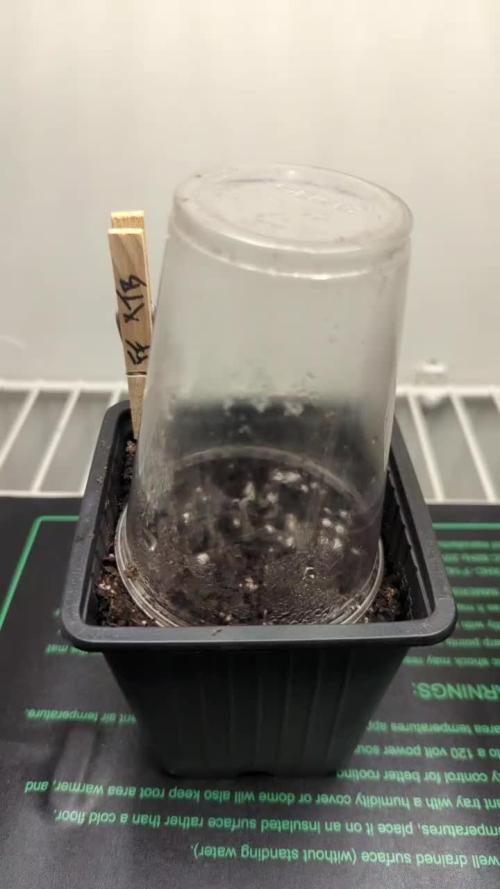
germination:
Came out strong in 2 days
transplanted to 1 gallon first week
Likes
99
Share


@Sativagrad
Follow
I have already said everything, in principle, I advise everyone to grow this variety, I got an amazing tree half purple with giant cones and a large harvest, I am delighted!
