


Likes
Comments
Share


Likes
2
Share


@Aleks555
Follow
SWEET SEEDS - Red Hot Cookies – Week 5
She's growing amazingly well — already reaching 80 cm in height! 🌿📏
We had to do more bending and even topped a few main colas to control the height and shape her structure 🌱✂️
Visually, everything looks healthy and strong — she's loving the sun, training, and nutrients ☀️💚

Likes
38
Share


@Cariboo_OG
Follow
Utopia Haze is a rare heavily sativa dominant hybrid (90% sativa/10% indica) strain created through back crossing Brazilian Sativa strains. This tasty little bud took home 1st Place for Best Sativa in the 2008 High Times’ Cannabis Cup and for good reason – with its potent 18-22% average THC level and long lasting cerebral effects, Utopia Haze is one powerhouse smoke. The Utopia Haze high comes on soon after you finish your first toke, hitting you with a strong cerebral lift that infuses you with a sense of hazy relaxation.
Type: Feminised/Photoperiod
Cultivation: Indoor/Outdoor
Flowering Time (days): 70-75
Indoor Yield (g): Up to 650
Feminised Outdoor Harvest Month: October
Feminised Outdoor Harvest Month Week: 3rd-4th week
Aroma: Citrus, Woody, Pungent, Mint
Effect: Cerebral Lift, Hazy Relaxation, Sleepy
Welcome Everyone to the Final Entry of my Utopia Haze Grow !
There is so much to discuss ! I have been extremely busy as of late trying to get this Harvest together, but i am happy to have it here for you now !
I Seriously under estimated the amount of time, help from others, and my own necessary skills to pull this off.. and i still kind of screwed it up lol !
But its worth noting i have never actually done this before and trying to document it during....was extremely hard.
It is next to impossible to work an iPhone with rubber gloves on !
First I want to discuss everything step by step so before you jump straight into the comments on how the end product is so small in "quantity"
Rest assured i am happy with its"quality"...and thats all that matters to me because Life is a journey not a destination! and i have learned so much from this grow that I couldn't be any happy even if i messed some things up :)
But at the very least I hope you read through this entry in its entirety with an open mind and focus more on the process, rather than just the outcome!
I ran out of Ice & i was only able to wash three times..(normally I've heard you should go sometimes 5-6 washes)
Preparation is Key & things will be much better next round :)
Photos 1-22
These are pretty self explanatory but for those of you just tuning in now.. this is what happens to a very happy plant when you don't have the necessary tools to monitor key components of growing cannabis.. Ph, as well as EC levels play a very key role in the outcome of your grow lol that being said I was just able to save this plant by purchasing both tools but that doesn't mean the plant didn't suffer because of the prior events.. This was a Huge reason behind me choosing to turn this harvest into what i would consider
"Solventless Hash Rosin" from "Ice water extracted Bubble hash".
Pictures 23
The idea here is the process of using "fresh Frozen Cannabis" this has been discussed many a time online on such sites as instagram and here on grow diaries as well.. I personally have Never tried the process so i decided to try it out and make a judgement for myself..
Video 24
The Cannabis has now been in the freezer for 72 hours making it very well frozen.. as you can tell i struggled getting it all into the 25u Screen Wash Bag. One thing of note i would do differently is i will de-stem my next batch as i also believe this played a part in the amount of plant matter that escaped through the sieves.
Photo/Video's 25-28
The idea here is "ice water Seiving" & especially with the bags that I am using here that are only have screen material on the bottom portion of the bag it is very important to have spaces in-between the screens to allow the water to pass directly through the screens into the bottom bucket with the least amount of resistance.. because the hash is so extremely temperature dependant if it gets warm on the side of the bag.. it will stick there and not make it to the bottom to become use able product..
29
You do not need to use as much Ice as i used here lol... the idea is to keep everything very cold..i certainly achieved that but at the sacrifice of using so much that i ended up grinding product and producing "contaminants" but in the end they are just plant matter that i would be smoking when i rolled up my joint either way so.. I'm not super disappointed..
But it should be noted that what you want to achieve here is a Layering effect where you have the wash bag between two small layers of ice while the "water current" washes the Trichomes away allowing them to be separated by the screens setup below :)
Before Starting the machine you should allow some time (i.e.;10-12minutes pre soak to allow the product to become saturated) before the first cycle.
By video 32 I have just ran out of ice lol..
Video 33-34
Here I have a tip for you.. to separate the screens that you sieve through.. cut 5 gallon buckets to stretch them across nice and tight.. it'll make scooping your Bubble that much easier ! i learned this from the many "Frenchy" videos I have watched :)
Picture 35
Here in lays the problem for most people.. drying your hash without loosing vast amounts of "Terpenes" whilst also stay ever vigilant against mold !
Thanks to all those videos I've watched on youtube.. id like to think this was one of my most successful parts of this process..
Things to Note; Terpenes start to seriously evaporate at temperatures 68F or 20C
you need to stay as cold as possible whilst bringing the Relative Humidity in the space down into the 40-30% to stay away from that nasty mold !
I used my cold storage room in the basement.. with a dehumidifier running to keep the space at 45% RH & staying at a constant 15c.
All while spreading the hash as thin as possible across parchment paper, on top of the white screens with a fan moving air across both sides of the paper.
Pictures 36-38
These are some macros i took in the middle of my drying session I fell in love with the colour.
Yes i know the black spots are plant material but they will get caught when i bag the hash & squish the oil out.
Thing to Note; at this stage it is important to ensure you 'micro plane" the hash down as fine as you can whilst staying weary of the temperature... any "chunks" will hold pockets of moisture.. that lead to potential problems..ie; mold ...
Picture/Video 39-41
Successfully planed bubble hash ready to be bagged and Squished !
Picture 42
Ive decided to follow Pedro.. from Pedros Grow Room and double bag to be on the safe side so i don't have any blow outs.
So thats One 25u bag inside one 160u bag ! :)
Pictures 43
This is almost 3 grams of the bubble hash from above, already melting in the bag.. this is where i ran into trouble again lol things started getting to warm in the house and i was only able to get one of the three squish's i did on video :( things started getting sticky.
Picture 44
This is basically just a photo of the equipment I'm using; 3x5 LowTemp Cage in the frame I built myself, with a 20Ton bottle jack.
Something to note here is this is an older Lowtemp model with only a single heating zone which is which i have it closed here heating Both sides of the press :)
As well as the importance of having adequate pressure on your plates.. my rig is very overkill for the size of hash bags..lol
Video 45
Here is the lovely press video.. its didn't quite work the way i wanted either lol my directional folding wasn't quite tight enough for a big "drip" :)
&the Press was set to 65°c
Photo's 46-50 are pretty self explanatory :) I had a blow out.. but still managed to pull an 80% return from the hash once squished...& yes it tasted amazing :)
Was it worth it in the end... that could be debated.. for some..i understand..its not your thing, but for those of us that are interested in making our own concentrates.. free from Solvents...
I wouldn't make it any other way :)
If even ONE of you reading this diary finds it helpful to reference for ANYTHING.....even if its "what not to do" ill consider it a success !
Thanks again for tagging along on this garden adventure.. its been one heck of a journey !
Much Love from B.C. Canada,
Until Next time,
Cariboo

Likes
11
Share


@Buddyhighs
Follow
Get out the way she’s about to blow 💢💣💥 it’s been a hot week this week I’ve had to dim the lights a bit a take the drivers out the tent to cool it down a bit. Might be a good thing she seem to be fading a little so hopefully diming the lights will slow down the rate she’s using nutes. I fed the worms some banana within a couple of days the turned it into fresh casting she seems to have started her swell too.
Until next week let’s get it 💪🏽


Processing
Likes
6
Share


@dank604
Follow
Starting to really take off in length since her 2nd feeding. I've been so far alternating between plain ph'd water and feeding every 3-4 days, moving on to week 5 feeding schedule in the coming days. This girl definitely smells a bit more than my first grow (great white auto) and I like that 😍
I'm wondering when I should start to defoliate a bit....

Likes
8
Share


@Kirsten
Follow
I took everything out of the tent and disinfected it again.
The pots have made the tent base into a ball 😅 The velcro tags fell off long ago. I decided to put some new ones on.
I have some wider velcro that I would've preferred to use, I have misplaced those. Anyway, these will have to do.
I also made some large pot markers to velcro to the pots, too. I figured it would be easier to recognise the plants in photos if I made some. I laminated them, then attached the velcro to the pots and pot markers. [I get bored] 😅 make everything as fun as possible 💚
I ended up finding some sticky back velcro rolls.
Of course, there's no way that it would stick to a slippery surface that gets wet from humidity.
So, I used my glue gun and added strips to each side of the tent liner and tent walls to hold ot in place.
The 8 gallon pots are very heavy after being watered, and the liner has suffered. Hopefully, this will work to keep it in place, at least for a while! 😅
7.5.25:
I also had to clean my pots, as you can see in the photos (if you want, lol).
They had got very mouldy/mildewy/fungussy. 🤢 also the under side of the tent liner.
So it was very lucky that I decided to clean it at this point. Or else I could have serious issues.
I'll look into the ventilation as I'm not exhausting the tent because I leave the door open with very strong airflow.
I did spray the plants with Trace, and I used a lot of it. So, that probably ran down the walls into the base of the tent before it dried 🤔 that could have easily caused it.
I'll have to make sure I dry off the walls after I use it next time. I certainly don't want to keep cleaning everything.
The plants are delicate, and unfortunately, however I try, it appears I am not.
I'm always snapping branches off by just watering, let alone removing them from the tent to clean! 😅 you can imagine. Accidental defoliation? 😉
I also cleaned the light, but I have noticed on one light that there are brown spots, which won't come off without damaging the LED's.
I really don't want to have to buy a new light. The par isn't great for full flowering. I just can't justify buying a new one right now, as I've already bought 2 in a year.
The light has been turned up to 100%, gradually, over the course of a few days. It has been fairly warm so I moved them further away too, as i don't want them to get heat stress, as I have already noticed a few leaves canoeing and having a taco on my dime! 🤨🤔😅
I'll continue to monitor and adjust again when possible/necessary.
7.5.25:
I retied down the branches on FastBuds Mystery seed #1.
I had to clean the tent, so the opportunity had to be taken, I hope not to have to move them again. I ended up snapping a small branch off another plant 😖
She is looking big out of the tent, and bigger than I thought! Now, having readjustmed, the fabric ties, and she is looking even larger still. This really is a sizeable plant! 😱
I really am struggling to get them all in, I think the 8 gallon pots were a definite factor in that. They certainly are great for getting big plants, but be prepared if you have a small space.
Really focusing on her bud development in these mid flowering weeks.
I watered some bloom nutes after I top dressed, with Mega Crop Part A by Greenleaf Nutrients. I watered 3.2 litres
PPM:745
PH:6.0.
This time, I'm going to keep the top dressing moist. So as not to kill all the beneficial microbes. Other than that, I will wait until the pots are light again.
Overall she is doing great, I wish she had stretched a little more evenly, to catch up in height. I just can't even out the canopy anymore.
I'll leave it and hope she'll sort herself out 😅
I'm very excited to see what happens next! This is going to be crazy whatever happens! 😍😋
9.5.25:
It's a necessity to keep the soil moist. That means I need to water more often now.
Today I watered with 1.5 litres of dechlorinated water PH'd to 6.4 which contained:
♡ 1/5 tsp of Sea K(elp). By Greenleaf nutrients
♡ 1/4 tsp Ecothrive Biosys.
PPM: 564
PH:6.4
Thanks for checking out my diary and hanging out 💚 ✌️ 🍃 😊 🌱


Likes
52
Share


@Santica_Garden
Follow
Hi Guys, Grow Diaries for whatever reason won't allow me to upload my complete harvest video which is a real bummer because I mainly do the videos for my YouTube channel but decided to also include them on grow diaries to give other growers who might be considering growing the same strain in the future. Helps give people an idea of what to expect when they grow it.
But honestly I can't be bothered to re-edit it to fit to Grow Diaries setting which I don't even know what they are.... Didn't think they had any! Maybe it's the length of my video..... 🤔! I don't know, but I like to give growers a good description of the strain and smoke review.
I hate it when I go to others peoples pages to have a look at a strain I'm thinking of growing and them not having hardly any pictures that properly show you the growth stages of the plants.... Really annoying. Which is why I chose to properly document mine to give you guys or try to give you guys the best view of my grows..... If that makes any sense 😅
https://youtu.be/iYNiI75Vvkg
That's the link for my channel guys, the complete King's Juice harvest review is there.
Really sorry I couldn't provide a better aspect to the Harvest guys, but at least I know for next time and I will be prepared. 👍🏾


Likes
8
Share


@ChitownCannaChica
Follow
I’ll be harvesting this lady next week! Super frosty and very happy with the yield and density considering she is in a tiny coke can 8.5 oz.
Smells sweet, dense, and yummy! Just trying to keep her upright and watered—- starting to flush now. ✌️💚🌿💨

Likes
25
Share


@DrGanj
Follow
Started flush now. I'm adding Nature Delight Active Sugar Boost as it's been recommended to boost terpene production. No idea if it will work this late into flower but trying anyway as apparently it has no need to be flushed and is fully organic.
Likes
1
Share

@4hundert20
Follow
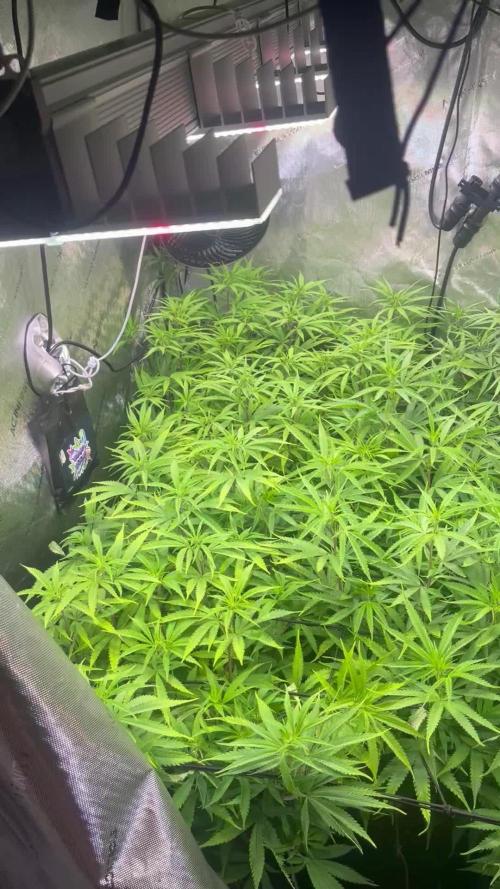
War ein drei Tage nicht daheim und konnte mir den Stretch nur bei Überwachungskamera ansehen. Wurde dennoch überrascht..
Das Netz macht so nicht mehr all zu viel Sinn aber ich lass das so einfach.
Muss immer wieder nach und nach ganze Äste abschneiden, um Platz zu machen. Teilweise teilen sich 4 Triebe eine Masche 😅
Likes
32
Share


@BB_US
Follow
This week I transplanted my ladies to their 3 gallon oxypot. They both look very healthy with a big root mass and strong stalk. Topping in 4 days or until they are settled in proper.
Likes
26
Share

@Arcadium
Follow
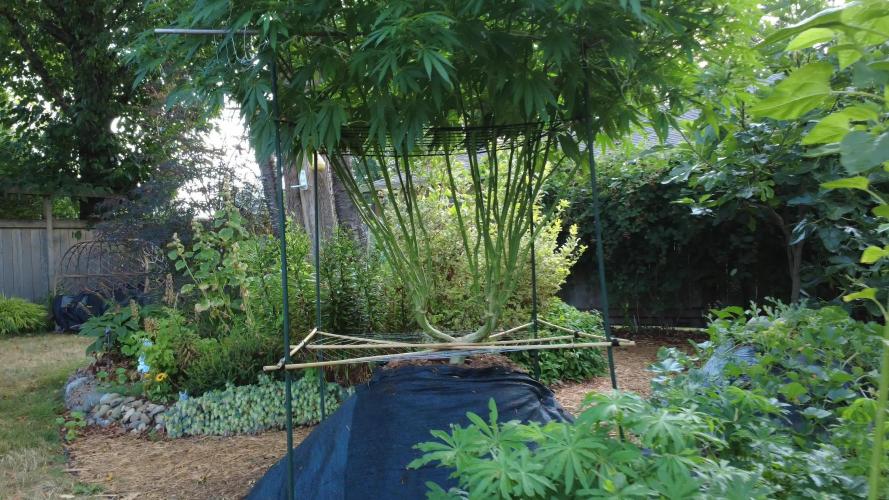
Cooling off at night, lots of dew, but being underneath my big Cherry Tree provides some relief. Did a big defoliation to help with airflow, removed quite a few inner branches that weren't keeping up with the canopy, but overall happy with the shape and structure, will probably just ride the rest out as it. Just water this week, spray of LCPT and a spray of BT for caterpillars. Will alternated LCPT / BT ever 3-4 days.
Flowering is looking great, very aggressive TONS of pistils, trichomes developing as well, going to be 6 weeks at least, if the weather can hold out that long that is!

Likes
56
Share


@Ledbelieve
Follow
This plant is a slow growing strain heavy on the Indica side. Is a connoisseur strain not recommended for commercial Grow. To slow if in it to make some money. But was a pleasure to grow. It is definitely a head turner and is more potent than most purple stains I have tried before. So if ya got time and like something truly special give it a go...happy growing guys0


Likes
1
Share

@Elron_mc_Bong
Follow
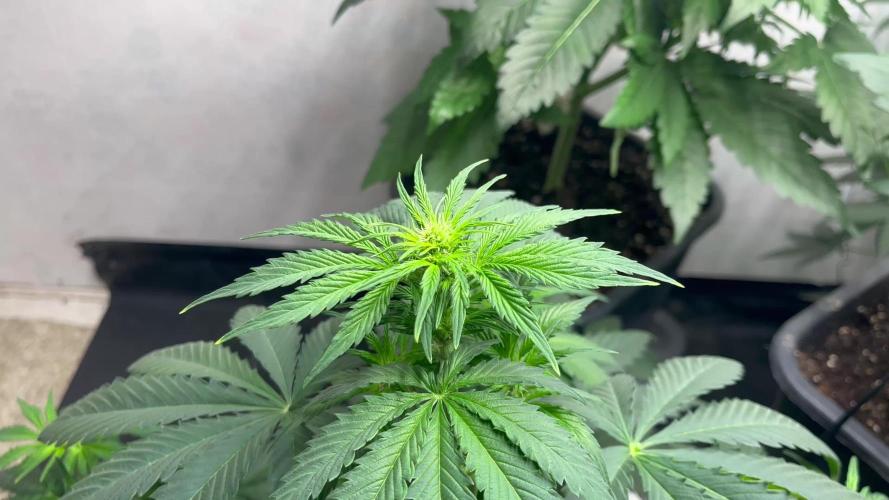
Woche 6 – Stretch des Todes & Kontrolle behalten
Diese Woche hatte es richtig in sich. Der Stretch ist komplett eskaliert – vor allem bei der Blueberry und der GMO. Beide haben in nur einer Woche rund +40 cm hingelegt. Direkt dahinter kommt die Hyperion, die ebenfalls ordentlich Gas gibt.
Runtz und Purple Punch bleiben dagegen ihrem Stil treu: kompakt, buschig und kontrollierbar – perfekter Kontrast im Raum.
Trotz des starken Wachstums konnte ich das Canopy sauber ausgleichen. Alle Pflanzen stehen jetzt auf einer Höhe und laufen stabil bei etwa 40 cm Abstand zur Lampe, was aktuell perfekt funktioniert.
Beim Gießen zeigen sich klare Unterschiede:
Die Blueberry ist weiterhin extrem durstig und zieht den Topf schnell leer, während Purple Punch deutlich weniger braucht. Das Handling der 15L Töpfe läuft inzwischen richtig präzise.
Untenrum habe ich weiter aufgeräumt, damit die Energie gezielt in die Tops geht. Die Struktur ist jetzt schön luftig und fokussiert auf die Hauptbuds.
👉 Fazit:
Massiver Stretch, saubere Kontrolle und eine sehr homogene Fläche – genau so soll’s in der Blüte aussehen
Likes
8
Share


@GrowPassionItalyChris
Follow
Aggiorniamo prima il diario di questa settimana datosi che il weekend sarò in Svizzera...ormai come ogni anno le dutchfemseeds autofiorenti in outdoor biologico sono una soddisfazione immensa,crescono rapide e resistono agli afidi, hanno iniziato a riempirsi di infiorescenze resinose e profumate e colorate. Giorno dopo giorno sembrano migliorare gradualmente e fino ad adesso promettono grandi soddisfazioni perché ormai hanno una struttura perfetta, molto diramate e molte di loro superano già il metro di altezza! Forza Dutchfemseeds autofiorenti in Italia! Un abbraccio a tutti

Likes
13
Share


@GrowerGaz
Follow
The plants are settling into their new shoes. They have just had water and elite 91 roots as there is some Greenhouse Bio Grow in the soil mix.
I am going to try and make some KNF nutrients this week to boost the growth phase.

