


Likes
Comments
Share


@Cannabeast40
Follow
Welcome back to my summer grow🙂
Everything is still in need for more, more light - more nutes - more airflow and last but not least, more ir/uv 😎
Also gaining weight so that’s also great 😊
Hope to see you again next week 😎
-------------------------------------------------------------------------------------------------------
SpectrumX LED🔥 @medicgrow
880 Watt⚡️
2x UV/IR LED panels 💥
2.7 μmol/J🔥
Full Spectrum V1,F1,VS,FS🌈
Display with PPFD & Live spectrum
Light measurement: Apogee MQ-610 & Apogee DLI-600.
Fertiliser:
Organics Nutrients
https://www.organicsnutrients.com/en/
Green Buzz Nutrients
Discount Code: GD42025
Grants 25% with a minimum Order value at 75 Euro.
https://greenbuzzliquids.com/en/shop/

Likes
36
Share


@GYOweed
Follow
This is week 1 almost.
Went 13/11 recently and did a major defol.
Gonna give it some cheat codes and let it flower 3 weeks before next defol.
Taking 2 clones each.

Likes
42
Share


@MadeInGermany
Follow
Unfortunately, I had to find out that my account is used for fake pages in social media.
I am only active here on growdiaries.
I am not on facebook instagram twitter etc All accounts except this one are fake.
Flowering day 49
since time change
to 12/12 h.
Hey everyone :-).
We are slowly getting closer to the last few weeks :-)
There are still 2-3 weeks and The buds develop very well towards the end :-).
It is slowly starting to use up its nutrients.
This week it was poured 3 times with 1 l each time.
Everything was cleaned and checked.
Have fun with the update.
Stay healthy 👍
You can buy This Strain at :
www.Zamnesia.com
☝️🏼☝️🏼☝️🏼☝️🏼☝️🏼☝️🏼
Strain
Gelato clone from mother (Zamnesia )
☝️
Genetics: Wedding Cake x Gelato x Gelato 33
Vega lamp:
2 x Todogrow Led
Quantum Board 100 W
💡
Bloom Lamp :
2 x Todogrow Led
Cxb 3590 COB 3500 K 205W
💡💡☝️🏼
Soil :
Canna Coco Professional +
☝️🏼
Fertilizer:
Green House Powder Feeding
☝️🏼🌱
Water:
Osmosis water mixed with normal water (24 hours stale that the chlorine evaporates) to 0.2 EC. Add Cal / Mag to 0.4 Ec Ph with Organic Ph - to 5.5 - 5.8 .

Likes
11
Share


@Someusername420
Follow
Nachdem ich ein paar Triebe aus Versehen abbrach, lies ich vergangene Woche die Pflanzen in ruhe.
Mittlerweile war alles zugewuchert, weshalb ich mich dazu entschloss, einige Blätter zu entfernen und mit etwas LST zu starten um die Pflanzen auf das kommende SCROG´ing vorzubereiten


Likes
12
Share


@SparkSupertramp
Follow
First of all, I let the seeds soak in water for 10 hrs and I used the paper towel method for germination.


Likes
12
Share


@TheNug
Follow
growing bushy as all hell, lifted lights to try get them to grow vertically more , we got some chubby plants right now lol

Likes
28
Share

@MadeInGermany
Follow
Flowering day 12
since time change
to 12/12 h.
Hey everyone ☺️.
Once again a wonderful week goes by 😀.
It has developed so far and is now slowly starting to develop its flowers :-).
As soon as the first forms of buds can be seen (I think in 5-10 days) 2 g GHSC Powder Feeding Bio Bloom per liter of substrate are added.
In the third week, 1 g per liter of substrate is added so that it lasts through to the end :-).
This week it was poured 3 times with 1 liter each 👍.
The entire tent was also cleaned and the electronics checked for functionality.
The humidifier was refilled every day and fresh osmosis water was drained into the tank for the coming week ☺️.
The plants have all been checked for health and pests 👍.
Next week the bamboo sticks are inserted towards the end for support and the lowest shoots are removed so that at the end the energy is not wasted in the lower area 👍.
Otherwise there is nothing more to report this week :-).
I wish you a lot of fun with the update 😎.
Stay healthy and let it grow 🍀.
You can buy this Strain at :
https://www.royalqueenseeds.de/feminisierte-hanfsamen/115-amnesia-haze.html
Type:
Amnesia Haze
☝️🏼
Genetics:
Original Amnesia Haze
👍
Vega lamp:
2 x Todogrow Led
Quantum Board 100 W
💡
Bloom Lamp :
2 x Todogrow Led
Cxb 3590 COB 3500 K 205W
💡💡☝️🏼
Soil :
Canna Coco Professional +
☝️🏼
Fertilizer:
Green House Powder Feeding
☝️🏼🌱
Water:
Osmosis water mixed with normal water (24 hours stale that the chlorine evaporates) to 0.2 EC. Add Cal / Mag to 0.4 Ec Ph with Organic Ph - to 5.5 - 5.8 .
Likes
3
Share


@KcKush
Follow
Week 1 of flowering.
Increased ppm from 1050 to 1150
I do see some growth but not looking optimal.
Temps seem to get pretty cold at night.
No sign of flowering yet.
Likes
Comments
Share


@The_Lonely_Farmer
Follow
So these girls are shorter than expected allthough the 2 girls are of decent height enough for me too flip along side my aptus fed girls.
I have defoliate all areas that covers light getting too the lowers and also removed excess branching too focus energy towards the main tops also did this via a little lst 🌱
One of each plus an extra 412 so hopefully they stick through and make it too harvest which they look too be healthy so far.
I will next defoliate on week 3 of flower and also remove excess plant matter taking up neccasary energy 🌱
Shogun is serving them well so fa!
Lights will be 12/12 tonight
Week 1 flower commences then
Stay blessed 💚
Likes
8
Share


@Nacho64r
Follow
De momento todo va bien, he añadido un sistema de co2 casero, no se si hará algo por que no tengo medidor, le he echado 500 gramos de azúcar disuelto en agua templada, media pastilla de levadura de unos 12 gramos... Y una uvas trituradas, godzilla Cookies Auto se le están poniendo las hojas más viejas amarillas y se están cayendo, no se si será por deficiencia de algún nutriente o el ciclo natural de la planta.

Processing
Likes
8
Share


@Max1973
Follow
Day 49 - lookin good..... been bending her, trimmin abit, messin with the water solution.....
ph and ppm have been all over the place..... lol
she's been transitioning from grow to flower, and once she settles into night mode, the
solution and growing should stabilize......
the new fan is cool... tents working properly now, neg pressure, drawing in air behind the floor fan, blown around the bottom,
and cpu extractor fan pushing the air out the top of the tent, straight into the filter..... really nice way to run a little tent, low airflow........
keeps the impurities out of the buds.....
the stalks have all tuffened up since trimmin, and pretty strong now.... should hold the full weight that's about to occur all over the place......
i've simplified the nutrients, they were gettin alittle confusing, so started doin nuets differently, .... so,
just making my own nuet solutions, nothing fancy just base amount of normal elements ....
should be a pretty good christmas ......
Day 51 - pics/vids...
👍😎


Likes
5
Share


@AestheticGenetix
Follow
5/27 this may be the last week?
5/31 the lowest branch has a thick lollipop nug on it. This plants starting to explode
Likes
82
Share

@wolfvb
Follow
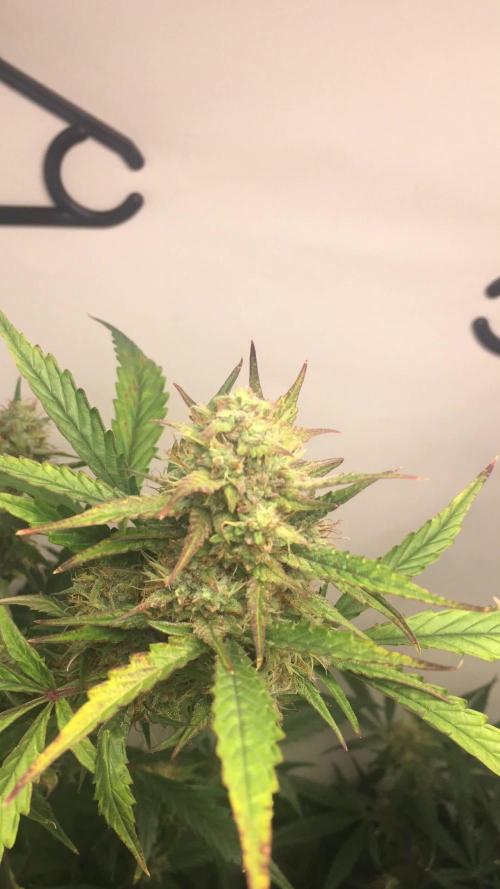
🌿 Week Update: The Frost is Landing! ❄️
The tent is starting to smell incredible! We are officially in the "bulk up" phase. I’m really seeing the benefits of the Bio-Bloom and Top-Max combo this week as the calyxes are swelling and the trichome production is kicking into high gear.
The Details:
Development: My main colas are starting to transition, with pistils turning a lovely orange, while the secondary sites are still pushing fresh white growth.
But the blue cheese is acting strange she started to stretch from a side pransh, while the main thing still short and very compact.
Structure: The LST clips have been lifesavers for keeping the height manageable in this tent. I’m focusing on keeping the airflow high with the fan to support these heavy tops.
Health: The leaves are holding a beautiful, deep green no signs of deficiencies or burn yet with the current 2-2-1 ml/L feed.
Next Steps:
I’m going to keep a close eye on those trichomes over the next two weeks. For now, it’s all about patience and keeping the environment stable while they finish stacking.
Likes
54
Share


@Fibro_Witch
Follow
Good week for this lovely lady.
Her color has improved immensely and she's almost caught up in size to the Blueberry.
Since they're settled in I took away the support hoops and will pack up the row cover.
Yet again I think it did a fabulous job reducing stress from transplanting.
I also added in some Calendula plants yesterday afternoon as they make good companions. It's gonna be a straight up partay in this garden bed😜
Update 6/26- I totally forgot to add that on Monday the garden got a spraying of horn manure. Horn manure is a biodynamic preparation of cow manure that's been fermented in a buried horn. This results in a material that's teeming with beneficial flora and fauna for the soil. Ideally it would be sprayed prior to planting in the spring as it encourages healthy root growth. I purchased the pre-potenized so that I only had to spend 20 mins stirring rather than an entire hour. That would have been brutal😵 I sprayed it at night when the earth is breathing in and used a spruce bough to sprinkle it over the plants in the garden. The extra icing on the cake was that there was a rain the day before, and another the day after I sprayed so it was well watered in.
Likes
10
Share


@HegauHillsFarmers_M11
Follow
Tag 35 - Ende der 5. Woche.
In dieser Woche an Tag 33 habe ich die Pflanze etwas entlaubt. Dabei habe ich die untersten Triebe entfernt und zusätzlich alle weiteren Blätter die im unteren Bereich nur im Schatten standen entfernt um die Luftzirkulation zu verbessern und die Belichtung zu erhöhen. Die Pflanze ist voll im Stretch und hat diese Woche nochmal ordentlich an Höhe dazu gewonnen.
Die Blüten entwickelt sich gut und wachsen.
An Tag 29 wurde die Pflanze gedüngt.
Nährstofflösung:
2 ml/l - Voodoo Juice Advanced Nutrients.
4 ml/l - pH Perfect Sensi Bloom Part A
4 ml/l - pH Perfect Sensi Bloom Part B
2 ml/l - Bud Candy Advanced Nutrients.
Davon hat die Pflanze 500ml an Tag 29 erhalten.

Likes
46
Share


@eldruida_lamota
Follow
Vamos familia que ya actualizamos la cosecha de estas Candy Rain de Zamnesia, para el concurso POWER BUDS Plagron x Zamnesia CONTEST.
Ya era hora de cosechar, estoy bastante contento con los resultados.
Vaya flores que se han marcado repletas de tricomas, y las flores se marcan aromas dulces y afrutados.
Es una variedad bastante fácil de cultivar y muy resistente, crecieron desde el principio bien vigorosas, sin problemas y al final de todo recompensó.
Las condiciones ambiéntales han sido máximas en 25 y mínimas en 20 y una humedad estable en torno al 36% al final de floración y en el secado.
Os comento que tengo un descuento y para que compréis en la web de Zamnesia de un 20%, el código es ZAMMIGD2023
The discount 20% and the code is ZAMMIGD2023
https://www.zamnesia.com/
Espero que disfruteis este diario, buenos humos 💨💨
Likes
31
Share


@Pedrojuan
Follow
Bueno arranca la semana con pocos cambios en la disposición de las cosas, se ve el rostro de la floración… una crece y se desarrolla más que la otro, se ve que la izquierda siempre inspira más… mantendremos la solución a 1.2 EC el PH siempre a 5.9. Por el resto todo va igual, dejaré el filtro de carbón activo para las últimas 4 semanas. Esperemos no haya mucho olor por ahora.
Iré actualizando novedades en un par de días.


