


Likes
Comments
Share


@Farmerbry71
Follow
Day 80 for this AK auto she Is big and fat buds with a sweet smell to her I would say she will go till day dy 95- 100 before she gets harvest

Likes
10
Share


@TiRobotProds
Follow
Vendanges en deux parties pour avoir différents effets. Après 8jours de séchage cette dame pesée 46g. Fumé douce note de fruits et de hash.


Processing
Likes
23
Share


@Organic_LarF
Follow
Hello,
This beautifull threesome of ladies have been bend over this week. As new(2) lights are on there way, they need to be trained a bit so the space would fill up (3×3 or 90x90).
Ive tried first to chiroprac 1 of them but it was still very flexible, so I took some rope and started bending. But I reflected first to now what I intend to reach.
As a result, they really bended very far and ive opend up a hole new set of branches to grow better faster stronger. 🤖
Looking forward to the new grow pattern!
Grow safe
🍀🍀🍀


Likes
6
Share


@mrcrop
Follow
They are fatting up really fast, the thing is all of them are smell like too much)) the neighbors are happy) Looks like the glookies is the less resistant to pests and desieses of all of them. I think i´m gonna chop the Purple lemonade next week.


Likes
11
Share

@Philhsy
Follow
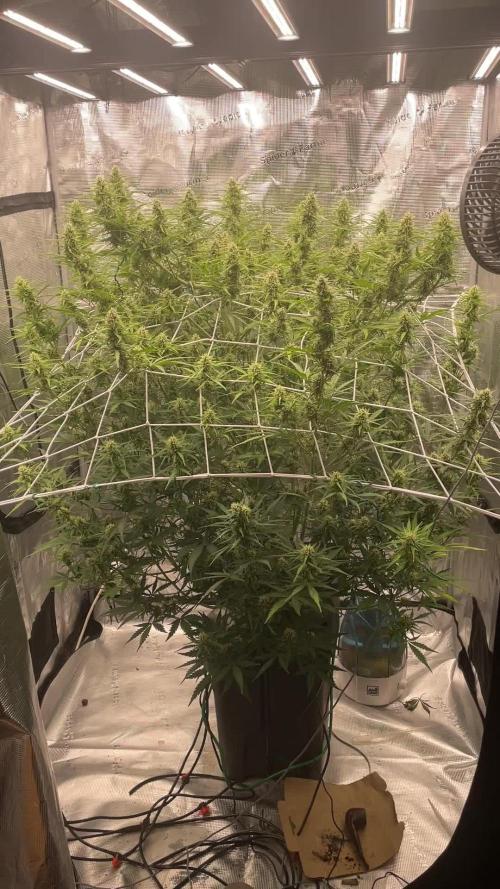
Added plagron powerbuds,, its eating like crazy and deinking, the stem is a tree, truly an oversized auto, hydronat itsbest :) hoping buds will fatten up more ans more , thwre are flowers that are matjring even furtjer down aswell, think it got a long way to go, but il be patient and did a clean bath the other day. But everything is green so!

Likes
3
Share
@Smev1337
Follow
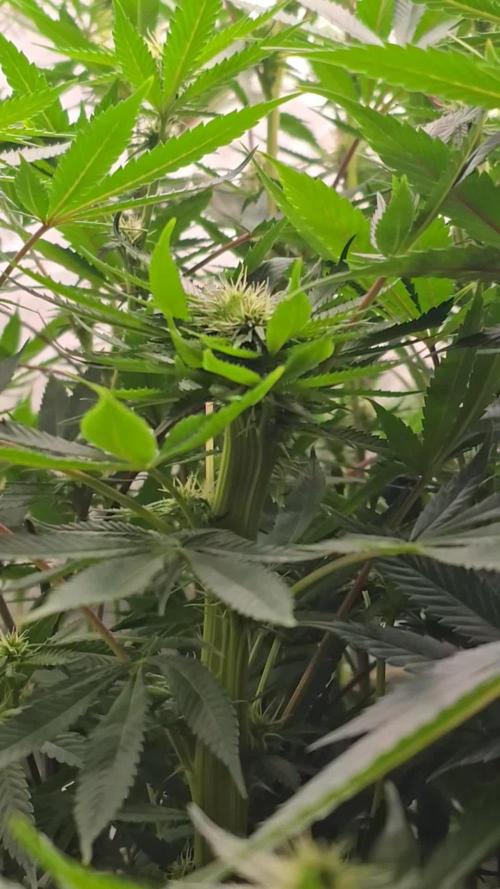
So both plants are in flowering phase now just the first week of it i didn't have footage but for the second i got some so here😁 starting off with the polyploid mutation which looks like an caterpillar with hairs to me haha, really nice to see a mutation with my own eyes in my own grow hehe 😅else the plants are doing really good and being healthy so far 😎 happy growing all 😎✌️💚

Likes
7
Share


@Mo_Powers
Follow
the race continues. at the moment both are still on a par. a good 5 cm in growth. there is currently a lot of sunshine and really good temperatures. apart from that, not much has happened yet.


Likes
1
Share


@therealgrowmie
Follow
What’s up, Growmies!
Even though I find LST plants a bit odd-looking, the training has gone solidly so far. One plant is already ahead and has entered the flowering stage, while the other two are a few days behind.
I’ve decided to stop LST on the plant that’s furthest along, and I’ll continue training the other two to help spread them out and even the canopy.
Aside from that, plant health is looking good. They’re just a few days away from hitting the stretch phase, where I’ll let them do their thing.
---
Quick rundown on everything else:
Watering: 600ml every third day
Fertilizer: According to the BioBizz schedule
Light intensity: Around 600 PPFD
VPD: Stable at 0.91 kPa
Temperature: ~28°C
Relative humidity: 75%
Likes
82
Share


@UnorthadoxDude
Follow
Hello growmies! Welcome to week six of An Epsilon Adventure! Massive thanks to both Shogun and Royal Queen Seeds for sponsoring this grow!
So here we are at week six and every one of these girls are at a slightly different stage, it is quite fascinating to watch them develop one after the other.
Today I made the last adjustment to the light possible. I removed the adjustable hangers and affixed a carabiner which I tightly tied to the top of the tent bar. There is about 1.5 inches of space between the top of the shade and the tallest part of the roof of the tent. Plant 1 is already taller than this, and it looks like plant 6 and maybe even plant 5 are going to join it. It's a madness. I am sure you have already looked at the photos but just in case you do what I do and read the diary first...
Here is my assessment at the beginning of week 6:
Plant 1:
Height: 1st (137cm) - what can I say about this ridiculous plant? Day 36... 137cm tall. I have had to raise the light to as high as it is physically possibly to raise it and it's still not high enough. She is done stretching now, she may add 3-5cm over the next week or so but I don't expect more than that, so her top of her main cola going to have to develop above the level of the light. Nothing I can really do, nothing wise anyway. What a monster plant.
Maturation: 4th - early into flower - bud sites developing, pistils just starting to explode.
Plant 2:
Height: 4th (111cm) - this plant has been there or there abouts as the tallest plant for most of the grow, but she has topped out at 111cm. She will gain some during flower but not much more than a few centimetres. Very impressive plant, loads of bud sites, really big strong secondary branches. This one is going to be colas galore.
Maturation: 3rd - well into flower - all white pistils
Plant 3:
Height: 6th (95cm) For some brief days the tallest plant in the room, she peaked early and is now the "shortest" at "only" 95cm for this "50-70cm" strain. She is utterly dwarfed by four of her five sisters in just about every department, being quite a bit smaller even than plant 4 (although I have removed the most lower nodes from this plant). Compared with her sisters she is almost a runt... except that she is 25cm taller than the strain top-end average and matches the maximal height of the previous tallest Epsilon F1 plant I am aware of. It's not that she is small, actually she's pretty big for an Epsilon F1, it's just that the rest of the girls are on another level altogether. Plants 1, 5 and 6 are all absolute beasts.
Maturation: 1st - well into flower - first shades of brown in some pistils.
Plant 4:
Height: 5th (98cm) although only 3cm taller than plant 3, overall she is a much larger plant. Her secondary nodes are the same height as plant 3.
Maturation: 2nd - well into flower - all white pistils
Plant 5:
Height: 3rd (113cm) - one of the two thick/short girls who have grown at a similar pace all along - she is further ahead than plant 6 but not by much and I think she will probably exceed 120cm this week, though I do not think she will outgrow plant 1 or 6.
Maturation: 5th - early into flower - bud sites developing.
Plant 6:
Height: 2nd (120cm) - my predictions were correct about this girl and her continued growth. I now think she might actually outgrow plant 1, which is quite worrying.
Maturation: 6th - early into flower - bud sites forming - by far the least mature plant of the six.
###
Week 6 Day 2 23:00 30/7
Photographed. Raised the light. Rotated the plants. Inspected, measured and reported on each plant.
###
Week 6 Day 3 23:00 31/7
It has not escaped my attention that the plants that are more advanced into flower have darkened and have some burnt tips. I need to flush them and lay off the base nutes a bit. These plants are just growing and maturing so quickly that I cannot keep up.
###
Week 6 Day 5 02:30 2/8
Fertigated 3l of nutrient mix, without either COCO A or B.
###
Week 6 Day 6 01:30 3/8
photographed
---
Thanks for reading growmies! 👊
==========
Tent: 120cm x 120cm x 180cm
Light: 600w HID Elite Dual Spectrum HPS + Angel Wing Reflector
Air: 5" duct fan system with carbon filter ~300 m3/hour + RAM 9" floor fan + 4" intake fan
Pots: Air Pruner Fabric Pots 30l - UGro XL Coco + horticultural grade perlite (~20%)
Seeds supplied by Royal Queen Seeds https://www.royalqueenseeds.com
Nutrients supplied by Shogun Fertilisers https://www.shogunfertilisers.com/en
==========
Processing
Likes
6
Share


@ProfDoty
Follow
This actually marks the first week from breaking through top soil.
My ladies are taking the somewhat high temps very well, doing my best to keep it down around 79-81(Day) and (72-75) at night. They say the colors really pop at lower temps so hopefully I can work my way down even more to achieve those colors in the end. I’m using the Batch 64 Moonshine (super coco), haven’t heard a lot about, but my hydroponics shop recommended and it looks like it’s treating the ladies right. GP started to lean over on Day 4 and just couldn’t get up , so I propped her up with a twist tie and she’s doing great now 😎Anybody have a clue as to why she just slumped over in the first place? I haven’t ph my water at all but I will this next week coming up and will also be adding in some small doses of Terpinator each watering. I will be Ph (ing) my water between 6.2-6.6 this coming week and will be observing how the plants respond to the watering. Hopefully another great week is ahead filled with lots of growth. All comments welcomed HELP ME !!! or jus say what’s up ha ✋
Likes
1
Share

@Skynets_Growing
Follow
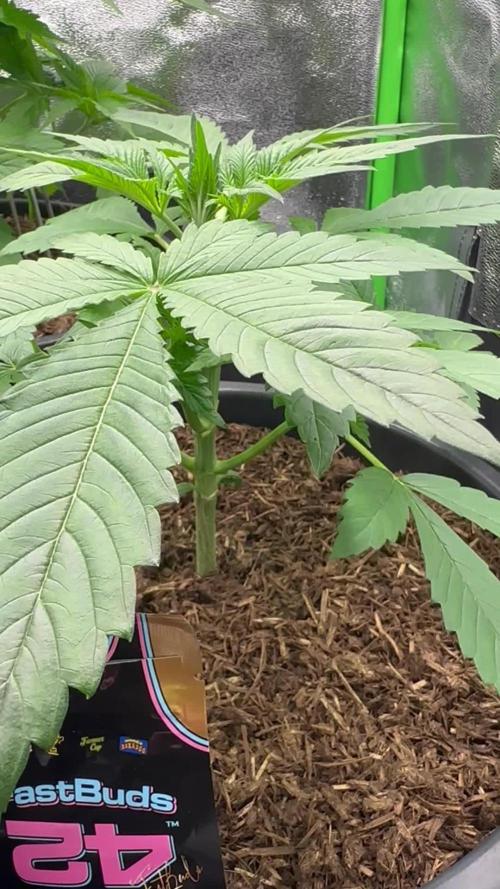
Eva my little plant where start‘s 9 days later than her older sisters show me in her week 4 what I known from Tamara. She go in her flower Part on day 27th and it‘s the same day like Tamara. FastBuds did a Great Job with our Strains. And I can say …Eva do her job Great because she has caught up with her sisters. It’s so nice :-)
Processing
Likes
44
Share


@PuraVidaG
Follow
The girls look really nice, growing strong and fast, except 1, I’m growing 2 Alakazam from Seedmakers and 2 Tangerine Dream from Barney’s. T
There’s one Alakazam that has presented problems since germination. Some of the leaves have yellow-brown dots, most of her root system is healthy, but it has some brown areas, it seems kinda weak overall, it’s the one that has grown more but the one showing problems.
The other Alakazam and the 2 Tangerine Dream are looking really nice.
Have been doing 50% nute strength feeding, adjusting ph level daily and showing them a lot of love. Should I do something different with the Alakazam or is it just a weak seed? Thanks!
Likes
11
Share


@CalGonJim
Follow
1/2/23 she’s doing great I moved a leaf and noticed that she has tan lines. That is amazing. This lights incredible
I took the two bottom branches that I usually trim off. I’m glad I didn’t because I got 1.83 ounces and 1.78 ounces wet. This plant has been the best strongest plant I’ve ever grown it’s really nice and it smells great. I’m gonna give the rest of her, maybe another couple weeks it’s just exciting to watch her grow. I’m not in a hurry to harvest. I do partial harvest as I go along.
1/3 I turned the viper spectra XS1500 light down to halfway which is 82.3 W. And the amount of energy still is more than two of my old spider farmer lights. I had no idea how important brand new LEDs are this is just fantastic. I bet I can grow an entire plant for probably 90 W.
1/4 yum yum omg smells gooooooood..
FYI, Just because a Gamorrean pledges their loyalty doesn't mean they wont eat your weed, lesson learned.
1/4 Just smoked some that had been drying for only 2 days. The smell was so strong like no auto I have ever smelled. This is like top shelf photo from the dispensary. I am totally impressed.
1/6 i’m going to set up a new tent. It starts with the power source. It looked really ugly, so I wanted to try something nicer.
I got one of the TP Link power strips three individual outlet controls for the smaller tent that I will germinate in my use one to monitor the power of the light and I keep switching them around. It’s really nice to have.
1/8 I’m going to plant some seeds today. It’s Elvis’s birthday. I threw away a liter of Purpinator today. I’ve been having nutrient troubles, and I noticed a little that I had mixed up in a small spray bottle had started to congeale. And after I tried 6 mL of it in a gallon twice I noticed some plant damage. I don’t know if it’s that stuff or not but when I add something new it seems to cause damage. So I will never use that again.
it’s taking me a month to set up a small 24 x 24“ tent
I don’t know what’s wrong with me so I have two 27“ x 27“ and one 24 x 24“. The small tent will be for photoperiod also for germination, the other two are going to be for autos only.
I’ve discovered auto flowers need their own tent and their own space, especially the way I train them. I top them after the 3rd node then wait until a couple weeks into flower and I soften the branches pressing them between my thumb & index finger to keep them limber then spread them out so they kind a look like a giant crab, but they grow up very strong and they don’t need support
I was going to go with 5 gallon but I think it would be just too heavy so I’ll stick with 3 gallons. I’ll be starting to gorilla cookies this coming week probably tonight, but I’ll start the diary tomorrow.
If you hold the phone up to the TV, it types out the dialogue . I’m gonna d mad max later don’t you wish you were like me easily amused? You get a lot less brains on your wall that way.
Likes
245
Share


@Nor_Cal_Kannabliss
Follow
July 5th : Allrighty then... Got another Video for everyone. Second Attempt adding a music track to the video. Hope you all enjoy! Sure is getting exciting in this tent!!
July 6th : Sorry No pics.
July 7th : Oh boy did the colors start to come in. How beautiful! Can't Believe I'm growing these. Lowered feed for the week finally. Forgot to do it last time oops..
July 8th : Patience makes the next pics that much better.
July 9th : Still couldn't get to photo's tonight sorry.
July 10th : Girls are thickening up nicely. Getting antsy just waiting.. Oh the days can't go by fast enough!
July 11th : Nothing Tonight But A Video Tomorrow!

Likes
9
Share


@JeyGanesha
Follow
Purtroppo ancora stanno così perché sul balcone non prende tante ore di luce solare diretta.....beh! Ancora c'è tempo per farla crescere fuori poi la metterò a fiorire indoor

Likes
29
Share


@Basementganja
Follow
This C4 auto was very fast to flower, and stretched up to produce some very pretty, berry smelling/tasting nugs!
The buds didn't flower very dense, they formed as fox-tail shapes.
Yield is on the low-end of acceptable, but good considering the bud structure!
I'm growing another next run, to compare phenotypes!
Likes
88
Share


@Roberts
Follow
Gorilla Jealousy F1 is growing good. She is making good progress. I will be starting lst on her 4 branches very soon. Nothing else is really going on at this moment. Thank you Spider Farmer, and Seedsman. 🤜🏻🤛🏻🌱🌱🌱
Thank you grow diaries community for the 👇likes👇, follows, comments, and subscriptions on my YouTube channel👇. ❄️🌱🍻
https://www.seedsman.com/?a_aid=Mrsour420.
This is my affiliate link to seedsman. Thank you
Happy Growing 🌱🌱🌱
https://youtube.com/channel/UCAhN7yRzWLpcaRHhMIQ7X4g

Likes
25
Share


@MadeInGermany
Follow
Info:
Unfortunately, I had to find out that my account is used for fake pages in social media.
I am only active here on growdiaries.
I am not on facebook instagram twitter etc All accounts except this one are fake.
Have fun with the update.
Flowering day 61
since time change
to 12/12 h.
Hey everyone ☺️.
Today the time has finally come and the last week of flowering has begun 😍.
She looks beautiful and her buds smell very tasty 👍.
The trichomes are 70% milky and 30% amber.
The lady comes in complete darkness for 48 hours before the harvest.
Of course, as always, there will be a small interim update of the harvest before the last major update.
Until then, I wish you all a lot of fun and stay healthy 👍🙏🏻
You can buy this Strain at :
www.Zamnesia.com
Type:
Purple Punch
☝️🏼
Genetics:
Granddaddy Purple x Larry OG
👍
Vega lamp:
2 x Todogrow Led
Quantum Board 100 W
💡
Bloom Lamp :
2 x Todogrow Led
Cxb 3590 COB 3500 K 205W
💡💡☝️🏼
Soil :
Canna Coco Professional +
☝️🏼
Fertilizer:
Green House Powder Feeding
☝️🏼🌱
Water:
Osmosis water mixed with normal water (24 hours stale that the chlorine evaporates) to 0.2 EC. Add Cal / Mag to 0.4 Ec Ph with Organic Ph - to 5.5 - 5.8 .