


Likes
Comments
Share


@Albanymedicinalgarden
Follow
Skywalker came down mid week with mostly cloudy trichomes. Probably could’ve pulled it longer but it looked ready to me and I’m expecting kush effects anyway.
Blueberry has a beautiful fade that would probably have scared me my first grow. She has definitely had calcium issues which is causing some leaves to burn crispy. That can all be cut away after drying so im not too concerned. Arguably i could’ve chopped her this week but i think she has more to do before her time is up
Glueberry OG just now getting some yellowing of leaves. Hard to tell if it’s a deficiency or fade to my eye but i top dressed a small amount of NLS concentrate before it gets much further along. This might be a mistake this far along but I’m willing to learn from it if it is


Likes
9
Share


@schmorgastheborg
Follow
Quite the week for growth. All the ladies have responded quite well. The Neville's Haze has taken off the most and its genetics are showing. I plan to take it back under the LED and flip it in about two weeks due the rapid growth and long flowering time. Northern souls is the smallest in size, but all are doing very well and the genetics are starting to differentiate. I have noticed they all seem a litter smaller under the Ultrasun in comparison to the Hortilux. I plan to monitor for this as a trend.


Likes
22
Share


@Noahistheguy
Follow
Great grow. Amazing terps and yield, smooth smoke. Watch for deficiencies and over nuting.


Likes
5
Share


@SkunkyDog420
Follow
Keine Probleme gehabt mit der Pflanze.
Kann ich nur empfehlen 🤙.
Bis dann.
Ende
Likes
27
Share


@Theia
Follow
Lovely big chunky lady. 80ccm across colas that are thick as a babies arm.. and a delightfully zesty sweet smell when she wobbles in the breeze.
My queen this run for sure. Such an imposing girl...
Feeds are down to 1.6ec as I remove the more pk from her diet. She just gets greenbuzz nutrients organic bloom for the duration now.
Lights are at 60% giving 1100umols average across the canopy.
Just a pleasure to grow..
Thanks for passing.
Grow well 🌿💚🌿🙏🏼

Likes
20
Share


@Ultraviolet
Follow
Not particularly growing for speed or any dedicated reason this time round, just adding water and a abundande of positivity, gotta admit I do like the autoseed logo. Off we go again into the magical forest.
(Arthrospira platensis) cultivated in high-alkaline, mineral-rich water in Kailua-Kona, Hawaii. It is renowned for having a higher nutrient content, including more carotenoids and essential fats, compared to other spirulina brands. It is frequently cited as a "complete food" due to its dense concentration of proteins, vitamins, minerals, and pigments.
The nutritional profile of standard dried Spirulina platensis biomass. 3kg of spirulina powder has an approximate NPK ratio of 10-2-1 (or 10% Nitrogen, 2% Phosphorus, and 1% Potassium).
Here is the breakdown of the nutrient content for 3kg of powder:
Nitrogen (N): ~300g (10% of total mass)
Phosphorus (P): ~60g (roughly 2% of total mass)
Potassium (K): ~30g (roughly 1% of total mass)
3kg of spirulina powder is more than enough nitrogen for 4 cannabis plants in a 100-gallon pot—in fact, it is likely excessive and could cause severe nutrient burn or toxicity if not properly managed. Spirulina has a very high protein content (46% to 63% dry weight), which translates to a significant nitrogen source. It is often described as a 5-1-1 NPK fertilizer.
3kg (3000g) of powder in 100 gallons means 30g per gallon. General organic recommendations for potent amendments (like frass) are often around 1–3 tablespoons per gallon. 30g of powder is roughly 2-3 tablespoons, making this a very high-strength application rate if added all at once. Balance this with calcium/magnesium, and organic nutrient delivery in soil growing can lead to deficiencies in these nutrients.
Not all of that 100 gallon is used, so figuring out precise measurements was ballpark, but there is about 10kg of engineered biochar in that pot. Mostly in the top half. Ideally, I'd have 25kg in a full active 100-gallon, but......... don't mess with something that is not broken. Roots do not utilize the entire 100 gallons. This has been a couple of years of trial and error, mostly error. The amount of cations you can add in grams depends entirely on the specific cation exchange capacity (CEC) of your biochar and the type of cation being added. Biochar CEC values vary widely, typically ranging from 4 to over 300cmolc/kg. Multiple Biochars in use, ranging upwards of 100cmolc/km.
Different cations have different atomic weights
Potassium K+ 39.1g/mol.
Calcium Ca2+ 40.1g/mol.
Magnesium Mg2+ 24.3g/mol.
Nitrogen NH4+ 18.04g/mol.
You get more nitrogen bang for your buck. It all depends on the CEC of the biochar you use, but brrrrrrrrrr roughly I'm looking at 500-600 grams worth of elemental cation exchange capacity, give or take. That's just for the biochar alone. Elemental cation exchange capacity refers to the ability of materials—such as soil, minerals, and biochar to adsorb, hold, and release positively charged ions Ca2+, Mg2+, K+, Na+, Al3+, and Zn2+. This capacity is a critical measure of nutrient availability in soil and energy density in electrochemical systems.
Added calmag 2:1 to complement spirulina.
Calcium (Ca): Approximately 150g - 300g of elemental calcium.
Magnesium (Mg): Approximately 75g - 150g of elemental magnesium.
So long as pH stays in 6.3 to 6.7 ish, the plant will unlock hydrogen. Plants will be able to cycle CEC for their own needs. Hydrogen ion pumping (proton pumping) is a fundamental mechanism used by plant roots to facilitate the cycling of nutrients within a medium's Cation Exchange Capacity (CEC), directly increasing nutrient availability. A growing medium's Cation Exchange Capacity (CEC) does not contribute directly to Electrical Conductivity (EC). CEC represents potential nutrient storage, while EC represents active nutrients in the water/soil solution. A medium with a high CEC can hold many nutrients, but if there is no water present, the EC will be low.
98% of plant nutrient uptake comes directly from the soil solution.
2% of nutrient uptake is directly from soil particles.
Nutrients held on exchange sites (CEC) are not directly measured by EC until they are released into the soil solution through exchange with other ions (e.g., hydrogen ions from roots or fertilizer).
Plants source the H+ ions (protons) used in cation exchange primarily by exuding carbon sugars into the rhizosphere, then microorganisms perform root respiration, which reacts with soil water to form carbonic acid H2CO3 that dissociates into H+ and bicarbonate. Roots also actively pump out H+ ions directly to acidify the rhizosphere, plants trade hydrogen produced through metabolism for essential nutrients held by the soil.
In plant cells, the H+ (protons) used in proton pumping across the plasma membrane come primarily from the cytoplasm (cytosol). The protons are derived from internal cellular sources, including metabolic processes that release H+, and the regulation of intracellular pH homeostasis.
Distilled water is highly useful in managing the electrical conductivity (EC) of a growing medium by allowing for precise control over nutrient concentration and assisting in the mobilization of nutrients from the cation exchange capacity (CEC) into the active, plant-available nutrient solution.
Just add water & positive energy.
Potential hydrogen. pH. + - , potential charge balance for hydrogen.
So long as there is adequate oxygen in the soil and air and water moves at a decent interval, its practically impossible for the pH to skew in a soil that is taking in oxygen and releasing CO2 and nitrogen, I say practically, but meh, even with plenty of oxygen, the process of converting ammonium NH4+ to nitrate NO3- by bacteria releases hydrogen ions H+, which directly causes acidification (lowering pH). While water movement is necessary, consistent water moving through the soil can leach away basic cations Ca2+, Mg2+, K+, Na+, leaving behind acidic hydrogen and aluminum ions, causing pH to drop, especially in humid regions. High levels of CO2 in the soil (from intense respiration) dissolve in soil water to create carbonic acid, H2CO3, which lowers the pH. (barometric pumping removes that possibility) The pH in a cannabis cultivation environment, particularly in hydroponic or soilless setups, will often naturally drift towards acidic (lower pH) over time. Understand how to know when to lime the pH back up. Complex but critical. Once I understood this it helped ease the pain of understanding pH.
Base saturation directly reflects the percentage of CEC occupied by base cations. Generally, as base saturation increases, soil pH increases because fewer acidic cations, H+ and Al3,+ are present on the soil colloid surfaces.
At a pH of 7 or higher, the soil colloids are saturated with base cations, resulting in a base saturation of 90+%.
While many sources include Sodium Na+ as a base cation, some calculations focused specifically on plant nutrients (like in some nutrient management contexts) may focus solely on the "Big 3": Ca2+, Mg2+, and K+. However, in soil science and CEC (Cation Exchange Capacity) measurements, sodium is usually included in the definition of total base cations, making it the "Big 4" base cations.
At a pH around 5.5, soils often have a 45–55% base saturation, while a soil with a pH between 6.5 and 6.8 generally has an 80–90% base saturation.
Base saturation is considered a reliable, albeit complex, indicator of soil fertility and the degree of soil weathering, acting as a crucial metric in soil classification and management.
Once you take full control of the pH, so long as there is oxygen, and one keeps tabs on base saturation levels. Its near impossible for anything to go wrong. All you are essentially doing is adding water and waiting for any sign of deficiency. Not so much growing as eliminating the possibilities of things going sideways. Can't over or under water, can't skew pH, can't go anaerobic. Everything runs in optimal cycles, watering every 2 to 3 days or as required, depending on the rate of combined ET. A little warmer, a little drier, but never short on water. All the nutrients are already there in the medium, we still focus on the water, just not adding salts, but to mobilize nutrients held in the Cation Exchange Capacity (CEC) and move them into the active soil solution for plant uptake, the best supplements to add to water are fulvic acid, humic acid, or seaweed/kelp extract. Liquid solutions with high concentrations of essential trace elements. Distilled water has no alkalinity or minerals to help buffer or release nutrients. Adding these supplements turns the "empty" water into an active agent that forces nutrients off the CEC colloids into the solution for plant uptake.
When to water? When Electrical Conductivity of soil gets low. No water, no conductivity.

Likes
27
Share


@Dunk_Junk
Follow
Almost doubled her height this week!!!!!!
Growing as well as she can. Getting quite rootbound in the cup.
I'm thinking she will enter flowering in the coming week.


Likes
52
Share


@SomeLikeItGrow
Follow
Hello! The girls are in bloom as well, used to spray a little bit CannaBioGen Delta 9, and thinking about a little bit defoliation to give more light for the buds, no a lot of place and looks like the leafs covering a lot of buds, but not sure. Also according to the @DinafemSeeds webpage the California Hash Plant and Critical+ has the same flowering time (45-50 days), but, it looks like a mistake or i don't know, but it seems like California Hash Plant has longer flowering time than Critical+, as you can see on the pictures and video.. Maybe @DinafemSeeds could clarify this for me as well too :) Thanks for following me and have a good grow and no stress to all you guys!!

Processing
Likes
6
Share


@Gordy
Follow
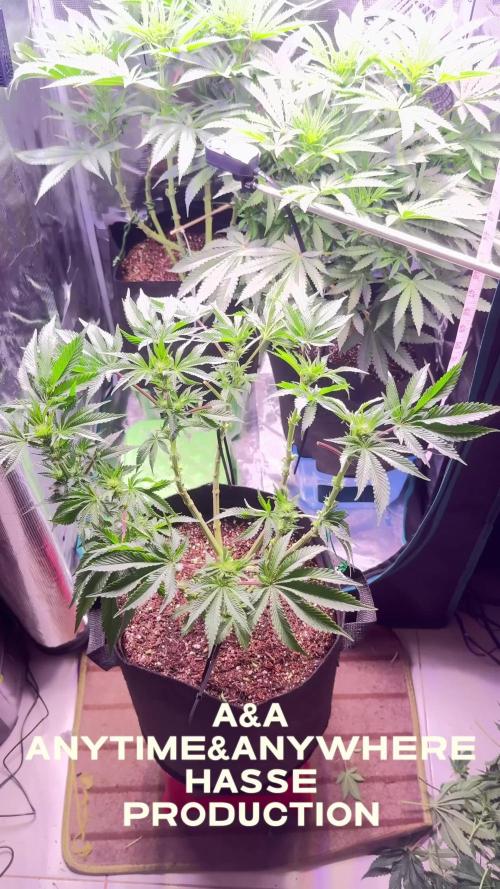
Bloom week 1:
I don’t really have too many pictures of this plant in veg. I didn’t plan to bloom her, but after some training she just looked pretty good. This plant is huge compared to my other 2. She’s about 6 months old.
I’ve only fed this plant about 3 times. I fed her yesterday for the first time in probably about 2 months. The plant looks good considering I’ve give her such little love. Hopefully with regular feeding she will blow up… but not too big for my tent I hope.


Likes
Comments
Share

@LoveTerps
Follow
May 26 2026
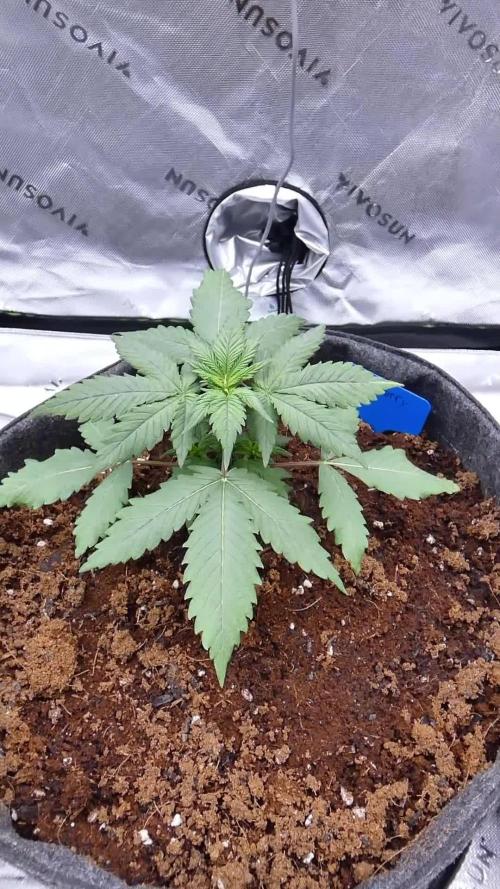
She's been repotted into a 5 gallon grow bag, and that will serve as her home for the remainder of the grow. The soil in the bottom half is pro-mix all purpose, and the top half is a combination of coco coir, perlite, worm castings, biochar, blood meal, bone meal, Epsom salts, and a bit of cal-mag.
Healthwise she is doing good, and also putting off a very faint aroma.

Likes
11
Share


@Chubbs
Follow
420 Fastbuds Week 2 Veg
FBT2303
The two of these are starting off great. The few rust spots stopped and stayed on the couple leafs it showed up on. I feed 500ml of solution every other day. I did start the General Hydroponics 3 part Flora series as well as the Calimagic. On week one I started 1/4tsp per gal ratio every other feed, so far no burn so will probably bump it up this coming week and see how they respond. All in all Happy Growing.

Likes
37
Share


@Rangaku
Follow
Soaked in water for 18 hours and then planted into pot . 24 hours on and she’s broke the surface . So keen for this one it’s my fave smoke
Likes
17
Share


@Hashy
Follow
Week 12
Light cycle=12/12
Light Power=130w
Extractor controller settings
High temp= 24c
Low temp= c
Temp step=0c
High Rh= 40%
Low Rh= %
Rh step=0%
Speed max=10
Speed min=1
Smart controller settings (during lights on).
Lights on=10.01-21.59
Radiator on= below 22.0c
Radiator off= above 23.0c
Dehumidifier on= not in use
Dehumidifier off= not in use
Smart controller settings (during lights off).
Lights off=22.00-10.00
Radiator on= below 18c
Radiator off= above 19c
Dehumidifier on= not in use
Dehumidifier off= not in use
Seperate feeding program.
#1 and #2 go onto dragon force.
#3 and #4 stay on schedule.
Fri 8/3/24
💧💧💧💧💧💧💧💧💧💧💧💧💧💧💧💧
Method= Manual
Feed=ripen nutes.
Dragon Force=4.0ml/L
Sumo Boost=1.0ml/L
Easy Ph up=0.1ml/L
Ec=1.45 PH=6.2/6.0
Total volume made=5L(L)
Total volume left=0L
Total volume used=5L
Volume per plant=2.5L
Runoff.
Total runoff=1.5L
Ec=1.9 PH=6.2/
💧💧💧💧💧💧💧💧💧💧💧💧💧💧💧💧
#1 (Day 78)(Day 40 flower)
📋 Ripen nutes.
Sat 9/3/24
#1 (Day 79)(Day 41 flower)
📋
Sun 10/3/34
#1 (Day 80)(Day 42 flower)
📋 Lowered light power from 130w to 120w
Small defoliation.
Mon 11/3/24
💧💧💧💧💧💧💧💧💧💧💧💧💧💧💧💧
Method= automatic
Feed=water
Neutralise=0.1ml/L
Easy Ph down=0.008ml/L (3 drops total).
Ec=0.2 PH=6.0/6.4
Time start=12.00pm
Finish time=13.45pm
(11×5 minute runs with 5 minute gaps)
Total flow rate=190ml/min
Flow rate per plant=47ml/min.
Total volume made=13L
Total volume left=3L
Total volume used=10L
Volume per plant=2.5L (Est)
Runoff.
Total runoff=2.5L
Ec=2.25 PH=6.1/
💧💧💧💧💧💧💧💧💧💧💧💧💧💧💧💧
#1 (Day 81)(Day 43 flower)
📋
Tue 12/3/24
#1 (Day 82)(Day 44 flower)
📋
Wed 13/3/24
#1 (Day 83)(Day 45 flower)
📋 Lowered light power from 120w to 100w
Thur 14/3/24
💧💧💧💧💧💧💧💧💧💧💧💧💧💧💧💧
Method= Manual
Feed=ripen nutes.
Dragon Force=4.0ml/L
Sumo Boost=1.0ml/L
Easy Ph up=0.1ml/L
Ec=1.45 PH=6.1/6.2
Total volume made=5L(L)
Total volume left=0L
Total volume used=5L
Volume per plant=2.5L
Runoff.
Total runoff for 2 plants=0.7L
Ec=2.1 PH=6.0/
💧💧💧💧💧💧💧💧💧💧💧💧💧💧💧💧
#1 (Day 84)(Day 46 flower)****
📋 H=101cm D=14cm DLI=40.0
Small defoliation.
She is coming along great. Final stage of flower so maybe chopped at the end of next week.
Back soon.
Take it easy.


Likes
15
Share


@Seabass
Follow
4.7.
every 3 days 4liters for 5 plants
Ph 6 with fertilizer
Slug repellent
Ants repelent
Yellow stickers
Neem oil


