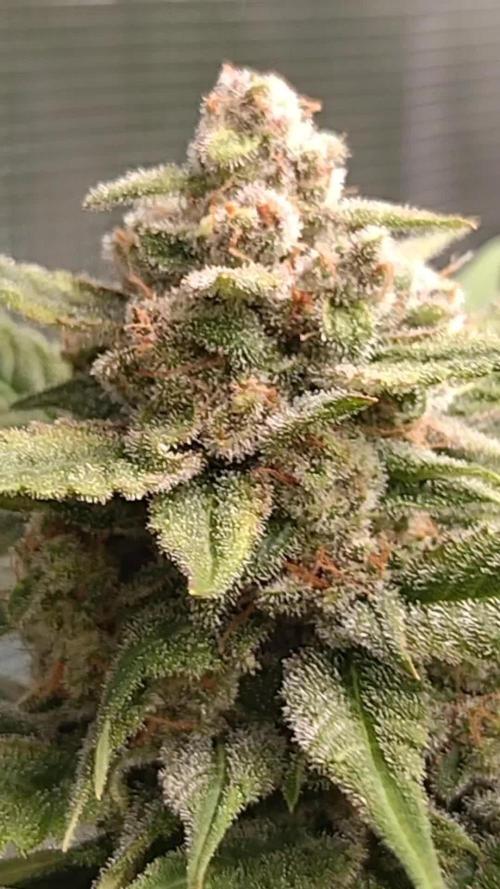
Processing
Likes
Comments
Share
@UrbanFog
Follow
This week again had some challenges with power and humidity but we push on. The ladies are getting seriously frosty and start to fatten up. They all looking good but the Lemon Zkittles is most impressive. Also the one pheno of Gorrila Cookies is frosty frosty frosty. But all the plants are looking good and stacking on buds nicely. Looking forward to harvesting in a couple of weeks. Here to hoping no more power or humidity issues, only fat and tasty buds ahead
Likes
18
Share
Had a couple of the stems which were almost drooping on the ground due to the weight of the buds, so decided to harvest those two branches today. Also, this week I did a bit more research on when to harvest. I had been waiting for the trichomes to begin to turn amber, but after reading this article: https://www.growweedeasy.com/harvest, I decided to harvest when the trichomes were cloudy. Experts say that the amber trichomes give a more relaxing effect, but I was growing this plant for daytime use. Looked at it under my digital microscope and decided to pull the trigger on the whole plant. Plus, the neighbors were starting to notice the smell. Final height - 104" - 8 1/2 feet - 2.64 meters. Not good. Was concerned that someone would hop the fence and pilfer my plant. Harvested her at 35 weeks - 281 days. Grow diaries really needs to expand the weeks available for us outdoor growers. Started her indoors in Feb. Transplanted outside on April 7th.
Likes
21
Share
@Hazeberg
Follow
Day 65: New week. I hope the dimmed lights satisfy her more. Let's find out during the week. Day 66: I added some strings to support the branches of the bigger buds. Let's see, if that helps to get them even bigger. Day 67: Nothing to do today. Day 68: Nothing to do today. Day 69: I cleaned the reservoir. I'm not quite sure why she has the CalMag issue. Maybe there is also something wrong with the PH, so I calibrated my device again. I ran out of BioBizz CalMag and now I switched to CANNA CalMag Agent. Let's see, how she reacts on that. Day 70: Last day of the week. Nothing to do today, except looking at that beautiful lady šŸ’š I’m curious, if the CalMag Agent from CANNA helps her during the next week. -------------------------------------------------------------- You also like to get some seeds from Fast Buds? You like a 15% discount? Just use the following code on your next order: CSYIJC Happy growing -------------------------------------------------------------- šŸ™ Thanks for visiting and follow for daily updates 🌱
Likes
6
Share
@TerpyOG
Follow
This week I did a fair amount of work on my grow. I did a bit of defoliation and spent some time tying down branches to shape the canopy. My goal is to get buds growing wall to wall! I can't wait to see the results of my efforts.
Processing
Likes
29
Share
So the girls are 4.5 weeks old there abouts. Happy with 4 of them (ish) seem to be transitioning to flower now so hopefully they get a nice stretch as there really short making me panic a little. Can see purple straight away.
Likes
Comments
Share
Day 42- ok so start of week 6…..she still has a lot of potential. Top buds are swelling good. She smells of citrus, mainly the mandarin but the lemon twang is there. I knew she was looking light in color but we’ve already started the fade so I’m still feeding all the ladies the same.
Likes
4
Share
7/9/29 día 1 de floración Esto arranca amigos, por desgracia lo hace con unas temperaturas altísimas, con maximas de incluso 32 grados debido a la ola de calor que estamos sufriendo. Ya hemos montado el sistema de riego y lo hemos preogramado para regar durante 1min cada 4h durante el día. La solución la hemos preparado con los productos Cyco arriba descritos, con una ec de 1 y un ph de 6,1. Por otro lado nuestro jardín. Esta iluminado por 4 barras led 100w de solux, y un lec solux de 630w aunque por el momento estÔ a 315w debido a las altas temperaturas. Para empezar la floración lo hacemos con una defoliación y una poda de ramas bajas. Estaremos atentos a cambios en las pequeñas para intentar mantener en cada momento la alimentación adecuada, sin carencia y sin excesos. No te lo pierdas!! 9/9/20 día 3 de floración Buenas, nuestras pequeñas se aclimatan bien a la nueva alimentación y a su nuevo medio. Aumentamos la ec del tanke a 1,1ec y seguimos manteniendo el ph a 6,1. Por otro lado las temperaturas parece que disminuyen por lo que pasamos el lec de 315w a 415w, manteniendo así unas temperaturas diurnas de entre 26 y 27 grados. Esperemos que continúen descendiendo hasta poder mantener las temperaturas a 23 grados durante todo el día. La humedad ronda el 40% y estaremos atentos para que no suba de ahí. Deja tu like y síguenos para no perderte nada. Buenos humos!! 11/9/20 día 5 de floración Nuestro cultivo avanza sin demasiados cambios, durante estos días se aprecia que las nenas aumentan su altura mÔs rÔpidamente y los brotes se multiplican.seguiremos atentos para que todo siga su curso. Buenos humos.
Likes
2
Share
21 dias de vida ya se ven bien cogidas a la tierra despues de dos semanas trasplantadas han dado buen tirón se ven muy sanas aunque hay alguna picadura de mosca blanca y estamos aplicando elicitacion y nutricion de terranabis. El PROJECT B como el PROJECT A van fenomenal šŸ‘ŒšŸ»šŸ¤©
Likes
19
Share
I can tell she’s going to take at least 70 days until harvest, maybe more. She’s growing strong and has moved past the brief pH issue she had a few weeks back. She’s starting to fatten up which I’m thankful for because I was just about out of vertical space to offer her. I still haven’t been able to really pinpoint her exact smell although it smells similar to other Mephisto strains. Drinking 2L of water every 2 days, I might increase to 2.5-3 L to get a little more runoff.
Likes
29
Share
@nonick123
Follow
DĆ­a 13 (06/05) Nos acercamos al final de la fase plĆ”ntula. A ver si ahora empiezan a crecer de forma explosiva! He sido muy estricto con los riegos, dejando que el top hasta el nudillo se seque completamente! DĆ­a 14 (07/05) Hago una mejora en la tienda. Hasta ahora tenia intracción pasiva, pero ahora he instalado una turbina para que impulse aire fresco dentro de la tienda DĆ­a 15 (08/05) Con el calor que hace me sorprende que las macetas sigan aguantando la humedad, pero al hundir el nudillo sigue hĆŗmeda. MaƱana harĆ© un riego de nuevo DĆ­a 16 (09/05) Relleno el top con sustrato para compensar la compactación y dar mas soporte a las plantas Riego con 300 ml solo H20 - pH 6,2 DĆ­a 17 (10/05) BaƱo de sol de dos horas. DĆ­a 18 (11/05) BaƱo de sol de dos horas DĆ­a 19 (12/05) Riego 750 ml H2O + Regulator 0,15 ml/l + CaMg-Boost 0,25 ml/l + Startbooster 0,25 ml/l - pH 6.2 šŸ’¦Nutrients by Aptus Holland - www.aptus-holland.com 🌱Substrate PRO-MIX HP BACILLUS + MYCORRHIZAE - www.pthorticulture.com/en/products/pro-mix-hp-biostimulant-plus-mycorrhizae
Likes
33
Share
šŸšŸ’ Runtz: La Runtz de Zamnesia šŸŒ±šŸ”„ es una variedad de cannabis de alta calidad, resultado del cruce entre las legendarias Zkittlez šŸ¬ y Gelato šŸ¦. Este hĆ­brido perfectamente equilibrado, con un 50% Ć­ndica šŸ›‹ļø y un 50% sativa šŸŒž, combina lo mejor de ambas genĆ©ticas para ofrecer una experiencia intensa šŸ’„, sabrosa šŸ˜‹ y completa. Su nivel de THC puede alcanzar el 27%. El TS1000 de Mars Hydro es una lĆ”mpara LED increĆ­ble para el cultivo interior šŸŒ±šŸ’”. Ofrece una excelente combinación de potencia y eficiencia, perfecta para espacios pequeƱos y medianos. Su espectro completo simula la luz solar šŸŒž, ideal para todas las etapas del cultivo, desde la germinación hasta la floración. AdemĆ”s, el consumo energĆ©tico es sĆŗper bajo ⚔, pero la producción es impresionante šŸŒæšŸ”„. La distribución uniforme de la luz asegura plantas sanas y cosechas abundantes. Definitivamente es una gran inversión. Para este Concurso usarĆ© la gama de fertilizantes de Plagron tal como mandan las reglas. šŸ“† Semana 6: La planta sigue evolucionando de manera espectacular. Los cogollos han ganado bastante volumen y densidad, mostrando una estructura compacta y resinosa. El **Green Sensation de Plagron** continĆŗa desempeƱando un papel clave en la nutrición, ayudando a potenciar la floración sin signos de sobrealimentación. El aroma dulce y afrutado de la **Runtz** se hace mĆ”s intenso con cada dĆ­a, llenando el espacio de cultivo con su fragancia caracterĆ­stica. Las hojas mantienen su tono verde vibrante, lo que indica un buen equilibrio nutricional y una salud general excelente. No he encontrado rastros de plagas ni deficiencias, lo que me permite enfocarme en maximizar la calidad de la floración. Estoy monitoreando de cerca la maduración de los tricomas para ajustar los próximos pasos en la fase final de floración. Ā”Cada dĆ­a mĆ”s cerca de la cosecha! Os seguirĆ© actualizando. 🌿
Likes
15
Share
We are in the middle of week 7 and flowering has started about 4 days ago. Big gal started budding 2 weeks ago.
Likes
9
Share
Welcome to Veg Week 3 of Kannabia Clementine Slush BioBoost Edition Need a Fail-Safe Germination and Express Flowering?Kannabia Makes It Easy with BioBoost, Sproutly and Its Fast Genetics . More informations to find at The Kannabia Blog on GrowDiaries. Check out Kannabia Seeds with my link [https://www.kannabia.com/de?ref=61966] and grab the germination device or the strains I used . Trust me – it’s worth it for sure ! Get another 20% Discount at all products using the code [GGD] at the checkout. little Holiday Present to the Community btw ā˜ƒļø For this Project , I’ve chosen the Feminized Photo Strain Clementine Slush BioBoost : Here’s what I’m working with: • 🌱 Tent: 120x60x80 • šŸ§‘ā€šŸŒ¾ Breeder Company: Kannabia Seeds • šŸ’§ Humidity Range: 60 • ā³ Flowering Time: 65 Days • Strain Info: 21%THC • šŸŒ”ļø Temperature: 26 • šŸµ Pot Size: 0.1 • Nutrient Brand: Hy-Pro • ⚔ Lights : 600W x 2 A huge thank you to Kannabia Seeds for allowing me to try my Best with this amazing collection from Photo Strains they managed to Sponsore . Big thanks for supporting the grower community worldwide! Your genetics and passion speak for themselves! Let’s grow together – and don’t forget to stop by again to see the latest updates! Happy growing! Stay lifted and stay curious! Peace & Buds!
Likes
19
Share
Legend Timestamp: šŸ“… EC - pH: āš—ļø Temp - Hum: šŸŒ”ļø Water: 🌊 Food: šŸ— pH Correction: šŸ’§ Actions: šŸ’¼ Thoughts: 🧠 Events: šŸš€ Media: šŸŽ¬ D: DAY, G: GERMINATION, V: VEGETATIVE, B: BLOOMING, R: RIPENING, D: DRYING, C: CURING ________________________________ šŸ“… D56/V49 - 10/01/24 āš—ļø EC: 1.1 pH 7.2 šŸŒ”ļø T: 23 °C H: 58% 🌊 šŸ— šŸ’§ šŸ’¼ 🧠 šŸš€ šŸŽ¬ Added Time lapse video ________________________________ šŸ“… D57/V50 - 11/01/24 āš—ļø EC: 1.1 pH 7.2 šŸŒ”ļø T: 23 °C H: 58% 🌊 šŸ— šŸ’§ šŸ’¼ Big Defolation and LST 🧠 Preparation for blooming stage šŸš€ Finally she has her space back, so all the grow box is for her 😊 šŸŽ¬ Added 4 pics ________________________________ šŸ“… D58/V51 - 12/01/24 āš—ļø EC: 0.9 pH: 7.6 šŸŒ”ļø T: 23 °C H: 58% 🌊 Added 4L šŸ— Added Bud Candy - B52 šŸ’§ šŸ’¼ Added ScrOG net. Defolation and LST to prepare the blooming stage 🧠 Blooming mode almost ready šŸš€ šŸŽ¬ Added Time lapse video and 1 pic ________________________________ šŸ“… D59/V52 - 13/01/24 āš—ļø EC: 0.9 pH: 7.6 šŸŒ”ļø T: 23 °C H: 58% 🌊 šŸ— šŸ’§ šŸ’¼ 🧠 pH is rising too much, but I'll not adding nothing for now šŸš€ šŸŽ¬ Added Time lapse video ________________________________ šŸ“… D60/V53 - 14/01/24 āš—ļø EC: 0.9 pH: 7.4 šŸŒ”ļø T: 23 °C H: 58% 🌊 Added 6L šŸ— Calmag - Grow A-B- B-52 - Bud Candy šŸ’§ šŸ’¼ 🧠 It's time to bloom triggering, in the next days I'll change the water for flush and bloom nutes šŸš€ šŸŽ¬ Added Time lapse video ________________________________ šŸ“… D61/V54 - 15/01/24 āš—ļø EC: 0.1 pH: 7.4 šŸŒ”ļø T: 23 °C H: 58% 🌊 RES Changed šŸ’¦šŸ’¦šŸ’¦. Flushing until tomorrow šŸ— šŸ’§ šŸ’¼ Passed lights to 12-12 (21.00 ON and 09.00 OFF) 🧠 šŸš€ šŸŽ¬ ________________________________ šŸ“… D62/V55 - 16/01/24 āš—ļø EC: 0.1 pH: 7.4 šŸŒ”ļø T: 23 °C H: 58% 🌊 Flushing almost finish, all is ready šŸ— šŸ’§ šŸ’¼ Made some LST 🧠 šŸš€ Let's BLOOMING !! YEAHHHHHH šŸŽ‰šŸ„‚ šŸŽ¬
Likes
5
Share
This beautiful lady is stacking so nicely. She has a main cola about 10’inches long! All the satellite buds are coming in nice too, lots of light penetration. I lowered the CalMag a little too early as some older, lower leaves are showing a slight magnesium deficiency, will correct at next feed. Happy growing šŸ‡ØšŸ‡¦ā¤ļøšŸŒ±šŸ˜ŽšŸ’Ø
Likes
12
Share
@cdxxbuds
Follow
Fruity aroma all over. This run came out better than i expected even though she took some abuse. Drying with herbnow dryer.
Likes
52
Share
Its time to prepare for war. *Blows bagpipe* FISH SH!T THE ORGANIC SOIL CONDITIONER (used twice before and always noticed instantly) Fish Shit is a living product! It provides a complex Microbial profile that includes thousands of different species of bacteria, fungi, and protozoa. This profile is closer to a natural ecosystem than anything you will find on the market. Fish Shit helps release essential oils and terpenes which contribute to the building of a myriad of flavonoids. Flavanoids play a key role in the development of the most potent aromas and tasteful flavors of a plant and its fruit. Fish Shit contains beneficial microorganisms that help plants maximize nutrient uptake. It does this by transforming nutrients into more usable forms and keeping these nutrients in the soil longer. During photosynthesis plants naturally produce exudates (chemicals that are secreted through their roots). Through these exudates, plants can attract the types of good bacteria that are beneficial to them at different points in their growing cycle. These good bacteria cover the roots and act as a barrier to the invasion of disease-causing organisms that may harm the plant. What Are Enzymes? Before we dive headfirst into how, exactly, enzymes can benefit cannabis plants, it helps to understand a little about what these microscopic proteins do. Essentially, enzymes facilitate chemical reactions. They do so by binding with a substrate and forming or breaking molecular bonds. In this context, the substrate is the molecule upon which an enzyme acts to boost the efficiency of a reaction. •substrate /sÅ­b′strāt″/ •noun •The material or substance on which an enzyme acts. A surface on which an organism grows or is attached. An underlying layer; a substratum. Enzymes are proteins with complex 3D shapes that feature regions called active sites. When the substrate binds to these active sites, it forms an enzyme-substrate complex that causes a chemical reaction to take place, temporarily changing the structure of the enzyme and ultimately causing molecules to either come together or break apart. As a result, molecular products are released, and the enzyme returns to its original shape. Specific enzymes are capable of binding with certain substrates, as the substrate fits into the active site more or less via a lock-and-key principle. Although, new research suggests a more accurate theory of "induced fit", in which enzymes and substrates undergo structural changes to facilitate the reaction. If you take the human body as an example, we have an abundance of enzymes in our saliva and digestive system. These molecules bind with substrates in these regions (food particles), working to break down the food we eat into usable parts before converting them to energy. Enzymes in cannabis work in a similar way to the example highlighted above. Typically, enzymes occur in soil naturally, but if your soil mix is lacking organic material, or you're growing hydroponically, then adding enzymes directly to the substrate is crucial. By using them in cannabis growing, enzymes not only help break down essential nutrients into smaller, more readily available pieces, but they also support the digestion of dead root cells, clearing a direct path for nutrients. Overall, enzymes make it easier for your cannabis plants to absorb all the elements they need to reach their full potential. For growers, a plant that reaches its full potential means a bucketload of juicy buds come harvest. This is essential if you want to reuse a pot with old systems left over like mine. Common plant enzymes include: •Cellulase •Xylanase •Beta-glucosidase •Hemicellulase •Amidase Amino acids are a crucial, yet basic unit of protein, and they contain an amino group and a carboxylic group. They play an extensive role in the gene expression process, which includes an adjustment of protein functions that facilitate messenger RNA Nitrogen, phosphorus, and potassium are the three main pillars of nutrient solutions and fertilizers, but there are countless other nutrients that your cannabis plants need to produce the best possible harvest. Amino acids are one of them. You may have noticed that amino acids get a lot of attention from bodybuilders and other athletes. That’s because they play a key role in the synthesis of protein, which, as you probably know, is super important for sports recovery and muscle growth. Amino acids are the building blocks of protein and the foundation of both plant and animal life. But what do amino acids do for cannabis? WHY IS PROTEIN IMPORTANT FOR CANNABIS? Just like proteins are important for the human body, they are equally important for the growth and development of plants. For example, proteins help plants: •Facilitate the growth of intracellular plant structures •Promote energy generation •Stimulate metabolic processes •Facilitate the absorption and transportation of nutrients So, where do plants get these vital proteins from? Well, unlike humans, plants can’t source proteins or amino acids from other organisms. Instead, they need to create their own amino acids, and then use these to build protein. That's why gardeners, much like athletes, go wild for amino acid supplements. Amino acids help plants by… • Increasing their production of chlorophyll, which ultimately improves their ability to photosynthesize • Serving as an easily absorbable form of nitrogen • Stimulating the synthesis of key vitamins • Improving their resistance to pests and diseases • Boosting the strength of their cells Amino acids also serve as the precursors to auxins, a group of plant hormones produced in the meristems—the apex of the stems where new leaves and stems are born. Auxins play a key role in the plant, activating genes for plant growth and development by triggering a multitude of vital plant functions. In other words, they determine what its size and architecture will look like. Auxins influence the development of branches, flowers, and roots, and even help to regulate the photoperiod response of the plant. Some amino acids, like cysteine, also work together with antioxidants like glutathione to help cannabis plants deal with oxidative stress, which can be caused by high-intensity lighting, some nutrient solutions, and high levels of COā‚‚. Unlike humans, plants can synthesize all the amino acids they need to survive and develop properly. Unfortunately, however, amino acid synthesis is a really high-energy process, and plants may struggle to produce enough amino acids when exposed to stress. WHAT FACTORS AFFECT A PLANT’S ABILITY TO SYNTHESISE AMINO ACIDS? Any kind of stress can affect a plant’s ability to produce enough amino acids. This includes: • Drought • Temperature extremes • Poor soil health • Pests • Diseases • Poor lighting • Lack of space • Poor root health WHAT DOES ALL OF THIS MEAN FOR WEED PLANTS? If you want to push your plants to their extreme in terms of floral growth and resin production, you should look into amino acid fertilizers. By making amino acids readily available to your plants, they’ll be able to use crucial energy to grow and bloom, rather than focusing on synthesizing amino acids themselves. Game of Inches, this is another Plants can absorb amino acids via their roots and leaves. They can also benefit from amino acids during both their vegetative and flowering phases. The fastest way for plants to absorb amino acids is via their leaves. The foliar application of amino acids is believed to improve the transportation of nutrients, increase transpiration, and boost photosynthesis. Hence, I recommend feeding your plants with foliar amino acid fertilizers. When doing so, however, carefully measure the amount of fertilizer you use, as—like with any nutrient—overfeeding can damage your plants. FOLIAR FEED AND SOIL SOAK • 1 crushed queen anne carrot • Add 2 tbsp of NPK Raw powdered water-soluble cane molasses • 20ml h2o2 • 1 crushed radish • 0.25 tsp NPK Enzymes • 0.25 tsp NPK Amino Acids • 50ml coconut water ( nature's own amniotic fluid packed with amino, enzymes ) + The sound of songbirds. Onto the predators 1250 -Green Lacewings Lacewings are extremely voracious predatory insects that feed on several pests. In adulthood, it feeds on pollen and nectar. In the larval stage, it feeds on aphids, thrips, and mealybugs at all stages of growth. It can also attack spider mites in moderate quantities. It is initially an aphid predator, but very effectively controls thrips and mealybugs infestations. It is so voracious that in the absence of prey, it will feed on its congeners. Lacewings are cannibalistic if there is no food available for them. It is therefore important to introduce them into an infestation situation, and not just preventively. •congener /kŏn′jə-nər/ •noun •A member of the same kind, class, or group. •An organism belonging to the same taxonomic genus as another organism. •A thing of the same kind as. or nearly allied to, another; specifically, in botany and zoology, a plant or an animal belonging to the same genus as another or to one nearly allied. Ideal temperature 20°C – 26°C Ideal humidity 60% – 70% Predatory stage life cycle 21 days Introduction rate 4 weeks Storage Refrigerator Use Immediately Are there any specific instructions on how to use this predator? Lacewings are available on small paper cards that you can hang to plant stems. On the cards are dozens of eggs ready to hatch. There are also sterile eggs they can feed on once they have hatched before they are ready to disperse in the foliage. It is important to use them quickly upon receipt to avoid cannibalism. If you don't use them right away, you can store the cards in the refrigerator for 24 to 48 hours to prevent the eggs from hatching too quickly. Avoid storing them for longer than this or you risk losing eggs. 1250 eggs are divided into 7.5 cards, 2500 eggs on 15 cards, and 5000 on 30 cards. The application rate is one card per square meter of growing surface. Is this predator best used for preventive or curative treatments? Lacewings are used as a curative solution. Anything else I should know? Lacewing eggs hatch approximately 24-72 hours after the cards are exposed to room temperature. When they emerge, the lacewings are just 1.5-2 mm long. They are very small so they are difficult to see. Once hatched, they will stay on the cards for a few hours and then disperse in the foliage. You quickly lose sight of them if you have not witnessed the hatching. They then live in the foliage for about 3 weeks. Often, you will see them towards the end of their larval cycle. After feeding for 3 weeks, they will triple and even quadruple in size. At that point, they are easier to see. But they remain very discreet insects, it is not abnormal not to see them. Egg carcasses left behind on the cards do not disappear after the hatching has happened. It's normal to see eggs still on the cards. Visually it is very similar before and after hatching. Also, on the boxes, there are sterile ephestia eggs which are used to feed the lacewings once hatched. Not all lacewing eggs are viable either. Only a certain percentage of lacewing eggs will hatch. Once hatched, the eggs are white. You can observe this using a magnifying glass. With, 5000 Stratiolaelaps Scimitus It is used to prevent or control thrips pupae, fungus gnats larvae, and root mealybugs in the soil. It can also be used for red mites in bird farms or hen houses. The adult is about 1 mm long and is medium brown with a beige triangle on its back. Another fun fact about them is they can survive without prey. They can eat algae and plant debris. This is why they can reproduce and stay in plants for long periods. Ideal temperature 15°C – 23°C Predatory stage life cycle 18 days Introduction rate 2 weeks Storage Room temperature Use Within one week Are there any specific instructions on how to use this predator? Sprinkle directly on the growing media. They can live in all types of substrates like potting soil, coconut fiber, rock wool, cedar mulch, etc. Stratiolaelaps establish easily so they are permanently fighting pests. One introduction is generally enough unless you have an infestation. In this case, introduce them at least twice at a 2-week interval for best results. If you grow your plants in a 100% mineral substrate, it will have to be released more often since there is less organic matter than in traditional soil. Do I need to take any specific precautions? Stratiolaelaps breed in the top layer of the soil. So it is important not to disturb them in the first days following their introduction. They don't like temperatures below 8 ° C. So be sure not to introduce them in a water-saturated or cold environment. Release them 24-48 hours after your last watering. They are very sensitive to chemical acaricides and diatomaceous earth. These methods are incompatible with their use.
Likes
22
Share
2 Pheno still in veg living da solo cup life
Likes
15
Share
Day 15-defoliated her probably for the last time after a few weeks of growth, she was very bushy. Added another fan to get more air moving as well. Also, I decided to try out the AN Sensi Bloom set. I didn’t mean to get the coco version but a little extra cal-mag won’t hurt in this case, I only fed at 75% strength and added big Bud powder at 0.5 grams/liter. I’m hoping her stretch finishes soon or I’ll run out of space, although she’s starting to really stack.