Likes
Comments
Share
@BLAZED
Follow
Week 11 (2-9 t/m 8-9) Week 1 bloei 2-9 Temperatuur: 29.8 graden (licht aan) 21.5 graden (licht uit) Luchtvochtigheid: 80% (hoogste) 50% (laagste) Week 1 van de bloei is begonnen! Watergift: 1250 ml, met 0.2 ml Silica per liter, 1 gr Calcium PowderFeeding per liter. EC: 0.4 PH: 6.4 3-9 Temperatuur: 29 graden (licht aan) 21.5 graden (licht uit) Luchtvochtigheid: 69% (hoogste) 50% (laagste) Watergift: 500 ml, met 0.2 ml Silica per liter, 1 gr Calcium PowderFeeding per liter. EC: 0.4 PH: 6.4 4-9 Temperatuur: 28.5 graden (licht aan) 21.5 graden (licht uit) Luchtvochtigheid: 71% (hoogste) 51% (laagste) Watergift: 1200 ml, met 0.2 ml Silica per liter, 1 gr Calcium en 0.4 gr Hybrids Powderfeeding per liter. EC: 0.9 PH: 6.5 5-9 Temperatuur: 29.6 graden (licht aan) 20.8 graden (licht uit) Luchtvochtigheid: 72% (hoogste) 51% (laagste) Wat blaadjes weggehaald. Watergift: Geen. 6-9 Temperatuur: 33 graden (licht aan) 22.3 graden (licht uit) Luchtvochtigheid: 70% (hoogste) 42% (laagste) Watergift: 850 ml, met 0.2 ml Silica per liter, 1 gr Calcium PowderFeeding per liter. EC: 0.4 PH: 6.4 7-9 Temperatuur: 32.2 graden (licht aan) 22.6 graden (licht uit) Luchtvochtigheid: 66% (hoogste) 45% (laagste) De kartelpuntjes van het blad zijn lichtelijk geel, na het water geven heb ik de runoff gemeten en dat geeft een EC 2.4 en PH 6.8 aan. Ik ga nu een weekje geen Hybrids voeding geven en daarna ga ik de runoff weer meten. Watergift: 1500 ml, met 0.2 ml Silica per liter, 1 gr Calcium PowderFeeding per liter. EC: 0.4 PH: 6.4 8-9 Temperatuur: 30.4 graden (licht aan) 22.8 graden (licht uit) Luchtvochtigheid: 75% (hoogste) 46% (laagste) Watergift: Geen.
Likes
6
Share
… just moved into my new home by @original_homebox and lads i can tell: the climate controlled by the @growcontrol.de growbase makes me so happy. Its so much nicer here than in that shady chamber. I also had my first „real“ simulated sunrise today . Omg its so cozy living at my new place. And i also have a training appointment with @le_rouge._ soon. I‘m so exited. Can‘t wait to show you more growth. Unsere privaten Growprojekte die wir mit freundlicher Unterstützung von unseren Partnern @growcontrol.de @original_homebox @mars.hydro @biotanicpro & @purolyt realisieren starten! 🌿
Likes
10
Share
😎Shalom brothers! Another week has passed and I am glad to share the results with you again. This week I continued to do all sorts of experiments testing my girl for strength. We survived lst, defoliation and cloning. And I also added 30 watts of red light with a wavelength of 630nm, using Samsung 351LH diodes.This spectrum enhances flowering, and helps the plant to form internodes with shorter distances, which will give more growth points for future buds. 👌Let's start with nutrition. I changed the frequency of watering, now my plant is watered 6 times for 20 minutes during daylight hours, every 3 hours. This week I made a nutrient solution with the following recipe: Water 183 ppm, 8l Silicon 4ml Сalmag 1.5ml GHE Flora: Gro 7.5 Micro 5 Bloom 2.5 pH down 5.5 ml Total 669 ppm, 5.6 pH 💪About training. Let's start with LST: Low stress training, abbreviated as LST (LowStressTrainig), is similar to the art of bonsai except for cannabis plants. This is a special technique of bending and tying plants to give them the desired shape. LST will also help you get a lot of massive buds by leveling the crown of your plant so that the lighting is more effective on it. Using LST will help you increase your yield and is surprisingly fun. 😈The following I did defoliation: Pruning leaves or defoliation is an old Japanese technique that has been kept secret for a long time. The main goal is the intensive development of the tree, that is, in one year the tree goes through a two-year growth cycle. This method consists in partial removal of leaves. Classically, only deciduous trees are subjected to such an operation. But, it is quite possible to do this with some tropical plants and not only, in order to bring them out of a prolonged period of dormancy. Defoliation leads to a decrease in the size of leaves and an increase in their number. As a side or positive effect, the rejuvenation of the crown can be considered, that is, new and fresh foliage appears, which will be better preserved and will have a more attractive appearance and bright color. 👊And as promised, I'll tell you about stimulants: GHE Root Booster - a natural supplement for the growth of the root system; promotes the growth and development of a rich, healthy root system. The preparation contains vitamins, enzymes, organic and humic acids that stimulate root growth without synthetic additives. GHE Fulvic - Soluble humates (humic and fulvic acids) contain a huge amount of natural components that stimulate plant growth, as well as enhance nutritional ingredients. Fulvic acid is the substance that does all the hard work: converting nutrients into a form readily available to plants, which increases the efficiency of the nutrients. RasTea Bio-Energy SPELL is a universal 100% organic stimulant for improving metabolism based on highly concentrated and highly purified humic and fulvic acids in combination with vitamins, amino acids, polysaccharides, extracts and extracts from plants, ensures better absorption of nutrients by plants. The unique formula activates the natural potential of plants, which has a beneficial effect on all stages of development, increasing stress resistance, growth intensity and yield. I give all three stimulants one sheet at a time, and since they are somewhat similar, I give them in turn. 👽Well, see you next week. This will be the last week of the growing season, we will go through another workout, take a break from stress and go to the bloom.
Likes
14
Share
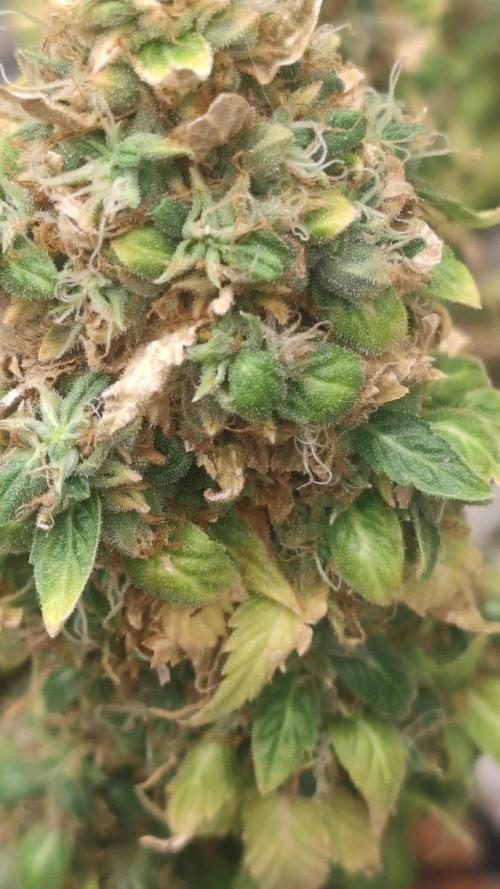
FINAL WEEK? Feb 28th - pH 6.0, PPM 400, 0.8 EC, Temp 77f, Humidity 50% - What changed! 3 gals, hoping this to be the final week. The trichomes look good, just want to ensure all are sufficiently done and ripe. Mar 1st - pH 6.3, PPM 400, 0.8 EC, Temp 81f, Humidity 70% - Adjusted pH from 5.0, added water to adjust PPM from 550. Mar 2nd - pH 6.4, PPM 420, 0.8 EC, Temp 80f, Humidity 55% - Adjusted pH from 5.4, added water to adjust PPM from 550. Mar 3rd - pH 6.4, PPM 460, 0.9 EC, Temp 77f, Humidity 62% - No adjustments. Mar 4th - pH 6.2, PPM 460, 0.9 EC, Temp 83f, Humidity 80% - Adjusted pH from 5.7, VPD is ass, no idea on how to change or fix it. I have 2 intakes and one exhaust, the room the cabinet is in is not high in humidity, just the 1.5x2.5 cabinet. :/ I have tried a dehumidifier, but in the end, it didn't collect anything after a few days, so truly at a loss, I've also tried defoliation, but I'm always afraid of doing too much, I mean I guess it's the last week/week and a half so it shouldn't be too bad to cut leaves off but damn, what about the earliest stages, shits going to be tough to dial in... Mar 5th - pH 6.3, PPM 430, 0.9 EC, Temp 85f, Humidity 70% - Adjusted pH from 5.7, seeing more purple on the buds, maybe I'll go another week just to see if any more color comes out. Mar 6th - pH 6.3, PPM 530, 1.1 EC, Temp 83f, Humidity 75% - No adjustments
Likes
16
Share
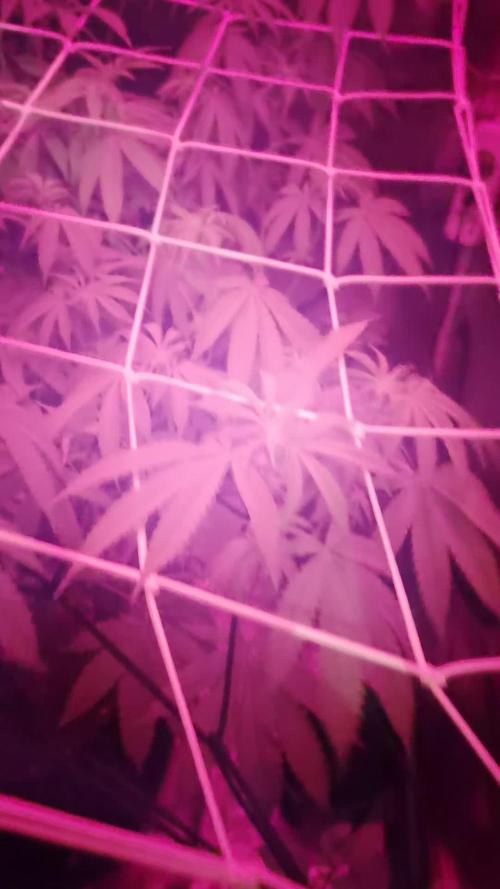
This first week in flower was a bit more exciting than previous weeks. I decided to put in a scrog net to help spread and even out the canopy. So naturally, I 3D-printed one. (Yes, I can be that nerdy.) Besides, it was the quickest and easiest solution as I don't like the stretchy-net kind so need a frame. Much easier to download a file and press print :D Installing it was a breeze and I also cleared away most branches and leaves below the screen. The stuff that won't make it above the screen and will just result in a bunch of larf. I'm still seeing chlorosis (which I suspect has to do with her transitioning into flower and stretching), so I gave her a bit of Orgatrex and Bactrex. Next week, I'll start feeding her PK booster. –––––––––––––––––––––––––––––––––––––––––––––––––––––––––––––––– This grow is generously sponsored by Bio Tabs Bio Tabs is an organic growing system that uses slow-release tablets of beneficial microbes, mycorrhizal fungi, and nutrients to create living soil that feeds plants naturally throughout their growth cycle. It’s designed to simplify growing and promoting strong roots, healthy growth, and large yields. Use code GDBT420 for 15% off at the BIOTABS Webshop https://biotabs.nl/en/shop/ ––––––––––––––––––––––––––––––––––––––––––––––––––––––––––––––––
Likes
59
Share
@Coopmc
Follow
LemonWalker #1 chelated for week 11 might got 11-1/2 30g wet so about a 1/4 dry should press a nice gram of rosin for me to sample her let her dry 4-5 days shooting for 68-72% to press!! Flavor mellowing a bit starting to smell more like Key Lime!!
Likes
3
Share
I hope you will enjoy my work, the peaks are to dry, share a few days for comments or advice, or questions please write to me.... !! peace & love
Likes
18
Share
Hi guys, day number 40 is the last day at 18/6. Now I'll give 24 hours of darkness and Then I'll start the 12/12 cycle. If I have not done anything wrong, I think I will collect about 100 grams of dried flowers per plant. I have not had any problems and I hope everything goes smoothly until the end. Stay tuned 🦍😁💪🏻
Likes
6
Share
Likes
28
Share
Week 3 of Flower (Day 15-21) Should be the last days of stretch. Hopefully, because the height is limited and i do not want to rethink the top of my growtent. Beautiful flower development and i have had no problems in flower so far. I will turn the nutes up a bit, as they have not complained so far. Furthermore, i will lollipop or make a major defoliation when stretch is done, in order to deal with temp and humidity. (airflow) 👽👉24/10 Praying hands, very happy ladies. 👽👉25/10 I am keeping a close eye to the grow, as i have implemented low-energy-consumption solutions, whenever the price of electricity is higest. Meaning the climate is less steady, in some times on the day. 👽👉26/10 I was supposed to water today, however my schedule did not allow. They do not have any drooping leaves yet, they will be fine. 👽👉27/10 Waterday* and cleaning up the dead bottom leaves. Upped my nutes from 1.77 EC to 2.08 EC Bioheaven 2ML/L > 3 BioGrow 2 ML/L > 2.5 BioBloom 1.5ML/L > 2.5 TopMax 1ML/L Calmag 0.4ML/L > 0.5ML/L Rootjuice 1ML/L 👽👉28/10 Upped the nutes quite a bit yesterday, so exiting to see their reaction. Until now they look healthy and responded well. 👽👉29/10 Amazing development. 👽👉30/10 Waterday* Ph 6.2 and they shared 12.5 liter Bioheaven 3ML/L BioGrow 2.5 ML/L BioBloom 2.5ML/L TopMax 1ML/L Calmag 0.5ML/L Rootjuice 1ML/L
Processing
Likes
19
Share
For some reason it's say 9 weeks flower. But it's only 4 weeks flower. Lol. Going well I guess for a 1st grow. Looking nice n frosty at 4 weeks.. Got a alien in the corner lol which knocked me.. Turns out to be a different strain.. 5 n half foot monster.. N still going up.. Have enjoyed this 1st 1 and hope to do more. Has any 1.got n ideas for next. 1 myt try autos. Are they easy to grow? Is is it best to stay away from them.. Happy growing ppl
Likes
10
Share
Processing
Likes
Comments
Share
@MG2009
Follow
07/07/2020 She drank 2 liters of OVERDRIVE this week, so one more week watering with OVERDRIVE and MICRO to supplement growing seeds, they getting fat. 07/10/20/20 New pistils popping out on sides of buds none on top so filling out. I guess she responding to (OVERDRIVE) Her last stage of flowering has begun should be done in 2 weeks 🙏 so one more week watering with OVERDRIVE and MICRO then water only for the flush week. And Harvest???
Likes
26
Share
It seems this little lady is the purple leaved geno type, And has already started too show her colours, I really pumped the nutrients this week as you can see, At the end of this week a stopped giving the plant these addavitves More roots, Humic acid, Growzyime, Fast bud folar spray, And big buds, And have now started too raise the house & Garden A&B soil feed and also there budXL I also started off early but as a trace amount of there top shooter, By the end of week I intend on giving them the full recommended of each and only be giving them the house and garden range at full streingh, I will then wait for the first Amber tricomb then instant flush feeds, Hopefully I get two weeks from that stage but it is often genetic so as long as I get at least one week and at least 3 feeds of water only then I'm happy
Likes
29
Share
@Naujas
Follow
wow!!!!! she's amazing :) her buds already look stiff, and she's still ripening :) Zamnesia Runtz auto is great for small spaces, I can also smell her amazing scent, I have no doubt that she'll have a great smoke :) the girl will only get 6.3ph water from now on, -washing :) I think she has about 2 weeks left until the finish :) I can't take all the credit for it, my Cat helps me :) watch the video :).
Likes
30
Share
Cheiro muito forte de Pinho e baunilha. Com certeza é o melhor resultado que já obtive cultivando com o coco.
Likes
2
Share
Loving how these girls are growing Fastbuds mystery #1 finally catching up, and may possibly in the end being a better producer than the RQS plant, which is surprising to me because of how badly I stunted this plant. Got me curious how good this plant could’ve been
Likes
18
Share
my dry and cure style is this: 4 days of hanging upside down to get water activity lower to around 0.6 in 50% humidity and 26 C temp (i know its a little high but we are in a hot summer right now and i cant get it lower even with air conditioner) and then after 4 days of drying i remove leaves and stalks, trim buds and move them to jar for the rest of their life :D . and in the first 4 days of curing i open the jar door and let hem get some fresh air in the jar for about 5 minutes and close the jar door again, after 4 days of curing like that buds are smokable but they will get better as they getting cured about 1 month. buds are one of the hardest as fucking rocks type of buds! very dense , compact , sticky , smelly , amazing at every aspect growing stage was 56 days and flowering stage was 75 days total (harvested tops at day 64th) the total weight of dry buds was : (plant #1 & #3 top buds 56 G + lower buds 22 G ) 78 G + (plant #2 top buds 47 G + lower buds 18 G ) 55 G + (plant #4 top buds 120 G + lower buds 67 G ) 187 G = 367 G
Likes
2
Share
67 days since April 16th, 2026 We become aware at such times of man's wonderful ability to bring seemingly unrelated elements into harmonic balance, and receive a glimpse into a world where everything exists in conscious sympathetic attunement to everything else. When we listen to a piece of music that seems to strike a beautiful chord somewhere inside us, or view a painting that simply glows with harmonic awareness well executed, we probably do not spare much time to contemplate the wonderfully intricate combination of vibrations that our sensors make it possible for us to perceive. We tend to appreciate the relationship between the parts of something by an awareness of the harmony or dissonance of the whole. This ability enables us to say "what a beautiful house!" instead of "analysis has proven that this collection of building materials exhibits certain elements of harmonic proportion." While this ability to instinctively appreciate the beauty of true harmony has an important role to play in evolution, a more analytical understanding of the laws involved can be most useful. This is especially so if we wish to create works of art where each part exists in true harmony, not only with the other part of that particular whole, but with the universe within which the creator and the created exist. Everything vibrates. From the most dense matter to the most subtle cosmic rays, everything which our senses allow our thoughts to become aware of, can be specified in terms of wavelength or frequency of vibration. These two terms define the same thing, but from different points of view. The following are the approximate wavelengths of various energy carriers: Cosmic rays 0.000,000,001 mm Gamma rays 0.000,000,1 mm X rays 0.000,500 mm Ultraviolet rays 0.003 mm Visible light 0.006 mm Infrared 0.01 mm Sound waves 1 meter Radio waves 300 meters Violet light 400 nm to 450 nm Blue light 450 nm to 500 nm Green light 500 nm to 570 nm Yellow light 570 nm to 590 nm Orange light 590 nm to 610 nm Red light 610 to 700 nm 1 nanometer (nm) = 0.000,000,1 cm = 1/10,000,000 cm If a guitar string is plucked and we hear a sound, it is not too difficult for the human mind to associate this sound with the vibration of the guitar string. With color it is quite different. It is difficult for us to conceive that the color of a substance is not an inherent property of the substance itself, but an indication picked up by our senses of that substance's ability to absorb or reflect the light which happens to be shining on it at that moment. Neither the matter nor the light is colored. What happens is that the brain learns to differentiate between the frequencies reflected or transmitted by the substance the eyes are focused on. The same thing happens with sound. When we say "Oh! Listen, they're playing my favorite song," what we really mean is: "My brain has stored within it a particular pattern of frequencies. I have compared the new information being received with this stored pattern and have deduced the answer that the two patterns are similar within certain specified tolerances." The 'pleasure' involved could have something to do with our running the pre-recorded pattern at the same time, in 'sympathy' with the new pattern as it is received. The word sympathy describes very well our ability to appreciate color and sound. It also describes the reason behind certain elements of harmony. For instance, if a substance vibrating at 100 cycles per second (tone 1) is in the proximity of another substance vibrating at 200 cycles per second (tone 2), we could perceive, if we had the right equipment, a certain sympathetic relationship between the two. We will see from this that there is a uniform doubling of the first tone seen in the second. At various points along the waves, the two are the same in amplitude. At other points, they are at opposite poles to each other. This doubled frequency has more points of similarity to the original than any other frequency except the original itself. If the equipment we had available for measuring these two frequencies was a soundboard amplifier and a pair of ears, then we would hear what would sound to us like one tone. If we had the opportunity to hear one at a time, we would hear that although they sound the same, one is higher in pitch than the other. This characteristic of 'the same but different in pitch', musicians have called the octave. Any two tones produced where one has exactly doubled the frequency of the other is called an octave. Speaking in ratios, an octave would appear then as the ratio 2:1 or 1:2, depending on whether we are talking of an octave up or down. A single note produced by almost any instrument will contain more than one wavelength or frequency. It will have a dominant frequency, the wavelength of which we would call the note's 'fundamental' or 1st harmonic. It will also have a varying number of upper harmonics, gradually fading in intensity into infinity or silence. Natural harmonics always have the same pattern of intervals between them. The interval between the 1st and 2nd harmonic is a perfect octave; between the 2nd and 3rd a perfect fifth; between the 3rd and 4th a perfect 4th; and so on, the intervals becoming smaller and smaller until they lose any relationship with the western 12 tone scale as it exists at the moment. Just as an octave has certain elements of sympathy with its fundamental, so some intervals have been noted to be more perfectly in sympathy with the fundamental than others. The ratio of the 'perfect 5th' or interval of 7 semitones, as it occurs in the harmonic series, is 3:2 or 2:3, while that of the 'perfect fourth" is 4:3 or 3:4. All the tones in the western 12 tone scale can be expressed in terms of the ratio between the upper tone and its fundamental. This would seem to be an ideal way of generating a scale from any given fundamental and several attempts have been made to do this, the Pythagorean system being probably the most well known. Although when working with a single tone instrument playing on its own, the Pythagorean formula works wonderfully well, if we had several instruments tuned this way together and asked them to play almost any western music, we would find that at times they sounded quite out of tune to each other. The lack of flexibility of the various scale systems based on the harmonic series has led to what is known as the 'tempered' scale. This uses as its primary unit of interval the ratio of the octave or 2:1. It then proceeds to divide the interval between any fundamental and its upper octave into 12 smaller intervals by applying the ratio: two to the one-twelfth power, to one (21/12:1). This equals 1.059463094, so by multiplying any frequency by this number, we will obtain the tempered semitone next up from our fundamental. We will also find that any tone twelve semitones up from any other tone, in a scale generated in this way, will have exactly double the frequency. If we took the note middle C on a piano and halved the wavelength, we would have the note C one octave above. If we halved this, we would have the C above, and so on. However, within about 6 octaves, we would find that although a 'sound' was being produced, no human ear could perceive it. If we kept on going, halving and producing upper octaves of our fundamental C, we would proceed through the infrared band, into the visible light spectrum. If we happened to be outside during the day, we would, for one octave only, see the note C with our eyes. The next octave above would already be in the ultraviolet band, and outside the eye's sensitivity range. If we can think of color as being an indication of a substance's vibratory rate or wavelength, we may begin to see a relationship that could exist between the color and sound spectrums. The logical extension of what has so far been said is that there exists a scale in the color spectrum that corresponds exactly to the scale in the sound spectrum, each color tone being an octave of the equivalent note in the sound range. This is not the end of the story but only the beginning. If we can for the moment accept that any wavelength in one band has upper and lower octave stretching out to infinity, then the next question is 'fine, but what shall we use as our fundamental? A particular color? A particular sound frequency?' The musicians among us will probably say 'A 440'. This means that the note A should vibrate at 440 Hertz, or 440 times per second. They would tell us that this is standard pitch has been adopted by most orchestras around the world; pianos are tuned to it, instruments are constructed to formulas based on it, and so to them it would probably seem the most appropriate place to begin. Some of these musicians may know of the battle that is still raging with regards to this being the standard, but few would know why A = 440 Hz was chosen except that it worked when it was set to be a suitable compromise between the many different pitches in use at the time. 432 Hz is said to be mathematically consistent with the patterns of the universe. Studies reveal that 432 Hz tuning vibrates with the universe’s golden mean PHI and unifies the properties of light, time, space, matter, gravity, and magnetism with biology, the DNA code, and consciousness. When our atoms and DNA start to resonate in harmony with the spiraling pattern of nature, our sense of connection to nature is said to be magnified. Another interesting factor to consider is that the A=432 Hz tuning correlates with the color spectrum, while the A=440 Hz is off. Audiophiles have also stated that A = 432 Hz music seems to be non-local and can fill an entire room, whereas A=440 Hz can be perceived as directional or linear in sound propagation. Once you adopt the idea that sound (or vibration in general) can have an equalizing and harmonizing effect (as well as a disturbing effect), the science of harmony can be applied to bring greater harmony into one's life or tune to specific energies. There is a form of absolute and relative harmony. Absolute harmony can, for example, be determined by the tuning of an instrument. The ancients tuned their instruments at an A of 432 Hz instead of 440 Hz - and for a good reason. There are plenty of music examples on the internet that you can listen to in order to establish the difference for yourself. Attuning the instrument to 432 Hz results in a more relaxing sound, while 440 Hz slightly tenses up the body. This is because 440 Hz is out of tune with both macro and micro cosmos. On the contrary, 432 Hz is in tune. To give an example of how this is manifested microcosmically: our breath (0,3 Hz) and our pulse (1,2 Hz) relate to the frequency of the lower octave of an A of 432 Hz (108 Hz) as 1:360 and 1:90. It is interesting to note that 432 Hz was the standard pitch of many old instruments and that it was only recently (19th and 20th century) the standard pitch was increased. This was done in order to be able to play for bigger audiences. Bigger audiences (more bodies) absorb more of the lower frequencies, so the higher pitch was more likely to “cut through”. One of the oldest instruments of the world is the bell ensemble of Yi Zeng (dated 423 BC), tuned to a standard F4 of 345 Hz, which gives an A= 432 Hz. The frequency of 345 Hz is that of the platonic year! Similarly, many old organs are tuned in A=432 as well; for example, St. Peter’s Capella Gregoriana, St. Peter’s Capella Giulia, S. Maria Maggiore in Rome. Maria Renold’s book “Intervals Scales Tones and the Concert Pitch C=128 Hz” claims conclusive evidence that 440 Hz and raising concert pitch above scientific “C” Prime=128 Hz (Concert A=432 Hz) disassociates the connection of consciousness to the body and creates anti-social conditions in humanity. The difference between concert pitch A=440 Hz and Concert A=432 Hz is only 8 cycles per second, but it is a perceptible difference of awareness in the human consciousness experience of the dream we share called existence.