Likes
Comments
Share


@Skunkstar
Follow
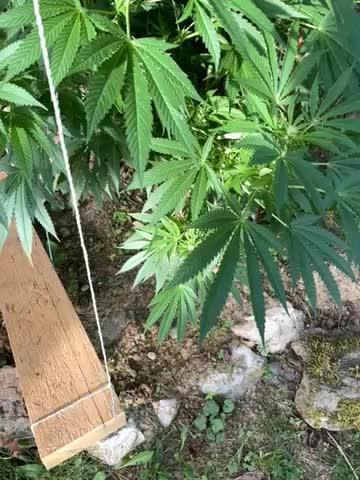
Flipped the girls fed ec 1.5 runoff was 1.7 coco drying back to half the weight of pot every feeding and started with the shogun boost hung the gavita 1000w se pro about 3 ft high and added another fan to the mix ph is around 6.2 on runoff im using a wet vac to clear all the runoff temps are around 26 day 22 night im looking to keep night time temps closer within 10 degree's diffrence for tighter intonode space there on a stretch looking to do some defolation usually I like to right before the flip and day 21 but I'm going for week after flip and end of week 3

Likes
15
Share

@DE_BW
Follow
Flowering Week 6
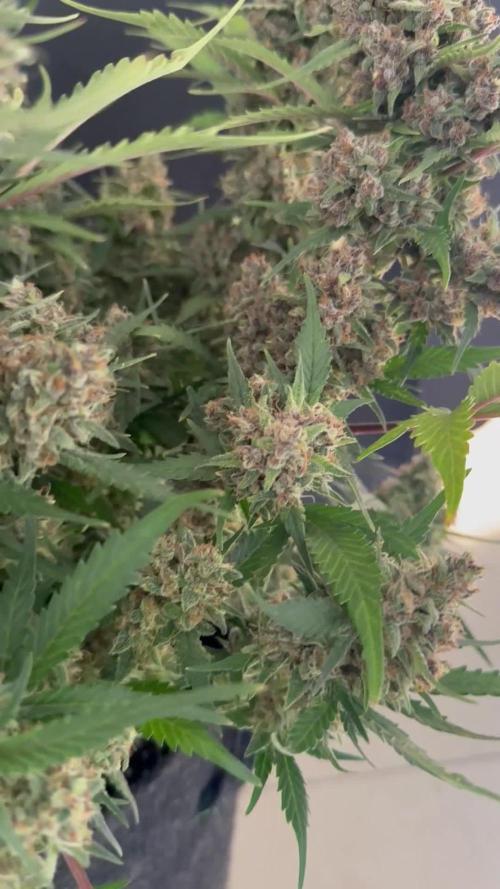
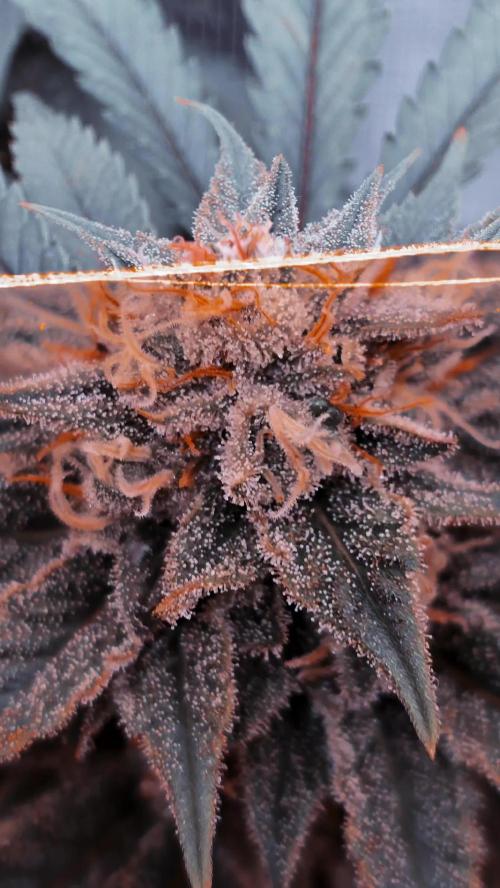
The plant continues to progress steadily towards harvest. The buds are now heavily covered in trichomes, showing strong resin production. The aroma remains very intense with a clear strawberry note.
I decided to add one more week of Overdrive to push the final phase a bit further. The plant was flushed yesterday using Flawless Finish.
Harvest will take place once the pot has fully dried out.
Overall, a very interesting plant — structurally a bit unusual, but the quality so far is definitely convincing.

Likes
1
Share

@Skipi007_CZ
Follow
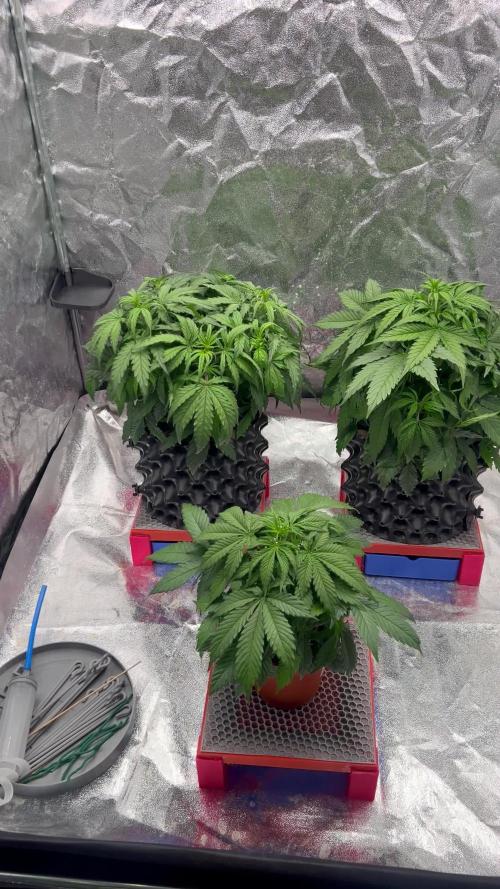
The girls are already starting to bloom, I think they have doubled in size, they look really nice and healthy, they have started to drink a lot, plant no. 1 - 0.9 l, plant no. 2 - 0.7 l, and no. 3 - 0.4 l, about 0.150 ml will flow out of 1 and 2, 3 - 50 ml. I hope they will grow nicely like this in the coming weeks.
Likes
4
Share


@AgroCultiveta
Follow
Holaa sexta de la Negra44 y ultima semana de vegetación lo que me tiene muy contento.
Hago los riegos 1/1, uno solo con agua(EC: 0.4) y el otro con los fertilizantes.
En los riegos estoy utilizando Sensi cal-mag para llegar a una EC base de 0.4 y luego aplicar los fertilizantes.
Regulo el PH con los reguladores de BioBizz.
El día de hoy (04/08) se le realizo una defoliación pequeña en la cual solo elimine los brotes del primer nodo de la planta, luego se hizo la segunda aplicación vía foliar de Delta9 y en 10 días será la ultima aplicación que será a través del riego.
El cambio del fotoperiodo lo hago de manera progresiva. Le doy dos horas más de oscuridad cada día hasta llegar a 12/12, el día de mañana (05/08) será el primer día con el ciclo 12/12 por esto el periodo de floración a empezado el día 43 de vida de esta planta.
Durante esta semana la planta creció bastante y todo va bien encaminado. Ahora solo queda esperar que todo siga así y esperar que las temperaturas con el led apagado no sean tan bajas.
Cualquier recomendación sera bien recibida!!
*Great White se mide en gramos. (Dosis: 1gr/3lt)

Processing
Likes
14
Share


@CommanderCannabis
Follow
Had very good growth this week in height and pistils. Roots are also doing well with more growth and nice color so I will keep my fingers crossed that they continue to do well. The MP3 player was not working again. I used a MicroSD card and put a Velvet Underground Album on it and stuck that into the newest speaker. This one is the smallest and easiet yet plus it has continuous play so the album plays all the time without stopping like the MP3 player did. Am getting a bigger SD card to put more Velvet Underground on. I also defoliated a small amount and don't expect to cut anymore. The Grow Chamber continues to perform nicely and I hope to start building the first real Model Type soon. I also had to make a new top drip system because the older one was not dripping water. I am also CO2 enriching the Chamber for a couple of hours every two days. Looking to see more pistil growth this week. I've also added my data charts for January. Everything was in range and moving forward.

Likes
4
Share


@Growstopher
Follow
6.18.25.
7th week of flower started on 6.16. To bad I stunted this one so bad because the quality is very good just quantity is sad. About 2-3 weeks left until harvest! Started lowering nutrient strength get a nice flush for the final 2-3 weeks
Likes
9
Share


@Bncgrower
Follow
Another week almost over, the girls are beautiful and smell great. Apparently everything is under control, I'm really looking forward to the results.
Happy growing! 🌱🌱🌱
Likes
13
Share


@DeepRootsGrowTrees
Follow
JOANNE'S CBD / ROYAL QUEEN SEEDS
Week #12 OVERALL
Week #11 VEG
This week she started to stretch out she was a slow starter but she's really begun to grow the last few weeks. It's almost time to flip to flower!! Stay Growing!!
Thank you for stopping by and taking a look it's much appreciated!!
THANK YOU ROYAL QUEEN SEEDS!!
JOANNE'S CBD / ROYAL QUEEN SEEDS

Likes
14
Share


@Auto_lover
Follow
She’s starting to stretch and flower nicely. I removed a few leaves for better light penetration. On day 29 another small defoliation day 34
Likes
28
Share


@Ultraviolet
Follow
If you are lonely when you are alone, then you are in bad company.
Bee pollen is considered a “vitamin bomb” due to the presence of almost all vitamins with an average of 0.02–0.7% of its total content, with a higher amount of water-soluble than fat-soluble vitamins. Bee pollen contains vitamins A, D, E, B1, B2, B6, and C. It also provides minerals such as calcium, magnesium, phosphorus, potassium, zinc, copper, manganese, iron, and selenium, I mixed a bunch of that with some honey and RAW cane molasses to make a nice big bucket of tea. A family friend who is a beekeeper was kind enough to share some honey. The nutritional content of raw honey is impressive and includes high levels of protein, amino acids, B vitamins, calcium, manganese, potassium, magnesium, zinc, and iron, as well as various polyphenolic antioxidants.
I am loading up nature's finest sugars, and sweet things, Honey & Mollases.
UV-B-induced DNA damage (CPDs and 6–4 PPs) can be repaired efficiently by photolyases. Pyrimidine dimers can be repaired by nucleotide excision repair (NER), or bypassed by replicative polymerases (Britt 2004). The expression of the CPD photolyase (PHR) gene is induced by UV-B light dependent on UVR8 signaling pathway, and is also induced by blue and UV-A light (Li et al. 2015)
https://link.springer.com/article/10.1007/s44154-022-00076-9?fromPaywallRec=true
Old but gold.
The camera picks up far more light than there is during the night cycle, camera is showing bright pink violet collages but my eyes barely see a thing, about 0.25ppfd in that tent overnight. Have been tweaking the spectrum of moonlight/intensity and watching the responses overnight.
Tweak, tweak, tweak all week.
PAR is 400-700nm,
Overnight UVA in the tent is all 365nm and 385nm, so the meter only picks up a fraction of the light curve that makes it photosynthetically active past 400nm. Of the light in the tent, 0.25ppfd is from UVA
Looks like It makes them 🕺 🕺 💃 all night.
Better flower soon or ill be screwed for space, they are stretching, but is it "the stretch"? She has fire in her belly.
Growing crops with insufficient light (i.e., below “optimal,” as defined here) limits the yield potential, which in turn wastes the other production inputs including labour, water, nutrients and electricity. As lighting fixture is one of the most expensive investment of the production, what is the relationship between light intensity and yield?
Potter and Duncombe (2012) grew cannabis plants with varying canopy-level PPFDs during the flowering stage and found that increasing PPFD from 400 to 900 μmol·m−2·s−1 increased yield an average of 1.3 times higher, across seven cultivars, with no light intensity treatment effects on floral cannabinoid concentrations. Vanhove et al. (2011) found that cannabis yields were 1.3 to 3.1 times higher (depending on cultivar) when plants were grown under approximately 1000 μmol·m−2·s−1 compared to approximately 450 μmol·m−2·s−1 during the flowering stage.It was predicted that cannabis yield would exhibit a saturating response to increasing Light intensity, thereby signifying an optimum light intensity range for indoor cannabis production.
However, a new research from Morrison (2021), after 81 days‘ experiment, found that When plants grew under LI ranging from 1200 to 1800 μmol·m–2·s–1 provided by light emitting diodes (LEDs), inflorescence yield increased linearly as LI increased up to 1800 μmol·m–2·s–1.
"Cannabis will not stop flowering if the lights are turned on for a few minutes once or twice during the 2-month-long flowering cycle. If a light is turned on for 5 to 30 minutes—long enough to disrupt the dark period—on 3 to 5 consecutive nights, plants will start to revert to vegetative growth."
"Less than one half of one foot-candle of light (0.1ppfd) from sunlight will prevent cannabis from flowering. That is a little more light than is reflected by a full moon on a clear night. Well-bred indica-dominant plants will revert within three days. Sativa-dominant plants take four to five days to revert to vegetative growth. Once they start to revegetate, it can take from four to six additional weeks to induce flowering again!"
Guess ill find out my answer soon.

Likes
11
Share


@4_Pro2Bono_0
Follow
Getting ready to flip to flower in a week or two with some trellis work. I should've shaved the legs of these ladies but I was unprepared for clones this week so I'll probably shave them this weekend. I'm happy with the results thus far. 🎋🌲🍃

Likes
19
Share


@Eauderay
Follow
Hello dear cannabis lovers,
Did nothing this week but watering with little Epsom salt added because water is soft around here.
She is beginning to puff up, and grow those buds, smelling flowery and sweet with some pine and earthy smell.
Very easy to grow and those 2 sisters looks and smell exactly the same, solid lineage!

Likes
2
Share


@CuriosityWebster
Follow
Went away for seven days had a friend come by and water the garden
Absolutely exploded since I’ve seen them last very pleased with all of the plants except for mystery auto number one. It is disappointing me some but hopefully the top will bring more growth.
Can’t wait to see these continued to develop!!!
Likes
1
Share


@GERGrowDesigns
Follow
Welcome to Flower week 1 of Sweet Seeds Mental Rainbow F1
I'm excited to share my grow journey with you from my
Sweet Seeds Project . It's going to be an incredible ride, full of learning, growing, and connecting with fellow growers from all around the world!
For this Project , I’ve chosen the Feminized Photo strain Mental Rainbow F1 :
Here’s what I’m working with:
• 🌱 Tent: 120x60x80
• 🧑🌾 Breeder Company: Sweet Seeds
• 💧 Humidity Range: 50
• ⏳ Flowering Time: 7-8weeks
• Strain Info: 22-30%THC
• 🌡️ Temperature: 26
• 🍵 Pot Size: 16
• Nutrient Brand: Narcos
• ⚡ Lights : 600W x 2
A huge thank you to Sweet Seeds for allowing me to try my Best with this amazing collection from Photo Strains they managed to Sponsore . Big thanks for supporting the grower community worldwide! Your genetics and passion speak for themselves!
I would truly appreciate every bit of feedback, help, questions, or discussions – and of course, your likes and interactions mean the world to me as I try to stand out in this exciting competition!
Let’s grow together – and don’t forget to stop by again to see the latest updates!
Happy growing!
Stay lifted and stay curious!
Peace & Buds!

Likes
2
Share


@GroloCup
Follow
Week 2 underway and she's developing accordingly. Everything is in the soil so we continue to just let her sip from the reservoir thru the wicks. I'm still misting the top of the soil to make sure she's getting enough to drink.

Likes
14
Share


@Terp_Derp
Follow
I am late this week because on the girls' 8 week birthday, they both started looking HORRIBLE, and I was scrambling for a couple days.
Looking back, documenting those moments is probably more helpful than just showing pictures of everything going smoothly.
I think it might have been a Zinc deficiency, but it all boiled down to poor nutrient, pH, and watering practices.
This is my first grow, so the more I learn the better!
New leaves were forming brown tips, growth was stunted overall, and the veins on the leaves were becoming very prominent and white. After a day or so, the tips and edges of leaves started to curl up or "taco".
So I flushed the plants for the first time.
One recovered really well in 24 hours while the other improved a bit, but was still looking sad. I ended up flushing her a second time the next day.
Soil for both plants is still pretty damp but should be flushed well, and once it completely dries out, I can amend my feeding practices and give them another ~week before flowering.
I'm going to cut the nutrient amounts in 1/2, only feed nutrients with every other watering, and also give the plants more water to allow the proper amount of run-off.
I guess this is very important in preventing a build up of nutrients in the soil.
Hey, you live and you learn!
Also started trying some super cropping because I want to try it all, haha.

Likes
120
Share


@Kitties_and_Colas
Follow
4th week of veg and everything is going beautifully ❤️.. we've been rotating pots every few days or so to encourage them to grow uniformly but 1 of the plants is a bit of a runt..I think its just the way it is..they're all using training ties now and couldn't look happier at the moment, which makes me happy! ❤️🌱..thanks for dropping by and happy harvests everyone!! 😽💨

Likes
8
Share


@Aircoholic
Follow
Growing well, so far. The added silica shows its effect - the stem is absolutely massive and solid, don't think LST is an option. I want to do either Topping or FIMing, but am not sure yet, which one. The decision will be shown in the pictures that I'll add, once the procedure is done.
UPDATE: I decided to top Banana Kush Auto, as seen in the added photos and video.


Likes
43
Share


@Bones_1986
Follow
Started using magic evolution foliar Spray. Once a week until 2nd week of flowering.
Day 19, pot was dry fed just over a litre.
Day 21. Fed just over litre. LST