Likes
Comments
Share
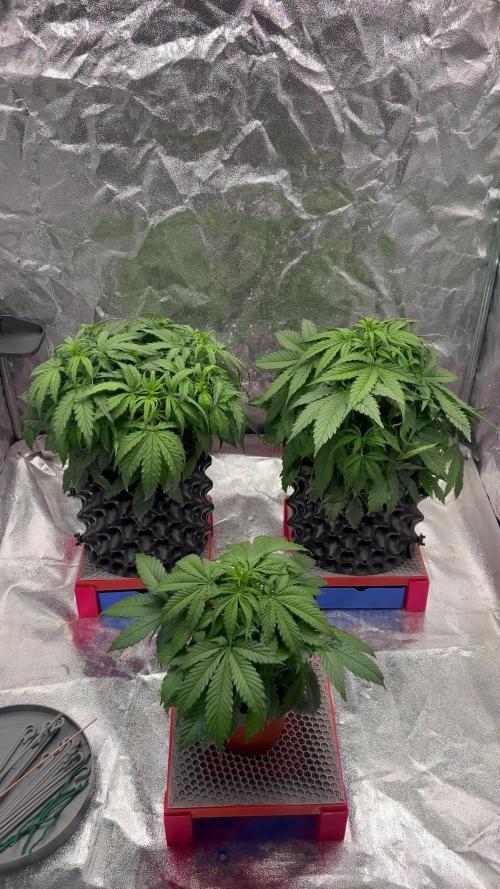
F1 for this mad dog, will turn to flowering in a couple of days. This plant is growing super strong and fast, biggest of the bunch, I'm trying to keep her from stretching, want to flowr them short and bushy. Hopefully they go through flowering just fine.
Likes
22
Share
This plant that I harvested today I've only defoliated and she took well to that. I LST and defoliated the other plant and she is still ripening will harvest her soon. 285gramms of wet bud is quite good for first grow, so i should get about 60g dry, I'll update actual value when dry. She was in the tent with 4 other plants under the Skyline 1000 lights which pull 500w from mains. She filled the room with some sort of orange/lemon candy smell. Smells really nice. I'll update when I harvest the other Candy Kush and report on taste/effect once dried. ------- Day 79 I harvested the other Candy Kush, gave 280g wet, not much of a difference between the trained and untrained plants, although I think she could have gotten fatter had I left her longer. Looking at the buds now that they dried up they got much smaller :D Really loving the smell, can't wait for them to cure.
Likes
41
Share
Well the suns been out the last few days and the girls are loving it. I think I’ll start flush although it’s a little early for some others are ready. So a one or two week flush and then we are done. After that I’ll chop as each one is ready.
Likes
2
Share
@Dralph
Follow
No recuerdo como fue esta semana, las Blackberry tienen 4 semanas, la White widow 6 y añadi un par mas de autos que luego retirare para exterior
Likes
6
Share
@mk420
Follow
35 days after planting seed. Plants have bushed out quite a lot more this week and gained some height. I don't think it is flowering yet, but I expect them to begin soon. Temps problem has come back the last couple of days I have struggled to get it over 15c. Plants appear to be healthy apart from what looks like nute burn on a few leaves. Decided to cut back on the rhizotonic this week, will probably cut it out altogether next week. A few changes to the set up this week, changed light from Meizhi "450w" to a Meizhi "900w" and put turned my autopot system on. I have noticed there are lots of lower branches developing underneath but are not able to get much light as are under a dense upper canopy of large leaves. would I benefit from any sort of cropping?
Likes
3
Share
Likes
11
Share
25-3-2023 Colors are starting to be more pronounced as she comes to her final week or not. Probably looking to a Good Friday Harvest of those sweet smelling eggs. 💪😎 Minor Feeding as she goes into Shop Vac Flush next week. Harvest just around the corner.
Likes
6
Share
@Chucky324
Follow
Hello. This is the end of week 4 and the beginning of week 5 of flowering.... I think. I'm finally seeing flowering on all 5 plants now. A couple of them took their time showing their white pistils. Looking very sativa-ish in here. The tallest plant is over 80 inches and might be growing through the roof vent before it's done. Plant #3 is the keeper of this lot... but it has a strong, lemony, used laundry water, type of smell to it. Sleepy Joe has this type of smell too. Been hot in here this week. I've had to water by hand each day to avoid wilting. Haven't felt very well this week... Got a flu or something.... Feeling better today.. OK. Be Cool. Chuck.
Likes
56
Share
What's in the soil? What's not in the soil would be an easier question to answer. 16-18 DLI @ the minute. +++ as she grows. Probably not recommended, but to get to where it needs to be, I need to start now. Vegetative @1400ppm 0.8–1.2 kPa 80–86°F (26.7–30°C) 65–75%, LST Day 10, Fim'd Day 11 CEC (Cation Exchange Capacity): This is a measure of a soil's ability to hold and exchange positively charged nutrients, like calcium, magnesium, and potassium. Soils with high CEC (more clay and organic matter) have more negative charges that attract and hold these essential nutrients, preventing them from leaching away. Biochar is highly efficient at increasing cation exchange capacity (CEC) compared to many other amendments. Biochar's high CEC potential stems from its negatively charged functional groups, and studies show it can increase CEC by over 90%. Amendments like compost also increase CEC but are often more prone to rapid biodegradation, which can make biochar's effect more long-lasting. biochar acts as a long-lasting Cation Exchange Capacity (CEC) enhancer because its porous, carbon-rich structure provides sites for nutrients to bind to, effectively improving nutrient retention in soil without relying on the short-term benefits of fresh organic matter like compost or manure. Biochar's stability means these benefits last much longer than those from traditional organic amendments, making it a sustainable way to improve soil fertility, water retention, and structure over time. Needs to be charged first, similar to Coco, or it will immobilize cations, but at a much higher ratio. a high cation exchange capacity (CEC) results in a high buffer protection, meaning the soil can better resist changes in pH and nutrient availability. This is because a high CEC soil has more negatively charged sites to hold onto essential positively charged nutrients, like calcium and magnesium, and to buffer against acid ions, such as hydrogen. EC (Electrical Conductivity): This measures the amount of soluble salts in the soil. High EC levels indicate a high concentration of dissolved salts and can be a sign of potential salinity issues that can harm plants. The stored cations associated with a medium's cation exchange capacity (CEC) do not directly contribute to a real-time electrical conductivity (EC) reading. A real-time EC measurement reflects only the concentration of free, dissolved salt ions in the water solution within the medium. 98% of a plants nutrients comes directly from the water solution. 2% come directly from soil particles. CEC is a mediums storage capacity for cations. These stored cations do not contribute to a mediums EC directly. Electrical Conductivity (EC) does not measure salt ions adsorbed (stored) onto a Cation Exchange Capacity (CEC) site, as EC measures the conductivity of ions in solution within a soil or water sample, not those held on soil particles. A medium releases stored cations to water by ion exchange, where a new, more desirable ion from the water solution temporarily displaces the stored cation from the medium's surface, a process also seen in plants absorbing nutrients via mass flow. For example, in water softeners, sodium ions are released from resin beads to bond with the medium's surface, displacing calcium and magnesium ions which then enter the water. This same principle applies when plants take up nutrients from the soil solution: the cations are released from the soil particles into the water in response to a concentration equilibrium, and then moved to the root surface via mass flow. An example of ion exchange within the context of Cation Exchange Capacity (CEC) is a soil particle with a negative charge attracting and holding positively charged nutrient ions, like potassium (K+) or calcium (Ca2+), and then exchanging them for other positive ions present in the soil solution. For instance, a negatively charged clay particle in soil can hold a K+ ion and later release it to a plant's roots when a different cation, such as calcium (Ca2+), is abundant and replaces the potassium. This process of holding and swapping positively charged ions is fundamental to soil fertility, as it provides plants with essential nutrients. Negative charges on soil particles: Soil particles, particularly clay and organic matter, have negatively charged surfaces due to their chemical structure. Attraction of cations: These negative charges attract and hold positively charged ions, or cations, such as: Potassium (K+) Calcium (Ca2+) Magnesium (Mg2+) Sodium (Na+) Ammonium (NH4+) Plant roots excrete hydrogen ions (H+) through the action of proton pumps embedded in the root cell membranes, which use ATP (energy) to actively transport H+ ions from inside the root cell into the surrounding soil. This process lowers the pH of the soil, which helps to make certain mineral nutrients, such as iron, more available for uptake by the plant. Mechanism of H+ Excretion Proton Pumps: Root cells contain specialized proteins called proton pumps (H+-ATPases) in their cell membranes. Active Transport: These proton pumps use energy from ATP to actively move H+ ions from the cytoplasm of the root cell into the soil, against their concentration gradient. Role in pH Regulation: This active excretion of H+ is a major way plants regulate their internal cytoplasmic pH. Nutrient Availability: The resulting decrease in soil pH makes certain essential mineral nutrients, like iron, more soluble and available for the root cells to absorb. Ion Exchange: The H+ ions also displace positively charged mineral cations from the soil particles, making them available for uptake. Iron Uptake: In response to iron deficiency stress, plants enhance H+ excretion and reductant release to lower the pH and convert Fe3+ to the more available form Fe2+. The altered pH can influence the activity and composition of beneficial microbes in the soil. The H+ gradient created by the proton pumps can also be used for other vital cell functions, such as ATP synthesis and the transport of other solutes. The hydrogen ions (H+) excreted during photosynthesis come from the splitting of water molecules. This splitting, called photolysis, occurs in Photosystem II to replace the electrons used in the light-dependent reactions. The released hydrogen ions are then pumped into the thylakoid lumen, creating a proton gradient that drives ATP synthesis. Plants release hydrogen ions (H+) from their roots into the soil, a process that occurs in conjunction with nutrient uptake and photosynthesis. These H+ ions compete with mineral cations for the negatively charged sites on soil particles, a phenomenon known as cation exchange. By displacing beneficial mineral cations, the excreted H+ ions make these nutrients available for the plant to absorb, which can also lower the soil pH and indirectly affect its Cation Exchange Capacity (CEC) by altering the pool of exchangeable cations in the soil solution. Plants use proton (H+) exudation, driven by the H+-ATPase enzyme, to release H+ ions into the soil, creating a more acidic rhizosphere, which enhances nutrient availability and influences nutrient cycling processes. This acidification mobilizes insoluble nutrients like iron (Fe) by breaking them down, while also facilitating the activity of beneficial microbes involved in the nutrient cycle. Therefore, H+ exudation is a critical plant strategy for nutrient acquisition and management, allowing plants to improve their access to essential elements from the soil. A lack of water splitting during photosynthesis can affect iron uptake because the resulting energy imbalance disrupts the plant's ability to produce ATP and NADPH, which are crucial for overall photosynthetic energy conversion and can trigger a deficiency in iron homeostasis pathways. While photosynthesis uses hydrogen ions produced from water splitting for the Calvin cycle, not to create a hydrogen gas deficiency, the overall process is sensitive to nutrient availability, and iron is essential for chloroplast function. In photosynthesis, water is split to provide electrons to replace those lost in Photosystem II, which is triggered by light absorption. These electrons then travel along a transport chain to generate ATP (energy currency) and NADPH (reducing power). Carbon Fixation: The generated ATP and NADPH are then used to convert carbon dioxide into carbohydrates in the Calvin cycle. Impaired water splitting (via water in or out) breaks the chain reaction of photosynthesis. This leads to an imbalance in ATP and NADPH levels, which disrupts the Calvin cycle and overall energy production in the plant. Plants require a sufficient supply of essential mineral elements like iron for photosynthesis. Iron is vital for chlorophyll formation and plays a crucial role in electron transport within the chloroplasts. The complex relationship between nutrient status and photosynthesis is evident when iron deficiency can be reverted by depleting other micronutrients like manganese. This highlights how nutrient homeostasis influences photosynthetic function. A lack of adequate energy and reducing power from photosynthesis, which is directly linked to water splitting, can trigger complex adaptive responses in the plant's iron uptake and distribution systems. Plants possess receptors called transceptors that can directly detect specific nutrient concentrations in the soil or within the plant's tissues. These receptors trigger signaling pathways, sometimes involving calcium influx or changes in protein complex activity, that then influence nutrient uptake by the roots. Plants use this information to make long-term adjustments, such as Increasing root biomass to explore more soil for nutrients. Modifying metabolic pathways to make better use of available resources. Adjusting the rate of nutrient transport into the roots. That's why I keep a high EC. Abundance resonates Abundance.
Likes
92
Share
Week 4 Veg Report - TrolMaster Chronicles 🌱 What a week it’s been in the garden! We finally transplanted the Papaya Zoap into its final Autopot, and let me tell you, this plant is something special. Though her roots weren’t quite where I wanted them to be yet, the move was needed to help her catch up with the rest of the crew. She’s already looking fantastic in her new home, and I have no doubt she’s about to explode with growth in the coming days. Sometimes, you just have to trust the process, and I’m feeling like this is one of those moments. It’s almost as if the room itself is taking on a life of its own. 🌿 In fact, I’m starting to believe that what we’re building here is something greater than ourselves—there’s this energy in the room, a feeling of everything coming together perfectly. I can’t wait to see how this journey unfolds! Dialing in the VPD with TrolMaster’s Tech Now, let’s talk VPD (Vapor Pressure Deficit) and how I’ve been keeping everything in check with the Tend-X and the incredible (DSH-2U) Humidity Station. VPD is crucial to plant health—it’s all about finding that perfect balance between humidity and temperature to optimize transpiration and nutrient uptake. The (DSH-2U) Humidity Station, connected directly to my humidifier, has been an absolute game-changer in this regard. With its real-time data and automation, it allows me to monitor and adjust the RH with pinpoint accuracy. Simple yet brilliant, the (DSH-2U) Humidity Station is keeping my room at the sweet spot I need. Whether I’m tweaking the settings from my phone while I’m out and about or just fine-tuning things while relaxing at home, this machine does it all. It’s like having an extra pair of hands in the grow room—and when you’re managing something as complex as VPD, that’s invaluable! And yes, the TM+ Pro App—let’s not forget how awesome it is. I’m adjusting my grow room from the couch, the car, or even the bathroom 😜. I’ve said it before, but this app is making growing easier than ever. Feeding the Girls: The Perfect Blend 🌱 We’ve upped the game by adding CaMg-Boost at 0.25 ml/L to the feeding schedule. Along with the 1 ml/L of the all-in-one liquid, this brings the TDS up to 320 ppm, with a pH of 5.99 and solution temperature of 24.8°C. In the soil, readings are around 415 ppm, with temperatures hovering around 25°C The plants are absolutely thriving, and I can already see the difference this new feed is making. I can’t help but have a bit of fun with this process—it feels like I’m spoiling them with the best of the best. And they’re rewarding me with beautiful growth and vibrant green color. You know how it is, with the right care and attention, these plants are truly becoming a masterpiece in the making. 🌱 Shoutouts 💚 Big shoutout to TrolMaster and ThinkGrow LED for the phenomenal gear that’s making this grow smoother than ever. Also, massive thanks to Aptus Holland for their top-notch nutrition, and of course, to the community here on GrowDiaries—you guys keep the energy alive! 🌱 Last but definitely not least, shoutout to all the seed banks supporting this journey. You’ve been a huge part of this process, and I couldn’t do it without you! Remember, for exclusive behind-the-scenes content and updates in real time, head over to my Instagram and YouTube channels @DogDoctorOfficial. We’ve got tons of epic content lined up, and you won’t want to miss it! P.S. Let’s talk about the new Model One LED Bars—these beauties are not only powerful but super efficient. I’ve been able to dim them down, save on electricity costs, and still maintain an incredible PAR and spectrum. It’s all about fine-tuning the balance of power and performance, and these lights make it easy to get the best results while being eco-friendly. Whether you’re running them full throttle or dialing it back, you’re still getting optimal growth conditions for your plants. That’s the kind of innovation that takes your grow to the next level. 💡 Growers Love to all 🌿💚
Likes
14
Share
We are very close to the harvest. One more week and it's good to go. Feeding with water only. No more nutrients. Aroma from this plant its incredible, its like a very good man's perfume. Musky with fruit like tangerine and mango. Incredible.
Likes
19
Share
@Coopmc
Follow
This Pheno from seeds from Supper Lemon Haze high CBD crossed with my FruitWalker!! Decided to call this pheno SubLIMEinaL since she taste like key lime is supper chill, relaxing., and a bit psychedelic!!
Likes
24
Share
Die fünfte Blütewoche hat begonnen. Das Höhenwachstum scheint nun endlich vorbei zu sein und die Pflanzen konzentrieren ihre Energie auf die Blüten. Ich hoffe sie kommen mit dem Abstand zur Lampe einigermaßen zurecht und bekommen keinen zu starken Lichtstress.
Likes
26
Share
@Sickone
Follow
Leider sind die letzten Wochen nicht sauber geführt worden auf dieser Seite da ich die Plattform aufgrund der ständigen Upload und Verbindungsprobleme etwas aus den Augen verloren habe. Allen Ladys geht es soweit ganz gut 2 Blühen schon fröhlich vor sich her und gehen vermutlich in die Endphase über während die andere langsam anfängt sich in die höhe zu Skretchen. Lampe: Mars Hydro FC evo 1500 / China LED mit angeblichen 700W ( Vermutlich eher um die 100-150 ) Abluft hinzugefügt da die Luftfeuchtigkeit die letzten Wochen extrem hoch wahren und die Ladys es nicht so gut vertragen haben. Gedüngt wurde das erste mal jetzt am 13.05.24 mit BioBizz Bloom / Grow / Top Max PPFD: Zwischen 950 und 1000 DLI: 60 Ich werde die fehlenden Wochen noch editieren Bilder etc. habe ich alles noch.
Likes
10
Share
Likes
63
Share
@AsNoriu
Follow
Day 113. Third wave of heavy flush, girls get from 30 to 50 liters in time-lapse of one hour. Planing to chop them after 10 days, two more heavy flushes ... Control Garden is a beauty ... They are a bit behind, but hopefully next week i will start to flush them aswell. Incredible Bulk standing in front of fan is most matured aka damaged ;))) Not many seeds i see, so i calmed down a bit, still free cheese is only in trap, fact ... Day 115. Girls fade nicely, today got 4th wave of flush, best case scenario in 8 days chop, worst - in 4. Busy work week, so it will be hard to find time, wet triming takes to much from me, i do it too carefully ... Happy Growing !
Likes
4
Share
@Hix57
Follow
Le 70e jour s'est écoulé tranquillement. J'espérais pouvoir récolter cette semaine, mais mon projet n'est pas encore prêt. J'ai l'impression que ma plante stagne, elle ne semble pas mûrir comme je l'espérais. Je vais donc lui accorder encore une semaine pour voir si les trichomes se développent davantage. Remarque : ces deux dernières semaines, il y a eu peu d'évolution. J'ai utilisé les nutriments Final part et Bloom à 100%.
Likes
20
Share
@Mikxy
Follow
Did 24 hours light cycle by mistake change it on week 3
Likes
11
Share
Likes
40
Share
@Coopmc
Follow
Beginning week 5 looks amazing!! Yes I am so loving this plant going to pollenate one with FruitWalker 50/50