




Likes
7
Share



Likes
120
Share


@DogDoctorOfficial
Follow
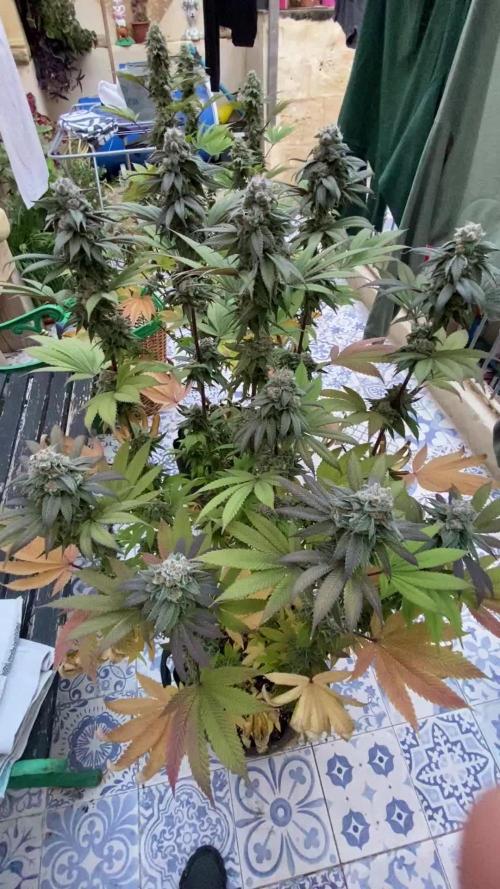
Welcome to Week 16, where our Lego Ninja Tropical Tangie is truly proving her resilience. Despite some hot temperatures, she's standing tall like a champion, although her leaves have seen a bit of scorching.
But, what's truly mesmerizing is her incredible fruit development. These beauties are laden with trichomes, glistening like stars in the night sky. They are a testament to her excellent genetics and your dedicated care.
In terms of adjustments, I've made a wise decision to stop the extra phosphorus (P) and instead introduced Aptus Fluvic Blast to my feeding regimen. This change isn't just about her current growth, it's also about planning for the future. The Fluvic Blast enriches the soil and enhances its microbial activity, which will be invaluable when you decide to reuse this soil in the future. It's all about long-term sustainability and health.
As always, the sharing of medicine continues. It's a bond that grows stronger with each passing week, connecting not only you and your Tangie but also your ever-watchful guardians, the Lego Ninjas.
A special shout-out to Dutch Passion for these fantastic genetics, Aptus Holland for their unwavering support, and Grow Diaries for providing the platform that allows you to share this incredible journey with the community.
Week 16 has been a testament to the rewards of perseverance and patience. As we look ahead, the promise of more trichome-covered buds and the continued growth of your girls and guardians is an exciting prospect.
Stay tuned for Week 17, as we delve even deeper into this remarkable journey. Until next time, fellow gardeners and enthusiasts! #TropicalTangie #Week16 #Resilience #TrichomeMagic #AptusHolland #DutchPassion #LegoNinjas #GrowDiariesCommunity"
As always thank you all for stopping by, for the love and for it all , this journey of mine wold just not be the same without you guys, the love and support is very much appreciated and i fell honored and blessed with you all in my life<3 <3 <3
#aptus #aptusplanttech #aptusgang #aptusfamily #aptustrueplantscience #inbalancewithnature #trueplantscience
With true love comes happiness <3 <3 <3 Always believe in your self and always do things expecting nothing and with an open heart , be a giver and the universe will give back to you in ways you could not even imagine so <3 <3 <3
Friendly reminder all you see here is pure research and for educational purposes only
<3 <3 <3 Growers Love To you All <3 <3 <3
P.S- I must extend my sincerest apologies for the missing video reports. Regrettably, Grow Diaries is still facing some technical issues that are preventing me from uploading them. Rest assured, as soon as the situation is resolved, I'll share those videos to give you an even closer look at this fascinating journey.

Likes
4
Share


@LittleBigTrees
Follow
This week I've been pulling the top fan leaves to stop the plant growing taller and to allow the side branches to catch up. I also started feeding them.
I will probably repot and switch to flower next week now they've all outgrown their mutations.
Likes
16
Share


@punktkomma
Follow
Really awesome plant :) super impressed by how fast and healthy she grew, and her structure was just beautiful.
She developed super dense and heavy buds, and the canopy turned out super even, even though she wasn’t topped or trained at all.
In the end, she gave me 1.1kg wet!
KMintz have to stay for some days. hope she make it good, while iam on vacation.
Update:
The Kiwi x NCH totally surprised me.
I stopped trimming after a bit over 175g dry since we’re only allowed to keep 50g anyway and I’ll be getting rid of the rest. 😇👻
That makes her my most productive plant so far, which really caught me off guard considering the buds were fairly small and the internodal spacing was quite wide. 💪😍
She actually does have a bit of a kiwi scent, lots of spice, with some floral and sweet notes coming through. I like it 👽
Just sent everything into the cure now! Let’s see how those terps develop

Likes
14
Share


@GoldenWeedGrower
Follow
D57/F13 - 27/05/23 - Added sunset and sunrise (only red lights for 1,5 hours at the start and 1,5 at the end)
D58/F14 - 28/05/23 - I set up my AFD (see picture). I find a way to feed her automaticly when I 'll be out, Every day I start the pump for 30 sec (about) to give her 2 liters of nutes with my AFS (Automatic Feeding System)
D59/F15 - 29/05/23 - Automatic feeding
D60/F16 - 30/05/23 - Automatic feeding
D61/F17 - 31/05/23 - Automatic feeding
D62/F18 - 01/06/23 - Automatic feeding
D63/F19 - 02/06/23 - I'm back, Nora looks ok, automatic feeding works. A little bit of problem with timelaps framing, but it's ok, I've got all info I need. EC 0.9 and pH 6.5
Likes
215
Share


@yan402
Follow
This two were part of another diary and got moved out due to space reasons at VW8 and moved back indoors at VW20
https://growdiaries.com/diaries/218151-auto-god-s-glue-grow-journal-by-yan402
13.09.25 VW21 Both are looking good and are developing tighter nodes than when they were outside, I'm going to have to keep cutting them back every once and a while I also applied nematodes against thrips and fungus gnats.
20.09.25 VW22 some spots and some yellow leafs, I think it's a root problem, probably root bound, but both seem healthy and are getting thicker so maybe just top up with Coco coir and give a slight different nutrient schedule less Tri Part Bloom could do the trick MAYBE lol.
27.09.25 VW23 Topped up the pots with extra coco coir and trimmed the side roots a bit, both plants were root bound 📹
03.10.25 VW23 did a HST/LST session 📹
12.10.25 VW25 Done a major HST session to try and keep them in line with the Sunset Sherbet GF I have going in the same tent, rest in the video 📹
17.10.25 VW25 ffj/fpj/fish 30 → 60 ml
19.10.25 VW26 it just became a one plant diary, keeping #5, #6 gets it's own diary for testing nutrients.
20.10.25 VW26(?) Feed tweak: added 3 g Calcium Nitrate/ 30 L (≈ 15 ppm N + 10 ppm Ca)
24.10.25 VW26 did a defoliation and trimming session 📹
25.10.25 VW26 I'll be repoting tomorrow, 26.10.25 VW27 rest in the video📹
27.10.25 VW27 Epsom Salt 0 → 2.5, Calcium Nitrate 3 → 9 g
01.11.25 VW28 CalMag 60 → 30ml, TriPartBloom 20 → 30ml, Magnesium 2.5 → 3.5g
🌱💦🌱💦🌱💦🌱💦🌱💦🌱
Day to day tasks & actions 🌿
🌱💦🌱💦🌱💦🌱💦🌱💦🌱
01.11.25 VW27 -- no feed no water
(*RUNOFF reused for indoor house plants)
🍶💧🍶💧🍶💧🍶💧🍶
💧 Nutrients in 30 L #1
🍶💧🍶💧🍶💧🍶💧🍶
💧 TriPart Micro: 10 → 30 → 40 ml
= 0.33 → 1.00 → 1.33 ml/L
🍶 TriPart Grow: 0 ml
= 0.00 ml/L
💧 TriPart Bloom: 10 → 30 → 20 ml
= 0.33 → 1.00 → 0.67 ml/L
💧 Cal-Mag: 60 ml
= 2.00 ml/L
🍶 Home-made FFJ/FPJ (new batch): 30 → 60 ml
= 1.00 → 2.00 ml/L
🍶 Calcium Nitrate (Calcinit): 3 g ≈ 15 ppm N + 10 ppm Ca
💧 pH Down: Citric acid (BuxXtrade) — adjust to ~pH 6.0
📦 TOTAL: ≈ 160 ml liquids + 3 g solids per 30 L
= ~6.0 ml/L active mix
🍶💧🍶💧🍶💧🍶💧🍶
⚙️✂️⚙️✂️⚙️✂️⚙️✂️⚙️
✂️ Tools & equipment ✂️
⚙️✂️⚙️✂️⚙️✂️⚙️✂️⚙️
✂️ 2× MarsHydro SP3000
⚙️ MarsHydro 150mm ACF Ventilator
✂️ Trotec dehumidifier (big unit)
⚙️ Mini no-name dehumidifier
✂️ Kebab skewers (LST – stainless)
⚙️ Wire + roast skewers (LST assist)
✂️ Scissors (HST)
⚙️ Vacuum (for spills & cleanup)
✂️⚙️✂️⚙️✂️⚙️⚙️✂️⚙️✂️⚙️✂️⚙️
🍒🍭🍬🌈🍒🍭🍬🌈🍒🍭🍬🌈🍒
🦄Fantasy Feast ( Seeds)🦄
🌈🍒🍭🍬🌈🍒🍭🍬🌈🍒🍭🍬🌈🍒
Species: Hybrid (Regular)
Genetics: The mother is Unicorn Whip by Dirty Bird Genetics. The father is Charcuterie by Cannarado Genetics.
Effect: Unknown Mixed effect body and head high
Flavor: Some phenos are Skunky gassy fruity, some are fruity sour citrus with a chemical touch and a touch of skunk
Flowering: Estimated 8–10 weeks
Resistance: Strong — Testing phase done
YouTube Link: https://youtube.com/-m8h?si=A7x4Zlr2kj-_ga31
Likes
3
Share


@KannaGrowing
Follow
Estamos en la semana de transición del periodo vegetativo al periodo de floración.
Nuestras plantas ya tienen un tamaño correcto para poder pasar de 18h de luz a 12h... De esta forma iniciamos dicho periodo.
Hemos conectado tres equipos led LazerLite Pro 720w ajustados al 50% de su potencia.
Repartimos bien todas las plantas para que reciban luz de forma homogénea.
Regamos, esta vez solo con agua, para no tener exceso de fertilización, ya que nuestro sustrato es muy rico en nutrientes.


Likes
12
Share


@Ieiogrow94
Follow
Eccoci qui...
Scusate per il ritardo ma sono stato super impegnato, SIAMO ENTRATI NELLE ULTIME SETTIMANE DI FIORITURA!!
Ormai si vede una maturazione costante giorno per giorno ed ha tutte cime come PIETRE, durissime e super colorate!!!
Grazie a @KhalifaGenetics e @xpertnutrients per la collab e a tutti per il supporto🔥🌲❤️

Likes
11
Share


@ButterfliesLittleFarm
Follow
Hello Diary,
We have reached the end of the third week of vegetation, which is also the beginning of flowering.
As you can see in the photos, the flowers started to form, which is usual for automatics after 3 weeks of vegetation.
For now, everything is fine, the plant is developing nicely, getting a lot of new leaves.
In terms of height, she did not grow much, only 22.5 cm in three weeks, I doubt that she will grow much now.
I started to feel a slight smell, which also makes me happy :).
At "Farm" she is the shortest, her roommates are much taller than her.
This week I also did minimal defoliation, I removed only the lowest leaves to make watering easier.
When it comes to watering, it is not frequent, about every 4 days. This week I added one tablet of Easy grow booster.
The conditions on the Farm are excellent I would say, the temperature is around 26 degrees while the humidity is around 50%.
Here's how it looked this week.
16/05/2023 - Day 17.
Watering. I prepared 7 liters of water, lowered the pH. to 6.0 and added one Easy Grow tablet and with that amount of water I watered all three plants equally.
19/05/2023 - Day 20.
First, I did a minimal defoliation, removing only the bottom leaves to make watering easier and improve air flow through the plant a bit.
After that I watered all three plants.
20/05/2023 - Day 21.
Measuring the height of the plants and taking photos at the end of the third week.
Apollo F1 - 22.5 cm.
That's all for this week, see you soon.


Likes
226
Share


@Kitties_and_Colas
Follow
~_~_~_~_~_~_~_~_~_~_~_~_~_~_~_~_~_~_~_~_~_~_~_~_~_~_~_~_~_~_~_~_~_~_~_~_~_~_~_~_~_~_~_~_~_~_~_~_~_~_~_~_~_~_~_~_~_~_~_~_~_~_~_~_~_~_~_~_~_~_~_~_~_~_~_~_~_~_~_~_~_~_~_
8/28/21
😺 We decided to flower these a little earlier than we originally intended to make room for some new strains...I will never mainline a plant this wide again indoors lol, it seemed cool at the time but as you can see it just takes up more space 😑 👎🏻
...we gave them their first shot of bloom nutrients yesterday (we typically do this 1 week before flower but things came up and we learned we'll need the tent available)...the calcium def spots seemed to have cleared up naturally on the mainline, the other plants are fairly uniform in color (not too dark anymore), and lower growth has been removed...all systems go for flower! 💪😺, I'm hoping for a significant flowering stretch, the new growth after the last mainline topping is approx. 6inches, if this stretches to 12-14inches it should build 8 really good sized colas per side.. thanks for reading! We'll update midweek..happy growing everyone!!
~_~_~_~_~_~_~_~_~_~_~_~_~_~_~_~_~_~_~_~_~_~_~_~_~_~_~_~_~_~_~_~_~_~_~_~_~_~_~_~_~_~_~_~_~_~_~_~_~_~_~_~_~_~_~_~_~_~_~_~_~_~_~_~_~_~_~_~_~_~_~_~_~_~_~_~_~_~_~_~_~_~_~_
9/2/21
🐱 be careful what you wish for folks..we asked for stretch and we got it..too much in fact, the node spacing isn't good, far too wide with this strain..we lowered both lights in the tent to get this to stop and turned up the fans to really beat on these for a few days..hopefully this will strengthen them, I really would hate to have to steak these later...
~_~_~_~_~_~_~_~_~_~_~_~_~_~_~_~_~_~_~_~_~_~_~_~_~_~_~_~_~_~_~_~_~_~_~_~_~_~_~_~_~_~_~_~_~_~_~_~_~_~_~_~_~_~_~_~_~_~_~_~_~_~_~_~_~_~_~_~_~_~_~_~_~_~_~_~_~_~_~_~_~_~_~

Likes
42
Share


@MadeInGermany
Follow
Info:
Unfortunately, I had to find out that my account is used for fake pages in social media.
I am only active here on growdiaries.
I am not on facebook instagram twitter etc All accounts except this one are fake.
Harvest day 69
since the time
change to 12/12 hrs.
Hey guys :-)
Finally the time has come .
The lady was harvested.
After the trichomes have been checked (70% milky 30% amber) as always, it was left in complete darkness for 48 hours before it was neatly trimmed by hand.
After trimming, she was put back in the drying tent on nets.
There they are allowed to dry for the next 8-12 days at 62% humidity before they are put into the jar to ferment with 62% boveda packs.
After about 4-6 weeks in the jar I will swap the 62% boveda pack for a 58% boveda pack where it can be ready for another 4-6 weeks to enjoy :-).
As always, the remains of the leaves are used to make Ice o Lator and oil.
Of course, as always, there is a final update during the fermentation process.
Until then, I wish you all a lot of fun with this update.
Stay healthy 🙏🏻 and let it grow 👍.
You can buy This Strain at :
www.Zamnesia.com
☝️🏼☝️🏼☝️🏼☝️🏼☝️🏼☝️🏼
Strain
Gelato clone from mother (Zamnesia )
☝️
Genetics: Wedding Cake x Gelato x Gelato 33
Vega lamp:
2 x Todogrow Led
Quantum Board 100 W
💡
Bloom Lamp :
2 x Todogrow Led
Cxb 3590 COB 3500 K 205W
💡💡☝️🏼
Soil :
Canna Coco Professional +
☝️🏼
Fertilizer:
Green House Powder Feeding
☝️🏼🌱
Water:
Osmosis water mixed with normal water (24 hours stale that the chlorine evaporates) to 0.2 EC. Add Cal / Mag to 0.4 Ec Ph with Organic Ph - to 5.5 - 5.8 .
Likes
14
Share


@Sadhus
Follow
Une des 2 en retard a redémarrer, la 2eme toujours bloqué et petite , elle grandit pas , les autres par contre sa pousse a vu d'œil je vous laisse voir la différence entre la semaine dernière et cette semaine ou pile 7 jours se sont écoulés, ph 5,78 ec 1,57 , tripart et plagron , amélioration de l'humidificateur d'air ! Et amélioration du vent avec un gros ventilateur oscillant, 30 min on 30 min off pour bien agiter les plante pour simuler le vent et renforcé les branches , amélioration de l'extraction et intracteur d'air avec filtre , passage de diamètre 120 a 200 pour l'extraction et a 150 pour lintracteur, fini les odeurs !
Processing
Likes
12
Share


@APOLLO
Follow
Total Week # 12 - Flowering week # 7
We are nearing the end. Flowers are ripening up very nicely and are getting dense. They are turning purple or violet indigo what the fuck ever lol They smell delicious I do not kid 😻!!!
I am happy I didn't go with 3 plants in this tent (3ft x 3ft, I think...😵) as many suggested I should have else I would have had to hide them in my bedroom or something.
I am feeding them lower on every feeding (dropped right to 600 ppm), will take that out as well towards the end and start watering only. by end of next week, I plan to reap what I sow.
As evident, the Northern Lights aka No Fucks Given, is doing its own thing and I cannot ideally dry the Gelato in the same tent but I have figured something out, as time goes, will post pics of weights, drying, cure, trim the whole 9 yards.
Once these 2 ladies are finished, I am going to work on a proper grow place with some proper good lights since this is just a test run after all and had a lot to learn and digest in terms of information and experience. I will definitely nail it next time (Famous last words...lol)
Diary is of course open for everyone to comment what they think of it, feedback or Sarcasm is also very welcome 😊

Likes
11
Share


@Liamp1603
Follow
Week five has ended theyre plain sailing now enjoying the whole process two phenos are showing some hairs turning a vibrant orange and some purple colours starting to creep up in the leaves .... humidity is a bit high in the tent of late so I might do some defoliation to bring it down a bit ..... plants seem to be loving the whole environment tho
Smells are starting to come through a lot better and a range from lime to fuel mash up some got just pure gas aswell with nothing else still waiting for some garlicky smells but none yet happy growing


Likes
2
Share


@SmokedSmoke
Follow
Everything is doing good visuals and smells are gonna be insane if it stays goin at this rate


Processing
Likes
8
Share

