


Likes
Comments
Share


@Big0zGrower420
Follow
Plants are finishing up, maybe another week and I can wrap things up. Buds didn’t get as fat as I would have liked but everything looks really nice and frosty. cleaned up all the plants with some defoliation.

Likes
25
Share


@XperencdGmanXG
Follow
got these clones of wedding cake from a local grow buddy, Thought I had room for them indoors but I was wrong. So outside they go for the year. They really wanted to reach for the sky indoors lets see how they do outdoors!


Likes
4
Share


@Naujas
Follow
42 days into my project - "Girl on the balcony on the north side" she is already blooming :) she looks really good, knowing what conditions she has to endure, this week there was not much sun, there was a lot of wind and rain, I used a little LST for the girl, the girl drinks = every other day 1.5 liters of water 6.3 ph, every 3rd watering I give biobizz nutrients :) good luck to everyone :).

Likes
142
Share


@MadeInGermany
Follow
Hi everyone 🤗
This week it looked more and more astonishing after opening the box a wonderful sweet smell wafts through the room 👍.
A few days ago the Blue Cheese Phenotype 1 was harvested and placed in the dark room :-).
This week both Kosher Tangie Kush phenotypes will be harvested 👍.
Next week the Blue Cheese phenotypes 1 and 2 will be harvested ;-) everyone else needs a while 😀.
I wish you all a nice week, stay healthy 🙏🏻 and let it grow 🌱👍


Likes
Comments
Share

@GoodTimesOrganics
Follow
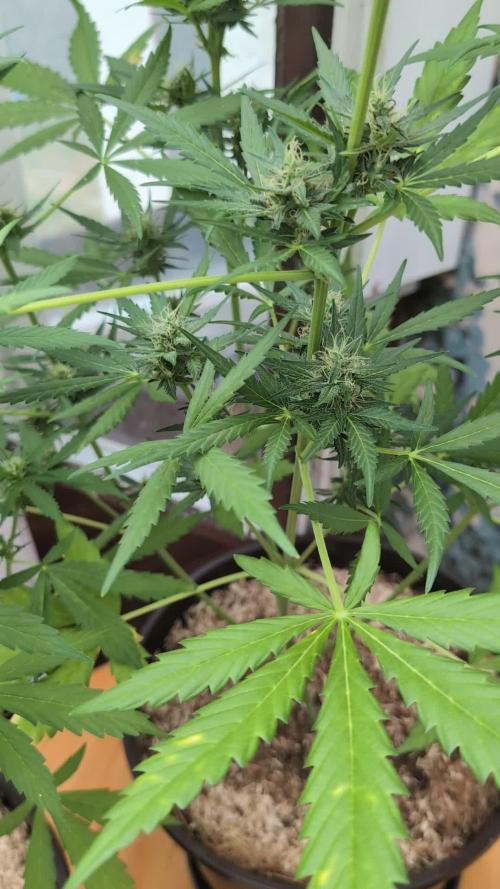
Jetzt lässt sich eine durchgängige Blütenentwicklung beobachten und die Grüße wird sich vermutlich nicht mehr Stark ändern.
Daher gehe ich davon aus, dass der Stretch allmählich abgeschlossen ist.
In der folgenden Woche bekommt die Pflanze nun einen Kompostee von Biotabs NL. 💚

Likes
2
Share


@Mr_Prawn
Follow
Final de la sexta semana, corto la primera con 40 días. El resto están sacando los pelillos marrones, unas mas unas menos.
Parece que falta poco, olor fuerte.
Likes
Comments
Share

@DogDoctorOfficial
Follow
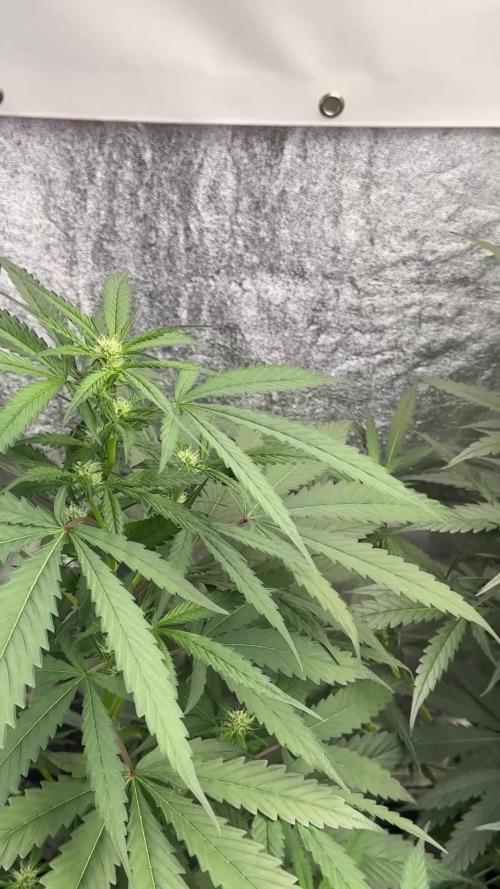
🌿 Frosted Guava Auto by Zamnesia | Pheno B | Week 6 (Early Flower)
🌱 Same Family, Completely Different Personality
One of the greatest joys of growing multiple phenotypes side by side is discovering just how differently they can express the very same genetics.
Frosted Guava Pheno B continues to surprise me every single week.
Sharing the same home, the same lighting, the same nutrition, the same environmental conditions, and the very same 12/12 From Seed journey as her sister, she's writing an entirely different story.
Where Pheno A reached for the sky with a broader, more open structure, Pheno B has remained wonderfully compact, building a dense framework of strong branches and closely spaced internodes that give her an incredibly sturdy appearance.
Standing at 99 cm, she isn't the tallest lady in the room.
But every day she convinces me a little more that height isn't everything.
Sometimes the smaller plants carry the biggest surprises.
🌸 Week 6 – Flowers Are Starting to Take Control
This week marks the moment where flowering truly begins taking over.
The vertical stretch has slowed considerably, allowing the plant to redirect her energy into building the dozens of flowering sites spread across her canopy.
Every branch now carries clusters of bright white pistils, and what were small pre-flowers only a week ago are already beginning to form recognizable bud sites.
There's a quiet confidence about this phenotype.
She isn't growing wildly.
She's growing with purpose.
Each node feels productive, each branch contributes to the canopy, and the entire plant appears focused on one objective—building flowers.
🌿 Compact Structure with Huge Potential
One characteristic continues standing out above everything else.
Density.
Her internodal spacing remains noticeably tighter than her sister's, creating a plant that feels full without becoming overcrowded.
The careful Low Stress Training carried out during vegetative growth has paid off beautifully, allowing light to reach deep into the canopy while preserving her naturally compact architecture.
Strong lateral branching, thick stems and excellent airflow throughout the plant provide a solid framework for the weeks ahead.
Looking at her today, it's easy to imagine each one of these flowering sites developing into chunky, well-supported colas.
Sometimes compact plants end up being the ones that surprise you the most.
🌼 Early Flower Development
Flower production has accelerated nicely this week.
Fresh clusters of pistils continue appearing across every growing tip, while the first small stacks of calyxes are beginning to give each bud site more definition.
Although it's still early in bloom, there's already a noticeable increase in flower density compared to last week.
Every passing day adds a little more volume.
A few more pistils.
A little more structure.
The transformation has clearly begun.
The first hints of resin are also starting to appear on the surrounding sugar leaves, offering a small preview of what's still to come.
🍃 Plant Health
Health remains exceptional.
The foliage displays a deep, healthy green, with leaves maintaining excellent posture throughout the entire canopy.
There are no signs of stress, deficiencies, or nutrient imbalance.
The stems continue thickening to support future flower weight, while new growth remains vigorous and beautifully uniform.
She has developed into one of those plants that simply looks comfortable.
Comfortable in her environment.
Comfortable with her feeding.
Comfortable doing exactly what nature designed her to do.
💧 Nutrition & Hand Watering
Unlike her sister, Pheno B continues her journey under traditional hand watering, allowing me to spend a little extra time with her during every irrigation.
This week's feeding consists of:
• Terra Bloom — 1.9 ml/L
• Pure Zym — 1 ml/L
• Sugar Royal — 1 ml/L
• Power Buds — 1 ml/L
• Green Sensation — 1 ml/L
Maintaining:
• EC: 1.78 mS/cm
• pH: 6.0
It's been fascinating to compare both irrigation methods throughout this project. Despite one plant growing with AutoPot and the other by hand, both continue developing beautifully under the same Plagron feeding program.
🌡️ Environment
Stable environmental conditions continue allowing each phenotype to express its genetics without unnecessary stress.
Current conditions:
• Day temperature: 29°C
• Night temperature: 25°C
• Relative humidity: 72%
• Solution temperature: 21°C
• Root zone temperature: 21°C
• CO₂: Approximately 639 ppm
Keeping these parameters consistent has allowed the subtle genetic differences between both Frosted Guava phenotypes to become the real story of this grow.
👀 Looking Ahead
Over the coming week, I expect flower production to accelerate significantly.
Those small clusters of pistils should begin stacking together into clearly defined buds, while resin production gradually spreads across the sugar leaves and surrounding calyxes.
What excites me most isn't her height.
It's her structure.
Her compact frame, tight internodal spacing, and impressive number of flowering sites give me the feeling that she could become one of those plants that quietly delivers an outstanding harvest without ever being the biggest in the room.
Sometimes the plants that ask for the least attention end up giving you the biggest smile at harvest.
🙏 Final Thoughts
Frosted Guava Pheno B is becoming one of the most fascinating plants in this entire 8×8 Adventure.
Growing beside her sister under identical conditions has been a perfect reminder that genetics are never just about a strain name—they're about expression.
Same family.
Same environment.
Same care.
Yet a completely different personality.
She has chosen to stay compact, sturdy and beautifully organized, and every week she becomes a little more convincing that this unique structure could translate into something very special when harvest day finally arrives.
A huge thank you to Zamnesia for trusting me with these incredible genetics, Plagron for consistently outstanding nutrition, Future ofGrow for powering the garden with exceptional lighting, TrolMaster for maintaining a stable environment, and to everyone following this journey here on GrowDiaries.
Your support, comments, and encouragement continue to make this 8×8 Adventure even more rewarding.
Until next week...
Growers Love and happy growing! 🌱💚

Likes
5
Share

@CannaArchive
Follow
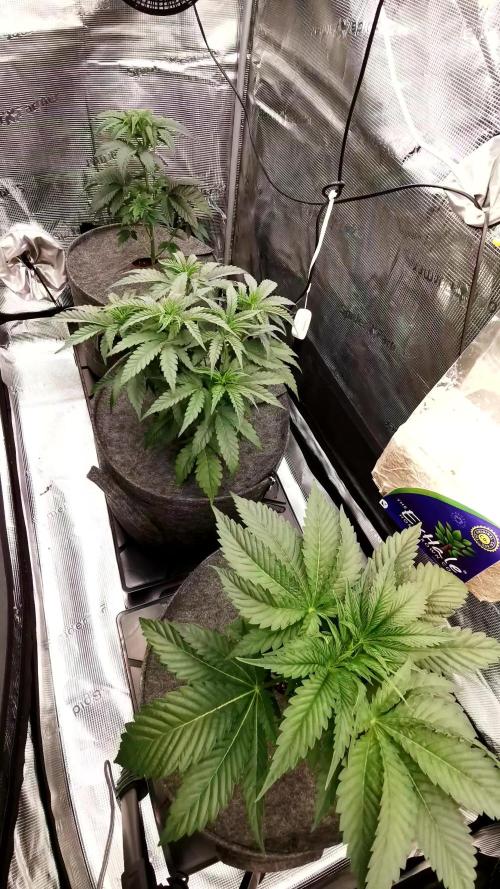
This week both plants entered a strong vertical expansion phase 🌿
Internodal spacing increased noticeably, showing a clear push in height rather than lateral stacking.
• Height approx. 30 cm
• 4+ developed nodes expanding rapidly
• No training applied (intentional canopy synchronization with Jelly Donutz)
Pheno #2 is clearly separating itself 👀
The stem thickness is impressive, (roughly the size of a thumb or a Clipper lighter) nearly twice as thick as the other plant.
Leaf size is the largest seen so far in this run, with very broad fan leaves and strong biomass production 💪
Lower damaged leaves from the transplant phase were removed. Canopy now fully green and healthy 💚
Light intensity increased to ~600 PPFD under 18/6 ☀️ IR schedule remains active.
Internodal spacing suggests vertical drive, likely influenced by genetics + IR interaction.
Leaf posture shows light praying but not aggressive, indicating comfort without excessive light stress.
Watering every 2–3 days based on pot weight 💧
Pheno #2 shows slightly higher demand, drying the pot roughly half a day earlier than its sister, a strong indicator of increased root and transpiration activity.
Feeding this week:
• 1x Orgatrex
• 1x Greenhouse Bio Enhancer
• Otherwise RO + CalMag (switching to BioBizz CalMag without nitrogen moving forward)
Environment stable, structure strong, momentum clearly increasing 🚀
Overall: strong vegetative drive, clear pheno divergence, and rising growth energy going into the pre-flip window

Likes
14
Share


@Bread_n_Buds
Follow
Going into flowering is always a special moment and we prepare to do it at our best to make the plant understand that it is time to become a woman and speed up the start of the formation of buds.
We start with 24 hours of darkness this to give a strong break and sign of change to the plant that understands the change of time and prepares to go into flowering.
Our Black Runtz was worked with a topping x16 buds but unfortunately I got stupid one day and after having vaporized something strong while doing a defoliation, I also cut a branch, our x16 buds became like this x14, story of a bullshit done. I hate doing bullshit and I expose them to public shame to remind myself not to do it again any normal human being would have hidden the fact. But we are not here to comb the dolls so we always tell the truth. It happens and the plant will be super beautiful anyway.
Another thing that gives the plant the signal to start flowering are flowering stimulators, we friends at Plagron use Power Buds.
The start of the flowering program includes the same additives as the vegetative phase Power Roots, Sugar Royal, Pure Zym and adds the flowering stimulant Power Buds. Now the basic fertilizer is Alga Bloom specific for flowering.
Green Sensation will arrive as the hero of the end of flowering and at the same time it will be time to remove Power Roots and a week later the Pure Zym enzymes. It is recommended from the 4th week, if the plants flower quickly I start at the 3rd, it depends on the size of the bud.
---- Decide on the right soil and calculate your fertilizer card based on the soil on the official website. -- www.plagron.com
Try a seed of this strain that drives us crazy..
-------- https://www.zamnesia.io/en/11159-zamnesia-seeds-black-runtz.html
Zamnesia Description // Black Runtz comes from a truly legendary gene pool. Our breeders used three modern classics from the US to create this strain: Zkittlez, Gelato, and Runtz. With 20% THC and flavors of grapes and berries, Zkittlez brought her delicious flavors and relaxing effects. Gelato contributed to Black Runtz's immense flavor profile by bringing high concentrations of the terpenes limonene and humulene. Finally, Black Runtz inherited the high potency of the original Runtz, a strain with a respectable 21% THC. The end result of this 3-way cross is a strain with 55% indica genetics and 45% sativa. Black Runtz boasts fast flowering times, high potency, and contrasting yet balanced terpenes that support her delicious flavor profile.
All the best that mother nature has to offer is at ---- www.zamnesia.com
Likes
39
Share


@J_diaz420
Follow
El día 19 de floración se hace poda de brotes bajos y una pequeña defoliación de hojas de abanico 👍


Likes
2
Share


@kissrubb
Follow
Actualización 05/10/2024
¡Hola, growers! Perdón por no poder compartir las semanas completas, pero poco a poco volvemos a la normalidad. Las fotos que ven corresponden al día 01/10/24 y, como pueden ver, están llenas de terpenos y tricomas por todas partes. Tanto la Fruit Gum como la Biscotti x Candy Rain son dos de las cepas más resinosas que he cultivado y, además, desprenden un olor increíblemente fuerte.
La Fruit Gum tiene esos toques dulces y nostálgicos, como a chicle de mascar, que me transportan directamente a mi infancia. En cuanto a la Biscotti x Candy Rain, su aroma es como el de una clásica galleta americana casera, ¡muy intenso! Ambas cepas me están impresionando mucho por su resinosidad y aromas únicos.
Cabe destacar que las genéticas de Uktha Genetics me han sorprendido gratamente; los resultados están siendo fantásticos. Eso sí, estas cepas comen como camiones, pero mientras se mantenga un control exhaustivo de las fertilizaciones y del medio de cultivo, no hay problema de sobrefertilización.
Pronto cortaremos una de las plantas que está bastante adelantada. Espero que disfruten tanto como yo este proceso y, como siempre, ¡buenos humos para todos! 🌱💨

Likes
9
Share


@Grow4Releaf
Follow
**(short video in photos added)**
This thing is fun to watch , still Trying to figure out what's all going on here.
She started to get a new product to me, Tea co Biological Supplies Super tea blend.
See how this works out. Using it on this and the LIT Velvet Gary and Most wanted Vaderade strains.
Besides the new brew, she's looking good .
Got moved to the 3x3 from the lil 2x2 now so hoping that she can get a bit more hieght prior to Flippin in the next 2 weeks.
But we will see how the Super Tea blend works over these next 2 weeks, of all is well ill be Flippin 12/12 (well 11/13 to initiate flower for a week or 2 then 12/12)
Beans_ Zamnesia USA-https://www.zamnesia.com/us/
If curious about the Tea blend here u go.
Tea co Biological Supplies / Shop- https://www.teacobiosupply.com/shop
Tea co Instagram -
https://www.instagram.com/teacobiosupply?igsh=enViOHE2dWltbHY2


Likes
62
Share


@Herbz_Unkraut
Follow
Lowered the lights & will set 24h light on monday
Most of the roots show on the bottom of the pots

Likes
13
Share


@TheUndercoverGrower
Follow
Plants are all a little out of sync with each other due to multiple strains. Most are in early flower, a couple in late veg but the big Tangiematic is way ahead of the rest.
Warm wet weather is making humidity a bit of an issue, hit 80% at one point so I've had to turn the outtake fan up to full power.


Likes
8
Share


@OS_Farmz
Follow
Since high colas have already a good colour i thing to start flushing from next week to cut them in 14 days.


Processing
Likes
26
Share


@LongJohn420
Follow
28.8 Eight flowering week is done now and one week of flushing. Both look excellent but they'll go nine weeks. Other one maybe at day 60 because she already is pretty ripe looking. Barney's recommend was 60-70 days so I'll check at 9 weeks 63 days... I'll keep flushing and girls still swell and stack trichs nicely.👌 Not much to report..
Thank for checking in! Happy growing! 👽
Processing
Likes
6
Share


@Deeganja
Follow
this girl is further ahead than the rest of the girls so I believe she will be finished a couple of weeks before the rest of them, looking stunning 😍
Likes
178
Share


@NuggetPawn
Follow
So, with these interesting times and what is becoming a fast evolving global catastrophe. I, myself, along with the rest of you ( I hope ) can take some solace in looking after our gardens, to have some peace away from the news, to give our ladies the best care we are able to provide 🌱
If you ever needed any vindication or validation as to why growing your own is best. More than half the world currently in lockdown, and with MJ in short supply, our actions speak for themselves!
Anyway, back to this diary.
I done a lot of work on the room, invested a lot and tried to make everything as automated as possible. Everything runs on smart plugs, the hydroponic system is DIY and is RDWC which is cooled with a Hailea 150a.
6 plants is what I am going for this time, with a shorter veg length compared to the last grow. I prefer to wait until they show their sex, but if they don’t by week 5, I plan on flipping anyway all being well.
I am using 730nm LED’s that come on 15 mins before lights on, turn off during lights on, and then they come back on when lights go out, and stay on for 15 mins. This should enable me to run 13/11 during flower with little risk.
I am also going to add a UVB fixture to my custom rig which will only be used during the final 2 weeks of flower.
I have 3 Alibaba lights attached to a custom rig, they really are awesome lights. I tested the room out with an Apogee SQ-520 par meter (PAR map in pics). I have dimmed them down, so PAR is around 500 across the whole canopy, this will be increased to 1000 once they’re flipped.
I vent from my house, to the room and then outside, this increases the CO2 in the room, which I think helped the yields on the last grow, generally CO2 hovers between 470 and 700 PPM.
My ladies look a little sick, but tbh, I struggle starting out in Rockwool, and things usually correct themselves within a couple weeks.
With the quarantine I have struggled to pick up a humidifier that is capable of maintaining that room, so it has been all over the place since the start.
I have opted to go with Royal Gorilla this cycle, let’s see if it’s as potent as RQS says that it is!
Good luck all and take care...