


Likes
Comments
Share


Likes
20
Share


@Xabii
Follow
Pictures taken on day 78 since sprout for the Northern Lights (left/right), day 75 for the Orion (middle).
NL#2 (left) still more and more rust colored spots, won't get better I gave up but bulking nicely.
NL#2 (right) comming along, looking healthy, bulking up.
Orion (middle) was chopped up for the most part to give the Northern Lights more space.
I expect a 1kg+ wet yield for each Northern Light.
Did a little final defoliation and rearranged the Northern Lights a little.
Did a reservoir change at the beginning of the week and added a little more Universol Yellow than Yara Kristalon Orange to get more P.
Trichomes are clear/milky on the Northern Lights, probably 2 more weeks.
NL#2 smells kind of fruity/lemony fresh.

Likes
28
Share


@Chubbs
Follow
420Fastbuds
FBT2307/Week11
What up everyone weekly update on these three beauties. All though they appear to be different in looks they all three are equally lovely. Really looking forward to the upcoming week as I'll start looking at the trichs to see if we got some amber showing up. All in all Happy Growing

Likes
27
Share


@NORTHWALESAUTOS
Follow
Sadly missed a week due to personal reason..
Anyway way this forbidden runtz is outstanding... she's grown so fast. She's smelling really good at the min..
Not a lot has change fees wise. Iv given her some boost so won't be long now.
Likes
10
Share


@HideAndFly420
Follow
Day 29, I’ve been slowing a little bit with fer too loser as I m going into flow and I used an all mix soil from biobizz that’s already charged with an high ec, I don’t wanna risk any over, I left it for one week with just water and regulator, the development of roots will help to absorbs the ec present in the soil so I will restart to fertilise next week.
I’m using the complete line from aptus and I’m really satisfied I see how healthy the littles are.
I will have my lamp 40 cm for this week and I’ll
Move to 33 at the end of this week
Day 32 this OS is flowering supersoeedy, I can already see buds, i had one of last lst just give her a more clean structure.
I stopped to fertilise in the last 5 days, I just gave ph controlled water and yesterday 0.5 lt of water with just regulator and calmag. I wanted the plant to eat all the nutrients I gave during veg, I think this worked pretty well as I I saw her growing every day and I can. See an healthy nice green on leaves .
I think that max tomorrow I’ll start again with fertiliser.
Day 33 the orange sherbert is really running fast.
I restarted feeding her today, flowering feedings started.
Let’s goo
Let’s goo!!
Likes
33
Share


@nonick123
Follow
Día 64 (17/03) Riego con 500 ml H2O EC 0,45
Estamos en el día 36 de floración y empieza a mostrar una senescencia preciosa 😍💥
Día 65 (18/03) Riego con 500 ml H2O EC 0,45
Día 66 (19/03) Dia 39 de floración y la senescencia empieza a avanzar en algunas hojas. Unos colores preciosos!
Riego con 150 ml H2O EC 0,45
Día 67 (20/03) Riego con 500 ml H2O EC 0,45
Día 68 (21/03) Riego con 500 ml H2O EC 0,45
Día 69 (22/03) No riego (vacaciones)
Día 70 (23/03) No riego (vacaciones)
Queda 1 semana (teórica) para la cosecha!
🚀 FastBuds 15% DISCOUNT code "NONICK" 2fast4buds.com @fastbuds.official
💦 BioTabs 15% DISCOUNT code "GDBT420" biotabs.nl/en/shop/ @biotabs_official
🌱Substrate PRO-MIX HP BACILLUS + MYCORRHIZAE @promixmitch @promixgrowers_unfiltered
💡2 x Mars Hydro FC1500 EVO Led Grow Light (2024 NEW FC 1500-EVO Samsung LM301H 150W LED) - https://marshydro.eu/products/fc1500-evo-led-grow-lights/ - https://www.amazon.de/dp/B0CSSGN5D8?ref=myi_title_dp
Likes
8
Share

@GREENPHOENIX6262
Follow
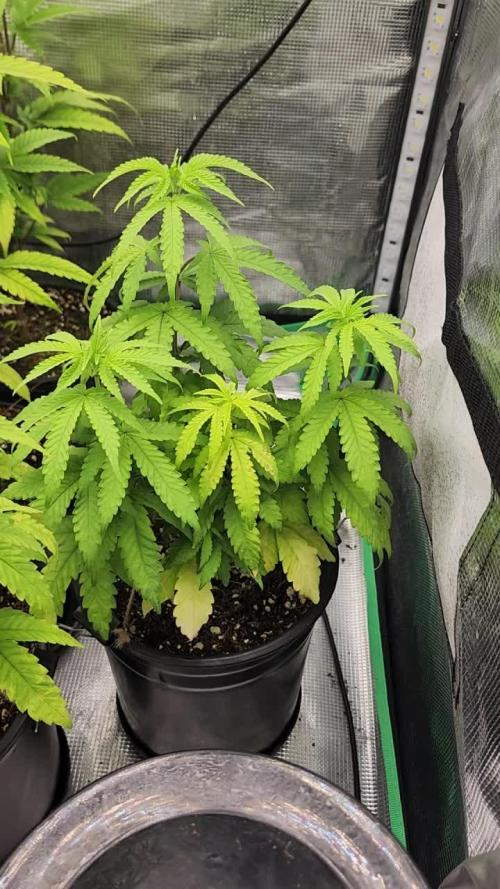
04/11 - Both plants are coming along accordingly on time - As stated previously I got careless with the PH and they suffered a harsh PH burn - Since then they have been flushed and nutes in coco stripped - Began introducing nute in micro-dosing stages.



Likes
21
Share

@Borberad
Follow
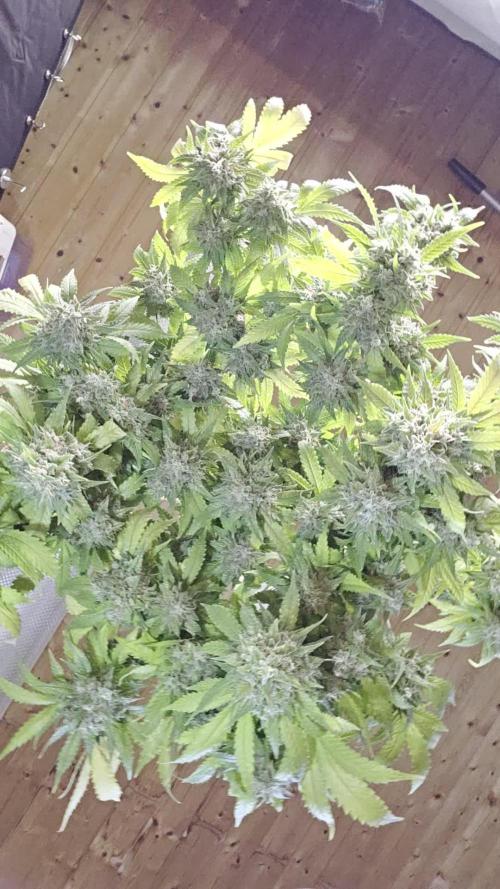
Die letzte Woche lief ohne Störung und Probleme, wahrscheinlich hätte man noch 5 bis 10 Tage warten können für 20% Bernstein, aber das ist eh nicht unser Ziel. Jedoch sind 74 Blüte Tage für ein Fast Flower schon ordentlich. Es sei aber bemerkt das auch die Frühe Ernte schon gut schmeckt, jedoch ist die Buddichte der frühen Ernte nicht mit dem Aktuellen Zustand vergleichbar. Also warten lohnt sich, wie immer! Gesamt Gewicht Nass 750g ungetrimmt mit Stängel ohne Stamm.

Likes
37
Share


@MrJones
Follow
OSS Ghost Train Power
🔹⊱╮🔹╰⊰🔹 GROW Started 03.10.24 INFORMATION 🔹╰⊰´🔹⊱╮🔹
🌞Environment - Maintaining 80F and 65%Humidity
🌾Training - The girls are recovering from last week's Pruning and Defoliation,
⚱️2-Gallon 📊6.2 PH
💧 Feeding - Using Horti Bloom and Horti Cal 12-0-0
🌞Medic Grow Smart 8 760 Watts
🕷️ IPM - CannControl from Mammoth and Mosquito Bits as needed
🔹⊱╮🔹╰⊰🔹 PLANT UPDATES 🔹╰⊰´🔹⊱╮🔹
📝 Notes - On 🗓️05.11.24, This week, we are on Auto-Pilot and just Fertigating as needed; the ladies are stacking up nicely, and the leaves have grown back not sure if it is the genetics or the new nutrients; I would like to see less and will evaluate if more defoliation will be needed.
📝Fertigation injects fertilizers into an irrigation system to supply dissolved nutrients to crops.
🗓️05.11.24 Just feeding daily, sometimes twice; today, fed with Hort-Bloom @ 2.7 GRMS Per Gal and Horti-Cal @ 2.5 GRMS Per Gal.
🗓️05.12.24 Just feeding daily, sometimes twice; today, fed with Hort-Bloom @ 2.7 GRMS Per Gal and Horti-Cal @ 2.5 GRMS Per Gal.
🗓️05.13.24 Just feeding daily, sometimes twice; today, fed with Hort-Bloom @ 2.7 GRMS Per Gal and Horti-Cal @ 2.5 GRMS Per Gal.
🗓️05.14.24 Just feeding daily, sometimes twice; today, fed with Hort-Bloom @ 2.7 GRMS Per Gal and Horti-Cal @ 2.5 GRMS Per Gal.
🗓️05.15.24 Just feeding daily, sometimes twice; today, fed with Hort-Bloom @ 2.7 GRMS Per Gal and Horti-Cal @ 2.5 GRMS Per Gal.
🗓️05.16.24 Just feeding daily, sometimes twice; today, fed with Hort-Bloom @ 2.7 GRMS Per Gal and Horti-Cal @ 2.5 GRMS Per Gal.
🗓️05.17.24 Just feeding daily, sometimes twice; today, fed with Hort-Bloom @ 2.7 GRMS Per Gal and Horti-Cal @ 2.5 GRMS Per Gal.
╰⊰🔹╰⊰´🔹⊱╮🔹╰⊰🔹╰⊰🔹STRAIN INFORMATION🔹⊱╮🔹╰⊰🔹╰⊰🔹╰⊰🔹⊱╮
Powerful West Coast genetics Ghost Train Haze x Pellezino combine to create this exceptional Cali weed strain Ghost Train Power. This exceptional strain exhibits dominant terpenes like Limonene, Linalool, and Terpinolene that produce a tempting citrus, herbal, floral scent with a fruity taste that is a flavor sensation.
Ghost Train Power comes from powerhouse parentage and produces extreme levels of THC up to and over 30%, and when you consider her substantial production, this strain is unprecedented. The potent effects are surreal and intoxicating, and the harvests are a treat. Indoors, this beauty will reward you with a generous 650 gr m2 of tantalizing frosted bud; outdoors, she can produce more than 1 kilo per plant. Ghost Train Power is USA genetics that will live up to its acclaimed reputation and have you coming back for more over and over again.

Likes
Comments
Share


@smoking_hills9
Follow
Top strain, very easy 2 grow with amazing results in the end. Didn't try it yet, but when I hit it , I will definitely update on here. Smells fantastic 🤩
So final results are 370gr of quality solid buds🤩✔️ that's not include the bottom trim and small buds. Very good yielder.
Final harvest weight is 5kg of quality solid buds and around 2kg of small bottom buds


Likes
3
Share

@ElCapo420
Follow
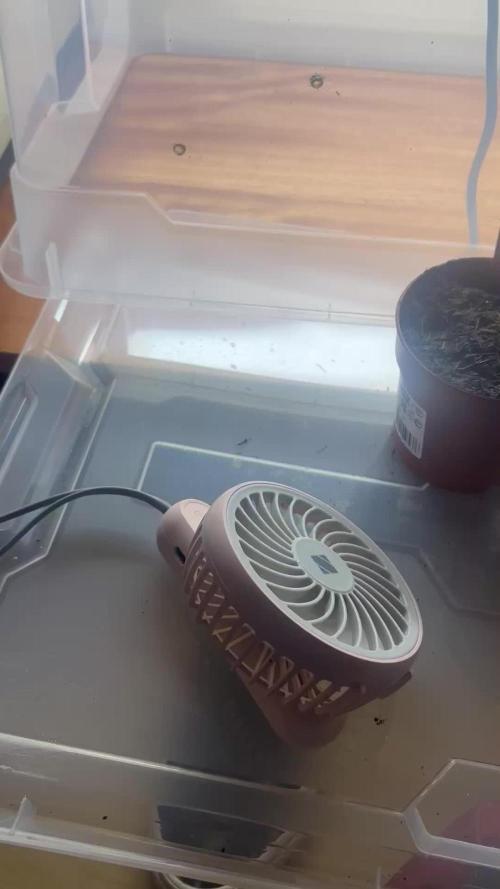
Ich habe mich doch dazu entschieden meine Ladys umzutopfen weil sie alle gespargelt sind, obwohl alle gegen das umtopfen von autoflowers sind. Diese Woche habe ich angefangen sie langsam an die Sonne zu gewöhnen am Balkon damit sie nach den Eisheiligen raus in den Garten können. Wie ihr seht wachsen sie alle relativ gut aber sehr unterschiedlich. Wir haben auch mit dem BioBizz Fish-Mix angefangen und sie hab es geliebt. Pflanze #3 ist ein bischen hinterher aber das wird hoffentlich noch.
Likes
11
Share


Likes
2
Share


@theicyeffect
Follow
A diary dedicated to the rest of my special girls. Check out my profile to see the Gorilla Glue up close (she will still appear here from time to time).
Germinated them directly in the soil with natural sunlight, achieving a 100% success rate.
All came out the soil with remarkably thick stems already, excited to see how these old school genetics will behave.
Lots of growth during their first week of life, reaching the end of it with 2 pairs of leaves each. We surely got some sturdy girls here.
Sunset Sherbet had some damage from struggling to hatch and is now slowly recovering, I’m sure she’ll catch up with time. Nothing good nutrition and proper lighting won’t fix.
Bruce Banner turned out to be incredibly big for her age, never grown a seedling like her! You can tell she’s already finding her germination vase too small. Making a statement with her presence.
Biscotti Mintz also looking big and very healthy.
Let’s watch them grow and see what they’ve got 🌱💪

Likes
29
Share


@HighZenBerg
Follow
Welcome back at week 6 in vegetative stage of my Sensi Amnesia feminized by Sensi Seeds.
She does great and almost the whole 60x60 space is filled with the 8 new mains.
I will give her one more week and a defoliation in a few days.
I am amazingly happy with her and can’t wait to start flowering stage.
Day 44: defoliation
Day 47: I flipped the switch to 12/12 ! Let the flowering begin
Keep in touch !
Cheers, HighZenBerg


Likes
18
Share


@Pokan187
Follow
This week went by well, I will start checking the trichomes on the Runtz at the end of this week. It should be ready for harvest in the next 2 to 3 weeks
The G13 is still smelling like magic, looking majestic.
The GDP buds are starting to put on weight

Likes
5
Share


@coolesrat
Follow
Still swelling but starting to slow down and swagger. It's kolas are becoming so large that it's really starting to weight down the plants small height and stature.
Trying to get away with not holding it up but I will see how the further biggest kola starts to lower more how it'll end.
I'm starting to lower the feed and get ready for the last 3-4 weeks I'll be giving these plants.
Some more foliage will be removed eventually in the coming weeks and also I'll start to change the feed up a little.
You can really see the difference in the two phenos. One's a lot like a leafy gelato and the other is OG all the way with great dense kolas. I'm expecting the Gelato type pheno to take 9-10 weeks and the OG one seems to be showing it's age more rapidly with it's pistil development and colour change beginning to start while the other seems untouched and continues to shoot newer whiter pistils!

Likes
9
Share


@TiRobotProds
Follow
Les pompoms commencent a se former belle structure de cette plante. Boit énormément. Les engrais se mettre en marche et cela fait une énorme différence.


