


Likes
Comments
Share


@valiotoro
Follow
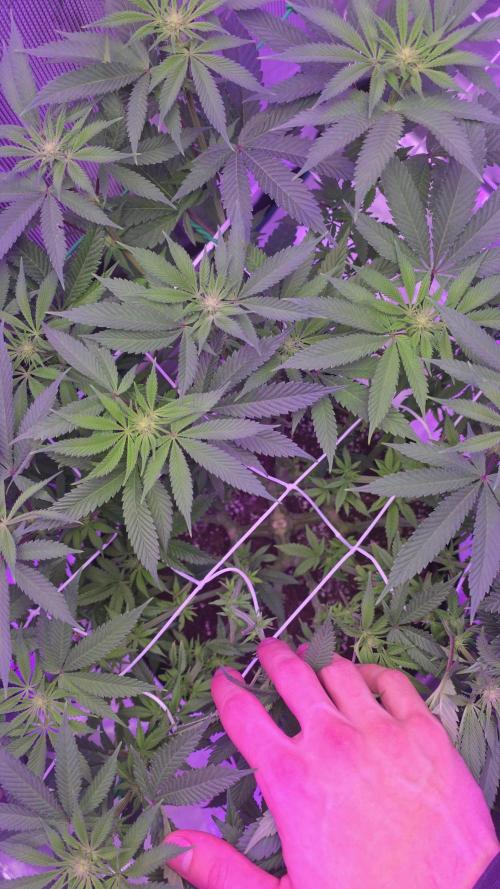
Hello everyone week 8 of flower has passed for this Mint Jelly auto ❄️
She’s ready !
For the feeding schedule i stopped feeding Power Roots and Pure Zym and started feeding Green Sensation 0,5/l
Mars hydro FC-E6500 75%
have a great day and wish you all happy growing 😎



Likes
12
Share


@GREENPHOENIX6262
Follow
Week 3 Veg - Thus far running accordingly. No signs of stress or deficiencies. Introduced a Co2 bag (Exhale 265) to run into early flowering.
*End of week recap* (08/27)
User error during LST for both -
Gave heavy nutes to assist on the rebound - Minor chance of stunting
Besides the LST error - Running smoothly -
Light flower will begin in 2 weeks.

Likes
17
Share


@smoking_hills9
Follow
Great lemon strain. Grew and smoke it before, very nice smell and dence buds, weight update soon. Ok can't be happier 🤩🌴 total weight from 3 trees are 316 gr of rock solid top quality bud. Didn't weight all the bottom trim but that's another 70gr on top of that at least. So almost 400gr 🤩😶🌫️ Seedsman genetics rocks hard💚🔥
Total harvest weight of 54 trees is 5kg, of solid quality buds, around 2kg of small bottom buds

Likes
33
Share


@Callys_Garden
Follow
This was the last photos and video I took before I chopped them. One of the girls started to yellow on the sugar leaves quiet badly!

Likes
10
Share


@berlinbeginner
Follow
Blueberry Muffin Week2 F14. After switching to 12/12 , they are still stretching and have already 2x in size. The plants smell strong already. Feeding 3x a week. 2x with grow,bloom,topmax and 1x with calmag and Alg a mic.

Likes
3
Share


@GoodTimesOrganics
Follow
Eine faszinierende süße Sorte, richtig durchdrlingiche fruchtig süßes Aroma.
Ich bin so auf dass gesamt Resultat gespannt!
Die Zuckerblätter glitzern in einem starken weißen funkeln und es werden immer mehr trichome sichtbar.
Diese Woche kam der Komposttee mit ca. 1,5 littern pro pflanze zum Einsatz.

Likes
15
Share

@420DeepGrow
Follow
📆 Semana 8
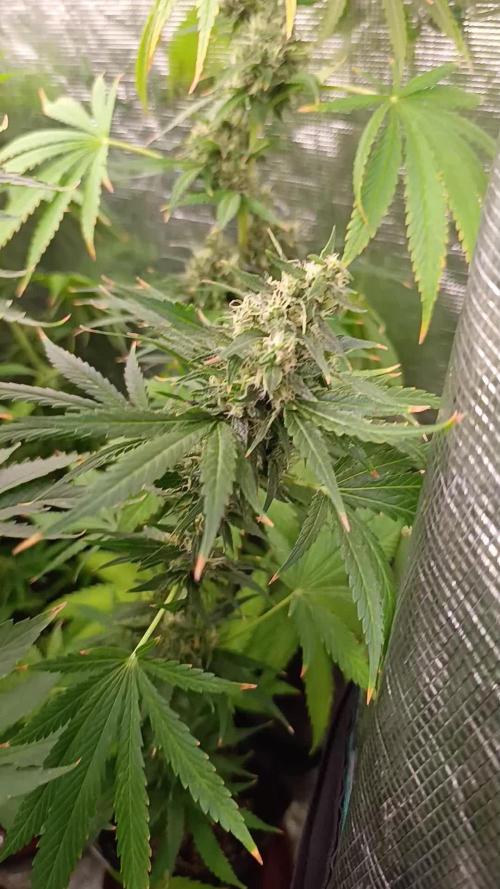
El engorde continúa avanzando a muy buen ritmo y los cogollos siguen aumentando progresivamente su volumen, densidad y peso. Los cálices continúan hinchándose y la producción de tricomas se intensifica, dejando las flores cada vez más cubiertas de una gruesa capa de resina.
Los pistilos comienzan poco a poco a cambiar de color, aunque todavía predominan los tonos blancos en buena parte de las flores, señal de que la maduración continúa su curso. Ambas plantas mantienen un consumo elevado de agua y nutrientes y siguen respondiendo de forma excelente, con una evolución uniforme y una estructura floral cada vez más compacta.
⚡ EC: 1.7–1.8
💧 pH: 6.2–6.5
🌡️ Agua: 21°C
🌫️ Humedad: 45–50%
💡 Intensidad: 1000–1050 PPFD
🔥 Nota de cultivo: Entramos en una fase decisiva de la floración. Mantener unas condiciones ambientales estables y una nutrición equilibrada será fundamental para completar el engorde, favorecer la maduración y conseguir la máxima calidad y producción de resina en la recta final.
Seguimos creciendo fuerte 💪!

Likes
8
Share


@Maggie_de_Block
Follow
Pistils finally starting to really show, expecting her to really fatten up the coming weeks.
Having some troubles keeping the humidity low, as I have a super budget little dehumidifier. Getting a bigger one would be about 100€ but I'm not sure if that's worth it, if anyone knows more please lemme know :)


Processing
Likes
7
Share


@Kushizlez
Follow
Day 77-84 (April 17th-24th)
(Day 78) I honestly cant believe I’ve been vegging this long. The growth for almost 80 days of veg is laughable. I’ve compiled a little list of what has gone wrong so far.
- I added too much glacial moraine which made the soil too water retentive
- I’ve been foliar feeding too much kelp
- I gave too many bloom nutrients for a plant in veg
- EDIT: DID NOT WATER ENOUGH AT ONCE
The plants have been drooping like crazy this past week and I’m going to try watering in a full gallon per plant. I first thought it was from the medium not drying out enough, soil compaction ect. and I’m sure those are definitely areas where my soil mix could improve but the bottom of the container is pretty damn dry. I could actually be under watering despite soaking the top with 500ml a day. I’m going to sit the pots on some plastic sheeting so they don’t evaporate as much from the bottom and water in a full gallon each making sure I get some runoff. I was going to wait until I get my air pump but fuck it, it’s coming tomorrow afternoon.
The pots are so big that they’re not fully wetting to the bottom even with a gallon. I’m going to try to water in a gallon every 4 days while keeping the top soil moist with the sprayer. In hindsight 6 plants in 5-7 gallon pots would be the most ideal.
(Day 79) Holy fuck did a full gallon watering make a difference. I should have been doing this the whole time. All 4 plants are praying and stretching upward like crazy. They just look more vigorous and happy within a day. I bet they will be even happier with that supplemental air. If things stay this smooth I should be able to flip around day 84, possibly earlier.
Got my air pump in the mail today. This is kind of a shot in the dark so hopefully it works. It’s super loud and vibrates like crazy. First I’m going to try running it 24/7 and see if there is any improvement over the next few days. If it does work, I’ll try running it on my humidity controller so it’s not constantly humming and will only turn on when the humidity is high.
I’m going to turn the night time temps down to 70f to prevent root problems now that I’m watering much bigger amounts less frequently and it’s getting warmer during the day.
(Day 81/Day 1F) Ever since I’ve been watering in the proper amounts I have seen an absolute explosion in growth. I’ve decided to flip today, now that I’m confident my soil mix isn’t completely fucked. I might run into some N/mg problems during the stretch so I will make sure to give a final foliar feeding around the end of week 1.
(Day 3F) So I’m literally seeing dwc growth rates now. Plants have grown more in the last 5 days than the last 3 weeks. If I had stayed at this pace of growth since day 1, I would have an 8 foot tall plant or I would be halfway through flower already. Oh well. Good learning experience. *grits teeth*
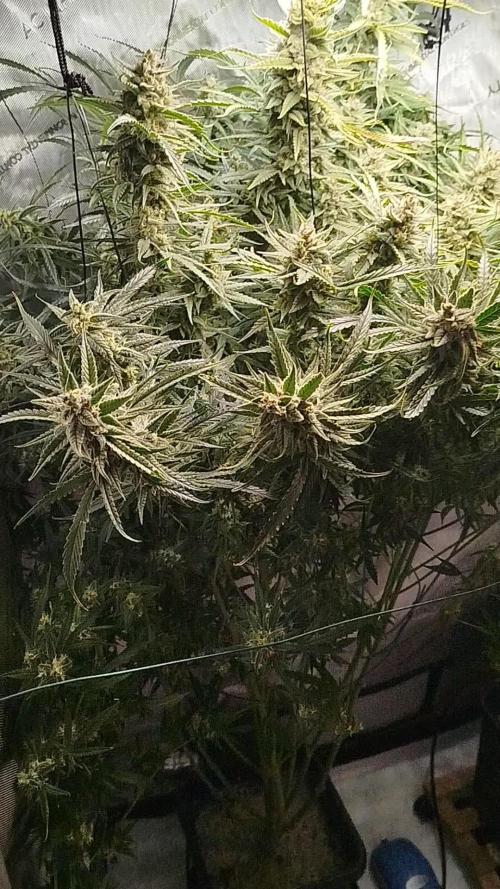
I’m going to put up the second layer of trellis before these girls stretch out of control. Bbb#3 is seriously stretchy and will likely more than double in size in the next 2 weeks. The other 4 are all quite stout and bushy.
I’m giving a light, preemptive defoliation each day and picking off some of the lower sucker branches. I will do a full strip around day 21F.


Likes
5
Share


@Pinkpanther
Follow
Veo que las plantas avanzan lentamente pero seguro, tengo buenas sensaciones. Hay 8 puntas por cada planta.

Likes
20
Share

@DevelGrow
Follow
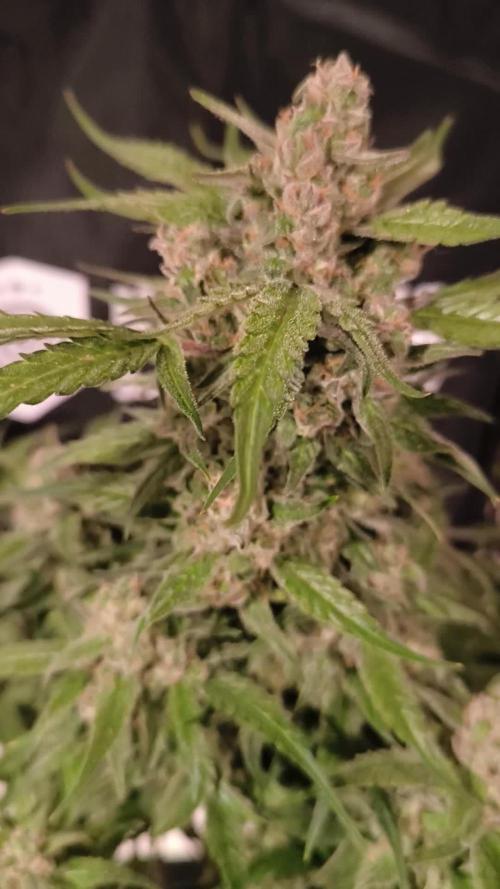
Ein Traum geht zu Ende! Und ist in klebrigen 6 Stunden Nass getrimmt worden! Sehr schöner Strain mit einem betörenden Geruch! Feste frostige buds die im dryferm BAG zum Trocknen [in der 60 iger Box, untergebracht für min 7 Tage! Keep Green und Danke an kannabia seeds für diese schöne Reise!✌️🍀🧡🍀

Likes
Comments
Share


@eldruida_lamota
Follow
Vamos familia, actualizamos la sexta semana de floración de estas Black Rainbow de Seedstockers, salieron las 3 de 3, 100% ratio éxito.
Aplicamos varios productos de Agrobeta, que son increíbles para aportar una buena alimentación a las plantas.
Temperatura y humedad dentro de los rangos correctos dentro de la etapa de floración.
La tierra utilizada es al mix top crop, por cambiar.
De 3 ejemplares seleccioné los 2 mejores para completar el indoor y trasplanté directamente a macetas de 7 litros, cambien el fotoperiodo a 12/12 y aplique una buena poda de ramas bajas, se ven bien sanas las plantas, tienen un buen color y progresan a muy buen ritmo por el momento, están cogiendo ya una tricomada seria.
Agrobeta:
https://www.agrobeta.com/agrobetatiendaonline/36-abonos-canamo
Hasta aquí todo, Buenos humos 💨💨💨

Likes
7
Share

@Mimi420
Follow
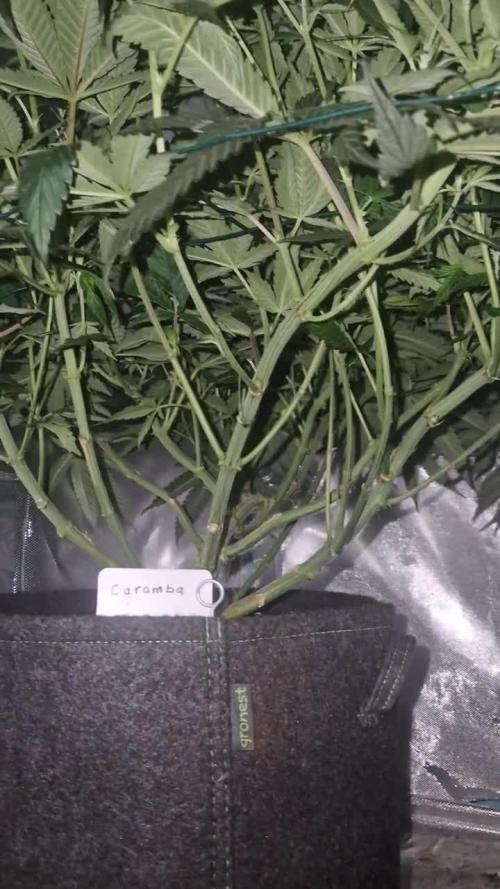
Week 1 Flowering: The Stretch is On!
Update:
We’ve officially wrapped up the first week of flower (Day 8 since the first 12/12 flip). The girls have really hit their stride and the stretch is in full effect—it’s amazing to see how much they’ve picked up speed over these past few days. Nebula and Caramba are looking strong, with that deep, healthy green color I love to see.
Training & Defoliation:
I’ve been heavy on the maintenance this week. I’ve done a solid round of defoliation below the ScrOG net to ensure maximum airflow and direct all that energy into the bud sites. Every now and then, I’m also plucking a few larger fan leaves from the canopy if they're shading the lower growth too much. It’s all about getting that light penetration dialed in from the start.
Climate Challenges:
It’s been a bit of a battle with the temps lately. I’ve been dealing with some heat spikes in the garage, which is definitely the biggest challenge right now. I’ve just made a major setup change—venting the exhaust directly outside the garage. It’s already showing signs of improvement, and it's a huge relief to know I'm not just recirculating that hot air.
I’m currently running HPS, but I’ve got my eyes on the prize: a new LED setup is coming in 2-3 weeks. I’m confident that will be the game-changer I need to stabilize the microclimate. Just gotta push through this heatwave until the upgrade arrives!
Current Vibe:
Despite the climate hurdles, the plants are showing great resilience. They’re thirsty, happy, and starting to form those early bud sites. I’m keeping a close eye on the VPD and staying consistent with the feeding. Can’t wait to see how they fill out that net as the stretch continues!
Stay tuned, more to come!



Likes
12
Share


Processing
Likes
24
Share


@Ironlungs
Follow
Gave her a fresh haircut for the start of week three flowering. Excited to see how much she fills out. This is my first attempt at a scrog and I love the difference in my last grow where I just did some light stress training.
I will post some more pictures once she's perks up. She's a little upset at the moment from the trim
Likes
74
Share


@Hou_Stone
Follow
Bonne journée tout le monde 💚
❄️❄️❄️❄️❄️❄️❄️❄️❄️❄️❄️❄️
Intensité de la FC3000: 90%
Ventilation : Extracteur mars hydro 6 pouces avec filtre à charbon puissance : 4/10 (24h/24h) + 3 ventilateurs à l'intérieur ( ON 8/24h). ils s'activent à un horaire différent.
Arrosage : Environ tout les 4-6 jours avec 1.5L d'eau. (+ 1gr de bioenhancer/L eau un arrosage sur 2)
Température & humidité : NUIT : 16°C & 70% / JOUR : 23°C & 50%
Mon instagram 🌱❤️️
https://www.instagram.com/hou_stone420/

Likes
25
Share


@Tetiana_Riz
Follow
The week has passed quite normally, and our girl continues to delight us with her growth. She has already grown by a whole 10 cm, and her leaves have become even wider and greener thanks to the Xpert Nutrients fertilizers that we use with pleasure.
However, we encountered some unpleasant situations related to Sensi Seeds. We reached out to them with an issue of seed germination, not only with Skunk but also with other strains from Sensi Seeds. We provided them with all the necessary information about the purchase, although the receipt was not saved due to various circumstances. But, to our great disappointment, Sensi Seeds denied us, citing the lack of a receipt. We provided them with the date and place of purchase, videos, and photos, but it was not enough.
Honestly, we feel deep disappointment from Sensi Seeds' attitude. We were ready to immerse ourselves in the world of their genetics, knowing that many legendary strains were bred from their seeds. But now we are disappointed not only with the quality of their product but also with the lack of honesty and support. We no longer want to have anything to do with Sensi Seeds and will seek other ways to fulfill our dreams.
People, please take a look at the photos and videos and share your opinion. Did I provide enough evidence to Sensi Seeds, or should I have provided a receipt as well? I believe that integrity should come first. Sensi Seeds, you have shown your lack of integrity. People, I appeal to you: no honest and self-respecting grower can stand aside. I ask each of you to voice your opinion.

Likes
25
Share


@PrairieFrostGrow
Follow
*****Week 14 growth – March 6 to 12, 2021 – Week 5 flower ******
These girls are certainly different from one another. Pheno 1 has a more bushy appearance and Pheno 2 is lighter in color and more bud swelling at the tops. Expect to see some nice colors come out in #2😃 In the end......it’s about the smoke😂👍🔥
Bud Fusion being introduced this week. Into the last phase of feeding during flower now. Nitrogen is continued to be reduced as its late flower. Keeping up the feeding ppm this week as we are getting to the end. May be pushing them a little more than I should but finding out how they react for next run.
Still continuing to play with the light intensity and seeing how the girls react to my environment conditions when pushed harder. Could have backed off and stayed with 100, 300, 600, 900 PAR levels at the different stages but I have trying to go a little higher in the late stages and going over 1,000 PAR.
Little more detail…..
Mar 6/21, Day 29
- Dry out day
- Changed light cycle to 11/13 today to help with light intensity and reducing DLI.
- Light power reduced to 425 watts
Mar 7/21, Day 30
- Keeping up the feeding but reducing nitrogen.
- feeding with micro – 1.5, bloom – 2.5, ult B – 0.5, carbs – 1, B Storm – 2, S Storm – 2.5, Bud Fusion 0.15gr/l, Terp – 1.5, Jet Fuel – 0.5, Rezin 1
- 1150ppm and 6.0pH
- 4L
Mar 8/21, Day 31
- Watering with 2L feed from yesterday and 16L plain water
- Over shot the pH
- 400ppm and 5.9pH
Mar 9/21, Day 32
- Feeding again with Grow – 0.5, Micro – 1, Bloom – 1.5, Carbs – 1, Magnifical – 1
- Didn’t add many of the supplements
- 875ppm and 6.0pH
- 4L
Mar 10/21, Day 33
- Middle of the week and just giving some enzymes today
- Enzymes – 1.5ml
- 300ppm and 6.1pH
- 4L
Mar 11/21, Day 34
- Microbes again today
- Tap water with Jet Fuel – 1ml, Terpinator – 2ml, Nature’s Candy – 1.5ml, Rezin – 1ml, Ultimate B+ - 0.5ml, Recharge – 1tsp/gal
- 800ppm and 6.0pH
- 4L
Mar 12/21, Day 35
- Dry out day
- Been feed a couple of times this week so work with ¾ strength next week.
