


Likes
Comments
Share


@Thee_HoffGuyy
Follow
Well it was another great week for the Super Silver Haze sisters!! Day 28 for them and they are growing very well👌They have all grown about an inch in height in the last week. Plant #1 has a slight earthy/ fruity smell starting to come out. Her bud sites are slowly starting to fill in nicely. Plant #2 has really filled in and is just a very quick growing pheno. It had the onset of flowering very quick and has just kept going at the same rate since🙌 Only thing about that is she is using way more Phosphorous than the other 2 plants and was starting to show the beginning of a deficiency, luckily It was caught quick and is not affected any of the top new growth or bud site areas. So now she is getting her own nutrient solution with a slightly higher amount of phosphorous. She also has a Strawberry fruity like smell, it is very unique! Plant #3 Is doing great👍 She doesn't have to much of a smell yet, but it does have a hint of a skunky/fruity smell to it according to what my nose is telling me😂 Overall they are growing fantastic with the exception of the slight P deficiency that showed up on Plant #2, Like I stated earlier I believe it is due in part to how fast she is growing and me not thinking to add a little more knowing she was growing faster than the other plants, combined with her position in the tent. Where she is kinda in the overlap of the 1000w HPS lights even though the light is strongest directly under them. Where I have 2 running in a 5'x10' area. So the overlap of them into each other creates quite an even light coverage, most of the time. but sometimes can be stronger than directly under the light depending on the spacing of the hoods/reflectors and type of hoods/reflectors, and that is what was happening here. They where fairly close together so the edge of their light dispersion was reaching almost to the center of the other light creating a pretty intense spot of light in the overlap. So I moved the lights just a little further apart, but did not want to go to far because the plant was loving that much light. and really only wanted to reduce it to help it bounce back from the slight P deficiency, since the more light the more photosynthesis the more Phosphorous😊 Anyways Thanks for stopping by to check things out!!👊 Happy Growing an Plentiful Harvests to All!!🙏

Likes
228
Share


@StarLorr
Follow
Welcome to my Pablø Ęscøbar diary.
In this diary:
Seeds: sponsored by Ðivine Șeeds
Media: Promix HP
Nutrients: Advanced Nutrients, Diablo Nutrients, Gaia Green Power Bloom.
Light and Weather: Şun☀️and Mother Earth.🌎
___________________________
Feeding:
Mon 26Aug: 4L water not pH'd
Tue 27Aug: 4L water not pH'd
Wed 28Aug: 4L water not pH'd
Thu 29Aug: 4L supplements Monster Blaster, Flower, K. Not pH'd
Fri 30Aug: 4L water not pH'd
Sat 31 Aug: Rain Showers🌧️
Sun 01Sep: 4L nutrients pH'd 6.5 with a micro tropical storm mid afternoon😬
___________________________
*please note that most watering are from top now since topping with Gaia Green Power Bloom*...... and since i smashed the saucers with the weed wacker🤦🏻♂️
______________________________
Pablo is "still"on autopilot. We had a warm humid week but Sunday's micro storm⛈️brought us cooler temperatures as today (sept 2nd)we maxed out a 17°C and this morning we had 12°C.
______________________________
Started using Diablo Nutrients's supplements for the blooming phase.
Monster Blaster, Monster Flower and Monster K.... for good mesures😉
______________________________
Thanks for stopping by, likes and comments are appreciated!👊🏻😎
Keep on growin!
Keep on tokin!!!
😙💨💨💨💨💨

Likes
1
Share


@HUUDUUH
Follow
Just a little bit of bokashi this week.
Beautiful!
So ready to flip!!!! 👾
2 more days 🤲
-
I noticed that the leaves were somewhat drooping and it wasn't due to lack of water. I asked the GPT for help and the advice was to reduce the ppfd. I was going a little over 600 in the center, I thought that since they weren't burnt it was ok, but I realized that there's no point in going over and expecting a good response. Less is more now. Just hold on for a smooth flip for the flora.
Likes
13
Share


@youdan
Follow
Questa settimana come è andata? Hehehehe è andata a meraviglia!!! LEI E SEMPLICEMENTE PERFETTA!!! cresce sempre di più le cime si ammassano e diventano sempre più dure! I colori sono stupendi e il profumo di limone mi ha invaso la villa!!! La struttura della pianta e veramente robusta ovviamente dopo un lst molto scrupoloso! Veramente una grande bella signora! Rimango sempre meravigliato con i semi di fast buds, veramente secondo me e la più valida di tutti! Ho visto i tricomi con il mio lumagny 100x e sono ancora bianco/trasparenti e si ammassano sempre di più! Deduco altre 2-3 settimane penso di fare un ultima settimana di nutrimenti e poi via con il flush! Laverò le radici per almeno 10 giorni, voglio un fumo morbido e deciso! Ringrazio voi per essere qui a vedere i miei lavori e ringrazio i ragazzi di FAST BUDS per avermi dato l'opportunità di coltivare le loro genetiche!!! Un bacio a tutti voi! 💪🏼🌈🌱

Likes
102
Share


@Aleks555
Follow
Hello, everyone. What happened with us this week - we moved our girl to another box because her height is now over 140 cm, and she started hitting the lights. I couldn't take good photos, so here's a video. The issue is that our girl was under the net in the box, and when the net was removed, she started collapsing under the weight of the buds. I ordered supports of 150 cm in height, and when I make our girl presentable, I'll take a lot of photos. We trimmed the leaves and small branches a bit.Take notice, it's the third week of flowering, and our girl is already covered in sugar. I want to wish everyone a good harvest and easy cultivation. Thanks to everyone who watches and reads, and especially those who leave comments, ask questions, and hit the like button. Also, a huge thanks to Zamnesia and Plagron.

Likes
15
Share


@Dunk_Junk
Follow
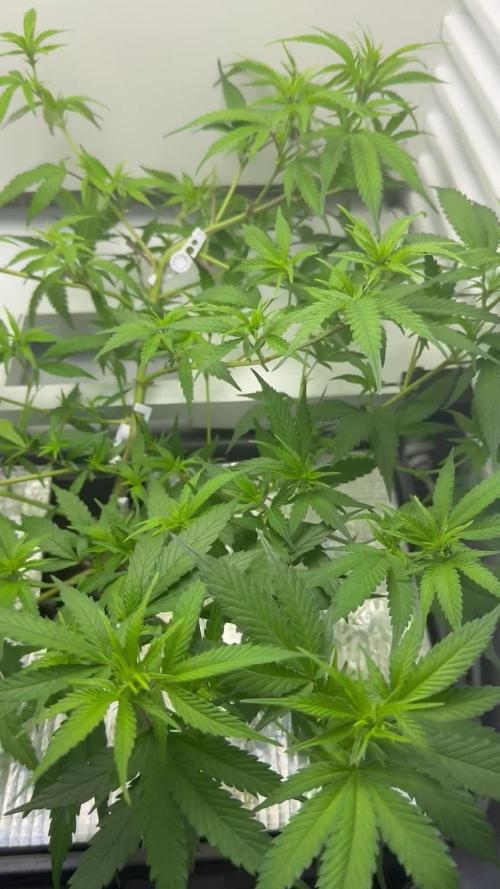
Day 21 - she got repotted into her 38 Litre airpot. She is not as close to the lights as I'd like, but saying that I wouldn't mind her to stretch a little bit.



Likes
6
Share


@Growspeed15
Follow
Two 27 gallon RDWC system, was initially for two plants but after issues with germination and this seed sprouting exceptionally fast, I decided to commit to this one. Two 1000 watt LEDs, one Bloom/Veg switch, one full spectrum with brightness knob. Have third that is bloom/veg switch 600w to put in middle over reservoir when growing two. 8" net pots to allow more spaced out root system in such a big container with 4 air stones. 1110GPH air pump, with 4 air stones to each tote, 70GPH water pump. Initially top fed, until roots are developed enough.

Likes
34
Share


@The_Bearded_Grower
Follow
Day 51 welcome this past week I've had to deal with extreme temperatures that were somewhat Beyond My Control. I ended up having to put an air conditioner in my grow room because the temperatures outside were in the 40s. But even with the high temperatures my purple Bliss is doing beautifully and was giving me a lot of growth. I'm continuing to tie down the tops even though I am in transition to mitigate the height of the plant and to ensure that light hits every single top equally my hopes are that I end up with an even canopy of massive flowers.

Likes
13
Share


@Fatnastyz
Follow
10-14
Buildabloom 1/2 tap
10-16
Water
Water between 500-700 ml a day.
10-18
Fed 450 ppm build a bloom
10-19
Water few leaves removed.
Love her smell. Lemon, lime, sourish!
I definitely over filled my tent and this one felt it the most. But mainly because I didn't know what to expect. Somehow she has not been over fed, yet! I still got time!
Im excited for her and to grow her again! Oh and to learn to not over feed more than anything. Think imma try just drit, till shes hungry, then do water feeds! When hungry 🤣🤞
.
Likes
42
Share


@iLoveGoodWeed
Follow
WEEK 12 - Both girls looks amazing covered in crystals
9L Pot is reciving the Final Part (Ripen) nuts for past 7 days, 3 more days and 3 days flush and harvest
12L Pot is getting there, today start I giving the Final Part Nuts (Ripen) and will harvest in 1.5 week
Likes
37
Share


@Kirsten
Follow
23.08.24:
I've done considerable defoliation. Also, FBP1 and FBP3 have grown all over the place. The stems are also relatively weaker as they've grown so much.
(Photos above).
Being as the plants were looking a bit delicate, I added some string and tied the side branches lightly to keep them a bit more compact.
Additionally, FBP2 has a considerable amount of buds on the main cola. So I've added a plant stake, and I just tied string around the stake and the main stalk.
The humidity has been able to stay under 53%. That's with 3 dehumidifiers. So I'm pretty sure that's about as good as it will probably be.
I've had to lower the watering frequency on FBP3, as I overwatered only this plant. and also added too much Nitrogen in. As a result all the leaves are looking droopy.
I'm really not sure how this will pan out, as they all still look like they're weeks away from harvest.
Anyway, I'll update throughout the week.
25.8.24:
I was tending to the garden a majority of the day, and realised that a branch had broken on FBP2. I acted quickly to insert plant stakes, to provide the heavily laden branches additional support. See photos above.
The branch was bent or snapped, but still in one piece. I used duct tape to carefully put it back together. Before making a stake for it.
Silica, apparently wasn't quite enough to get the FBP2 through the whole way. The flowers are very heavy and dense.
I have also given the plants water yesterday with concentrations of the following nutrients, per plant.
● 9ltr of dechlorinated tap water with 6ml of cal-mag, 3ml of Ecothrive Flourish, 6ml of Xpert Nutrients Bloom Booster.
I have also added cinnamon top dress after watering, as I have noticed some fungus gnats.
I checked the trichomes through one of my loupes yesterday too, and nearly all are still glass like in appearance, with some cloudy here and there. I'm definitely going to have some time left on these girls.
I did check the PH if my soil on all plants as I was concerned about nutrient lock out on FBP3. All pots tested out at 7.0 Ph exactly, before and after watering.
Thanks for reading my diary 😊

Processing
Likes
6
Share


@Alejangrow
Follow
Had to keep them in veg for another week while something finished up in the flower room. ⏰ cant hurt right. 🤷♂️🏽
did some more cleaning up to prepare them for the flip. ✂️

Processing
Likes
17
Share


@Easygrower
Follow
Hello growers day 56 in the garden with the crystal candy and red poison all is well and good the red poison is very nearly done I’m watching the trics I have a few amber heads still flushing trying to get as much out of them as possible but they will probably come down next week the crystal candy’s are starting to swell so probably couple more weeks for them but all in all very good and nearly there so until the harvest next week be safe and happy growing ✌️

Likes
57
Share


@Regenwurm
Follow
17.01.2021 alle Ladies getoppt.
In der ganzen Woche nur 2 mal gegossen und Pflanzen austrocknen lassen. Am 24.01.2021 alle Sonnensegel entfernt da kein Licht auf die Triebe gekommen ist. Ladies haben sich 7 Tage vom Topping erholen können. Bei den neuen Trieben am Hauptstamm auch am 24.01.2021 Superscropping damit alles gleichmäßig wachsen kann.
Klima ist sehr gut, dort keine Probleme. Düngemenge des Hesi Schema wie letzte Woche angekündigt reduziert ..... also 2 ml pro l .... Düngeplan Hesi sagt 5 ml.... die Pflanze möchte weniger, also bekommt sie weniger. In ein paar Tagen geht es in die Blüte, nächste Woche ist sie Bereit.


Likes
4
Share


@Thibaut
Follow
The girls enjoyed the weather this week nice to see them lile this, we have like 3-4 weeks to go so stay blazin and wait
Likes
17
Share


@HighZenBerg
Follow
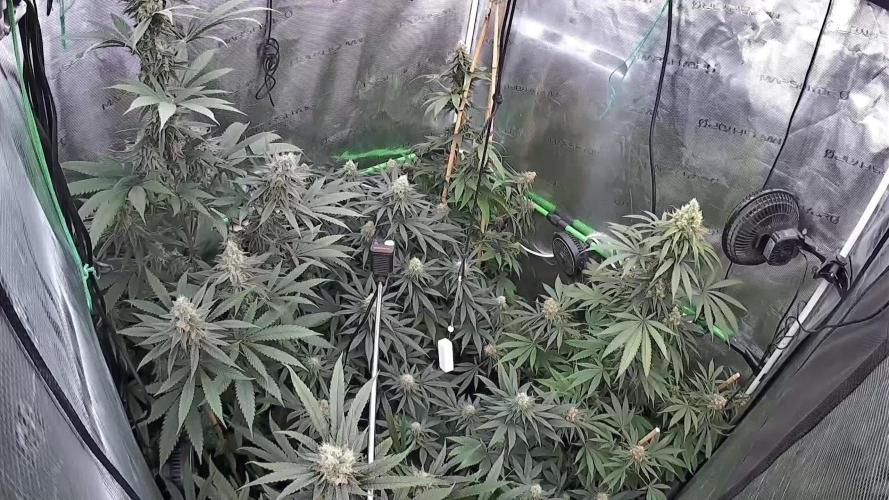
Welcome back to my indoor grow with the beautiful White Skunk Automatic from White Label.
In week 4, she started to grow faster and taller…finally ! The temperature in the grow room got a little lower and the plant seems healthy.
This week I startet with LST to expose more light to the side branches. Hopefully she will respond good to it.
Keep in touch !
Cheers,
HighZenBerg


Likes
17
Share


@Italian_Cannabis_Top_Strain
Follow
E' DAVVERO INCREDIBILE!!! COME IO ABBIA AVUTO TALENTO PUR ESSENDO ALLE PRIME ARMI.... QUASI MEZZO CHILO .. IMPRESSIONANTE ANCORA NON CI VOGLIO CREDERE!!! TUTTO QUESTO GRAZIE ALLA MIA PASSIONE... E COSTANZA ... HO ADOTTATO IL TOPPING DALLA TERZA SETTIMANA E DA LI GIA HO NOTATO CHE IL RACCOLTO E LA PRODUZIONE AUMENTAVA... DOPODICHÉ HO ADOTTATO UMA MIA TECNICA SIMILE AL LST E ALLO SCROG.... PRATICAMENTE HO PIEGATO IN GIU TUTTI I RAMI UNO PER UNO CON DEI FILI COME LO SCROG MA SENZA RETE...A MANO ..CON DEI FILI.. COSI CHE LE CIME AVREBBERO POTUTO PRENDERE LUCE IN TUTTI GLI ANGOLI POSSIBILI E COSÌ È STATO SIGNORI E SIGNORE DA LÌ HO NOTATO CHE IL RACCOLTO TRIPLICAVA!! NON HO DAVVERO PAROLE SONO ULTRA SODDISFATTO VEDREMO IL PESO DA ASCIUTTE ASCIUTTE