The Grow Awards 2026 🏆
Likes
Comments
Share
@pzwags420
Follow
On day 1 I transplanted 2 BB clones into 3 gal smart pots with coco coir. I watered them in with veg formula and set up my blumat watering system with week 1 flower nutes. I raised PPFD to 600-700. On day 2 the reservoirs PH was adjusted from 6.4 to 6.0. The rez is 823 ppm. The tops are 16.5" from the grow light. The blumats have not started watering yet and I will monitor to ensure it goes smoothly. I have the blumats set at 1.25 carrots on left plant and 1 carrot on right plant. The average PPFD of my 16 tops is 703 PPFD. I increased temps to 85 day 81 night to get leaf surface around 80 f during day. On day 3 the reservoirs PH is 6.2. The rez is 782 ppm. The blumats have started watering and I will monitor closely over the next few days. On day 4 the reservoirs PH was adjusted from 6.3 to 6.1. The rez is 717ppm. On day 5 the reservoirs PH is steady at 6.1. The rez is 706 ppm. The highest top is 15.25" from the light. I defoliated to bring in more air and light to deeper into the canopy. I increased the flow rate of blumat by .5 carrot on the right plant as it was a little to dry for my liking. The Clones are preforming well. On day 6 the reservoir PH is going down so I adjusted up from 6.0 to 6.2. The rez is 730 ppm. The highest cola is 14.75" from the light. The left plant had a runaway so I reduced blumat by 1 carrot. I increased flow of blumat on right plant by .5 carrot as it is still drier than I would like. On day 7 the reservoirs PH was adjusted from 6.3 to 6.0. The highest cola is 14.25". I reset rez with nutes.
Likes
34
Share
*****Week 14 growth – March 13 to 19, 2021 – Week 6 flower ****** Feeding has ended this week and we are in flush mode now. The girls have just started to slow down their drinking and pistols are changing colour, buds are swelling, they are getting ready to finish. Added the UV and IR light bars in this week. Started the week with just one bar and then both in place by end of week. Each bar has 10 x 730nm, 10 x 395nm, 6 x 660nm pulling 30 watts each. Trichome enhancers!! Working with the new light this run I have certainly pushed them with more light intensity than they should have received, broke 1100 PAR for a bit. This has also started to cause some foxtails to begin rather than staying compact and swelling the buds. Know for next time……always changes to make 😊 Little more detail….. Mar 13/21, Day 36 - Feed day with full line of Innovating Plant Products but at ¾ strength. - Keeping up the feeding but thinking about nitrogen levels and working on reducing. - feeding with grow – 0.5, micro – 1.5, bloom – 2.5, ult B – 0.5, carbs – 0.75, B Storm – 2, S Storm – 3, Terp – 3, Jet Fuel – 1.5, Rezin 1 - 1300ppm and 6.2pH - MM1 – 4L and MM2 – 3L - Added in the first UV bar today Mar 14/21, Day 37 - Seeing lots of swelling these days from the girls. - Microbe feeding today…….possibly last round of microbes. - Plain tap water with Recharge @ ½ tsp/gal and Natures Candy @ 1.5ml - 400ppm and 6.1pH - 3L all around today…..very little run off. Mar 15/21, Day 38 - Another feed day today. Last week of feed so pushing them a little more. No Grow added! Last couple of feeds with CalMag as well, seeing some magnesium issues so giving last dose. - feeding with micro – 1.5, bloom – 2.5, ult B – 0.5, carbs – 1, B Storm – 2.5, S Storm – 3, Terp – 3, Jet Fuel – 1.5, MagNifiCal – 1.5ml - 1175ppm and 6.0pH - MM1 – 4L and MM2 – 3L - Mar 16/21, Day 39 - Just giving the basic building blocks at this stage. Most of the supplements not added this feeding. - feeding with Grow – 0.5, micro – 1.5, bloom – 2, carbs – 1, Rezin – 1.5ml, MagNifiCal – 0.5ml - 875ppm and 6.0pH - MM1 – 4L and MM2 – 2.5L Mar 17/21, Day 40 - Last Feed Day……calling it at day 40 this run!!!!! - 4L of feed water left from yesterday so added in 12L of RO water to keep the ppm down. - Left over plus Rezin @ 2ml, Overdrive @ 2ml (its hard to let go of your routines…I have been using Overdrive for so long……it feels wrong to not be using it this run….snuck in a couple ml😊) - 485ppm and 6.0pH - MM1 – 4L and MM2 – 2.5L - Light power pushed back up to 525 watts……..keeping the intensity up to hit the lower bud sites….will see what happens to the uppers. Mar 18/21, Day 41 - Starting flush but not hitting the pots with 12 gallons of water each type of flush! Will just drop the ppm down to nothing and use RO water……planning on having close to 3 weeks to flush….second guessing that I really have that long though so may actually end up adding a flushing agent to the girls…..decide in the next 4 days so can leave plain water time if I do. - Watering with Enzymes @ 2ml…….clean up the roots and help them get more of the ppm out of the media. - 100ppm and 5.9pH……..missed the pH but not adding both up and down, ran with this. - Light power pulled back down 480 watts Mar 19/21, Day 42 - Dry out day today. Will be letting the pots get dryer now before adding more moisture. - Leaving them for today though. Give flushing agent in next 2 days if going to. - Work down the light intensity more in next couple of days as well. - UV lights going now for 3 hours per day on both fixtures at the middle of the light schedule.
Likes
52
Share
Lacewings seemed to have mostly killed themselves by flying into hot light fixtures. I may have left the UV on which was smart of me :) Done very little to combat if anything but make a sea of carcasses, on the bright side its good nutrition for the soil. Made a concoction of ethanol 70%, equal parts water, and cayenne pepper with a couple of squirts of dish soap. Took around an hour of good scrubbing the entire canopy. Worked a lot more effectively and way cheaper. Scorched earth right now, but it seems to have wiped them out almost entirely very pleased. Attempted a "Fudge I Missed" for the topping. So just time to wait and see how it goes. Question? If I attached a plant to two separate pots but it was connected by rootzone, one has a pH of 7.5 ish the other has 4.5. Would the Intelligence of the plant able to dictate each pot separately to uptake the nutrients best suited to pH or would it still try to draw nitrogen from a pot with a pH where nitrogen struggles to uptake? Food for stoner thought experiments! Another was on my mind. What happens when a plant gets too much light? Well, it burns and curls up leaves. That's the heat radiation, let's remove excess heat, now what? I've always read it's just bad, or not good, but when I look for an explanation on a deeper level it's just bad and you shouldn't do it. So I did. How much can a cannabis plant absorb, 40 moles in a day, ok I'll give it 60 moles. 80 nothing bad ever happened. The answer, finally. Oh great........more questions........ Reactive oxygen species (ROS) are molecules capable of independent existence, containing at least one oxygen atom and one or more unpaired electrons. "Sunlight is the essential source of energy for most photosynthetic organisms, yet sunlight in excess of the organism’s photosynthetic capacity can generate reactive oxygen species (ROS) that lead to cellular damage. To avoid damage, plants respond to high light (HL) by activating photophysical pathways that safely convert excess energy to heat, which is known as nonphotochemical quenching (NPQ) (Rochaix, 2014). While NPQ allows for healthy growth, it also limits the overall photosynthetic efficiency under many conditions. If NPQ were optimized for biomass, yields would improve dramatically, potentially by up to 30% (Kromdijk et al., 2016; Zhu et al., 2010). However, critical information to guide optimization is still lacking, including the molecular origin of NPQ and the mechanism of regulation." What I found most interesting was research pointing out that pH is linked to this defense mechanism. The organism can better facilitate "quenching" when oversaturated with light in a low pH. Now I Know during photosynthesis plants naturally produce exudates (chemicals that are secreted through their roots). Do they have the ability to alter pH themselves using these excretions? Or is that done by the beneficial bacteria? If I can prevent reactive oxygen species from causing damage by "too much light". The extra water needed to keep this level of burn cooled though, I must learn to crawl before I can run. Reactive oxygen species (ROS) are key signaling molecules that enable cells to rapidly respond to different stimuli. In plants, ROS plays a crucial role in abiotic and biotic stress sensing, integration of different environmental signals, and activation of stress-response networks, thus contributing to the establishment of defense mechanisms and plant resilience. Recent advances in the study of ROS signaling in plants include the identification of ROS receptors and key regulatory hubs that connect ROS signaling with other important stress-response signal transduction pathways and hormones, as well as new roles for ROS in organelle-to-organelle and cell-to-cell signaling. Our understanding of how ROS are regulated in cells by balancing production, scavenging, and transport has also increased. In this Review, we discuss these promising developments and how they might be used to increase plant resilience to environmental stress. Temperature stress is one of the major abiotic stresses that adversely affect agricultural productivity worldwide. Temperatures beyond a plant's physiological optimum can trigger significant physiological and biochemical perturbations, reducing plant growth and tolerance to stress. Improving a plant's tolerance to these temperature fluctuations requires a deep understanding of its responses to environmental change. To adapt to temperature fluctuations, plants tailor their acclimatory signal transduction events, specifically, cellular redox state, that are governed by plant hormones, reactive oxygen species (ROS) regulatory systems, and other molecular components. The role of ROS in plants as important signaling molecules during stress acclimation has recently been established. Here, hormone-triggered ROS produced by NADPH oxidases, feedback regulation, and integrated signaling events during temperature stress activate stress-response pathways and induce acclimation or defense mechanisms. At the other extreme, excess ROS accumulation, following temperature-induced oxidative stress, can have negative consequences on plant growth and stress acclimation. The excessive ROS is regulated by the ROS scavenging system, which subsequently promotes plant tolerance. All these signaling events, including crosstalk between hormones and ROS, modify the plant's transcriptomic, metabolomic, and biochemical states and promote plant acclimation, tolerance, and survival. Here, we provide a comprehensive review of the ROS, hormones, and their joint role in shaping a plant's responses to high and low temperatures, and we conclude by outlining hormone/ROS-regulated plant-responsive strategies for developing stress-tolerant crops to combat temperature changes. Onward upward for now. Next! Adenosine triphosphate (ATP) is an energy-carrying molecule known as "the energy currency of life" or "the fuel of life," because it's the universal energy source for all living cells.1 Every living organism consists of cells that rely on ATP for their energy needs. ATP is made by converting the food we eat into energy. It's an essential building block for all life forms. Without ATP, cells wouldn't have the fuel or power to perform functions necessary to stay alive, and they would eventually die. All forms of life rely on ATP to do the things they must do to survive.2 ATP is made of a nitrogen base (adenine) and a sugar molecule (ribose), which create adenosine, plus three phosphate molecules. If adenosine only has one phosphate molecule, it’s called adenosine monophosphate (AMP). If it has two phosphates, it’s called adenosine diphosphate (ADP). Although adenosine is a fundamental part of ATP, when it comes to providing energy to a cell and fueling cellular processes, the phosphate molecules are what really matter. The most energy-loaded composition for adenosine is ATP, which has three phosphates.3 ATP was first discovered in the 1920s. In 1929, Karl Lohmann—a German chemist studying muscle contractions—isolated what we now call adenosine triphosphate in a laboratory. At the time, Lohmann called ATP by a different name. It wasn't until a decade later, in 1939, that Nobel Prize–-winner Fritz Lipmann established that ATP is the universal carrier of energy in all living cells and coined the term "energy-rich phosphate bonds."45 Lipmann focused on phosphate bonds as the key to ATP being the universal energy source for all living cells, because adenosine triphosphate releases energy when one of its three phosphate bonds breaks off to form ADP. ATP is a high-energy molecule with three phosphate bonds; ADP is low-energy with only two phosphate bonds. The Twos and Threes of ATP and ADP Adenosine triphosphate (ATP) becomes adenosine diphosphate (ADP) when one of its three phosphate molecules breaks free and releases energy (“tri” means “three,” while “di” means “two”). Conversely, ADP becomes ATP when a phosphate molecule is added. As part of an ongoing energy cycle, ADP is constantly recycled back into ATP.3 Much like a rechargeable battery with a fluctuating state of charge, ATP represents a fully charged battery, and ADP represents a "low-power mode." Every time a fully charged ATP molecule loses a phosphate bond, it becomes ADP; energy is released via the process of ATP becoming ADP. On the flip side, when a phosphate bond is added, ADP becomes ATP. When ADP becomes ATP, what was previously a low-charged energy adenosine molecule (ADP) becomes fully charged ATP. This energy-creation and energy-depletion cycle happens time and time again, much like your smartphone battery can be recharged countless times during its lifespan. The human body uses molecules held in the fats, proteins, and carbohydrates we eat or drink as sources of energy to make ATP. This happens through a process called hydrolysis . After food is digested, it's synthesized into glucose, which is a form of sugar. Glucose is the main source of fuel that our cells' mitochondria use to convert caloric energy from food into ATP, which is an energy form that can be used by cells. ATP is made via a process called cellular respiration that occurs in the mitochondria of a cell. Mitochondria are tiny subunits within a cell that specialize in extracting energy from the foods we eat and converting it into ATP. Mitochondria can convert glucose into ATP via two different types of cellular respiration: Aerobic (with oxygen) Anaerobic (without oxygen) Aerobic cellular respiration transforms glucose into ATP in a three-step process, as follows: Step 1: Glycolysis Step 2: The Krebs cycle (also called the citric acid cycle) Step 3: Electron transport chain During glycolysis, glucose (i.e., sugar) from food sources is broken down into pyruvate molecules. This is followed by the Krebs cycle, which is an aerobic process that uses oxygen to finish breaking down sugar and harnesses energy into electron carriers that fuel the synthesis of ATP. Lastly, the electron transport chain (ETC) pumps positively charged protons that drive ATP production throughout the mitochondria’s inner membrane.2 ATP can also be produced without oxygen (i.e., anaerobic), which is something plants, algae, and some bacteria do by converting the energy held in sunlight into energy that can be used by a cell via photosynthesis. Anaerobic exercise means that your body is working out "without oxygen." Anaerobic glycolysis occurs in human cells when there isn't enough oxygen available during an anaerobic workout. If no oxygen is present during cellular respiration, pyruvate can't enter the Krebs cycle and is oxidized into lactic acid. In the absence of oxygen, lactic acid fermentation makes ATP anaerobically. The burning sensation you feel in your muscles when you're huffing and puffing during anaerobic high-intensity interval training (HIIT) that maxes out your aerobic capacity or during a strenuous weight-lifting workout is lactic acid, which is used to make ATP via anaerobic glycolysis. During aerobic exercise, mitochondria have enough oxygen to make ATP aerobically. However, when you're out of breath and your cells don’t have enough oxygen to perform cellular respiration aerobically, the process can still happen anaerobically, but it creates a temporary burning sensation in your skeletal muscles. Why ATP Is So Important? ATP is essential for life and makes it possible for us to do the things we do. Without ATP, cells wouldn't be able to use the energy held in food to fuel cellular processes, and an organism couldn't stay alive. As a real-world example, when a car runs out of gas and is parked on the side of the road, the only thing that will make the car drivable again is putting some gasoline back in the tank. For all living cells, ATP is like the gas in a car's fuel tank. Without ATP, cells wouldn't have a source of usable energy, and the organism would die. Eating a well-balanced diet and staying hydrated should give your body all the resources it needs to produce plenty of ATP. Although some athletes may slightly improve their performance by taking supplements or ergonomic aids designed to increase ATP production, it's debatable that oral adenosine triphosphate supplementation actually increases energy. An average cell in the human body uses about 10 million ATP molecules per second and can recycle all of its ATP in less than a minute. Over 24 hours, the human body turns over its weight in ATP. You can last weeks without food. You can last days without water. You can last minutes without oxygen. You can last 16 seconds at most without ATP. Food amounts to one-third of ATP production within the human body.
Likes
4
Share
@buzbun
Follow
smoke is really good.strong taste and effect that you feel imideately.some times i catch a good paranoia with this strain.good psy effect. maybe it cause 11/13 light cycle. few hours after smoke good to sleep or eat smth good.not for day smoking.somy buds i stored in vacuum bags they very dense after this
Likes
14
Share
@HickNella
Follow
Beginning my flush this week. Starting to see amber trichomes here and there
Likes
6
Share
@IamCy
Follow
Week 6........... Getting frosty Edit: on day 41,I already have amber but it's still packing on weight. I don't know what to do at this point.
Likes
5
Share
Plants are currently drying 2+ months later. And next project au79
Likes
35
Share
The LSD25’s are doing pretty well! They’ve stayed short and stalky but their buds seem to be filling out nice and dense. Two of the lsd’s were suffering a slight nitrogen and phosphorus deficiency. I’m not too worried about it since it is somewhat natural for this to happen during this part of their life cycle. I gave them a nice dose of bloom nutrients and so far they seem to be really enjoying their food. A day after the feed they bulked up quite a bit and the trichromes became much more visible to the naked eye. Regardless of my initial issues with my medium and original ph pen, I am pleased with these girls so far. The scent and aroma coming off of the plants is nothing like I’ve smelt before. Almost every bud site releases a different terp/aromatic profile when touched. It’s an interesting smell the notes/terp profile I get from it is; musk (mycerene), lemon (limonene), peppery/herbal (caryophyllene) and slight lavender (linalool) type scent. I’m not used to smelling this many different profiles from one strain but I must say that the smell is almost addicting!
Likes
1
Share
Hello Growers & Tokers! Roots, roots, roots. At the beginning of the week they got transplanted into their final pot, 11L fabric. Medium used was Light Mix from BioBizz. Synergy from Grotek nutrients was blended in the medium to help out the roots. They were a bit down after transplanting but by the end of the week they were doing better. I'll leave her be for a week then I'll be topping to spread that canopy out and have loads of colas. Or at least that's the idea but two of them seem to be growing faster than the others so I might have to die those tops down. Take care out there and happy growing!
Likes
5
Share
She looks very good and healthy,however she started flower with a very small size,I thought she was gonna be a little bigger at least but regardless of that,she's such a beauty and smelling very good so far,I'm excited about this strain. Let's see how she performs guys!
Likes
2
Share
Likes
2
Share
@SamDo
Follow
🇺🇸Week 3🇺🇸 – Growth Explosion & First Training Back again for this week’s update! The Mother Gorilla is going crazy—she’s growing at an insane pace, and honestly, I couldn’t be happier. The plant is super strong, and the leaves are just massive. Some are reaching up to 21 cm long, which is wild. I don’t think I’ve ever seen that before. And honestly, I have to say—I’m seriously impressed by Formulex from Growth Technology. I’ve been using the same nutrient solution since the start, and the results are just insane. It’s such a simple product, but what it’s delivering so far is absolutely incredible. I’ll be switching to growth fertilizers soon (they’re on the way), but for now, I’m sticking with Formulex, and it’s honestly blowing my mind. Environmental Conditions Not much has changed on that front. The environment is still dialed in: • Temperature: ~22-23°C during the day, 18°C at night. • Nutrient solution temp: Holding steady at 17-18°C. • pH levels: Hovering around 5.8-6.0—had to adjust it slightly during the week, but nothing major. It’s stable overall. • VPD (Vapor Pressure Deficit): Still around 0.6, which seems to be working well. As long as it stays below 0.8, I think we’re in the sweet spot. • Humidity: Holding at 70%. Everything’s been pretty stable, and it looks like the plant is loving it. Major Work This Week – Defoliation & Topping This week was huge in terms of plant training. The foliage was getting super dense, so I went in for a heavy defoliation, removing all the big fan leaves. On top of that, I topped the plant—cut the main shoot to redirect energy towards the secondary branches. The goal is to push those side branches so they can take full advantage of the SCROG I just set up! Now, it’s all about recovery. Hopefully, she bounces back strong, and we can really start working that SCROG. Alright, that’s it for this week! Let’s keep an eye on things and see how she responds. Super excited to check in next week and see how she evolves. 🇫🇷Semaine 3🇫🇷 – Explosion de croissance & Premier palissage De retour pour l’update de la semaine ! La Mother Gorilla part en vrille, elle pousse à une vitesse folle et franchement, je suis super content. La plante est ultra vigoureuse, et les feuilles sont juste énormes. Certaines atteignent 21 cm de longueur, c’est complètement dingue. Je crois que je n’ai jamais vu ça avant. Et franchement, je dois le dire—je suis vraiment impressionné par le Formulex de chez Growth Technology. J’utilise exactement la même solution nutritive depuis le début, et les résultats sont juste dingues. C’est un produit hyper simple, mais ce que ça donne pour l’instant, c’est vraiment incroyable. Je vais bientôt passer sur les engrais de croissance (ils sont en commande), mais en attendant, je continue avec Formulex, et ça me bluffe complètement. Conditions Environnementales Pas de gros changements de ce côté-là, tout est toujours bien calé : • Température : ~22-23°C en journée, 18°C la nuit. • Température de la solution nutritive : Toujours 17-18°C. • pH : Entre 5.8 et 6.0—j’ai dû l’ajuster un peu dans la semaine, mais rien de bien méchant. Globalement, c’est stable. • VPD (Déficit de Pression de Vapeur) : Toujours aux alentours de 0.6, ce qui a l’air de bien convenir. Tant qu’on ne dépasse pas 0.8, on est bien. • Humidité : 70% constants. Tout est super stable et visiblement, la plante kiffe ça. Travaux de la semaine – Défoliation & Topping Cette semaine, grosse session d’entretien. La canopée devenait hyper dense, donc j’ai fait une bonne défoliation, en enlevant toutes les grosses feuilles. J’ai aussi topé la plante—j’ai coupé l’apex principal pour rediriger l’énergie vers les branches secondaires. L’idée, c’est de booster les secondaires pour qu’elles profitent à fond du SCROG que je viens d’installer ! Maintenant, elle doit récupérer. J’espère qu’elle va repartir de plus belle et qu’on va vraiment pouvoir bosser ce SCROG. Voilà pour cette semaine ! On garde un œil sur tout ça et on voit comment elle évolue. Hâte de voir ce que ça va donner la semaine prochaine ! 🤘😎
Likes
36
Share
@Grey_Wolf
Follow
Eva Seeds High level 27th December 2021 Another very bloody Hot week here with temps nudging 46.1 on Christmas day 😬 But with plenty of shade cloth and water this plant is doing well 👊 Gave her some Bio Enhancer this week as well as some more mycorrhizae . Cheers for stopping by 👍
Likes
6
Share
Esta es la última semana de crecimiento que le doy a las pequeñas, el último día antes de hacer el cambio de horas de luz le hago una pequeña poda de bajos ya que eso le dará más aire a la zona baja y más fuerza a la parte superior de nuestras plantas. En esta semana terminamos con una Ec de 1.6 y un ph de 5.8. Están creciendo muy rápido y con fuerza en los tallos. Los tamaños de las pequeñas son: las red hot cookies 24 y 34 cm, las tropicanas 27 y 37 cm y la purple puch og 24 cm.
Likes
4
Share
@Midge
Follow
Much better harvest to end this first greenhouse grow. 48g dry on this plant. Still quite airy, but resinous and great smell. More relaxed effect than harvest 1. I could have done with another week or two with her, but the humidity was regularly into the 90s, there was very little sun and nearby tomato plants were starting to grow mold. I cut and ran, I need these meds to get me through the winter. Final total for both plants 59g. With a bit of luck, this should keep me medicated for a while. Indications are good.
Likes
54
Share
new grow started by @polasekplants 😁 This time there are blue dream, girl scout cookies, forbidden fruit, and white kush seeds started in a peat moss soil with about 60% already pop. Mars hydro tsw2000 is set at 25% power and at 36in above the seedings.
Likes
Comments
Share
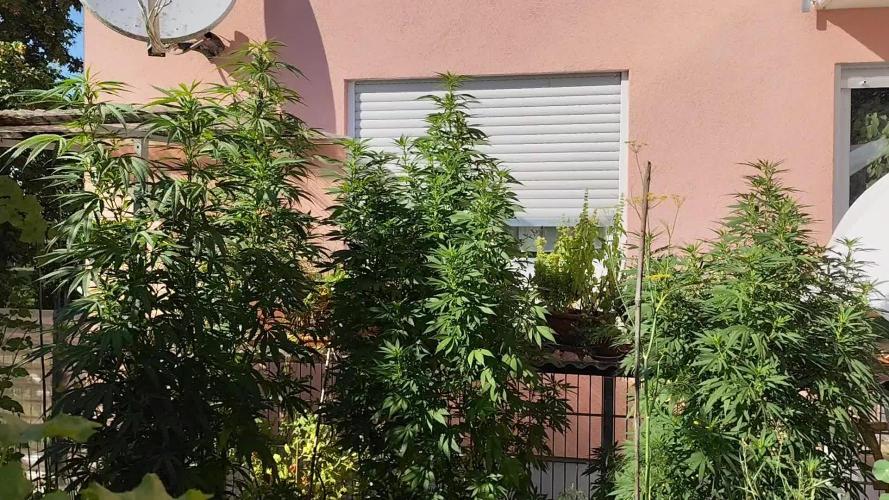
Did some defoliation this week also had some worm attacks one of the luxuries that comes with outdoor n they always seem to wait until the buds start to get pretty
Likes
44
Share
@RakonGrow
Follow
Note : + jegliches Zubehör wird in der GermniationsWoche aufgelistet . Zeitraffer Videos folgen immer nachträglich. + videos werden so geschnitten das nur ein geschlossenes Zelt erscheint , ergo Fehlen paar reale Minuten (ca 1 Std) . + + leider ist die Halterung defekt und die Videos etwas schief . Vielleicht mach ich mich irgendwann mal daran und korrigiere das. Sorry Day 43: + Höhe : 64cm Es wächst und wächst :)) Day 44: + Höhe : 65cm + 2 Liter Flaschenwasser , kein Dünger . + + PH 6.5 + Drain : PH 7.0 Höhe ist bei 63cm , das ist 3 cm mehr als die Vorgabe ausweisst :)) Day 45: + 66cm höhe. + 2 Liter Flaschenwasser + + Dünger für Blühte + + + Canna Terrar Flores (Achtung wirkt wie PH-) + + + Canna Boost + + + Cannazym + + + Greenhouse Feeding BioEnhancer als PH+ Jetzt säuft sie wie wilde , keine 24h und die 2Liter sind komplett wech . Mehr geht aber nicht in den Topf , ergo muss ich mir langsam mal überlegen ob ich Tropfbewässerung nutze . Und es treten duch das nur Wasser extreme "Calzium" Probleme auf . Hihi , aber so hab ich mal das ganze auf Startsequenze gesetzt . Ich arbeite also noch daran diese Mischung aus BioBizz Light und Urgesteinmehl nach Schätzung zu meistern :)) Den Fakt ist , da ist viel zu viel Urgesteinmehl drinne , was auch die Vegiphase schon gezeigt hat. Day 46: + 1.5 Liter Flaschenwasser + + Dünger für Blühte + + + Canna Terrar Flores (Achtung wirkt wie PH-) + + + Canna Boost + + + Cannazym + + + Greenhouse Feeding BioEnhancer als PH+ Day 47: Draussen zu heiss , drinnen zu feucht ... Ja genau was ich nicht brauch lol ... GoPro aus der Halterung gefallen :)) Day 48: + Höhe : 68cm + 2 Liter Flaschenwasser + + Dünger für Blühte + + + Canna Terrar Flores (Achtung wirkt wie PH-) + + + Canna Boost + + + Cannazym + + + Greenhouse Feeding BioEnhancer als PH+ Draussen zu heiss , drinnen naja ... Der Entfeuchter arbeitet weil ich sonst hier Tropenstimmung bekomme :)) Ein wenig Entlaubung . Day 49: + Höhe : 68cm + 2 Liter Flaschenwasser + + Dünger für Blühte + + + Canna Terrar Flores (Achtung wirkt wie PH-) + + + Canna Boost + + + Cannazym + + + Greenhouse Feeding BioEnhancer als PH+ + + + PH 5.8 + + Drain PH 6.5 Läuft bei der Lady , sie trinkt , liebt das Licht (auch wenn die Spitze etwas zuviel bekommt , sie betet halt etwas ) , Mangelerscheinungen sind echt gering . Hat die heissen Tage (27° im Zelt bei 60%-57% ) hat sie super überstanden . Ich werde immer besser im Gießen . 75% von oben , 25% lass ich von unten aufsaugen .