




Likes
44
Share


@Jd1971
Follow
Cut down wet weight 721 g :))))))
Bottom half to do in a week or two:)))) will up date all in harvested week
first weigh in 165 g :))))

Likes
22
Share


@bypado_farm
Follow
Day 57:
Watered each plant with 1L with nuts
1588 ppm, 3380 us/cm, 3.3 EC (purple punch, strawberry banana, wedding Cheesecake)
1690 ppm, 3595 us/cm, 3.5 EC
(gorilla cookies)
2 different feedings for the 10 plants
Day 60:
Watered each plant with 1L with nuts
1563 ppm, 3325 us/cm, 3.3 EC
Day 62:
Watered each plant with 1L with nuts
1726 ppm, 3712 us/cm, 3.7 EC (purple punch, strawberry banana, wedding Cheesecake)(I gave them more than usual, by mistake)
1528 ppm, 3525 us/cm, 3.5 EC (gorilla cookies)
2 different feedings for the 10 plants
Day 63:
Watered each plant with 1L with nuts
1563 ppm, 3325us/cm, 3.3 EC (purple punch, strawberry banana, wedding Cheesecake)
1523 ppm, 3301 us/cm, 3.3 EC (gorilla cookies)
2 different feedings for the 10 plants
Day 65:
Watered each plant with 1L with nuts
1518 ppm, 3210 us/cm, 3.2 EC (purple punch, strawberry banana, wedding Cheesecake)
1359 ppm, 2891 us/cm, 2.9 EC (gorilla cookies)
2 different feedings for the 10 plants
Next feeding I will start to flush some plants, 1st week with flawless finish, 2nd week clean water, 10x the pot, 150L each
Day 67:
Watered each plant with 1L with nuts
1379 ppm, 2908 us/cm, 2.9 EC (1 purple punch, wedding Cheesecake)
1250 ppm, 2687 us/cm, 2.7 EC (gorilla cookies)
285 ppm, 606 us/cm 0.6 EC (3 strawberry banana and 2 purple punch) (2L each)
3 different feedings for the 10 plants
Started to flush all the strawberry banana and 2 purple punch with flawless finisher. (1st week flawless finisher, 2L each, 2nd week clear water, 150L)

Likes
4
Share


@Naujas
Follow
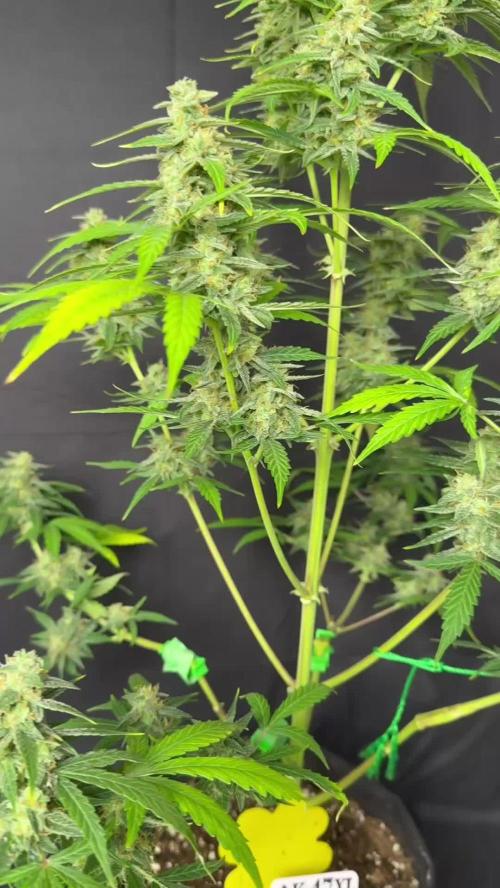
Day 70!!! This week was really hot, when the sun shone on it, the thermometer showed 40°. I think her roots don't like it very much, the girl needs to be watered every day, sometimes even 2 times a day :) I also removed the yellow leaves of the marigolds, there was also a really strong wind, which is why I had to cover the girl a little so that she wouldn't break the branches :) I'm leaving tomorrow for a short 5-day vacation, then these days I'll ask her to come and water once every 2 days, I hope that will be enough for her :) good luck to everyone.

Likes
15
Share


Likes
112
Share


@Dunk_Junk
Follow
This week she grew 23cm taller! I have been doing experiments through the week FIMing various upper growth sites. We will see what effects this will have in the weeks to come.. I've also been seeing upper leaf tips going a very light green. Is it nutrient burn? Light burn?
Nutrients used this week: 20 grams 20-20-20 powder mixed with 10 litres of water + 40ml of Cannazym = ~1470ppm
Timelapse sequence is:
Auto Jack
*** Pineapple express ***
CBD Lime
Blue Dream
Auto Jack
*** Pineapple Express ***
CBD Lime
Blue Dream
Likes
4
Share

@BeskarBuds
Follow
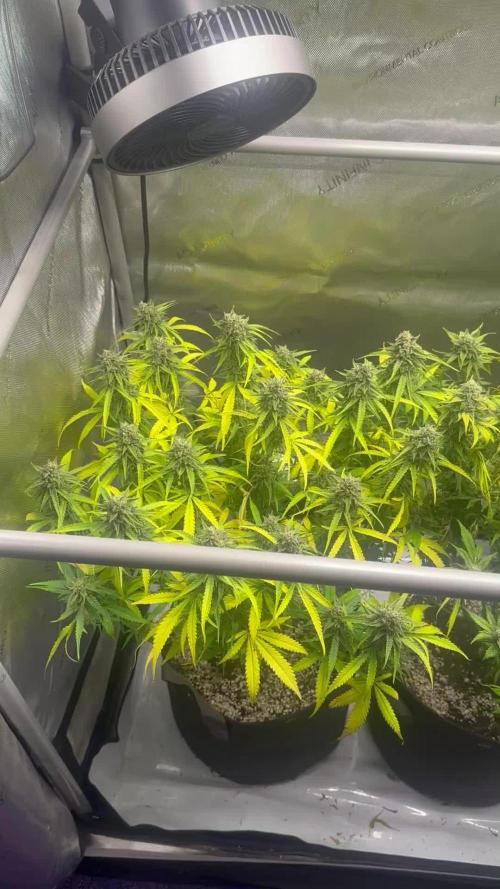
Buds coming in nicely and starting to see amber Trichomes forming. Almost time for harvest for these ladies but would like to give one or two more weeks.
The end is almost here!
Have had a hard time managing the environment in my garage so this grow has definitely been challenging in the late flower stage so I’m just pleased the buds look half decent this time around.
This is the way 😎
Likes
5
Share

@Shivashamboom1
Follow
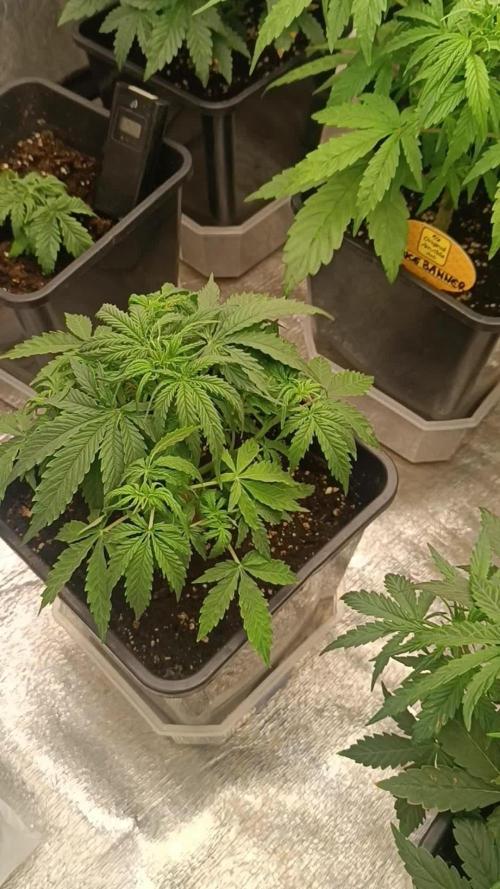
2 delle 4 Bruce banner sono rimaste in po' dietro con la crescita.. una sicuramente dovrò tirarla via


Likes
12
Share


@valiotoro
Follow
One with a topping the other one just LST both huge yield!🦖
For the smell its cookie dough,lemon & diesel🍪🍋⛽️
Super sticky buds 🤩


Likes
30
Share


@WeWantItToGrow
Follow
This week has been one of great gains in both size and vegetation we have seen a vertical leap in two plants that is astronomical almost 4 inches in a week! Had to do some pruning to expose new bud and a little bit of low stress training on to plants to see if we can expose light to the underside and perhaps get a little more love out of our lower buds The stalk size on almost all of these plants is almost as big as your thumb but on one it is actually relatively skinny that is the one we’re doing the low stress training on we just started the low stress training and it is taking very well to it One of these plants is extremely dark in color on the vegetation and has typically about 11 fingers per leaf! Not sure what that means yet

Likes
16
Share

@Suemchen
Follow
Sanlight EVO 3-60 at 80%
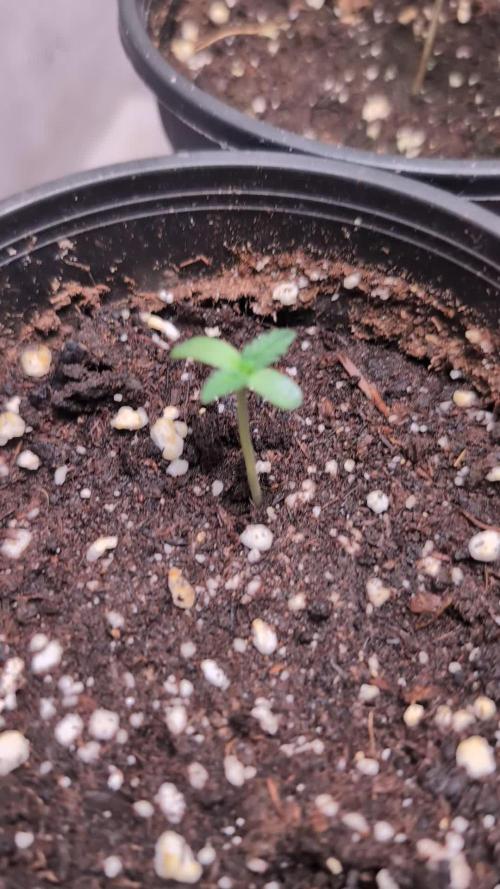
Day 1: Here she is 🤗 watering with rain water and 0.5 ml/l root juice 👌🏻
Day 3: looking good 👍🏻 watering with rain water 1 ml/l root juice and 1 ml/l Pure Zym 👌🏻
Day 4: developing nicely 👍🏻 watering with rain water 1 ml/l root juice and 1 ml/l Pure Zym 👌🏻
Day 5: heating dropped out and IT got Cold the Last couple of days ? should start developing nicely now👍🏻
Day 6: looking good 👍🏻 watering with rain water 1 ml/l root juice and 1 ml/l Pure Zym 👌🏻
Day 7: looking good 👍🏻 keeping the soil moist 👍🏻

Likes
34
Share


@AshBrand
Follow
Welcome!
In this grow we have:
2x Platinum Wedding Crasher
2x Gelato 41
1x Sour OG
2x Lemon Kush
Germination/Rooting - 14 Days
9/17/21 - The clones look good in solo cups of soil. We will transplant into 5 gallon pots in the grow tent after they fully root in the cups.
9/18/21 - Looks like the clones are doing well in soil! We are so excited to grow these out. The clones came from a very highly respected grower.
9/19/21 - No ugly growth. All clones look amazing! We upgraded the light to a Mars TSW 2000.
9/20/21 - They are looking good and most likely rooting throughout the cups. I’ll give them a little bit of water today. I want the roots to go looking for the water so I’ve kept them slightly dry.
9/21/21 - They look happy. I will let them just do their thing… We are waiting on our Mars TSW 2000 light to show up anyways. No roots visible from the drainage holes in the cups.
9/22/21 - Looking really healthy and growing nicely. I’m excited for them to fully root in the cups so we can transplant them into the tent. The Mars TSW 2000 should be here in the next few days.
9/23/21 - Looking so good! We can’t wait to get these under the Mars TSW 2000 in the tent. They smell and look great.
9/24/21 - The clones look really good except for one Sour OG. It wilted and died, roots did not take unfortunately. I have a Lemon Kush started from seed we will grow in place of the dead Sour OG. Today we got our Mars Hydro TSW 2000 light. We will be hanging it and updating with pics/videos.
9/25/21 - They look amazing. Lots of growth while rooting.
9/26/21 - So far so good. Watering when the cups get light in weight. In just a few days we will be transplanting. See the video for today, we hung the Mars Hydro TSW 2000!
9/27/21 - Watered them yesterday, they look healthy. The Lemon Kush isn’t a clone, it is from seed. It’s the smallest girl but it’ll perk up quickly.
9/28/21 - Transplant day!! The clones are looking really good and it’s time to transplant into the 4x4 under that Mars Hydro TSW 2000 at 50% intensity. Check out the pictures and videos from today!

Likes
9
Share


@JamaweedOPO
Follow
Crescendo rápido e forte sem nenhum sinal de estresse
+ 1 ventilador vertical, na estrutura
+ 1 ventoinha de mesa


Likes
7
Share


Likes
Comments
Share


@Opulent_Amber_69
Follow
I took these on my Snapchat is why there is so many of them 😅 I'm currently doing the 48 hours of darkness to help produce more trichomes. I did SO MUCH to this plant, it looks like it will DEFINITELY have some weight to it, but you will have to wait until it's dry 😄
Processing
Likes
15
Share


@MG2009
Follow
Top dressed with Budswel guano 0-0.7-0,watering in with protilizer mychorihiza.