


Likes
Comments
Share


@Hou_Stone
Follow
I am doing a light defoliation ✂️on my 3 Noris Cakes, I will continue in the coming weeks to reduce the humidity in the tent starting with the leaves and new shoots from below which capture less light from the lamp👌
⌚️At the end of this week I start to reduce the schedule where my lamp is on by 1 hour per day to reach 12 hours of day and 12 hours of night next week and start flowering.
------------------------------------------------------------
💧Watering each pot:
Day 25 : 0.5 L
Day 28 : 0.5 L
I use tap water, adjust the ph to around 6 and water
------------------------------------------------------------
🔥❄️Temperature of the week :
Day : 19-23°C (Humidity : 60-75%)
Night : 14-17°C
------------------------------------------------------------
🚀Equipment of the week ⭐️ :
Light FC3000 Mars hydro. power 95% at 50cm
Extractor 6 inch Mars Hydro. power 1/10. ON 24/24h
2 fans to circulate the air inside the tent. Each on for 30 minutes then off for 1 hour. this rhythm repeats itself in a loop
Heating mat 95x95cm. ON 45 minutes. OFF 30minutes. In a loop. The day only
------------------------------------------------------------
🌎 I created my discount code on Mars Hydro.
Get 5% off with my code: houstone5
By using a code, in addition to getting a discount, you directly support the creator who shares it.🙏
So if you make purchases on Mars Hydro don't forget to enter a code😀
Mine is "houstone5" 😉
https://www.mars-hydro.com/?acc=hou-stone
-----------------------------------------------------
My instagram 👨🚀🌱 :
https://www.instagram.com/hou_stone420/
------------------------------------------------------
Thanks for your visit 👌 💚

Likes
12
Share


@RickSanchez
Follow
its week 3 of flowering and all 4 plants went trough the early stages very well 💚 two plants are building up frost already, i am pretty sure this will be the ones, i'll keep. i took clones before the light flip, so no need to re-veg those beauties 🌱

Likes
31
Share


@The_Bearded_Grower
Follow
Day 11 of veg 10/9 : Welcome to week 3 and as you can see she is doing very well. I have micro toped her and now i wait to see how fast she recovers. more updates to come as the days move on.
Happy growing and keep your stick on the ice

Likes
8
Share


@skaterblasted
Follow
Days 99 - 105 (from sprout)
8/30/24 - 9/5/24
Raised light above canopy of The Good Shit - PAR on main tops is 800-700+ while remaining lowers are seeing closer to 450-500
Loompa's Headband x TK fading to a close this week - trichome check starting to show amber on the bracts
Sweet 16 S1 now starting senescence and a little fading on some fan leaves
The Good Shit showed signs of some overwatering, so a newly made FPE was added to feed schedule to assist the microbiology
Light schedule lowered to 10 hrs this week
IPM: Applied enzymes (tweetmint) at a rate of 0.5 fl oz to 1/2 gallon and sprayed on cover crops + mulch throughout the week. Significant decrease in pest population, now needs a high quality compost top dressing for long term correction

Likes
17
Share


@Naujas
Follow
wow wow !!!! 404 gr ! from the suitcase!!!!!!!258 gr of wet dried buds!!!!!!! I am impressed with the result, and I don't really believe that I will ever be able to improve it :) It was a truly amazing journey with FastBuds Gorilla cookies auto, my house is filled with a wonderful sweet smell, the buds look really full and very very shiny :) I also collected a lot of sugar leaves from which I will make bubble hash:) the girl coped with high temperatures and high humidity throughout her growth, which is why I was afraid of rot, but everything went well!!!! She is amazing. smoke review and dry weight will be up very soon, good luck to everyone :)!!!

Likes
91
Share


@Salokin
Follow
Hi Growmies,
I'm excited to share some big news today! Although there have been some unexpected twists, it's all part of the incredible journey of gardening.
I've just completed the harvest, a tad earlier than initially planned, due to finding a bit of mold in one of the buds. Despite this minor hiccup, the trichomes were already at a decent 10% to 15% amber. So, all things considered, the timing ended up being pretty spot-on. The harvested weight was a solid 609 grams after trimming, which is quite a feat!
A lesson learned for next time: perhaps I let her grow a few too many buds, leading to a denser canopy than ideal. But on the bright side, the aroma is absolutely divine. I sampled an airy bud that had dried a bit, and wow, it packs a stronger punch than its clone mother. And the flavor? Pure, unadulterated cheese – no hint of pineapple here!
Now, the anticipation builds for the final dry weight, which I should know in about 3-4 days. It's always exciting to see the fruits of our labor fully realized.
A huge thanks to everyone who's been following along on this journey. Your interest and support mean the world.
And now, the adventure continues! I've started on Epic Buzz by Anesia Seeds. The diary for this new chapter is up and running, and the seedlings have already sprouted, marking the beginning of another exciting phase.
(https://growdiaries.com/diaries/185718-grow-journal-by-salokin)
I can't wait to share more updates with you all. Here's to the continued growth and learning in our gardening adventures!


Likes
Comments
Share

@deseed_uy
Follow
La hermosa bike😻 durante el vege fue todo un tema mantenerla feliz pero ahora es otra cosa, le hice defoliacion hace dos semanas cuando la pase a la oscuridad y hoy ya deberia hacerle de nuevo, ha estirado una locura para arriba 😏


Likes
12
Share


@cookingwithninja
Follow
Day 1 flower lights on 100% 640w draw. Felt amazing inside right when I unzipped the tent, I wanted to chill in the tropical climate. I will still continue to add humic, organic booster, to water. Now along with 1/2 tbsp of soluble PK (bluesky organics FLOWER2). This will bring my natural ph to 6.5ish bringing it down without the need for "ph down" in solution. I will try to get into Dr. Thunder today and remove some more foliage of what I couldn't reach last night.
day5 video, showing off custom spectrum. CW, NW, R on 100%, UVA and IR off. IR will make things stretch more, UVA is off because no trics yet. I added a lot of 7month old coffee grounds I've been saving for N boost, then finding out I had 17-0-0 blood meal. I also started to add very little soluble PK into 5 gal along with normal watering ingredients, like always. I am verry happy with things are until day 19-21 where defoliation again.

Likes
3
Share

@Organic_G
Follow
Wachsen soweit super, kein Top Dressig kein anderen Dünger sonst verwendet, Erde einmal angereichert und läuft Super sind Glücklich.
Hätte tatsächlich nicht gedacht das die das Zelt nochmal so füllen würden wie beim Run zuvor mit 6 Pflanzen aber da haben wir es… werden morgen von unten nochmal leicht entlaubt ansonsten war’s das bis zur Ernte. Nothing to do at this point.

Likes
10
Share

@RooftopFarmer
Follow
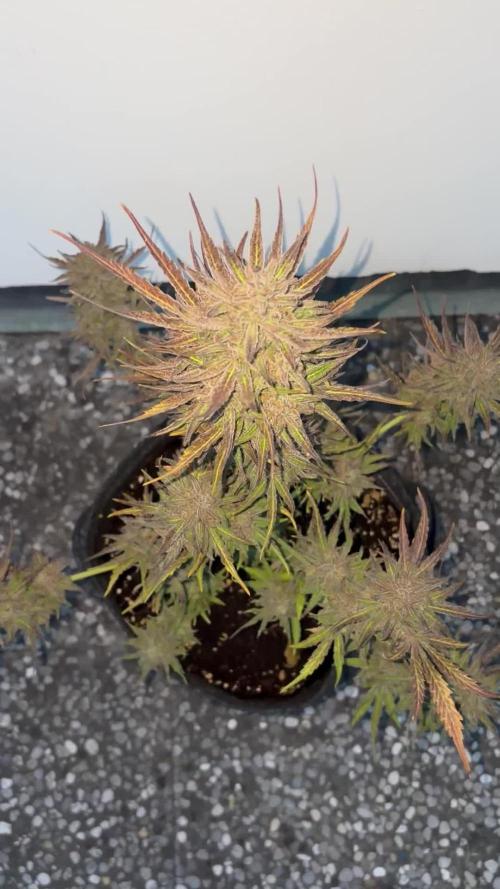
Guava Runtz – Week 11 (Fast Buds Outdoor 2026)
Guava Runtz is done. She was harvested and lightly wet trimmed, then properly trimmed after drying. She is now in the jar for curing.
Final dried weight came out at 34 g. Beautiful red colors throughout and a strong fruity smell that hits hard. Really happy with how she turned out.
Likes
12
Share


@Bluemels
Follow
Tag 53: Jede Menge entlaubt habe ich die Fat Banana heute. Ihr fehlt es noch etwas an Höhe und Form. Das will ich die kommenden Woche in Angriff nehmen. Und dann schicke ich sie nächstes Wochenende in die Blüte 😊 So jedenfalls mein Plan 😜

Likes
22
Share


@donovanliam
Follow
Flowers are coming along nice. Im happy with my new light. Just changed my fertilizer from pre bloom to blooming. Thinking about getting big bud and bud candy.
Likes
19
Share

@DivineBuds420
Follow
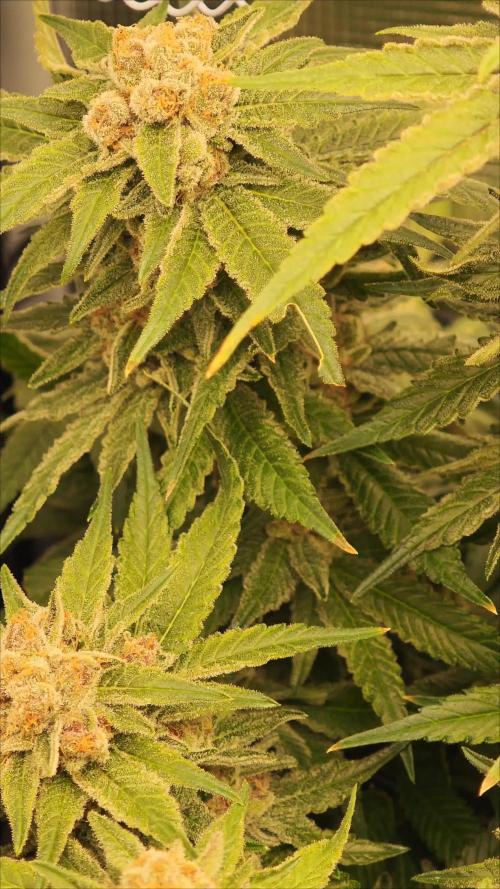
After going back and forth about the harvest, I decided to give her another week. It feels like the right balance between playing it safe and giving the plant the chance to fully express herself.
The flowers keep maturing, the trichomes continue to develop and the terpene profile becomes more intense.
The buds are getting heavy enough that several branches are now resting on the net for support. Without it, they would probably start collapsing under their own weight.
The finish line is close now. Time to stay patient and let nature do the rest.

Likes
81
Share


@LockDownGrow
Follow
Ok so this week I did a defoliation and a tigh down too the netting , I really was not planning on doing such a big defoliation but the leafs became thick and dense and there was almost no light penitration down too the lower branches of the plant , so she is opened right up now and the humidity and temperature has dropped loads and the air is moving alot better around the leaves and branches , I will not take anything more off her now , I have also added Cal mag too the nutrients for this week only ,
I am very happy with them so far and being new too all this it's all very exciting ,
Thanks for looking :)
Likes
11
Share


@Tygrows420
Follow
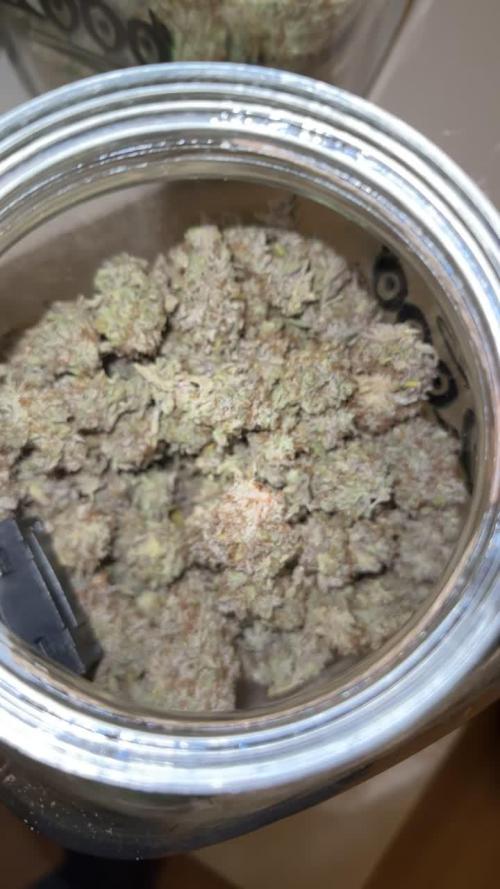
Week 8 of veg she is looking good and green she’s really starting to stretch.


Likes
Comments
Share

@BackdoorMan
Follow
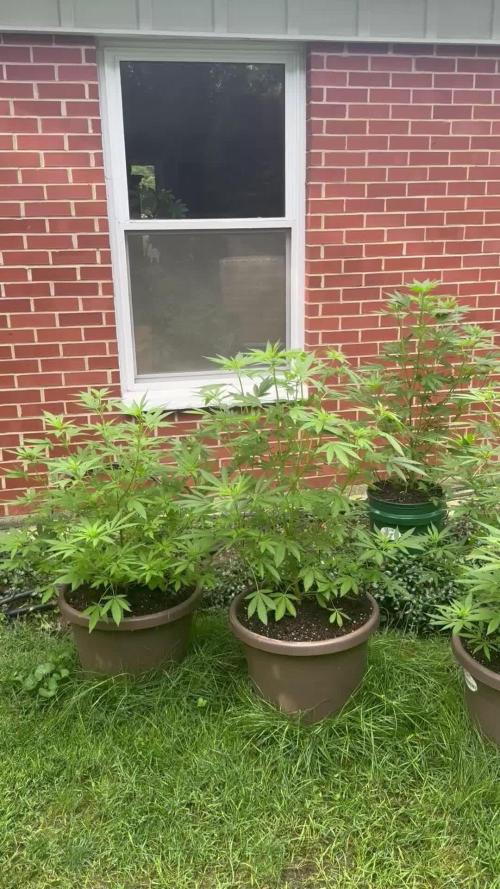
Eight weeks in their big girl pots! No fertilizer last week due to rains every day, and they look great. Even the slow to grow sour strawberries are looking good, and my rogue seed from last year’s Runtz Layer Cake is growing tall quickly. The crop is wuickly becoming a back door “Wall of Weed”.
Likes
81
Share

@LockDownGrow
Follow
Although the yellow appearance this lady has still been growing at the same rate as the rest and shooting out the side branches nicley , she is a week behind the rest due too the first seed not germinating but week by week progress has been the same as the others