Likes
Comments
Share
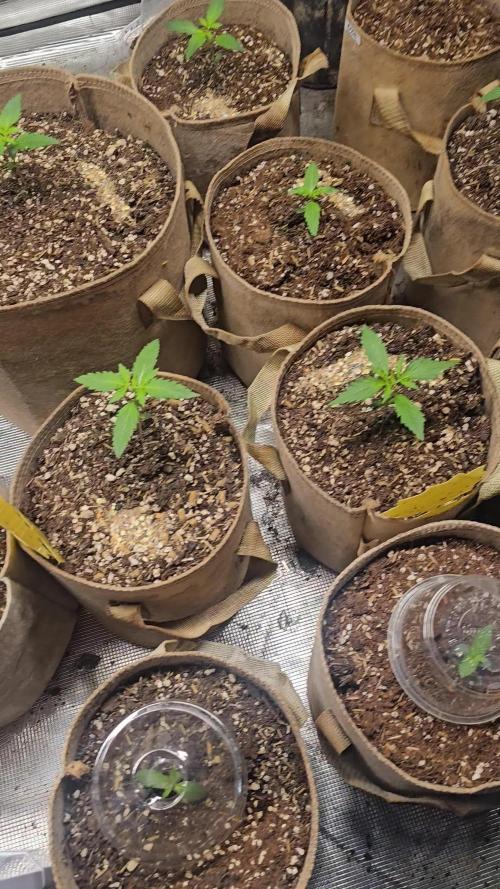
after the 5 days all are sprouted through. Update: first full week out of the soil with just minor water added with a pH of 6.3 from the sink. The Do-Si-Dos didn't sprout with normal leaves but is starting to come along so we shall see how she does. The others are coming along fine so far (fingers crossed)

Likes
12
Share
@Growbody
Follow
Tag 29: Die Watermelon Candy F1 Automatic von Zamnesia Seeds bleibt kompakt und kräftig. Durch den starken Blattwuchs werden die noch kleinen Ästchen beschattet. Diese in die richtige Position zu bringen ist ziemlich filigran. Tag 31: Die SF-Nematoden Kapseln für 6 Wochen Langzeitschutz sind gekommen. Beim Einarbeiten in den Boden muss es passiert sein, die Spitze ist gebrochen. Die Bruchstelle hat schon braune Ränder, kann also auch sein, dass ich das Biegen vor 2 Tagen übertrieben habe. Tag 33: Einer der oberen Seitentriebe hat die Aufgabe der Spitze übernommen und rennt los.
Likes
36
Share
Hey everyone 😀. Another veggie week goes by and they are developing surprisingly well 😃. Both phenotypes look very nice and have a perfect leaf green. Both were topped again. I wish you lots of fun with the update, and stay healthy 🙏🏻🍀 You can buy this Strain at : https://sweetseeds.es/de/sweet-skunk-f1-fast-version/ Type: Sweet Skunk F1 Fast Version ☝️🏼 Genetics: Sweet Skunk Auto (SWS34) X Early Skunk 👍 Vega lamp: 2 x Todogrow Led Quantum Board 100 W 💡 Bloom Lamp : 2 x Todogrow Led Cxb 3590 COB 3500 K 205W 💡💡☝️🏼 Soil : Canna Coco Professional + ☝️🏼 Fertilizer: Green House Powder Feeding ☝️🏼🌱 Water: Osmosis water mixed with normal water (24 hours stale that the chlorine evaporates) to 0.2 EC. Add Cal / Mag to 0.4 Ec Ph with Organic Ph - to 5.5 - 5.8 .
Likes
51
Share
@Comfrey
Follow
Dutch Passion Shaman Pünktlich zum Erntedankfest am 5.10. war für mich der kritische Punkt überschritten. Shamanin 1 hat ihren Headbud und drei weitere Blüten genommen bekommen. Ich habe die beiden Pflanzen in der letzten Zeit täglich mit einer Taschenlampe abgesucht und nun war es soweit, leichte Faulstellen an dennStielen in mehreren Bereichen der Pflanze. Es waren nur sehr kleine Teile der Blüten, bzw. schlaffe Zuckerblätter betroffen, ich erkenne das mittlerweile relativ früh. Die Stielfäule, wie bei @birdmountain hatte sich bei der dunklen Dame an fünf Stellen gebildet und die angrenzende Blüte befallen. Verlust liegt bei zwei bis drei Gramm trocken. Am Sonntag gab es zum Erntedank Space Tee für zwei und der war sehr lecker, mit starker aber angenehmer Wirkung. Ich lasse den frischen Trimm und Blütenmaterial bei 90 Grad mit einem guten Schuss Olivenöl (zwei Esslöffel ca. eine Stunde ziehen. Die Kräuter aus dem Tee schmecken mit bissl Salz wie Spinat, lecker, und wenn man sich die auch reinzieht, dann wird‘s richtig gut, mit Lachflashs. 🤤 😅 Jetzt bin ich entspannter, was den Erntezeitpunkt und die zu erwartende Wirkung betrifft. Shamanin No. 2 musste dursten, hat recht weit oben eine weitere Blüte verloren, wobei ich die Stelle an einem dünneren Stiel auch hier vor der eigentlichen Blütenfäule entdeckt habe. Hier saß auch ein kleiner Käfer in der Nähe, wahrscheinlich hatte der es mitgebracht. Ihre Blätter beginnen sich zu verfärben. Es geht weiter, bis nächste Woche! Danke für‘s vorbeischauen. 💚
Likes
11
Share
Nous sommes à la 7ème de fruits gros colas principal, tête des tiges secondaire moyennement gros. Je n'envoie plus de nut irrigation a l'eau uniquement.
Likes
18
Share
Green light is radiation with wavelengths between 520 and 560 nm and it affects photosynthesis, plant height, and flowering. Plants reflect green light and this is why they appear green to our eyes. As a result, some growers think that plants don’t use green wavelengths, but they actually do! In fact, only around 5 – 10% of green light is reflected from leaves and the rest (90 – 95 %) is absorbed or transmitted to lower leaves [1]. Green wavelengths get used in photosynthesis. Chlorophyll pigments absorb small amounts of green wavelengths. Light that doesn’t get absorbed is transmitted to leaves that are shaded out from direct light. This means that leaves at the bottom of the canopy get more green light than leaves at the top. A high proportion of green wavelengths compared to other colors tells lower leaves that they are being shaded out, so they are able to react accordingly. Lower leaves may react by opening or closing their stomata or growing longer stems that help the leaves reach brighter light [1, 2, 3]. When it comes to growing cannabis, many cultivators are interested in the quality of light used for the flowering stage. In many plants, flowering is regulated by two main photoreceptors: cryptochrome and phytochrome. Both photoreceptors primarily respond to blue light but can also respond to green, although to a lesser extent. Green can accelerate the start of flowering in several species (although cannabis has yet to be tested) [1, 4, 5]. However, once flowering has begun, it’s important to provide plants with a “full spectrum” light that has high amounts of blue and red light, and moderate amounts of green, in order for photosynthesis to be optimized. Green light mediates seed germination in some species. Seeds use green wavelengths to decide whether the environment is good for germination. Shade environments are enriched in green relative to red and blue light, so a plant can tell if it is shady or sunny. A seed that senses a shaded environment may stay dormant to avoid poor growing conditions [1]. Some examples of plant species where researchers have documented this response are: ryegrass (a grass that grows in tufts) and Chondrilla (a plant related to dandelion) [1, 6]. Although green wavelengths generally tell plants NOT to germinate, there are some exceptions! Surprisingly, green wavelengths can stimulate seed germination in some species like Aeschynomene, Tephrosia, Solidago, Cyrtopodium, and Atriplex [1, 6, 7]. Of course, light is not the only factor affecting seed germination – it’s a combination of many factors, such as soil moisture, soil type, temperature, photoperiod, and light quality. When combined with red and blue light, green can really enhance plant growth [1, 8]. However, too much green light (more than 50% of the total light) can actually reduce plant growth [8]. Based on the most current research, the ideal ratio of green, red, and blue light is thought to be around 1:2:1 for green:blue:red [9]. When choosing a horticultural light, choose one that has high amounts of blue and red light and moderate amounts of green and other colors of light. Not many studies can be found about the effect of green light on cannabis growth or metabolism. However, if one reads carefully, there are clues and data available even from the very early papers. Mahlberg and Hemphill (1983) used colored filters in their study to alter the sunlight spectrum and study green light among others. They concluded that the green filter, which makes the environment green by cutting other wavelengths out, reduced the THC concentration significantly compared to the daylight control treatment. It has been demonstrated that green color can reduce secondary metabolite activity with other species as well. For example, the addition of green to a light spectrum decreases anthocyanin concentration in lettuce (Zhang and Folta 2012). If green light only reverses the biosynthesis of some secondary metabolites, then why put green light into a growth spectrum at all? Well, there are a couple of good reasons. One is that green penetrates leaf layers effectively. Conversely red and blue light is almost completely absorbed by the first leaf layer. Green travels through the first, second, and even third layers effectively (Figure 2). Lower leaf layers can utilize green light in photosynthesis and therefore produce yields as well. Even though a green light-specific photoreceptor has not yet been found, it is known that green light has effects independent from the cryptochrome but then again, also cryptochrome-dependent ones, just like blue light. It is known that green light in low light intensity conditions can enhance far red stimulating secondary metabolite production in microgreens and then again, counteracts the production of these compounds in high-intensity light conditions (Kim et al. 2004). In many cases, green light promoted physiological changes in plants that are opposite to the actions of blue light. In the study by Kim et al. blue light-induced anthocyanin accumulation was inhibited by green light. In another study it has been found that blue light promotes stomatal opening whereas green light promotes stomatal closure (Frechilla et al. 2000). Blue light inhibits the early stem elongation in the seedling stage whereas green light promotes it (Folta 2004). Also, blue light results in flowering induction, and green light inhibits it (Banerjee et al., 2007). As you can see, green light works very closely with blue light, and therefore not only the amount of these two wavelengths separately is important but also the ratio (Blue: Green) between these two in the designed spectrum. Furthermore, green light has been found to affect the elongation of petioles and upward leaf reorientation with the model plant Arabidopsis thaliana both of which are a sign of shade avoidance symptoms (Zhang et al. 2011) and also gene expression in the same plant (Dhingra et al. 2006). As mentioned before, green light produces shade avoidance symptoms which are quite intuitive if you consider the natural conditions where the plants grow. Not all the green light is reflected from the highest canopy leaves in nature but a lot of it (50-90%) has been estimated to penetrate the upper leaves at the plant level ((Terashima et al., 2009; Nishio, 2000). For the plant growing in the understory of the forest green light is a signal for the plant of being in the shade of a bigger plant. Then again, the plants growing under unobstructed sunlight can take advantage of the green photons that can more easily penetrate the upper leaves than the red and blue photons. From the photosynthetic pigments in higher plants, chlorophyll is crucial for plant growth. Dissolved chlorophyll and absorb maximally in the red (λ600–700 nm) and blue (λ400–500 nm) regions of the spectrum and not as easily in the green (λ500–600 nm) regions. Up to 80% of all green light is thought to be transmitted through the chloroplast (Terashima et al., 2009) and this allows more green photons to pass deeper into the leaf mesophyll layer than red and blue photons. When the green light is scattered in the vertical leaf profile its journey is lengthened and therefore photons have a higher chance of hitting and being absorbed by chloroplasts on their passage through the leaf to the lower leaves of the plant. Photons of PPFD (photosynthetic photon flux density) are captured by chlorophyll causing an excitation of an electron to enter a higher energy state in which the energy is immediately passed on to the neighboring chlorophyll molecule by resonance transfer or released to the electron transport chain (PSII and PSI). Despite the low extinction coefficient of chlorophyll in the green 500–600 nm region it needs to be noted that the absorbance can be significant if the pigment (chlorophyll) concentration in the leaf is high enough. The research available clearly shows that plants use green wavelengths to promote higher biomass and yield (photosynthetic activity), and that it is a crucial signal for long-term developmental and short-term dynamic acclimation (Blue:Green ratio) to the environment. It should not be dismissed but studied more because it brings more opportunities to control plant gene expression and physiology in plant production. REFERENCES Banerjee R., Schleicher E., Meier S. Viana R. M., Pokorny R., Ahmad M., Bittl R., Batschauer. 2007. The signaling state of Arabidopsis cryptochrome 2 contains flavin semiquinone. The Journal of Biological Chemistry 282, 14916–14922. Dhingra, A., Bies, D. H., Lehner, K. R., and Folta, K. M. 2006. Green light adjusts the plastic transcriptome during early photomorphogenic development. Plant Physiol. 142, 1256-1266. Folta, K. M. 2004. Green light stimulates early stem elongation, antagonizing light-mediated growth inhibition. Plant Physiol. 135, 1407-1416. Frechilla, S., Talbott, L. D., Bogomolmi, R. A., and Zeiger, E. 2000. Reversal of blue light -stimulated stomatal opening by green light. Plant Cell Physiol. 41, 171-176. Kim, H.H., Goins, G. D., Wheeler, R. M., and Sager, J. C. 2004.Green-light supplementation for enhanced lettuce growth under red- and blue-light emitting diodes. HortScience 39, 1617-1622. Nishio, J.N. 2000. Why are higher plants green? Evolution of the higher plant photosynthetic pigment complement. Plant Cell and Environment 23, 539–548. Terashima I., Fujita T., Inoue T., Chow W.S., Oguchi R. 2009. Green light drives leaf photosynthesis more efficiently than red light in strong white light: revisiting the enigmatic question of why leaves are green. Plant & Cell Physiology 50, 684–697. Zhang, T., Maruhnich, S. A., and Folta, K. M. 2011. Green light induces shade avoidance symptoms. Plant Physiol. 157, 1528-156. Wang, Y. & Folta, K. M. Contributions of green light to plant growth and development. Am. J. Bot. 100, 70–78 (2013). Zhang, T. & Folta, K. M. Green light signaling and adaptive response. Plant Signal. Behav. 7, 75–78 (2012). Johkan, M. et al. Blue light-emitting diode light irradiation of seedlings improves seedling quality and growth after transplanting in red leaf lettuce. HortScience 45, 1809–1814 (2010). Kasajima, S., et al. Effect of Light Quality on Developmental Rate of Wheat under Continuous Light at a Constant Temperature. Plant Prod. Sci. 10, 286–291 (2007). Banerjee, R. et al. The signaling state of Arabidopsis cryptochrome 2 contains flavin semiquinone. J. Biol. Chem. 282, 14916–14922 (2007). Goggin, D. E. & Steadman, K. J. Blue and green are frequently seen: responses of seeds to short- and mid-wavelength light. Seed Sci. Res. 22, 27–35 (2012). Mandák, B. & Pyšek, P. The effects of light quality, nitrate concentration and presence of bracteoles on germination of different fruit types in the heterocarpous Atriplex sagittata. J. Ecol. 89, 149–158 (2001). Darko, E. et al. Photosynthesis under artificial light: the shift in primary and secondary metabolism. Philos. Trans. R. Soc. B Biol. Sci. 369 (2014). Lu, N. et al. Effects of Supplemental Lighting with Light-Emitting Diodes (LEDs) on Tomato Yield and Quality of Single-Truss Tomato Plants Grown at High Planting Density. Environ. Control Biol. 50, 63–74 (2012).
Likes
2
Share
Likes
5
Share
@Rko41
Follow
Bon stretching température 14-28 bonne surprise en 1 semaine car la Flo était légèrement en retard!
Likes
7
Share
Hace un par de días le he dejado de dar nutrientes y he suspendido todo tipo de alimentación para terminar con una cosecha más limpia. Ahora solo toca ir aumentando el volumen de riego e intercalar los riegos de agua sola y enzimas para aprovechar todo el alimento que pueda quedar en el sustrato y así lograr la cenecencia.
Likes
50
Share
@ClubRiot
Follow
Start week 7 , Top-Max 4 ml/L + Cal-Mag Xtra 2 ml/L + Bio Bloom 4 ml/L + CarboLoad 2 ml/L + Alg-A-Mic 2 ml/L + Bio-Heaven 2 ml/L ( Ph 6.6 )
Processing
Likes
12
Share
Desculpe não atualizar antes mais muito trabalho neste fim de ano adoro as cores da Red Hot tive ao total 3 Red Hot mais só fiz o diário de uma três feno tipos diferentes todos reds aromas diferentes em todos doce, pungente, frutas tropicais, owwwwww good Nice, a sweet zkitllez está muito bem também tive outras que não fiz o diário. Obrigado a todos
Likes
6
Share
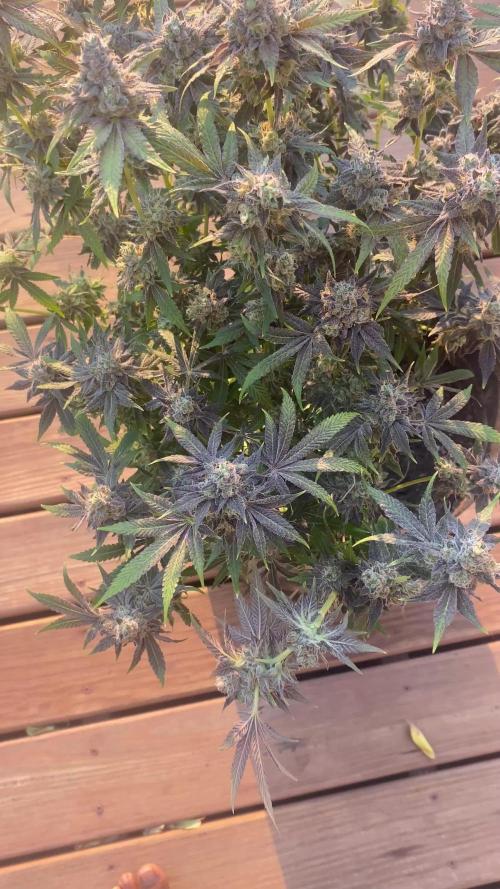
This baby was horribly stunted, but I decided to keep her alive and now it's covered in Crystals. May use it for consentrates.
Likes
24
Share
@nerdz
Follow
Easy harvest. Chopped and hung em down full. After curing 3 weeks this stuff is probably my best grow. Super duper mega dense nugs, and I have to say the taste is amazing compared to my other grows, so I will have to try flushing again.. Drying at 18c @ ~60rh and hoping to get ~12 days or so Yield was 24.9oz dried
Likes
27
Share
Olá amigos, estamos na terceira semana de floração, 54 dias de vida, pois as meninas não param de me surpreender, estão a crescer cheias de vigor, com um bom desenvolvimento de floração e a esticar para todos os lados, tenho o armário com 0,89m2 cheio de flores 🤩💪💪, a shyscaberry tem um aspeto sativa cheia de ramos, a BlueBerry OG tem um estilo indica robusta, e a runtz muffin tem aspeto híbrido muito forte, ambas com muito boa saúde 🤩 esta semana adicionei 1ml delta9 para ajudar na floração... Até para a semana ✌️
Likes
6
Share
Hi liebe Community und Willkommen zurück im Sensi Seeds Wettbewerb! 💚 Nach der vierten Wachstumswoche entwickelt sich die Chocolate Rainbow XXL sehr homogen. Die Seitentriebe wachsen an der Seite schön entlang Richtung Haupttrieb. Um eine schöne Homogenität zu erreichen, habe ich die Pflanze diese Woche getoppt. Die Höhe liegt bei 29 cm und nimmt nun immer mehr an Fahrt auf. Die Bedingungen im Growschrank sind für die Wachstumsphase top! ————— 🌡️ Temp: 26 🌚 Temp: 18°C bis 19°C 💧 RH: 64% 🌬️ VPD: 1,1 kPa ☀️ ppfd: 330 mpm
Likes
19
Share
Let’s go Day 46 from seed!! What a great week it’s been, girls structured up real nice veg has been huge for us, looking super healthy an catching a nice smell ! This will be the last week of feeding them the veg schedule, next we will be dipping right into bloom, starting Monday yall We will be in full bloom !! Can’t wait to watch these ladies stack over the next few weeks 😍! I hope you all enjoy an have an amazing productive day an week ! Peace love an positive vibes y’all Cheers 😶‍🌫️💨💨💨💨💨🤙🏻
Likes
1
Share
@Ninjabuds
Follow
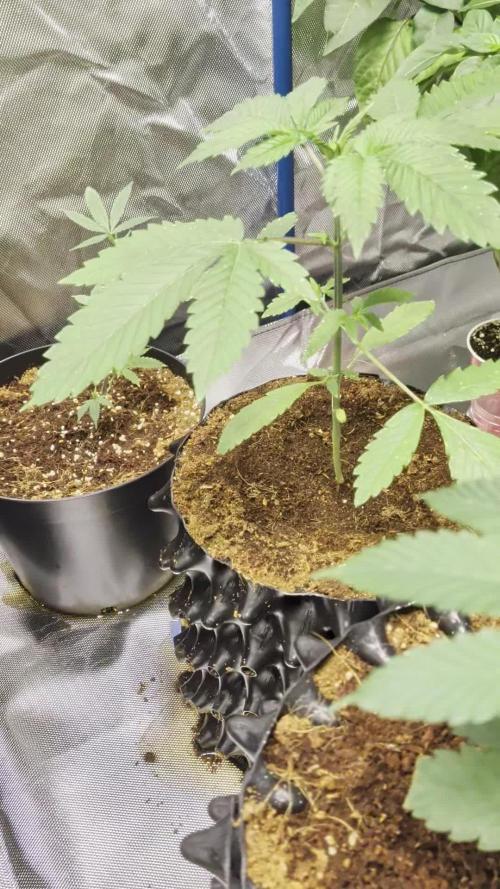
The Soaptini is a small seedling with a slow start but it’s coming around I have high hopes for the little plant This past week was smooth sailing and I topped all the plants
Likes
4
Share
@Canna055
Follow
Zweite Woche überstanden die Autos machen sich gut nur die Frostbanger struggelt noch Habe angefangen mit ein wenig LST Eine Ztrawberriez wurde getoppt