


Likes
Comments
Share


@Ultraviolet
Follow
I gave Isopropyl alcohol 70% equal parts water, 1 tsp cayenne, and kept enough for multiday application, what little population of aphids is left I shall catch them the next morning, opening the tent 10 min before lights on the clovers have yet to open, all the aphids hiding on the undersides are easily visible, still none ever went near cannabis plant. Clovers are far tastier it seems.
The alcohol kills on contact, the idea was to saturate the leaves with a light foliar application, and once I was done I ran it through the canopy with my hands, making sure as much of the clover surface came in contact with the iso, once done, I turned on the fans and evaporated it quickly. The beautiful thing about Isopropyl is that it evaporates rapidly at room temperature, way below boiling point leaving behind zero residual so nothing seeps its way into root zones unless you spill it there.
It is a magical solvent that leaves no trace that it was ever there.
Resonant Frequency:
A resonant frequency is the natural vibrating frequency of an object and is denoted as ‘f’ with a subscript zero (f0). When an object is in equilibrium with acting forces and can keep vibrating for a long time under perfect conditions, this phenomenon is resonance.
In our daily life example of a resonant frequency is a pendulum. If we pull back the pendulum and leave, it will swing out and return at its resonant frequency. Objects combine to form a system, this system can have more than one resonance frequency. The resonant frequency is termed as the resonance frequency.
The phenomena of resonant frequency used in the series circuit when the inductive reactance (XL) is equal to the capacitive reactance (XC). If the value of supply frequency is changed, we can observe that the value inductive reactance (XL) and capacitive reactance (XC) is also changed.
Inductive reactance (XL) and capacitive reactance (XC) are inversely proportional to each other. When we increase the frequency, the value of XL increases, whereas the value of XC decreases. When we decrease the frequency, the value of XL decreases whereas the value of XC increases.
At series resonance, when XL = XC. The mathematical equation of resonant frequency is:
XL = 2πfL; XC = 1/2πfC
XL = XC
2π f0L = 1/ 2πf0C ; f0=1/2π sqrt{LC}
Where f0 is the resonant frequency, L is the inductance, C is the capacitance
How to Calculate the Resonant Frequency of an Object?
An object exposed to its resonant frequency can vibrate in symphony with the sound. The wavefronts pushing on the object will arrive at just the right time to push the object with greater and greater amplitude in each cycle.
To get a clear idea of this concept one of the best examples is pushing a friend on a swing. If you push the swing randomly, the swing will not move very well but if you push the swing at a specific time, the swing will get higher and higher.
Another example to find the resonant frequencies is to place the object next to a speaker and place a microphone attached to an oscilloscope next to the object. Then play the sound in the speaker at a given volume, and then without changing the volume slowly change the frequency.
Now observe the oscilloscope, you will observe that at certain frequencies the amplitude of the wave, is proportional to the volume of the sound that the microphone is able to pick up.
The frequency that is caught by the microphone will be greater than at surrounding frequencies. These are the resonant frequencies and are detectable as the sound energy absorbed by the object is re-emitted more efficiently at these frequencies. The precise moment that constructive interference happens the amplitude of the wave will spike at the precise frequency emitted.
Q: Compute the resonant frequency of a circuit whose inductance is 25mH and capacitance is 5mu F?
A: Known values are,
L = 25mH = 25 x 10-3 H
C = 5mu F = 5 x 10⁻⁶ F
Formula for resonant frequency is,
f0= 1/2π sqrt{LC}1/2π√L
f0=1/2 ͯ 3.14√ (25 ͯ 10-3 ͯ 5 ͯ 10-6)
= 450.384Hz
Why Neodymium?
Ferromagnetism is an exciting phenomenon observed in certain materials, known as ferromagnetic materials, that can retain their magnetization even after removing an external magnetic field. Ferromagnetic materials can become ferromagnets and interact strongly with other magnets and magnetic fields. A characteristic of ferromagnetic materials is their magnetization ability, distinguishing them from paramagnetic and diamagnetic materials, where weak magnetism exists temporarily.
This unique property allows for making permanent magnets widely used in various applications such as motors, generators, speakers, and data storage devices. The ability to generate and maintain a magnetic field without the need for a constant external source of power makes ferromagnets highly valuable.
An alloy of neodymium, iron, and boron discovered in the 1980s is ferromagnetic, yielding permanent magnets over 1000 times stronger than anything ever seen before.
The name neodymium comes from the Greek neos didumous, which means "new twin."
Neodymium magnets are made of an alloy of neodymium, boron, and iron. This allows them to simultaneously store impressive amounts of magnetic energy while being highly resistant to demagnetization.
Because iron oxidizes quickly, neodymium magnets are coated to prevent rust from accumulating.
The attraction between two neodymium magnets is so strong that if placed close enough together, they can collide and shatter.
Neodymium magnets have an unusually high-temperature resistance, and they can even withstand heat exceeding 200 degrees Celsius.
N50UH 1-1/2"OD x 1.065"ID x 3/8"

Likes
4
Share


@OHighOBoyz
Follow
Hoping by the end of this week to see a decent bit of vegative growth. I also had a boost in growth after sprouting but has slowed down decently. Plants leaves started drooping down and one edge of leaf turned a lighter green, leaves also look wrinkled, but don’t feel dry. I was advised it was nothing to be concerned of but I want other opinions. Also started a little LST today 2/15/24

Likes
5
Share


@Manes420
Follow
Buon 420 ragazzi e scusate se nn ho messo foto delle og gaucho e glueberry, le mettero il prossimo aggiornamento.


Likes
295
Share


@Ju_Bps
Follow
Hello growmies 👩🌾👨🌾🌲🌲,
👋 This one is also still happy and like the food,
I don't really know how big they are with all the leaves, will be the surprise on the harvest, buts I see them bump, and got more frosty each days 😋😋😋❄️
💪keep removing some leaves 🍃
💧 Give water each 2/3 day
1.5 l Water + Roots + Zym + Bloom + Green Sensation (1 + 1 + 5 + 1 ml/l)
1.5 l Water + Roots + Zym + Bloom + Green Sensation + Sugar Royal (1 + 1 + 5 + 1 + 1 ml/l)
1.5 l Water + Roots + Zym + Bloom + Green Sensation (1 + 1 + 5 + 1 + 1ml/l)
PH @6
💡Mars Hydro - FC 3000
50% 48 cm.
Mars Hydro Fan kit
Setting 6, don't need more for the moment, no smeel out of the tent.
Have a good week and see you next week 👋
Thanks community for follow, likes, comments, always a pleasure 👩🌾👨🌾❤️🌲
Mars Hydro - Smart FC3000 300W Samsung LM301B LED Grow Light💡💡
https://www.mars-hydro.com/fc-3000-samsung-lm301b-led-grow-light
Mars Hydro - 6 Inch Inline Fan And Carbon Filter Combo With Thermostat Controller 💨💨
https://www.mars-hydro.com/6-inch-inline-duct-fan-and-carbon-filter-combo-with-thermostat-controller
Anesia Seeds - Deep Jealousy Auto🌲🌲
https://anesiaseeds.com/product/deep-jealousy-auto/

Likes
7
Share

@Meshugga
Follow
Tak tenhle týden jsem jim přidal víc supermixu a pk13-14. Nevím jestli je to tím ale začni pěkně kynout. Taky už nezbývá moc času ještě tak 14 dní budu hnojit pak týden flashing a kosa. No a jelikož už mám nakoupeno něco z řady advanced nutrients tak jsem začal přidávat i overdrive (hodně lidí mi řekne že zbytečně ale já to tak chci a aspoň vyzkoušet celou řadu) Jo a nemám tam danou síť a zhruba v polovině týdne mi ze dne na den totálně zhutněli palice a kytky začaly doslova padat na sebe jako že ty stolky to opravdu neudržely tak jsem musel improvizovat pomocí drátu na ploty a udělat tam takovou provizorní podpěru
Likes
2
Share


@DyadyaAsya
Follow
Miami Mami by Solfire (clones, two phenotypes)
Vega (18/6), days: 19
Flowering (12/12), days: 61
Total, days: 80
Ec 0.2-0.45 (FloraKleen, reverse osmosis water)
Ph 6.4
Red 100%
Blue 50%
UV 0%
DLI ~36
T. Day: ~27C
T. Night: ~22C
Humidity: ~55%
T.leaf: 28C 🔥
VPD: 1.78kPa
4 days before harvesting I watered with FloraKleen, 2 days before harvesting I watered with reverse osmosis water,
the last day I gave not darkness but 24 hours of light :)
Everything seems ok.
Harvested, I don't know the weight, how it dries, I'll thaw and weigh it.
The smell is sweet, with the taste of either berries or roses with a light mint note, without a hint of the classic skunk smell.
The buds are not large but very dense and trichomycete, the leaves are purple-pink,
If you take off the leaves with your fingers, it leaves not a green color on your hands, but purple-pink (as from mulberry), I have never seen such a thing.
I dry at vpd 0.7-0.8kPa,
temperature 19C,
humidity 65%.
It will dry in 7-10 days.
The cycle ended almost a month early due to the use of clones.

Likes
39
Share


@HydroHerb420
Follow
Massive dense colas. Is definately going to be the biggest yield of the three.


Likes
4
Share


@Phatlad187
Follow
Week 9 now all growing perfect so this the last week of veg then they are going to 12/12.
@growerchoice
@SHOGUN COCO A 4ml/L
160ml
@SHOGUN COCO B 4ml/L.
160ml
@SHOGUN ACTIVE BOOST 2ml/L.
40ml
@SHOGUN CAL MAG 1ml/L
20ml
@SHOGUN ZENZYM 2.5ml/L.
100ml

Likes
47
Share


@Growdaddy420
Follow
Good yield, bad rot. Overall satisfied with outcome but would not grow outdoors again. Too much rain is a problem with this strain.

Likes
25
Share


@NorseGrower
Follow
Week 8: Everything is going great. I didn't plan on taking them all out again till they got chopped, but decided to get them out one at a time today and give them a good thorough defoliation, peeled off any undergrowth and water and feed them all. Temps remain completely under control and no longer an issue, even in 90 degree weather here. I've continued to alternate between feeding and just water, cal mag and fish shit. The only plant of the 6 to show any deficiencies was the #1 Skunk. Every leaf on leaf chart looks same to me lol. I upped today's feeding to 3/4 strength instead of half strength. If I had to guess, I would say that this is the last feeding for the Creme de la Chem, Strawberry Couch and the Double Grape. Those three will likely all fall in the 70-80 day harvest range and those three are at day 58. Not 100% on the #1 Skunk or not, it may get one more feeding, along with the Watermelon Skittles. The Fruit Punch? Well there is a chance I will be smoking cured Creme de la Chem before that one gets chopped lol. It will continue to get fed for a while as buds still very under developed. Today's defoliation was barely anything for a couple plants like the Watermelon Zkittles. A few big fan leaves blocked bud sites, but the Skunk needed thinned out badly and I took a good 20 minutes to go around the outside them come in from over top to really get in there and try to make some airflow and better light penetration. These are definitely drinking at different rates but in order to not be mixing up stuff daily, I feed them all on the same day and the couple that still had some weight to them just get less. I think these will all meet and exceed my 2 ounce goal per plant and 5 of the 6 after topping and training have conformed to the types of plants I really want to grow with the space I have. Thats 6-8 tops on a short compact plant. The Fruit Punch went off the reservations waiting till day 50 to start flower and is acting like this is a 3 plant grow not a 6. But shoving it in corner and putting short Skunk plant by it on bucket to raise up canopy along with raising one side of my TSL2000 and lowering other side towards shorter plants appears to be working great. Its great to be thinking about the flush. Having plants out, I did check trichomes on a couple just for the fun of it and mainly clear so got couple weeks or more for most of these.


Likes
91
Share


@Greenwolvesfarmer
Follow
Me encantó la cepa y su facilidad de cultivo ! Aun que tuve muchos problemas ambientales y climáticos . Me atrasé unas 3 a 5 semanas con estas nenas , pero nos recuperamos bien ! Usamos malla scrog chilena #kanovicultivo , lo mejor que he usado en malla scrog , no se le comparan , su espacio preciso! .
Las 4 comenzaron en pequeños vasos , luego de 1 a 2 semanas , trasplanté a macetero de 5.8lts , finalizaron 3 en maceteros textil 19lts y 1 en macetero de 20lts AirPot !
Comencé a brindarle 20hrs de luz / 4 hrs oscuridad , a la 3era semana 19hrs de luz y a la 5ta semana bajé hasta el 18 / 6 .
Usé un panel QB de 480w regulables , chips marca Samsung de 3500k , chips epistar UV 660nm iR , el mix completo gracias a mi bro MKleds chile ! Se pasó ! De todas maneras recomiendo una potencia mínima de 600w ( QB LED ) para espacio de 120x ..
Usé un bio estimulante chileno , que a mi parecer fue uno de los mejores que he visto y usado ! El grande #trichomemania , te cuento que este producto activa un mecanismo de defensa en la planta (SAR) , haciendo que reaccione y se trate de defender con mayor producción de resina , terpenos y tricomas ! Es increíble ! A los 24hrs tienes resultados , un saludo grande a los hermanos ! El mejor producto 10000000%....
Grande eva seed , buenisima esta cepa , me dí cuenta que si se deja madurar un poco más , su sabor es más frutal candy , exquisita cepa !....
Estamos probando con un papel de blunt organico 100% libre de tabaco marca *jamaican buzz*...al fumarla su efecto es notorio , enseguida viene el efecto psicoactivo y cerebral , se viene a la vista un tanto distorsionado el entorno ...la vision un poco más brillante , y a la vez relajado ..
Hoy 18 de agosto estamos probando con un papel de celulosa organico marca lion rolling circus ( foto al final del album ) , quema bastante bien , al parecer ya está casi en su totalidad secado , combustión lenta , buen sabor afrutado citrico con toques candy diesel ...uuff efecto despues de 3 quemadas ya por los cielos , totalmente cerebral y estimulante , un gusto charlar con amigos !
Al manipular su fruto , la planta expele un olor afrutado con limon maduro y skunk , con finales de candy terra , una delicia , muy buena cepa , ahora mientras escribo me siento un tanto "mareado" con esa mitad de blunt ! Buenisinaaa!...
____
La verdad cuando comencé a cortar cada planta era como llenar "infinitamente" el armario donde dejaría secandola , se llenó casi la mitad y un poco más sólo con 1 planta cortada ! Increíble producción , yo estimo unos 90g por planta aprox , ya he consumido un buen peso además ...veremos en estos días que esté por completo su secado ! Esta riquísima , sus efectos fuertísimos ...100% ...
___
Una cosecha buenísima, muy parecido como obtengo resultados en comparación con el sodio , todo bien me gustó la experiencia !....
Además tuve la oportunidad de hacer extracción en seco de su materia vegetal . Obtuvimos entre un 18 a 20% de retorno ! Para mi primera vez , geniaaaal ! Su utilizó prensa de 12 toneladas , de apretó a 80°C por 4 minutos .
.
.
Usen lemon king ! Una delicia .


Likes
24
Share


@Canadian
Follow
The plant seems to grow very slowly so lots of vegging time will be very beneficial for this one overall health smell and looks are doing fine and the plan seem to enter flowering stage and it's starting to create the beginnings of the buds.
Day 44 the plant is very bushy and today I have to trim some more fan leafs a bit more mostly in the centre area of the plant so that I can encourage maximum light penetration.
Thank you for reading I will continue to update have a happy grow

Processing
Likes
22
Share


@Heady_McDank
Follow
Cash express 150cm
Thc Bunker Buster 90 cm
Ladies doing dandy fine, not so hot anymore so they enjoy the garden to the full.
Cash Express of this journal passes the one from my other journal in height with 10 cm now, and at first they told me to kick it out 🤔 lucky I didn't 😂
Likes
16
Share


@HowtoBubatz
Follow
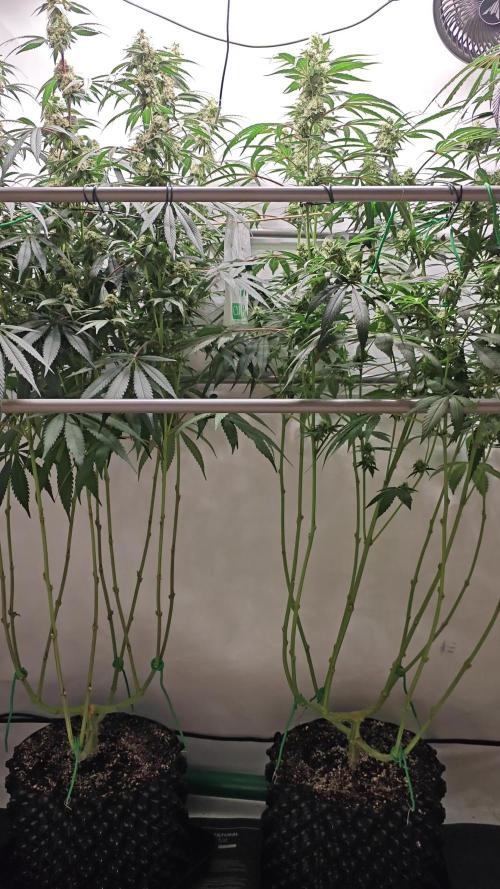
LST went good the plant is growing ervery day for 1-2 cm
I am very happy with the products used.Until now i didnt run in any issue :)
Starting to give a little more Water.
Likes
54
Share


@MadeInGermany
Follow
Hey guys :-)
First of all I have to say that all 5 strains I have in the tent from Amsterdam Genetic are beautiful genetics 👍 .
This week they were repotted into 8L fabric pots.
When repotting, 2 g of Green House Powder Feeding Bio line were added per liter of substrate :-) .
That's enough until the first flowers start 👍.
Watering was done twice this week with 0.8 l each.
Otherwise everything was cleaned and checked and fresh osmosis water was mixed.
Stay healthy 🙏🏻💚
👇🏼👇🏼👇🏼👇🏼👇🏼👇🏼👇🏼👇🏼👇🏼👇🏼👇🏼👇🏼
‘Powered by GreenHouse Feeding’
Copy the link for 10% off all Nutrients 👇🏼
https://shop.greenhousefeeding.com/affiliate/MadeInGermany_PassionGrower
👇🏼👇🏼👇🏼👇🏼👇🏼👇🏼👇🏼👇🏼👇🏼👇🏼👇🏼👇🏼
You can buy this strain at :
https://www.amsterdamgenetics.com/product/choco-cheesecake/
👇🏼👇🏼👇🏼
Use the coupon code: madeingermany
for 10% on all Amsterdam Genetics seeds
Water 💧 💧💧
Osmosis water mixed with Cal/Mag (24 hours stale that the chlorine evaporates) to 290 ppm and Ph with Ph- to 5.8 - 6.4
MadeInGermany


Likes
6
Share


@ForbiddenBotanist
Follow
1st week of flowering over. Trim at the end of this week to redirect energy again and then we'll

Likes
60
Share


@Drgreenthumb627
Follow
Pineapple Express looks to be coming in on the finish line, maybe 2 weeks tops on left on it.
The ghost Train haze i the back of the tent is still throwing out all white pistils and i see bo end in sight for that one, the ghost train at the front of the tent however looks much farther along and may be ready in 2-3 weeks. they are all looking healthy, save for some fade starting to hit some of the leaves. the flowers are dense and sticky, i cannot wait to experience these plants after cure!

Likes
14
Share


@Terpyboyz
Follow
Hi growmies 👌🏻 sorry I’ve missed out the last 3 weeks but al add them to the diaries soon. Everything has been going great so far only a few more weeks to go on some of these girls - the clones are in week 3 of flowering as well so they’ll not be far behind. Clones are looking beautiful as well happy with this run of they fill out a bit more before chopping 👌🏻🔥


Likes
26
Share


@Silverback_Guerilla
Follow
9/10:
New week, pictures are worth thousands of words.. will have more to say later-
9/11:
I waited to long to transplant them and they have root problems to some degree or another...too wet for too long.
I transplanted both of them into 3 gallon pots and observed about 50% brownish roots on both of them. 😕
I powdered the planting holes with myco, tricho, and other goodness.
I added two Mars Hydro 150w lights, and a 60w 6500k LED panel light since they are all spread out now. The average CCT is still a little over 4800k, even though the Mars are a little warmer color temp than the Viparspectras.
9/12:
Between the root problems and the transplant, they looked horrible, so I sprayed them with BoomBoom Spray today and will do a good root drench tomorrow with BushDoctor Boomerang.
They looked better by the end of day, but still have a ways to go to get back on track...
9/17:
I fed them boomerang only twice this week, and also gave them kangaroots yesterday. One of them is still kinda droopy looking..hopefully she snaps out of it soon.
I'll prolly flip to 13/11 with emerson effect in the next couple of days.