


Likes
Comments
Share


@Roberts
Follow
Bubba OG Gum autoflower has been growing great. Just keeping up on her training and letting her spread out. She is due for a solution change soon. Everything has been going well for her. Thank you Spider Farmer, Athena, and Ganja Farmer. 🤜🏻🤛🏻🌱🌱🌱
Thank you grow diaries community for the 👇likes👇, follows, comments, and subscriptions on my YouTube channel👇. ❄️🌱🍻
Happy Growing 🌱🌱🌱
https://youtube.com/channel/UCAhN7yRzWLpcaRHhMIQ7X4g


Likes
22
Share


@SecretTreasures
Follow
The tuber boost increased significantly from the 5th week onwards.
It has become colder outside, but the climate in the tent has remained fairly constant. During the day around 25 degrees, at night around 19 degrees. In the meantime, beautiful head buds have formed which appear very compact and firm. The smell on the fingers is now also intense if you have to remove a few leaves for better light penetration.
Watering is still done three times a week with compost tea, water and PK Bosster plus water alternately. If watering is necessary in between, then with normal water (~23°C).
Soil temperature:~18°C
The slightly younger London Pound Cake X Zoap can be clearly distinguished by its tuber structure and seems to be ready at the same time despite being 1.5 weeks younger.
The three Mimosa X Orange Punch are partially peach colored and the Fat Freddy's are darker and partially purple colored. Flowering was given as 8-9 weeks, which I think is correct. But I think it's more like 9 weeks, as I want to let the plants mature properly.
The leaves are now also turning purple in places and in general some parts are starting to 'leaf out'.
As I have already said, the plants have generally grown too tall and maybe 12 is too many, which is particularly noticeable in the middle and lower part of the plants, as they are quite compact and quite light, which suggests that there is not enough light.
As the plants are now concentrating almost exclusively on flower formation, I have again removed some leaves that are too large in the upper third to the middle to give the lower flowers better lighting. Overall, however, all the plants have developed really well and I'm already looking forward to the final result.


Likes
1
Share

@KurtThePlantGuru
Follow
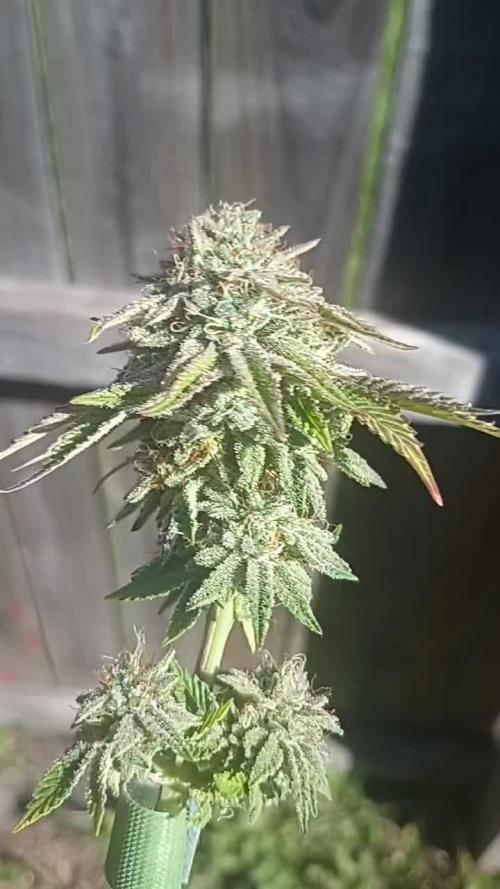
One of my best grows to date, super happy with how it came out... A Gorilla Glue heavy strain with a background notes of Oreoz. Deep Chocolate Diesel. I'm in love with it. Gonna make sum tasty tasty rosin.
Would be 10/10 if it didn't herm
Likes
42
Share


@Hashy
Follow
Grow diary 11 stage 7
Day 61-70
She has come on a bit this last 9 days. Showing Iron deficiency in the tips but that's probably due to over watering a while ago. She is the 2nd farthest along.

Likes
29
Share


@TonyTrichomes
Follow
Not an overly impressive strain and I would say she was not that hard to grow. If I even grew this one again I would let it go naturally with some LST. Wanted more grape flavours but they don't really come through in the smoke. There's a bit of a sharp fruity smell that's sort of piney with a hint of fuel at the end. The smoke is not too flavourful in my opinion but that just means I didn't grow it well. Super tight nugs so be careful with humidity as stated above. Also she's a bit of a light feeder so be careful with your nutes. As you can see I burnt her tips and over fed her a lot. Not a bad yield though! I've only really smoked the lowers on this one so far so that gave me a bit of a racey high, just slightly racey. I would accredit that to the lowers not being mature enough at chop. The plant is super dense and since I mainlined it the lowers didn't receive enough light. I tried to let the lowers mature more but the plant stopped maturing when I chopped the tops, this caused stress and the plant just shut down basically. Not sure if I would grow Blimburn's GDP again until I grow the real GDP.

Likes
19
Share


@CannabisAprendiz
Follow
Hola hemos tenido problemas con la cámara del celular y no hemos podido tomar muchas fotos por lo mismo .
Esta es la Segunda semana de floración de este seguimiento , me parecen bastante rápidas la formación de sus flores y ya se está viendo una formación de resina en las flores.
tenemos una SBR que se espigo más que las demás intentaremos ir controlando su crecimiento con algún cropping.
Hello, we had problems with the cell phone camera and we could not take many photos for the same.
This is the second week of flowering of this follow-up, the formation of its flowers seems quite fast to me and a resin formation is already being seen in the flowers.
We have an SBR that spikes more than the others, we will try to control its growth with some cropping.

Likes
5
Share


@Mr_Puff_N_Stuff
Follow
Start of week 7 and all plants are looking great. Added the net to hold them later but I may take it out.
Ran into a slight issue…my plants got so tall that I was not able to provide enough PPDF to the lower stems (I need a bigger tent and better lighting…in time). As a result a caused light burn on the top leaves. Additionally, early in my grow I was using Mass Pro. That alone with amendments and I foliaged early with Foop. I believe the Foop and Mass Pro were too much for these plants to handle.
Still rocking though…
Likes
18
Share


@Diips
Follow
d.57 - looks alright, had to do some lst and adjustments to level out the height
gave an additional biotab.
move my big fan, below the plant, in an effort to push the moisture upwards and out, which resulted in me being able to raise the lights further up.. my plant is way over the average height of is genetics, thanks to biotabs 🌞.
fastbuds said it would have an average height of 70-100 cm, and ny plant is closing in on the 80 cm and she keeps going ^^. and people say that autoflowers cant be main lined, well i believe this grow proves it.
achieved darker folliage in the bottom, so i believe that we are on the right track. hopefully the deficiency levels out.
day 62/63 gave an additional biotab so we are at 6 total. day 63 i gave 10 ml bio pk with the watering.
Likes
3
Share


@Nat889
Follow
Purchased a new night which is 24 inches from the plant. The bottom two leaves have started to turn slightly yellow. The PH levels have not changed. I may have over watered, but I don’t believe I did. Not quite sure what is going on here. She has taken off in growth this week compared to the last.
She is on a 18hour light schedule and taken out into the sun from 12pm to 6pm and then back under the lights. I am not overly sure of how much water is required.

Likes
6
Share


@CannaGrown
Follow
We are in the first week where the growth was good, watering was done only with water without adding fertilizers.

Likes
276
Share


@Polygus
Follow
A big hello to all the cannabis growing gardeners...and all the other visitors that came across my grow journal.
Just on harvest day I was summoned on a long quest...around 700 km. will be away for three days. I will update this diary as fast as i"m back. For now just the photos as no time for anything.
----------------------------------------------------------------------------------
Now cannabis smell is overpowering in my grow room I can finally write something about Spider Farmers 6-Inch Inline Fan with Smart Controller and Carbon Filter :)
As my grow room gets really stinky at times i always invest in a top shelf carbon filter almost twice the size of the one provided by Spider Farmer, to my shock Spider Farmer carbon filter absorbs the smells wonderfully well.
No smell leaks and that just when the fan is running at 5 out of 10 levels of output. The smart controller is something completely new to me, and had a lot of fun experimenting with it during the veg and early flower, when the smell began i needed it to run full time at level 4 or 5 to rid the fragnance.
All in all the whole combo is a great deal. If you are not as keen on technology the set without the controller is awesome on it's own. But to have some extra options open, the controller at the device throws at you a ton of settings you can use to optemiase you grow enviornment.
The SE 7000 is hanged at 40 cm. over the canopy and runs at 520W.
This whole grow's main sponsor is Spider Farmer. You can easily obtain all the great grow equipment we use at: spider-farmer.com
A big thank you to Jessie and the whole Spider Farmer crew for supporting me with the newest technological advancements in horticulture. Thanks to them what i do here is possible.
Thank you Mafia Seeds for giving me the opportunity to try out your stock.
seedsmafia.com/en/feminized-cannabis-seeds/moby-dick-feminized.html
Plagron did send us their Contest package for the Power Buds competition .
Thank you for your visit, please leave a like and hope to see you beck here in about a week.

Likes
8
Share


@Growin_Ish
Follow
Candace hasn't recovered from overwatering. The pot is very light / dry, but the leaves still droop. They aren't crispy, discolored, curling, or taco, just droopy. I'm concerned if I let the pot dry completely it will force the microbes to go dormant and the short flower cycle may never catch up. She has the perfect structure to be a monster but this leaf drooping is not helping at all! She doesn't even need LST!
Sheryl looks to have recovered fine but is much smaller and bushier than Candace.
I skipped the preflower top dress because this strain has a 4 week flower cycle. I'll keep feeding them SimPro once a week. If I top dress, I'll never be able to get a good fade on these.
Day 36
Bottom watered both with plain PH water.
Day 37 - Both liked the bottom watering. Candace is 9" Sheryl is 11.25".
LST the side branches on both.
Day 41
The leaves had bounced back, but are now droopy again, which tells me they're thirsty. I have two small lower leaves on both plants show PK deficiency, so they're hungry too.
Whipped up a tea using Roots Organics Terp Tea Bloom, Azoz, & Simpro Bloom. Each got 1Ml of Fish Sh!t & CalMag.

Likes
142
Share


@MadeInGermany
Follow
Hi everyone 🤗.
Everything is going great 👍.
There are no defects or anything unusual :-).
Today the Blue Cheese Pheno 1 became the first time rinsed, and now only gets 0.4 Ec water for the next 10 days ca :-).
Everyone else needs a while.
otherwise there is not much to report this week.
I wish you all a nice week, stay healthy 🙏🏻 and let it grow 🌱


Likes
57
Share


@Todzilla
Follow
Flowering Purple Push Pops (grew 2023 outside) and Black Cherry Gelato (love to smoke it, first time growing)
Clones- from my clone guy- 4 Purple Push Pops and 2 Black Cherry Gelato
1000w LED, 4G Autopots,, coco/perlite 65/35, GH 3-part+ flourolicious, calimagic, SI, chelated iron, and humic acid , RO water, AC pro Controller and T8, 5x5 GG Tent with extension
Garage grow SoCal
This week I kept up the tucking and defoliating with the objective of stretching out the scrog and having at least one bud site per grid.
I also upgraded to an oscillating fan which I hung to free up grow space.
We’re running just under 1000ppm with no issues. I bumped my VPD up to account for leaf temp.
The autopots are working. They just increased their (self feeding) appetite - up from .3 gallon a day to .8 gallons a day.
This weeks accomplishments:
Dehumidifier venting tuning
Filled each scrog grid with at least one cola
Stabilize temp, humidity and VPD.
Stretched trellis with pvc frame
Better oscillating fans for top and bottom airflow
This week to-do
By Monday evening, I have to install two more autopots - I’m still hand feeding the gelatos.
I’m going on vaca, so we’ll see how this turns out.
Long term issues
Cooling and VPD targets during heat waves
Preventing pest and mold issues
My fiancé is getting jealous of all the attention to my grow!
I hope you all are having as much fun as I am.
Best of luck gromies.


Likes
29
Share


@JeyGanesha
Follow
Un altra settimana è passata senza problemi...grazie alla mia perseveranza nel curarla e debellare i ragnetti Rossi che bastardelli mi sono arrivati anche dentro al box... sicuramente c'è li ho portati io involontariamente quando sono andato a vedere delle piante di un amico che erano impregnate di ragnetti e ragnatele sui fiori....vabbè ora devo sbattermi un po' più ma non lascerò che mi rovinino la mia terapia 💪👍🙏🕉️🙏... Boom Shiva Shankar 🕉️ belle le mie coccinelle 🐞 che mi tengono pulita la mia terapia
Likes
4
Share


@GoodTimesOrganics
Follow
Nach dem letzten entlauben und leichtem Biegen der Äste, entwickelt sich die Pflanze etwas homogener. Allerdings hat sie im Stretch nochmal ordentlich an Höhe dazu gewonnen.
Auch bei ihr ist ein leichter Tripsbefall vorhanden und Raubmilben wurden eingebracht.
Likes
6
Share


@ao_grows1978
Follow
The Afghani x Mac1 auto solo grow yielded 9.7g of potent, stank nugs. Smelling a bit like fruit and paint thinner in the jar, and transforming into sweet tarts candy once ground up. Excellent flavor and blissful effects.


Likes
18
Share


@Canna96
Follow
Hey now, hope everyone is having a great weekend. Not much to report on the Sundae Driver, she smells amazing, just kidding. I am feeding her with a syringe just plain water every 2-3 days and just lightly around the edge of the solo cup. I then go by weight of the cup to avoid over feeding. I will hopefully transplant to a solo cup in 7-10 days if all goes well.
This is my first run with Royal Queen Seeds Genetics but I have smoked the hell out of some sundae driver genetics in the past and they were some of the best tasting nugs you could ever ask for. I plan to build a mainline and flip to 12/12 as soon as all 5 mainlines are built, hopefully around week 7. This Medic Grow light is perfect for a 5X5, and the AC Infinity 8" exhaust does an excellent job of keeping the tent cool. I will set up an auto feeding system which consists of a reservoir, and some 1/2" tubing that is hooked to a submersible pump in the reservoir and set to feed for 1 minute every 6 hours through halo feeders connected to ball valves to adjust the flow. The runoff then flows via gravity to a 5 gallon bucket in the tent with a shallow pan condensate pump that pumps the runoff out of the tent when it gets above 3 inches to another reservoir. I have been growing fruit and vegetables for over 40 years and I have recently switched to high frequency fertigation in Coco Coir for my tomatoes as well, as I believe this growth medium combined with this technique is the safest, most environment friendly, and foolproof method of getting monster yields no matter what crop you are growing, and I have seen massive results in both cannabis and tomatoes. My goal is to have these ladies transplanted by around day 14-17, and have the first toppings done within 48 hours or so of transplant. I hope everyone has a safe and peaceful weekend.
Thanks for stopping by, Stay Safe and Blaze On!!! 💪
Website: https://medicgrow.com/
https://growdiaries.com/grower/medicgrowled