


Likes
Comments
Share




Likes
Comments
Share


@Casa_das_Arvores
Follow
Olá amigos, obrigado por acompanhar meu diário!
Siga meu perfil, deixe seu like, comentário ou dúvida, ficarei feliz em ajudar se eu puder.
Mais uma semana demonstrando uma deficiência que me parece ser Magnésio, porém é sempre complexo em se tratando de coco pois o equilíbrio entre K, Ca, Mg e Fe é ainda mais complexo nesse tipo de mídia. Fato é que esses clones foram retirados com urgência sem que eu conseguisse ter feito uma seleção da madre antes, e a planta mãe apresentou essa deficiência o ciclo todo e não houve o que eu conseguisse fazer para corrigir, etnão devo estar fadado à isso novamente. Vivendo e aprendendo!
Fiz um ajuste na nutrição para poder testar. O objetivo e conseguir entregar os ppm de cada elemento muito próximo do feedchart da Advanced Nutrients, porém usando fertilizante mineral muito mais barato e acessível no meu país, e algumas sobras q tenho da linha GH
Sigam também meu Instagram @casadasarvoresgrow
Cultivo Medicinal brasileiro. Uso pessoal, não vendo nada!

Likes
11
Share


@Skinnytalls420
Follow
Day 38- 18/01/22 and we are now in flowering everything is looking good I’m still cutting down the plants from my last grow Afghan kush and once I’m done with that I’ll be moving everything that isn’t chemdawg into the HPS tent!! Day42 -22/01/22 looking good apart from the burnt tips in the hps tent now!!!

Likes
6
Share


@MG2009
Follow
08/13/2019
She cleaned up nicely and ready for flower taking a couple clones this week to preserve this girl I love this plant!

Likes
17
Share


@Its_Fruz
Follow
🐒🐒🐒
20day base + delta9 total 900ppm
25 day base + terpinator total 1000ppm
Likes
3
Share


@OldskoolHed
Follow
Fattening up and fading yellow and purple. Believe she'll be a fast finisher and will probably go ahead and start the flush process.
Likes
7
Share


@Polakush420
Follow
MACK AND CRACK 30 % THC / Hidroponia
(TERPENO A LIMONELO)
Lo mas clave de la Hidroponia es el CLIMA PERFECTO - EL AGUA NO DEBE SUPERAR LOS 24 GRADOS !!
Saludos de Argentina

Likes
1
Share

@PapaTerps
Follow
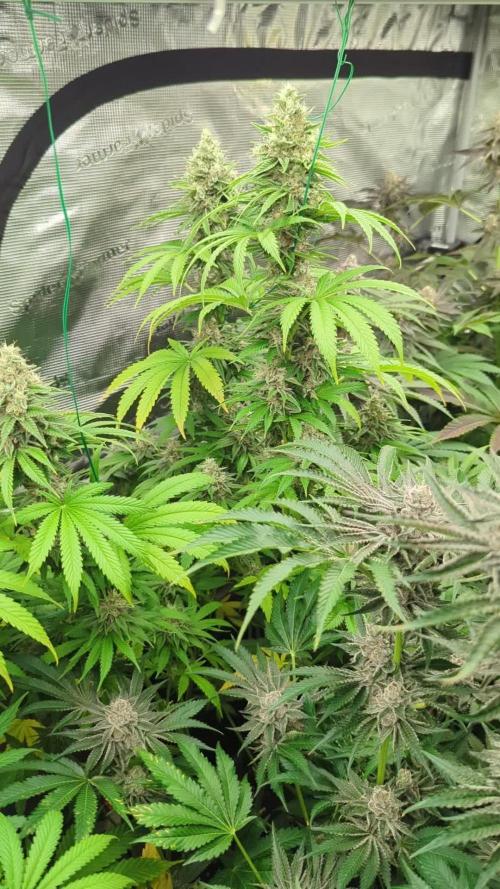
Zu-Tang Clan - N.Y.Ceeds
Week 8 Bloom
🌸 She's at day 54 of bloom, and she has grown incredibly well, producing clusters of wine bottle sized flower atop thick stems that have been struggling with the weight and has required stem support since week 3 of bloom. They're light green in colour, covered in ambering pisitils and glistening trichomes, which have started to turn milky - her scent is also totally unique for me, sweet lavender with a creamy finish in the nose. Super impressed with this phenotype, one of the biggest I've grown to date! She should be ready for harvest in the next two weeks, so I'm starting to get excited 🙌🏻
✂️ No work this week, she has good light penetration and airflow. She won't need anything between now and harvest 👌🏻
💧 Watered every three days with 4L of RO water, nutrients were mixed individually, in order and then finally pH'd to 6.3. I've begun to reduce her nutrients as she approaches harvest - I won't completely remove everything, but the last week she will be getting no more than 300ppm.
💡 PPFD: ~900
♒ VPD: 1.51kPa
🌱 Days from seed: 115
🌸 Days in Bloom: 54


Likes
37
Share


@Tripaholic88
Follow
OK guys so i figured i would do a video update instead of pictures now that we have some flowers! They are gaining weight everyday now that i got things under control. I went through a pH upswing again and still cannot find the cause of it. but regardless we are back on track i believe


Likes
55
Share


@Ultraviolet
Follow
2nd net is up. Early bud formations are promising. holding up to the extremes pretty well, some leaves taking minor damage, but overall, she is holding up, gave her 1 night at 50F see how she would react, stressful. Not advised as it messes with her metabolism, but I want to see if it triggers any anthocyanin response. Love to see her purp up but no signs yet. Remember, For every molecule of glucose produced during photosynthesis, a plant needs to split six molecules of water. This process provides the hydrogen needed for synthesizing glucose and other organic compounds, while oxygen is released as a byproduct.
Homework.
If Rubisco activity is impaired and it cannot properly function or regenerate its substrate, the plant's leaves are likely to turn a pale green or lime green, a condition known as chlorosis. Essentially, Rubisco activity is highly regulated and susceptible to various environmental and metabolic factors that can cause it to become inhibited, leading to an apparent failure in RuBP regeneration due to a lack of consumption.
Rubisco regeneration is intrinsically linked to nitrogen supply because Rubisco is a major sink for nitrogen in plants, typically accounting for 15% to over 25% of total leaf nitrogen. The regeneration phase itself consumes nitrogen through the synthesis of the Rubisco enzyme and associated proteins (like Rubisco activase), and overall nitrogen status heavily influences the efficiency of RuBP regeneration. RuBisCO is a very large enzyme that constitutes a significant proportion (up to 50%) of leaf soluble protein and requires large investments in nitrogen. Insufficient nitrogen supply limits the plant's ability to produce adequate amounts of RuBisCO, thereby limiting the overall capacity for photosynthesis and carbon fixation. Maintaining the optimal, slightly alkaline pH is crucial for the proper function and regeneration of Rubisco. Deviations in either direction (too high or too low) disrupt the enzyme's structure, activation state, and interaction with its substrates, leading to decreased activity and impaired RuBP regeneration. (Lime/yellowing)
Structural Component: Nitrogen is an essential building block for all proteins, and the sheer abundance of the Rubisco protein makes it the single largest storage of nitrogen in the leaf.
Synthesis and Activity: Adequate nitrogen supply is crucial for the synthesis and maintenance of sufficient Rubisco enzyme and Rubisco activase (Rca), the regulatory protein responsible for maintaining Rubisco's active state. Nitrogen deficiency leads to a decrease in the content and activity of both Rubisco and Rca, which in turn limits the maximum carboxylation rate, Vmax, and the rate of RuBP regeneration Jmax, thus reducing overall photosynthetic capacity.
Nitrogen Storage and Remobilization: Rubisco can act as a temporary nitrogen storage protein, which is degraded to remobilize nitrogen to other growing parts of the plant, especially under conditions of nitrogen deficiency or senescence.
Nitrogen Use Efficiency (NUE): The allocation of nitrogen to Rubisco is a key determinant of a plant's photosynthetic nitrogen use efficiency (PNUE). In high-nitrogen conditions, plants may accumulate a surplus of Rubisco, which may not be fully activated, leading to a lower PNUE. Optimizing the amount and activity of Rubisco relative to nitrogen availability is a target for improving crop NUE.
Photorespiration and Nitrogen Metabolism: Nitrogen metabolism is also linked to the photorespiration pathway (which competes with carboxylation at the Rubisco active site), particularly in the reassimilation of ammonia released during the process.
To increase RuBisCO regeneration, which refers to the process of forming the CO2 acceptor molecule Ribulose-1,5-bisphosphate (RuBP) during photosynthesis, the primary methods involve optimizing the levels and activity of Rubisco activase (Rca) and enhancing the performance of other Calvin-Benson-Bassham (CBB) cycle enzymes.
Biochemical and Environmental Approaches:
Optimize Rubisco Activase (Rca) activity: Rca is a crucial chaperone protein that removes inhibitory sugar phosphates, such as CA1P (2-carboxy-D-arabinitol 1-phosphate), from the Rubisco active site, thus maintaining its catalytic competence.
•Ensure optimal light conditions: Rca is light-activated via the chloroplast's redox status. Adequate light intensity ensures Rca can effectively maintain Rubisco in its active, carbamylated state.
•Maintain optimal temperature: Rca is highly temperature-sensitive and can become unstable at moderately high temperatures (e.g., above 35°C/95F° in many C3 plants), which decreases its ability to activate Rubisco. Maintaining temperatures within the optimal range for a specific plant species is important.
•Optimize Mg2+ concentration: Mg2+ is a key cofactor for both Rubisco carbamylation and Rca activity. In the light, Mg2+ concentration in the chloroplast stroma increases, promoting activation.
•Manage ATP/ADP ratio: Rca activity depends on ATP hydrolysis and is inhibited by ADP. Conditions that maintain a high ATP/ADP ratio in the chloroplast stroma favor Rca activity.
Enhance Calvin-Benson-Bassham (CBB) cycle enzyme activity: The overall rate of RuBP regeneration can be limited by other enzymes in the cycle.
•Increase SBPase activity: Sedoheptulose-1,7-bisphosphatase (SBPase) is a key regulatory enzyme in the regeneration pathway, and increasing its activity can enhance RuBP regeneration and overall photosynthesis.
•Optimize other enzymes: Overexpression of other CBB cycle enzymes such as fructose-1,6-bisphosphate aldolase (FBA) and triose phosphate isomerase (TPI) can also help to balance the metabolic flux and improve RuBP regeneration capacity.
Magnesium ions, Mg2+, are specifically required for Rubisco activation because the cation plays a critical structural and chemical role in forming the active site: A specific lysine residue in the active site must be carbamylated by a CO2 molecule to activate the enzyme. The resulting negatively charged carbamyl group then facilitates the binding of the positively charged Mg2+ion. While other divalent metal ions like Mn2+ can bind to Rubisco, they alter the enzyme's substrate specificity and lead to dramatically lower activity or a higher rate of the non-productive oxygenation reaction compared to Mg2+, making them biologically unfavorable in the context of efficient carbon fixation. The concentration of Mg2+ in the chloroplast stroma naturally increases in the light due to ion potential balancing during ATP synthesis, providing a physiological mechanism to ensure the enzyme is activated when photosynthesis is possible. At the center of the porphyrin ring, nestled within its nitrogen atoms, is a Magnesium ion (Mg2+). This magnesium ion is crucial for the function of chlorophyll, and without it, the pigment cannot effectively capture and transfer light energy.
Mg acts as a cofactor: Mg2+ binds to Rubisco after an activator CO2 molecule, forming a catalytically competent complex (Enzyme-CO2-Mg2+). High light + CO2) increases demand: Under high light (60 DLI is a very high intensity, potentially saturating) and high CO2, the plant's capacity for photosynthesis is high, and thus the demand for activated Rubisco and the necessary Mg2+ cofactor increases. Mg deficiency becomes limiting: If Mg2+ is deficient under these conditions, the higher levels of Rubisco and Rubisco activase produced cannot be fully activated, leading to lower photosynthetic rates and potential photo-oxidative damage.
Optimal range: Studies show that adequate Mg2+ application can enhance Rubisco activation and stabilize net photosynthetic rates under stress conditions, but the required concentration is specific to the experimental setup.
Monitoring is key: The most effective approach in a controlled environment is to monitor the plant's physiological responses e.g., leaf Mg2+ concentration, photosynthetic rate, Rubisco activation state, and adjust the nutrient solution/fertilizer to maintain adequate levels, rather than supplementing a fixed "extra" amount.
In practice, this means ensuring that Mg2+ is not a limiting factor in the plant's standard nutrient solution when pushing the limits with high light and CO2.
Applying Mg2+ through foliar spray is beneficial to Rubisco regeneration, particularly in alleviating the negative effects of magnesium (Mg) deficiency and high-temperature stress (HTS). While Mg can be leached from soil, within the plant it is considered a mobile nutrient, particularly in the phloem. Foliar-applied Mg is quickly absorbed by the leaves and can be translocate to other plant parts, including new growth and sink organs.
Foliar application of: NATURES VERY OWN MgSO4 @ 15.0g L-1 in a spray bottle. For those high-intensity workouts when 1 meal a day is just not enough!
Foliar sprays are often recommended as a rapid rescue measure for existing deficiencies or as a supplement during critical growth stages, when demand for Mg is high. Application in the early morning or late evening can improve absorption and prevent leaf burn. The plant was getting a little limey yellow in the centre. Shortly thereafter, she was back in business, green mostly regenerated. The starting point [of creativity] is curiosity: pondering why the default exists in the first place. We’re driven to question defaults when we experience vuja de, the opposite of déjà vu. Déjà vu occurs when we encounter something new, but it feels as if we’ve seen it before. Vuja de is the reverse—we face something familiar, but we see it with a fresh perspective that enables us to gain new insights into old problems.
Confidence is evidence... nothing more. You are confident because you have driven 10,000 times, you are confident because you have spoken 10,000 times. People think confidence is a feeling, but it's not. If you want more confidence, then you need to create evidence, take more shots, collect more data, build more experiences, take more risks; fail, confidence doesn't come first; it is the reward you get for doing the work. no one else wants to do.


Likes
4
Share


Likes
34
Share


@BOMbolenath
Follow
The girl is progressing well.
She is receiving around 25 DLI of light.
I did a topping.

Likes
9
Share


@Tobecobe
Follow
04/09 - Started minor defoliation. Shes getting too bushy and blocking bud sites and causing moisture spots. Will remove a couple of leaves every other day for the next week.
05/09 - Full res change. Realised I mucked up the ratio. Went 35ml Micro, 25ml grow, (Shouldve been the other way around, so added an extra 10ml grow), 15ml Bloom and 15ml Silica. EC 1.4, PH 5.7. Will keep an eye on her and add some additional grow if she does alright.
06/09 - Minor defoliation. Removed about 12 leaves total so far. LST to spread the canopy a little more. PH stable at 5.8, EC at 1.4, Water level dropping. Seems to be stretching and pistils have begun to form! Responding well to the uptick in nutes from the res change.
07/09 - Leaf tucking, LST and took a leaf or two. Shes getting her stretch on for sure. PH stable at 5.8, EC stable at 1.4. Water level still dropping.
09/09 - After much deliberation, I ended up going for a fairly heavy defoliation session and am now going to leave her the hell alone until at least mid flower. I removed a large chunk of shaded leaves and bud sites and effectively ended up lollipopping her. I also removed all the old LST, and added a couple to pull leaves out of the way. The canopy remains largely unchanged, but shes much more airy now, and Im seeing far fewer damp spots where leaf perspiration has occured. Now to see if I can keep my hands off for a few weeks!
Likes
15
Share
@Scandinavia
Follow
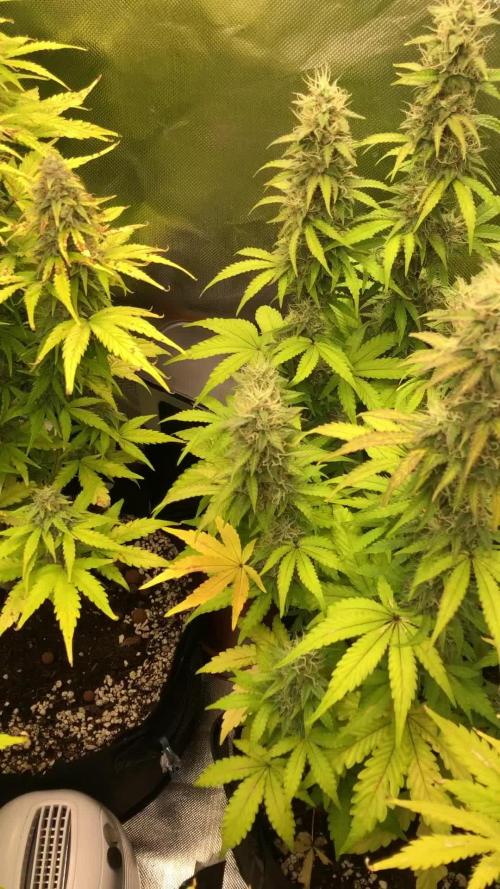
Day 70.
Last week of nutrients. Flushing will begin before this week is over actually.
Next three waterings will in general be like this:
1:
4ml Bloom + 1ml Green Sensation
2:
3ml + 1ml Green Sensation
3:
Flush from there so only pure PH water.
————————
But there is a plan for each of the 4 Bananas.
The Biggest will start flush quickest. And the healthiest will get nutrients for the longest since its behind the others and acting more like a sativa.
Sadly, im forced to harvest all at once. And right now, I think it will be around 7 november.
_____________________
I have harvested 4 topshoots of the plant I named "the biggest" since they were pretty much done and then the buds under can devolop better. I left 4-6 other tops though which were further away from the center of the light. Just to see how they progress in comparison with the ones I took down.
The ones I harvested today, was not fully flushed, so i will also compare that to the other topshoots which will get a full flush before the harvest of "the big" plant.
_______________________
The Big: around 10 days left - Flushing started
The small: Around 10 days left - Flushing started
The Bushy: around 10-14 left - Flushing in 5 days
the Healthy: around 14 days left (minimum) Ideally more like: 3 weeks - Flushing in 7 days
ATM my plan is to harvest it all latest by 7-10 november.

Likes
12
Share


@Chubbs
Follow
I hope everyone's New Year is off to a great start. These two are not the tallest but sure make up for it in flower and smell. They're stacked super tight a little to close for my liking but still healthy and happy. Over all Happy
Processing
Likes
4
Share


@ReelEyezEnt
Follow
So the at the start of week 4 the girls have taken a beating from the pesticide that I spray on them, had to take off some dying fan leaves.
the one plant is recovering nicely while her sister on the other hands need a close eye.
This week the girls will get their first watering with actual noots

Likes
23
Share


@Lapolda
Follow
Hello to all growers and friends.
The week was basically nice. I still don't fertilize, the flower looks fantastic. I'm just worried about maturing. It looks like another 3 weeks. Hold my fists.
Good luck friends
Likes
14
Share


@Chronigmatic
Follow
What to say...this girls are awesome, 2 super different phenos.
Awesome smell
Still not figured out whats that pattern on sativa one but i think 15 days i’ll make the cut.
Getting closeer