


Likes
Comments
Share


Processing
Likes
7
Share


@Kenethica
Follow
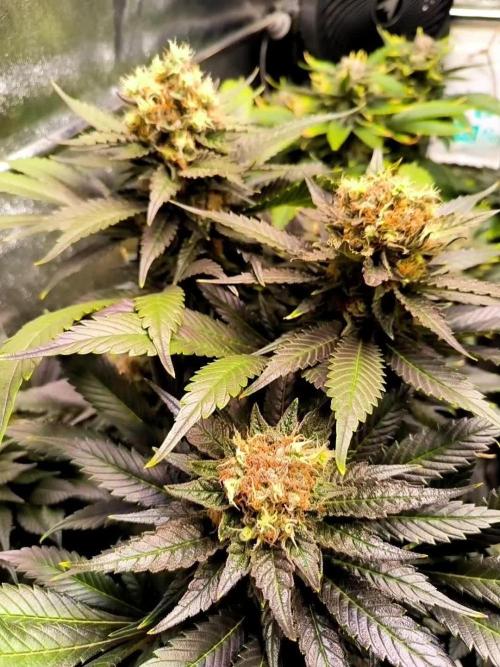
Shitty weather wooooooop, too cold and too rainy. they have been sitting inside mostly near the window with the CFL as support. Not ideal but I'd rather have less bud than rotten bud.
That being said they are fattening up nicely. Trich show more milk and the occasional amber (only saw 2 to be honest). Lower nodes are still pretty clear and still have lots of white pistils. I am thinking 1 more week of feed then start the 2 weeks of flushing.
Having a hard time watering them evenly with all the LST straps. Expecting a tiny watering can one of these days to get that even watering job.



Likes
9
Share


@Vet4weed
Follow
Well, so much for taking the hands-off approach. Winter is coming and the heater has been on, which is drying out the air more. Temperature is the same in the grow room, but humidity has plunged to 23%. Gave the plants a thorough watering with nutrients last week. Today and the rest of the week, I'm going to treat them to just plain water until next week.
UPDATE: Humidity definitely the culprit. Placed a small humidifier by the plants on Wednesday, and they sprang right back. All is going well now. Seed description says flowering phase of 11 Weeks. Should expect to begin harvesting around Dec. 20th (4 weeks from now).

Likes
Comments
Share


@ORION1_1
Follow
Still happy and doing well. Maybe a little slow since I was getting the living soil watering differences figured out. Water only living soil for now ph at 6.3-6.6
Likes
1
Share


@GaliforniaWeeds
Follow
7/9/29 día 1 de floración
Esto arranca amigos, por desgracia lo hace con unas temperaturas altísimas, con maximas de incluso 32 grados debido a la ola de calor que estamos sufriendo. Ya hemos montado el sistema de riego y lo hemos preogramado para regar durante 1min cada 4h durante el día. La solución la hemos preparado con los productos Cyco arriba descritos, con una ec de 1 y un ph de 6,1. Por otro lado nuestro jardín. Esta iluminado por 4 barras led 100w de solux, y un lec solux de 630w aunque por el momento está a 315w debido a las altas temperaturas. Para empezar la floración lo hacemos con una defoliación y una poda de ramas bajas. Estaremos atentos a cambios en las pequeñas para intentar mantener en cada momento la alimentación adecuada, sin carencia y sin excesos. No te lo pierdas!!
9/9/20 día 3 de floración
Buenas, nuestras pequeñas se aclimatan bien a la nueva alimentación y a su nuevo medio. Aumentamos la ec del tanke a 1,1ec y seguimos manteniendo el ph a 6,1. Por otro lado las temperaturas parece que disminuyen por lo que pasamos el lec de 315w a 415w, manteniendo así unas temperaturas diurnas de entre 26 y 27 grados. Esperemos que continúen descendiendo hasta poder mantener las temperaturas a 23 grados durante todo el día. La humedad ronda el 40% y estaremos atentos para que no suba de ahí. Deja tu like y síguenos para no perderte nada. Buenos humos!!
11/9/20 día 5 de floración
Nuestro cultivo avanza sin demasiados cambios, durante estos días se aprecia que las nenas aumentan su altura más rápidamente y los brotes se multiplican.seguiremos atentos para que todo siga su curso. Buenos humos.
Likes
3
Share

@Black_Widow
Follow
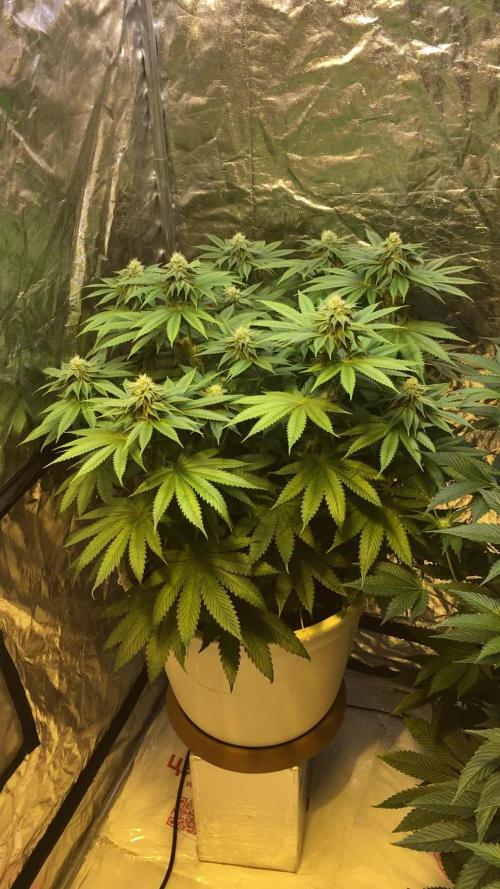
Привет садоводы и огородники !
Началась новая неделя
растения выглядят хорошо
подруга гидропоника становится больше
у ее сестры в земле уже 3 неделя цветения

Likes
Comments
Share

@All_about_420
Follow
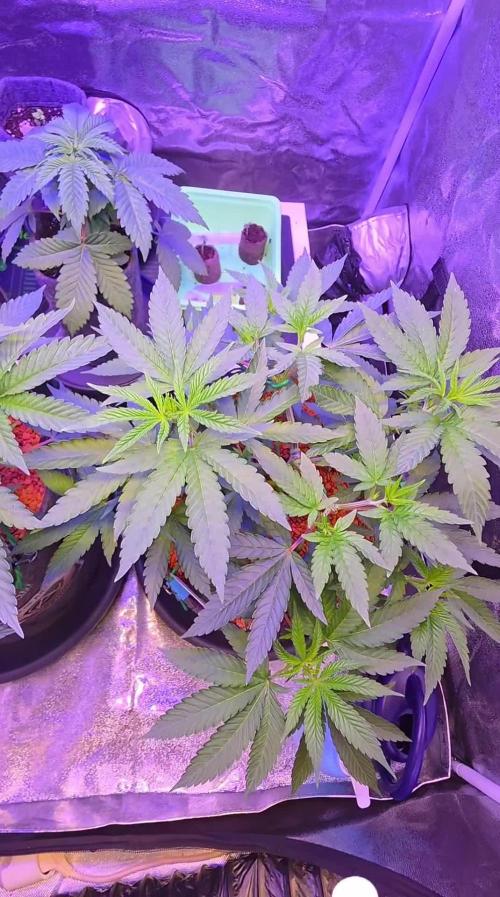
Verhält sich hier bei der Dancing Sprite genau wie bei ihrer Schwester Naughty Dawg von Wundebohnen.de aus dem Hause Seeds of Anarchy.
Aus diesem Grund bin ich mal faul und kopiere den Text gerade so wie er ist hier rein 😜
Nachdem sie sich vom letzten Stress gut erholt hat,
war es nun an der Zeit für das zweite Topping , mehr LST und ein bisschen Defolierung.
Die Genetik enttäuscht bisher kein bisschen. Im Gegenteil.
Jegliche Tortur, sei es vom Umtopfen, oder vom Training, steckt sie sehr gut weg,
was sich durch schnellen Wuchs und keinerlei Mangel- oder Stressanzeichen widerspiegelt.
Noch eine weitere Erholungsphase vor dem finalen Zurechtschneiden- und biegen vor der Blüte...


Processing
Likes
5
Share


@Mr_nugs_lover_David
Follow
She looks very healthy, sticky nuggets, exact same aroma as her sisters, very citric and lemony. Let's see how she keeps developing

Processing
Likes
3
Share


@GanjaFarmerGrow
Follow
Dispite having problems and bad conditions she managed to pull through...
I am verry happy with the way she is going after all..
She is very tall and the buds are bending the branches...
she strangly smells of blueberry...
last week of feeding..
hope she goes well...
fingers crossed...
🙏

Likes
42
Share


@Ultraviolet
Follow
Thank you. Gave her a cocktail to help with stress. Added 1st net for lateral support, not so much now, but for later. Blue light is absorbed by photoreceptor proteins called phototropins, which trigger a hormonal response that causes cells on the shaded side to elongate, making the plant bend toward the light. Try and fill this side a little. She is quite big already, just needs to find her stride again after the undue torture.
5 apex stems with 20-30 mini cola, let them develop a little, with the apical dominance shattered, all those 20-30 will all compete with each other as soon as that stretch is initiated. Key to a good stretch is making sure the plant is cycling efficiently, with large ATP conversions occurring lights out.
For now, I'm keeping light intensity high. A plant will slow its vertical growth in very high light intensities, leading to a more compact form with thicker stems and leaves. This response is a protective mechanism against light stress, which can damage the photosynthetic apparatus and lead to symptoms like leaf scorching, yellowing, and brittleness. Instead of growing taller, the plant invests its energy into creating a more robust, stress-tolerant structure.
Providing plants with necessary antioxidants helps protect the photosynthetic apparatus by scavenging reactive oxygen species (ROS) that cause damage from excess light.
UV light exposure can impact the xanthophyll cycle by either enhancing its photoprotective role or causing damage, depending on the intensity and type of UV radiation. UV exposure can trigger the synthesis of more xanthophyll cycle pigments to increase the plant's capacity to dissipate excess energy, but it can also cause direct damage, particularly to Photosystem II, and may lead to a decrease in the de-epoxidation state (DEPS ratio) which indicates a reduced capacity to dissipate excess energy.
Plants can respond to UV stress by increasing the synthesis of xanthophyll cycle pigments, such as violaxanthin and zeaxanthin, to improve their photoprotective capacity. UV-induced changes in xanthophyll cycle pigments can be linked to a plant's overall tolerance to high radiation stress. The xanthophyll cycle helps protect against photoinhibition, which is especially important when the plant is exposed to high levels of both UV and visible light. High doses of UV radiation can directly damage photosynthetic components, including the proteins, lipids, and pigments in the thylakoid membranes. Exposure to UV radiation can have a mixed effect on the de-epoxidation state (DEPS ratio) of the xanthophyll cycle pigments. In some cases, UV can inhibit the conversion of violaxanthin to zeaxanthin, resulting in a lower DEPS ratio and a reduced capacity for energy dissipation. However, the total pool of xanthophyll cycle pigments may increase, and this enhanced pool size could provide a greater potential for photoprotection despite a lower DEPS ratio.
The xanthophyll cycle works alongside other mechanisms, such as the accumulation of flavonoids (UV screens), to protect the plant from UV-induced damage.
Blue light repairs 100% UV-induced damage in plants through a process called photoreactivation, which uses a light-dependent enzyme called photolyase. This enzyme uses energy from blue and UV-A light to directly reverse the damaging pyrimidine dimers in the DNA caused by UV-B radiation, a key mechanism for maintaining the plant's genetic integrity.
After carbon, light, water, temperature, and nutrients, the limiting factor of a plant's growth is often its own internal factors or the amount of a key ingredient. Chlorophyll concentration is one such factor, as the amount of this pigment limits how much light can be captured for photosynthesis. Other factors include chloroplast number, respiration rate, and the concentration of carbon dioxide in the atmosphere, as plants are often in a CO2-deficient condition.
60x60x18=64800seconds x 700 = 45,360,000moles. 45DLI
Exposure to 165 µW/cm² of ultraviolet-B (UV-B) light for 3600 seconds = 1 hour, a extremely high, acute dose triggering stress responses and protective mechanisms.
.
The plant's photoreceptor protein, UVR8, senses the UV-B radiation. This triggers a signaling cascade that activates specific genes to protect the plant from damage. In response to the UV-B signal, the plant ramps up the biosynthesis of protective compounds like flavonoids, phenolic acids, and anthocyanins. These compounds absorb UV radiation and accumulate in the epidermal layers of leaves to shield inner photosynthetic tissues. The plant may increase leaf thickness or deposit more cuticular wax, creating a physical barrier to the radiation. The plant will produce more enzymatic and non-enzymatic antioxidants to neutralize the reactive oxygen species (ROS) produced by the UV-B radiation. The plant activates enzymes, including photolyases, to repair DNA damage caused by the UV-B. These repair mechanisms are critical for preventing permanent genetic mutations.
While protective measures are activated, a high dose delivered over a short period can cause stress that overwhelms the plant's defenses.
Photosynthesis is highly sensitive to UV-B. A high dose can inactivate Photosystem II (PSII), damage thylakoid membranes within the chloroplasts, and reduce chlorophyll content, which lowers the plant's overall photosynthetic capacity. Despite repair mechanisms, high UV-B doses can inflict persistent damage on the plant's DNA. The overproduction of reactive oxygen species can cause oxidative stress, leading to the oxidation of lipids and proteins and disrupting cellular function.
Likes
21
Share


@GODSGIFT_2005_JM
Follow
🍼Greenhouse Feeding BioGrow
⛺️MARSHYDRO
The ⛺️ has a small door 🚪 on the sides which is useful for mid section groom room work. 🤩
☀️ by VIPARSPECTRA (models: P2000 & XS 2000)

Likes
66
Share


@DogDoctorOfficial
Follow
So far so good they are handling quite good , keeping ,y Ppfds around 1400 on average with some points closer to 1600 Umols/m2s 😜🤦♂️💪💪💪 always believing hahahaha
Day 32 Flower and all seems to be running on track , leafs are tip burned just as i like , this means im pushing them to they’re limits , more they wold go in lock mode and that as we all know is not a good thing 😆
Day 32 Flower and I’m starting to think in defoliation again, i know im not supposed, but as always i will read my garden and leaf strip as many times needed during flower or no flower time 😆😜😅💚 let’s see how they grow but i fell they need space asap already 😆💚💚💚
Trying big numbers on the Ppfd department and see how far they can take without supplement extra CO2, i mean i have the bags they help but lol
Ppfd- 1400 Umol/m2s
VPD- 1.51 kPa
Girls :
Tropicana Poison @sweetseeds - 7X
Chocolate Skunk @00seeds - 2X
Badazz Cookies OG @seedsman- 3X
Lights 2X Lumatek Zeus 465W Compact Pro @ 100%
All i Grow is medicine for myself, i do it with love for the love 💚💚💚
Growers love to you all

Likes
5
Share


@Xpie77
Follow
🌸 Kweekverslag – Amnesia Autoflower (Hy Seeds)
Week: 5 totaal – Week 1 van de bloei
Type: Autoflower (Sativa-dominant)
Aantal planten: 5
Medium: Aarde (lightmix)
Potten: 11 liter
Verlichting: Mars Hydro 450W LED
Lichtschema: 20/4
Temperatuur: 22–26°C
Luchtvochtigheid: 50–55%
---
🌱 Plantontwikkeling
Planten zijn gemiddeld 40–60 cm hoog (afhankelijk van fenotype & training).
Bloei is begonnen: witte bloeiharen (pistils) goed zichtbaar op top en zijtakken.
Stretch-fase volop bezig → sommige planten groeien nu 3–5 cm per dag.
Structuur: slank, sativa-achtig met veel zijtakontwikkeling.
---
✂️ Training (indien gedaan)
✅ LST kan nog worden afgemaakt (geen toppen bij autoflowers).
⛔ Geen nieuwe stress (zoals defoliatie of buigen van dikke stengels).
✅ Blad een klein beetje uitdunnen onderaan indien luchtcirculatie beperkt is.
---
💧 Watergift & Voeding
Watergift: Om de 2 dagen bij ±50% droog gewicht pot
pH: 6.3–6.5
Voeding aanpassen naar bloei:
Biobizz Bloom: 2–3 ml/L
Biobizz Top Max: 1 ml/L
Biobizz Grow: 1–1.5 ml/L (nog licht aanhouden tijdens stretch)
Eventueel CalMag 0.5 ml/L bij tekenen van tekorten (LED-kweek → soms nodig)
---
🔍 Waarnemingen
Gezonde bladstand, donkergroen en licht omhoog gericht ("biddend")
Witte pistils zichtbaar op hoofdtop en zijtakken
Geen verbrande punten, geen overvoeding
Geur begint zich te ontwikkelen: scherp citrus/haze profiel

Likes
2
Share


@OS_Farmz
Follow
Flowering goes good, also found the possible reason of slowy grow of one of the plants.

Likes
2
Share

@IceGenetics
Follow
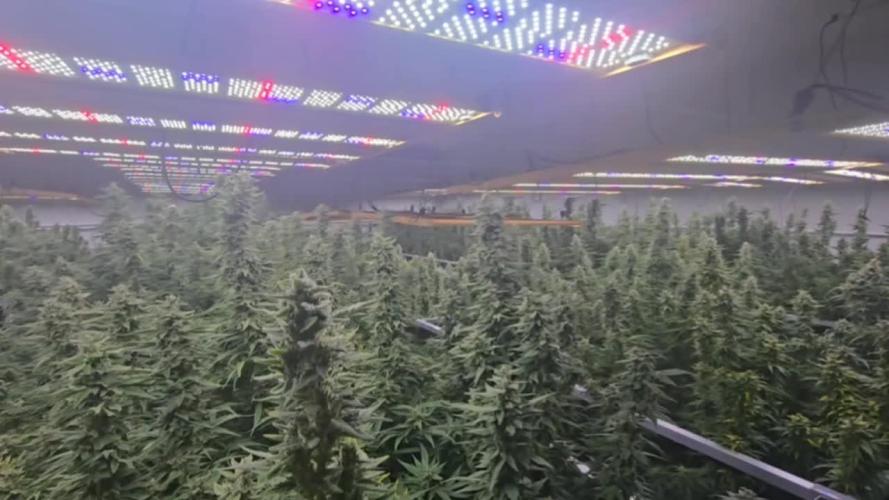
Today, day 80. Plant height 120–155 cm. Over just over 2 weeks, the bushes have gained a decent amount of mass.
Nutrient concentration — 1050 ppm, room temperature daytime up to 26 °C, nighttime up to 22 °C, CO2 concentration about 1000 ppm, and humidity 40%. The light schedule is 18 hours of light and 6 hours of darkness. PPFD — 950. Visually, over two weeks the bushes have gained mass excellently, the inflorescences continue to swell very vigorously. The fertilizers at 1050 ppm were already mixed for full flowering with an emphasis on PK. Increased the duration of shots (irrigations).
We remind you, friends, of the goals of our grow report:
- To check the autoflowering genetics and strains that we've been working on for over 5 years.
- To test the new fertilizer composition.
- To study the final yield indicators per m² in "classic" mode, using a minimum of training.
- To check this cultivation economic model with the ratio of labor costs (man-hours), spent resources and funds.
P.S. For reasons of privacy, intellectual property, and commercial secrecy, some additional goals are not disclosed.
We are confidently and steadily moving toward the set goal, friends-rastamans! 🧐


Likes
48
Share


@Rangaku
Follow
This GSC is a beast of a thing that will love some more room to really spread out once the cherry colas are out . Throwing the K in now , maybe another month to go
Likes
81
Share


@Hou_Stone
Follow
This week i flush the roots with tap water ( PPM : 310 , PH : 7.5) after i add water with 0.7 grow powder and 0.1g of Booster PK+ to reach 720PPM and adjust PH to 5.8
----------------------------------------------------
-Daytime temperature: 27°C
-Night temperature: 23°C
-Humidity: 45-65%
-Lamp: Mars Hydro FC3000. intensity 80% at 40cm from the top leaves
-Room: Mars Hydro 100x100x180cm
-Extractor: Mars hydro 402 CFM Max. power 2/10
-Substrate : 70% coco, 25% perlite, 5% vermiculite.
My instagram : https://www.instagram.com/p/CuMhQ_BsjRP/?utm_source=ig_web_copy_link&igshid=MzRlODBiNWFlZA==
