The Grow Awards 2026 🏆
Likes
Comments
Share
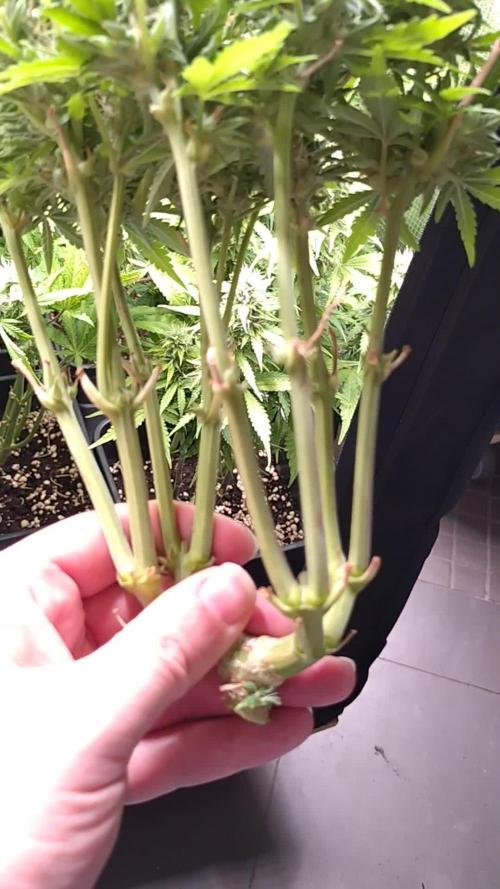
Hey guys and welcome to start of Week 8! 🌻 Today is day 21 of flower so i went ahead and cut most of the plats Fanleaves off. It took a while but now the Airmovement is improved and the humidity should also be lower. I also hope I didn‘t stress them too much. From now on they will be reseaving less and less Nitrogen going forward. I hope the colours come through as well 🤞🏻 Thanks for following along and I will keep updating the progress. Happy growing 🍀

Likes
Comments
Share
@Leanback
Follow
Short summary of my pheno hunt for a gas strain to build up a lib
Likes
24
Share
SWISS DREAM ROSE 🌹 CBD AUTO KANNABIA SEEDS Week #4 Overall June 16th-23rd Week #1 Flower This week she started to flower good thing she stretched to about 13 inches hopefully she'll stretch more to make room for buds. No issues this week. Stay Growing!! Kannabia.com SWISS DREAM ROSE 🌹 CBD AUTO
Likes
45
Share
2nd net is up. Early bud formations are promising. holding up to the extremes pretty well, some leaves taking minor damage, but overall, she is holding up, gave her 1 night at 50F see how she would react, stressful. Not advised as it messes with her metabolism, but I want to see if it triggers any anthocyanin response. Love to see her purp up but no signs yet. Homework. If Rubisco activity is impaired and it cannot properly function or regenerate its substrate, the plant's leaves are likely to turn a pale green or lime green, a condition known as chlorosis. Essentially, Rubisco activity is highly regulated and susceptible to various environmental and metabolic factors that can cause it to become inhibited, leading to an apparent failure in RuBP regeneration due to a lack of consumption. Rubisco regeneration is intrinsically linked to nitrogen supply because Rubisco is a major sink for nitrogen in plants, typically accounting for 15% to over 25% of total leaf nitrogen. The regeneration phase itself consumes nitrogen through the synthesis of the Rubisco enzyme and associated proteins (like Rubisco activase), and overall nitrogen status heavily influences the efficiency of RuBP regeneration. RuBisCO is a very large enzyme that constitutes a significant proportion (up to 50%) of leaf soluble protein and requires large investments in nitrogen. Insufficient nitrogen supply limits the plant's ability to produce adequate amounts of RuBisCO, thereby limiting the overall capacity for photosynthesis and carbon fixation. Maintaining the optimal, slightly alkaline pH is crucial for the proper function and regeneration of Rubisco. Deviations in either direction (too high or too low) disrupt the enzyme's structure, activation state, and interaction with its substrates, leading to decreased activity and impaired RuBP regeneration. (LIME GREEN CHLOROSIS) Structural Component: Nitrogen is an essential building block for all proteins, and the sheer abundance of the Rubisco protein makes it the single largest storage of nitrogen in the leaf. Synthesis and Activity: Adequate nitrogen supply is crucial for the synthesis and maintenance of sufficient Rubisco enzyme and Rubisco activase (Rca), the regulatory protein responsible for maintaining Rubisco's active state. Nitrogen deficiency leads to a decrease in the content and activity of both Rubisco and Rca, which in turn limits the maximum carboxylation rate, Vmax, and the rate of RuBP regeneration Jmax, thus reducing overall photosynthetic capacity. Nitrogen Storage and Remobilization: Rubisco can act as a temporary nitrogen storage protein, which is degraded to remobilize nitrogen to other growing parts of the plant, especially under conditions of nitrogen deficiency or senescence. Nitrogen Use Efficiency (NUE): The allocation of nitrogen to Rubisco is a key determinant of a plant's photosynthetic nitrogen use efficiency (PNUE). In high-nitrogen conditions, plants may accumulate a surplus of Rubisco, which may not be fully activated, leading to a lower PNUE. Optimizing the amount and activity of Rubisco relative to nitrogen availability is a target for improving crop NUE. Photorespiration and Nitrogen Metabolism: Nitrogen metabolism is also linked to the photorespiration pathway (which competes with carboxylation at the Rubisco active site), particularly in the reassimilation of ammonia released during the process. To increase RuBisCO regeneration, which refers to the process of forming the CO2 acceptor molecule Ribulose-1,5-bisphosphate (RuBP) during photosynthesis, the primary methods involve optimizing the levels and activity of Rubisco activase (Rca) and enhancing the performance of other Calvin-Benson-Bassham (CBB) cycle enzymes. Biochemical and Environmental Approaches: Optimize Rubisco Activase (Rca) activity: Rca is a crucial chaperone protein that removes inhibitory sugar phosphates, such as CA1P (2-carboxy-D-arabinitol 1-phosphate), from the Rubisco active site, thus maintaining its catalytic competence. •Ensure optimal light conditions: Rca is light-activated via the chloroplast's redox status. Adequate light intensity ensures Rca can effectively maintain Rubisco in its active, carbamylated state. •Maintain optimal temperature: Rca is highly temperature-sensitive and can become unstable at moderately high temperatures (e.g., above 35°C/95F° in many C3 plants), which decreases its ability to activate Rubisco. Maintaining temperatures within the optimal range for a specific plant species is important. •Optimize Mg2+ concentration: Mg2+ is a key cofactor for both Rubisco carbamylation and Rca activity. In the light, Mg2+ concentration in the chloroplast stroma increases, promoting activation. •Manage ATP/ADP ratio: Rca activity depends on ATP hydrolysis and is inhibited by ADP. Conditions that maintain a high ATP/ADP ratio in the chloroplast stroma favor Rca activity. Enhance Calvin-Benson-Bassham (CBB) cycle enzyme activity: The overall rate of RuBP regeneration can be limited by other enzymes in the cycle. •Increase SBPase activity: Sedoheptulose-1,7-bisphosphatase (SBPase) is a key regulatory enzyme in the regeneration pathway, and increasing its activity can enhance RuBP regeneration and overall photosynthesis. •Optimize other enzymes: Overexpression of other CBB cycle enzymes such as fructose-1,6-bisphosphate aldolase (FBA) and triose phosphate isomerase (TPI) can also help to balance the metabolic flux and improve RuBP regeneration capacity. Magnesium ions, Mg2+, are specifically required for Rubisco activation because the cation plays a critical structural and chemical role in forming the active site: A specific lysine residue in the active site must be carbamylated by a CO2 molecule to activate the enzyme. The resulting negatively charged carbamyl group then facilitates the binding of the positively charged Mg2+ion. While other divalent metal ions like Mn2+ can bind to Rubisco, they alter the enzyme's substrate specificity and lead to dramatically lower activity or a higher rate of the non-productive oxygenation reaction compared to Mg2+, making them biologically unfavorable in the context of efficient carbon fixation. The concentration of Mg2+ in the chloroplast stroma naturally increases in the light due to ion potential balancing during ATP synthesis, providing a physiological mechanism to ensure the enzyme is activated when photosynthesis is possible. At the center of the porphyrin ring, nestled within its nitrogen atoms, is a Magnesium ion (Mg2+). This magnesium ion is crucial for the function of chlorophyll, and without it, the pigment cannot effectively capture and transfer light energy. Mg acts as a cofactor: Mg2+ binds to Rubisco after an activator CO2 molecule, forming a catalytically competent complex (Enzyme-CO2-Mg2+). High light + CO2) increases demand: Under high light (60 DLI is a very high intensity, potentially saturating) and high CO2, the plant's capacity for photosynthesis is high, and thus the demand for activated Rubisco and the necessary Mg2+ cofactor increases. Mg deficiency becomes limiting: If Mg2+ is deficient under these conditions, the higher levels of Rubisco and Rubisco activase produced cannot be fully activated, leading to lower photosynthetic rates and potential photo-oxidative damage. Optimal range: Studies show that adequate Mg2+ application can enhance Rubisco activation and stabilize net photosynthetic rates under stress conditions, but the required concentration is specific to the experimental setup. Monitoring is key: The most effective approach in a controlled environment is to monitor the plant's physiological responses e.g., leaf Mg2+ concentration, photosynthetic rate, Rubisco activation state, and adjust the nutrient solution/fertilizer to maintain adequate levels, rather than supplementing a fixed "extra" amount. In practice, this means ensuring that Mg2+ is not a limiting factor in the plant's standard nutrient solution when pushing the limits with high light and CO2. Applying Mg2+ through foliar spray is beneficial to Rubisco regeneration, particularly in alleviating the negative effects of magnesium (Mg) deficiency and high-temperature stress (HTS). While Mg can be leached from soil, within the plant it is considered a mobile nutrient, particularly in the phloem. Foliar-applied Mg is quickly absorbed by the leaves and can be translocate to other plant parts, including new growth and sink organs. Foliar application of: NATURES VERY OWN MgSO4 @ 15.0g L-1 in a spray bottle. Foliar sprays are often recommended as a rapid rescue measure for existing deficiencies or as a supplement during critical growth stages, when demand for Mg is high. Application in the early morning or late evening can improve absorption and prevent leaf burn. The starting point [of creativity] is curiosity: pondering why the default exists in the first place. We’re driven to question defaults when we experience vuja de, the opposite of déjà vu. Déjà vu occurs when we encounter something new, but it feels as if we’ve seen it before. Vuja de is the reverse—we face something familiar, but we see it with a fresh perspective that enables us to gain new insights into old problems. Come walk in the enchanted forest.
Likes
13
Share
So after 9 Weeks of Veg we are finaly in Bloom Modus Someone broke the mainstream last night
Likes
4
Share
WK2F - regular scheduled watering day 2 week 2 of flower in 3x3 tent. Beginning to see first signs of bud(lets) forming on clones. Raining this week, so increased airflow and running humidifier to maintain a 53-55% ROH. LED lighting adjusted to maintain 12" distance during flower stretch. PPFD adjusted PAR to maintain range of 600-900. Scheduled IPM foliar spray. WK6V - regular scheduled watering day 6 week 6 in 2x4 tent. Raining so increased airflow and running humidifier to maintain 55-60% ROH. LED lighting set at 12" height during veg. PPFD adjusted PAR to maintain range of 400-600. Scheduled IPM foliar spray. WK1V - first full watering of Afgooey Autos in one gallons day 1 week 1 in 2x2 veg tent. 12 clones (variety of cuttings) Day 7. Day6 added 1+ cups of water to base of tray to hydrate peat pellets and closed humidity vents 90% shut. Maintain high misty humidity in dome. Clones appear fine, but no sign of rooting. Maintain current environmental conditions thru days 8-9.
Likes
5
Share
Struggling with temps this week, heat wave in uk and tent getting up to 32c during the day. Bought a dehumidifier for the final few weeks of flowering so hopefully can get it down to at least 40% and should cool down this week. Suffering from nite burn on the gorilla glue, think it maybe due to plant taking in nutrients too fast due to the heat so have scaled down for now. Having said all this still really happy with how my first grow is going and now can’t wait to see the final outcome! Happy growing!
Likes
12
Share
@Luv2Grow
Follow
Day 57 - Starting week 9 and thinking I might give her one more week or so. Might end up chopping the top colas and letting the bottom buds catch some light for a week and then harvest the rest.
Likes
24
Share
@MrPott
Follow
Really surprised with how everyone turned out! Everyone is starting to flower but Kayla definitely got the lead in terms of pistils and bud sites. These ladies still need to be LST every other day. Looking forward to an early harvest!
Likes
54
Share
@rhodes68
Follow
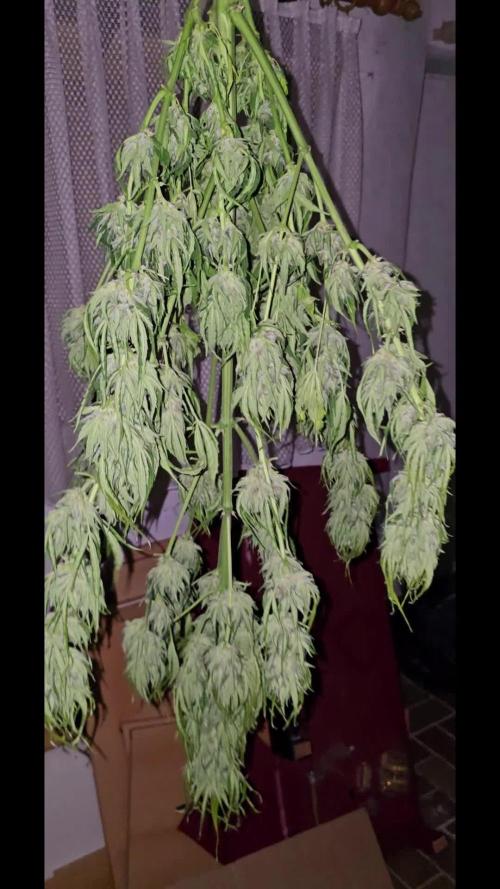
What a frosty strain, rivals Stardawg in the stickiness. Good resin potential Not a big feeder, normal levels do the trick as they will show some burn if they dont like it. Not a stinker at all Will try to foxtail @ 85F The stretch caused by the tent space issues with the Green Crack really shows here, man 2 ft of plant that was not needed. My fault, start flower under blue or white lights until stretch ends as they will get tall Serious stretch under HPS Excellent genetics, taste test in a few days I _ WANT_ MORE ... please 😉 Letting the FF7 stay in the tent a bit longer, removed all but the small fans to keep the air moving but slow down the rate. Just test weights (love hanging them like this) say @200g a plant. maybe we will see Almost forgot, pulling a small branch from Aeryn to test Easy harvest, nice dense frosty sticky buds, cannot ask for more.
Likes
4
Share
@SamDo
Follow
This week marks Week 18 of veg for the Pineapple Upside Down, and things are getting interesting. The plant is still pushing hard, stacking growth on all sides — more height, more volume, more density. She’s clearly in that phase where she’s comfortable, full of energy, and ready to take every bit of space you give her. But that’s exactly where the challenge begins. Right now, I still can’t move her into the bloom tent. There’s another plant finishing inside, so the space isn’t free yet. And that delay changes the whole strategy, because this girl is getting tall — fast. So the main question of the week is the same one I’ve been wrestling with for a while: Should I let her stretch and plan a SCROG, or should I top her to keep things low and contained? And to be honest, I’m still not ready to decide. I want to see her in her final environment before making that call. Transplanting into the bloom tent will change the lighting, the airflow, the VPD, the root-zone rhythm — and I don’t want to shape her structure blindly before she settles in. On top of that, she’ll need a short acclimation period once she’s transferred, so there’s no point in rushing structural training now. It could do more harm than good. So for the moment, the rule is simple: don’t touch anything. I’m keeping her on the same settings, same nutrition, same EC, same feeding schedule. She’s clearly thriving, and when a plant is this comfortable, the smartest move is not to interrupt her momentum. You can feel she’s building up internal energy — thicker stems, fuller leaves, faster node spacing. All of that will pay off in bloom, as long as I manage the height correctly once she moves to her final tent. This week is all about timing. Letting her grow, monitoring the stretch, and holding the decision until the very last moment. The more I watch her, the more I realize that patience here is probably the winning move. For now, she’s healthy, beautiful, vigorous, and still accelerating. No signs of stress, no burn, no deficiencies. Just a plant in full confidence. Next week should be decisive — hopefully the bloom tent will finally be free, and I’ll get a clearer picture of the strategy: SCROG or top. Until then, she keeps growing… and I keep observing.
Likes
20
Share
@ukterpdoc
Follow
Everything going well c02 bags shoud activate soon so with fans being able to run so low because of the led's I expect bags to be a winner got co2 kit ram controller was going to wait till next run which will be sealed but might give it a try as fans running so low (Any comments friends?)
Likes
24
Share
@nonick123
Follow
Cosecha Reporte de Peso húmedo & Peso Seco de KS1 by Terpyz Mutant Genetics ⚖️ Total peso húmedo 404 ⚖️ Total peso seco TBD 💦Pérdida de H2O durante el proceso de secado TBD 🎨Colores Un color verde claro completamente perlada de tricomas! 👃Olores 💐Floración Principalmente kush: terroso (predominante), notas de pino, combustible, toque de cítricos y ligero fondo de skunk 🏜️ Secado TBD 🍗 Curado TBD 🍽️Sabor A definir cuando esté bien curada en el reporte de humo Variedad 💪Resistencia Resistente 5/10! - MUY afectada por el bloqueo de nutrientes que se ha presentado en la mayoria de plantas de este ciclo. No he conseguido erradicar la mosca blanca que ha estado presente en toda la floración! 🏋️‍♂️Entrenamiento: Se ha adaptado bien al topping (en 2 ocasiones), supercropping y LST! 🌱Vegetativo: Un vegetativo sin incidencias, aunque no creció mucho... 💐 Floración: Cogollos no muy densos por el bloqueo de nutrientes, pero cubiertos de muchos tricomas y con un aroma kush delicioso! Genética: Regular trabajo de breeding de Terpyz 👨‍⚖️Conclusión: Una cepa a probar en otras condiciones. No resistente. Pero perfil terpenico kush muy apreciado!
Processing
Likes
5
Share
Likes
30
Share
@RakonGrow
Follow
Note : + jegliches Zubehör wird in der GermniationsWoche aufgelistet . Ich hab keine Ahnung was es wiegt , da ich keine Zugwage hatte. Warten wir also ab was es an trockengewicht wirklich wird. Aber da ist viel Drann , bei 116cm größe ist selbst der kleinste Bud noch groß :)) Es sind nach 5 Tagen Trocknung bei 22°C und 55%rH genau 204g
Likes
Comments
Share
@420stuffs
Follow
Offers a unique flavor profile with earthy and garlic notes. High THC content makes it a favorite for concentrates. Order Now 🔥✅ Chat Telegram @cerianberigam
Likes
1
Share
They will all be ready at different times so that'll make harvest easy. Orion is finishing up for harvest and smells like sweet candy/berry same with Quick one. They all have distinct smells and are beautiful. Will be chopping the two by next week. I'm impressed how all these girls strived through storms, extreme heat, and a newbie grower. (Did tons of research)
Likes
4
Share
@Filiaes
Follow
20.05 Noticed one girl with some drinking issues ... maybe some problem with the capilar effect of the autopot system. Top watered this plant and will inspect that one a bit closer the next days. Except that am really happy about the grow at the moment, the autopot system safe so much time, it's impressive. 22.05 Installed a ScrOG net