


Likes
Comments
Share


@UDUDUDUDU
Follow
da secret of why plants need ventilation is two things.
one da air moves da plants cells allowing them to stretch.
two da air helps maintain a plants electromagnetic charge.

Likes
3
Share


@AestheticGenetics
Follow
5/6/25 the trichomes on this plant are spectacular and special. The cameras not picking it up very well but they shine so freaking bright. brighter than other strains. She also has a very unique smell. The breeder mentioned that thesr equatorial photo periods that show autoflower traits have a unique high as well and i wonder if thats due to the unique smell/ terpenes shes
Likes
44
Share


@SooSan
Follow
12/12 + 19 jours
1️⃣
🏠 90x60x90
☀️ FC-E 4800 => puissance a 30%
🍁
1x Black Bomb / Philosopher Seed
2x Amnesia Lemon / PEV Seeds
1x Blueberry / PEV Seeds
1x Blueberry / 00 Seeds
1x Wappa / Paradise Seed
1x Dark Phoenix / Green House Seed
1x Quick Sherbet / Exotic Seeds
1x Mango Cream / Exotic Seeds
1x Banana Frosting / Sensi Seed
1x Hindu Kush / Sensi Seed
4x Fast Mix / Sweet Seed
📎 https://growdiaries.com/diaries/122084-grow-journal-by-soosan
📎https://growdiaries.com/diaries/124052-grow-journal-by-soosan
2️⃣
🏠 30x60x50
☀️TS1000 => puissance a 60%
🍁 4x Quick Sherbet - Exotic Seed
📎 https://growdiaries.com/diaries/122080-grow-journal-by-soosan
Sponsorisé par Mars Hydro


Likes
6
Share

@CheeRz
Follow
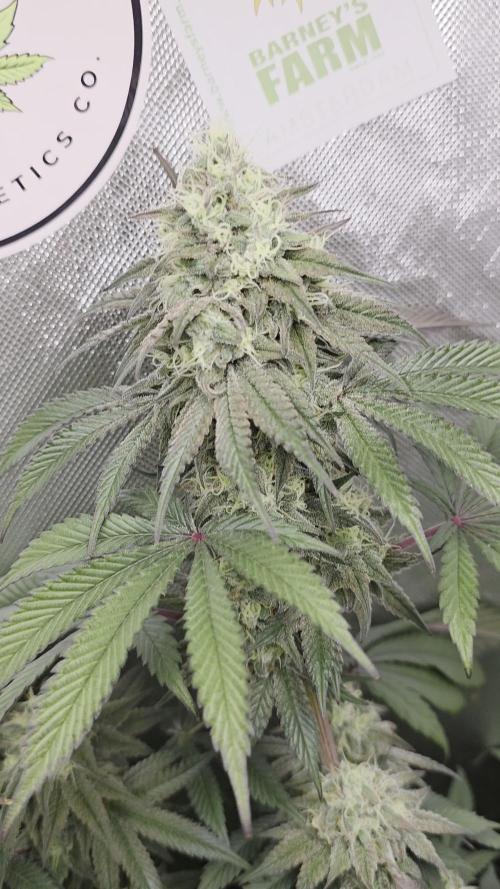
WEEK 10 - FLOWERING: Tropical Maturation
🌼 FLOWERING PROGRESS
We are now in the 10th week (6th week of flowering), and the Papayton is showing impressive development. The buds are visibly gaining weight and density every day. The resin production is in full swing, covering the flowers in a thick, sticky layer of crystals. It’s great to see how the plant is putting all its energy into the final flower formation. ❄️
👃 TERPENES & AROMA
The tropical scent is becoming much more defined this week. There is a strong, sweet papaya aroma that dominates the tent, perfectly complemented by a creamy finish. The Top-Max is clearly doing its job in bringing out these exotic fruit notes as the plant matures. 🍦
💧 NUTRIENT FEEDING & WATERING
The feeding schedule remains at a high level to provide all the necessary building blocks for the final ripening process. The focus is on maximizing terpene development and resin output.
Current Feeding Schedule:
Calmag: 1.5 ml/l
Acti-Vera: 5 ml/l
Bio-Heaven: 5 ml/l
Bio-Bloom: 4 ml/l
Top-Max: 5 ml/l
Bio-Grow: 1 ml/l

Likes
24
Share


@Jays_Not_Here_Man
Follow
The girls have been very busy making golf balls this week!
At the beginning of the week there was not much to do, the girls had stopped stretching and were settled in. In my 2x4 tent, all I had to do was tuck fold the leaves to open up the bud sites.
I basically did the same for my big tent. Simply moved some leaves from blocking sites, and plucked just a few that were rather large.
They are still needing to be watered every 72 hours or so. I have been keeping to a feed, water, feed schedule now that we are into flower. I just started to notice that some of the tops are showing some nutrient burn, just a little, and not every plant. This tells me I have hit their limit with the nutrients, somewhere between 700 and 750 ppm. The last watering I did, I watered to about 10% runoff, trying to make sure that there are no salt or mineral buildup that can cause lockout or other issues.
At the end of the week, day 21, I defoliated both tents, not too much, but enough to open up the bottom growth a bit. Also tidied up the lower portion below the trellis, as this just wastes energy and yield from the main colas in the long run. No real issues or problems so far, Happy Gardening Folks! 🇨🇦👊❤️😎💨

Likes
4
Share

@Jabbamo
Follow
_______________________________________________________
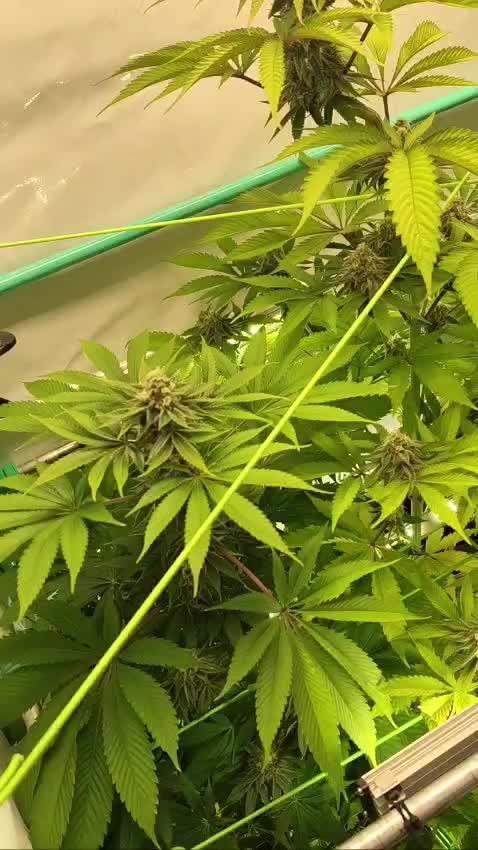
Mi. 25.3.
- 3,5 Liter pro Pflanze gegossen (ca. 200ml Drain)
- Rainpoint Bewässerungssystem eingesetzt
- 1L auf 3 Pflanzen Nährlösung per Hand angegossen
- Programm: 3min. ON / 3min. PAUSE / 3min. ON
- 2L pro Zyklus.
- 1L klar spülen zur Systemreinigung
1,2 ml / Liter "Calmag"
1,5 ml / Liter "Bio Grow"
4,0 ml / Liter "Bio Bloom"
4,0 ml / Liter "Top Max"
Ph 6,2 / 790 ppm
_______________________________________________________

Likes
97
Share


@AsNoriu
Follow
Day 106. Trim jaiiiiiilllllllll !!!!
First done, think it could reach my record 240. Insane quality. 4 rows of solid buds hanging ....
Next one ....
Both finally finished and honestly, that's my plants to be proud of !!!
Day 114. All is done, no doubts its my best grow.
Happy Growing !!!

Likes
41
Share


@TerpTurtle
Follow
15 Day dry then trimmed using the Trim Bin.
Curing with Grove bags, first harvest filled 3, 1/4lb grove bags.
*Updating with clone pictures of this pheno in late flower labeled in diary as you look through, If I pop a new seed of this strain Ill start another diary

Likes
17
Share


@Canna96
Follow
Hey now, hope everyone is staying safe, good week for the Red Hot Cookies, she is still looking a little deformed with her leaves, but she is green and healthy. The Medic Grow is still running at 30% in the V1 or vegetative stage which is the mostly blue spectrum. I am watering them every other day or so with a small syringe around the edge of the solo cups. I am hoping to transplant them i about 48 hours to 3.4 gallon airpots and hook them up to an automatic fertigation system that feeds every 6 hours or so.
I hope everyone has a peaceful weekend, thanks for stopping by, Stay Safe and Blaze On!!! 💪
Website: https://medicgrow.com/
https://growdiaries.com/grower/medicgrowled

Likes
6
Share

@Weed_Wizard
Follow
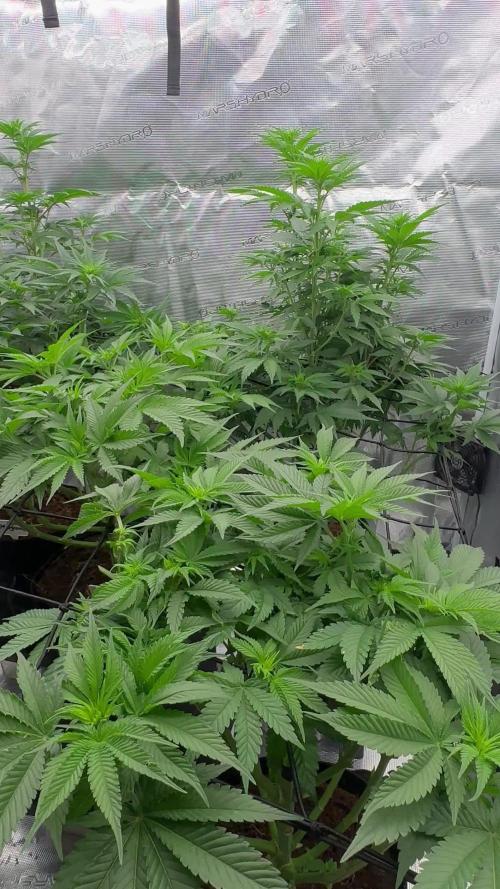
Welcome to week 8 🌱✨
The Girl Scout Cookies ladies are doing good so far. I did some more defoliation and lollipopping. I guess the stretch will be done soon. Unfortunately Salem and Morgana are still standing tall in the back. I still have no idea how to get those main stems out of the hotspot.
Edit: I installed an automatic watering system today. Indicidual treatment for every lady. Let’s see how they’ll like it. 🧙♂️

Likes
9
Share


@Cestlaweed
Follow
La temperatura sigue elevada debido la zona, pero las plantas no presentan problemas y se cuenta con buen sistema de ventilación.
Día 18 noche se riega con 1ml/L de Top Veg, fertilizante de crecimiento de TopCrop.
Día 19 segundo día de entrenamiento

Likes
20
Share


@Santica_Garden
Follow
So this is how things are looking for the ladies at the end of Week 6 of Veg, I have uploaded a video for you guys with all the information, any questions just ask away 👍🏾👊🏾😎

Likes
11
Share


@FrostbiteFlowers
Follow
Overall the plant yielded good dense nugs with strong smell, if your planning on running these seeds make sure you have a good germination rate so you can get at least 1 good pheno with good color on it. This strain was very resistant to deficiencies, large amount of root development and decent lateral growth. I will post nug shots after dry and trim

Processing
Likes
15
Share


@MG2009
Follow
LED is back, and the girls doing great..👍, will do more photos mid week.✌️✌️
Likes
25
Share


@Le_Duc_Du_Bud
Follow
Salut amis cultivateurs ✌️✂️🌿
Aujourd'hui je pose la nouvelle semaine 🗓️
Comment vous dire que je suis impressionnée ❗
Les plante ce développement a merveille voyait par vous même 🙏
Elles ont fortement grandi, je suis monter a 1.5L par plante, elle consomme la totalité des nutriments et me le montre très très bien 😍🤗
Merci Kannabia 🙏 encore des variétés merveilleuses 😊
J'espère que dame nature sera me récompense 🌿🍁
Pour plus d'informations par rapport à ces génétique, je vous laisse cliquer ici : https://www.kannabia.com/fr

Likes
2
Share


@420_liquidsun
Follow
Day 44, growing well..
One pheno has strange branch development. First time seeing this, she topped herself :) you can see on video.

Likes
52
Share


@kbloom
Follow
Back from vacation and plants did not have any issues. Starting to smell fantastic and flowers are starting to bulk. The one free cheese seed I have just started flower and is really starting to stretch. I’m starting to get impatient, but still got about 3-4 weeks left.

Likes
29
Share


@Spliffing_Around
Follow
Has a sweet taste to it. Again , I didn’t log any larf in the weight. Very resistant strain.
Likes
15
Share


@blazin_skywalker
Follow
I guess I can't put it off any longer.... This plant officially needs some yoyos. She can no longer hold herself up, and I have too many colas leaning against the wall.
These buds are exquisite! The contrast of the trichomes against the purple bud is stunning! I want to make it my mission to grow all the purple FastBuds strains! They're just breathtaking!
The smell in this tent is phenomenal. If only I could upload the smell! 🍇🍇🍇
Likes
7
Share


@Fat_Olsh_Farms
Follow
Day 70. Gorgeous plant. Leaves are changing color exactly how the advertisement looks. Fastbuds is dope.
Processing
Likes
27
Share


@Hawkbo
Follow
These are doing pretty damn good for the most part. I figured out with the green buzz the only thing in bloom that raises ppm is the base bloom and the more PK which is good to know. Also been using lower ppm for the autos and they seem healthier than usual. These pics and the video were taken on Day 36.