


Likes
Comments
Share


@BicRed
Follow
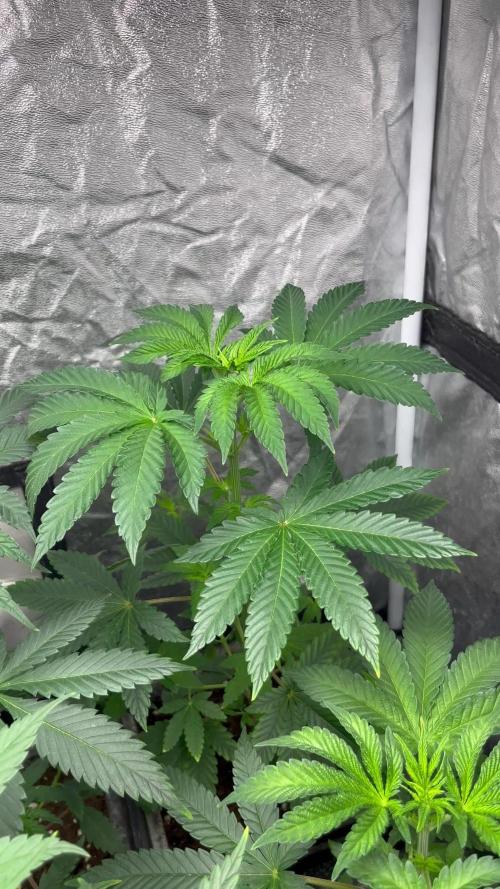
The buds are starting to form. The smell is strong when I open the cabinet, but with the filter, it doesn't smell.
I corrected the deficiencies I had correctly. I defoliated a bit to allow good light penetration. I'll let you judge how they look now. I did a week of stretching, lowering the light by 1 hour each day.


Likes
11
Share


@millerman543
Follow
Finally have the gnats under control!!! Using a combination of beneficial bacteria, neem oil, and organic pesticides. They’re still there but only a couple so I will continue use.
Skywalker og is still double the size of all the others and drinks double the water so that is crazy idk how to deal with that I might just start watering it in between watering the other ones idk it’s crazy. Also don’t know how long we’re gonna go with this veg I want to do a pound which is ambitious for a second grow with a 300w light in a 2 x 4 but that would be cool.
Looking good tho next grow I’m only gonna do 3 strains instead of 4 or even 2 but we’ll see.
Went a little too heavy on the nitrogen I think i dialed it back a bit but plants are healthy and strong I think the silica helps a lot.
Processing
Likes
1
Share


@Deathby420
Follow
I got some new lights this week, so am looking forward to seeing the difference led can do, getting awesome growth from the auto's, and the fem seeds are going well too. All is well in the garden this week other than the Lsd 25 auto seed, which is struggling still, wet feet may be, I will try to dry the pot, before more water is fed. Any ideas?
Likes
35
Share


@nonick123
Follow
Día 9 (10/06) N/A
Día 10 (11/06) N/A
Día 11 (12/06) Llueve mucho. Humedad alta por aquí. Eso les favorece
Día 12 (13/06) Se empiezan a desarrollar las hojas verdaderas a una buena velocidad! Todo en marcha! 💨
Día 13 (14/06) Riego ligero 100 ml sólo H20 EC 0,5 en previsión del trasplante en el día 15 de la planta
Día 14 (15/06) Se nota que estamos en el día 14 desde germinación y la mayoría de las plántulas van viento en popa!
Día 15 (16/06) Hoy procedemos a trasplantar a las chicas a su maceta intermedia de 6,5 litros
Se prepara con 5,5 Litros (85%) de sustrato PRO-MIX HP BACILLUS+MYCORRHIZAE + 1 Litro de Insect Frass (15%) + 65 gramos de Earth Vibes Super Soil (10 g/L substrato)
Se llena la maceta de sustrato con las manos (limpias) y rompiendo los trozos más gruesos, para que el sustrato esté aireado y esponjoso, sin presionar
Se coloca una maceta vacía de 1L para que quede la forma perfecta de la maceta donde están las plántulas (ver fotos)
Se espolvorea la parte proporcional de la probeta de microorganismos sobre el agujero de trasplante
Se saca la plántula de su maceta actual (bonitas raíces 😍) y se coloca en la maceta final
Se riega muy lentamente hasta percolación profunda con H2O EC 0,5 pH 6,5
Se coloca mulch (acolchado) de paja para evitar traspiración excesiva y cuidar a los microorganismos del suelo
A ver como reacciona al trasplante!
💦Nutrients by Lurpe Solutions - www.lurpenaturalsolutions.com
🌱Substrate PRO-MIX HP BACILLUS + MYCORRHIZAE - www.pthorticulture.com/en/products/pro-mix-hp-biostimulant-plus-mycorrhizae

Likes
2
Share

@eldruida_lamota
Follow
Que pasa familia, vamos con la quinta semana de vida de estas F.U.H. feminizadas de Seedstockers.
Vamos al lío, las plantas se trasplantaron a macetas de 7 litros.
El ph se controla en 6.5, la temperatura la tenemos entre 24/22 grados y la humedad ronda el 70%.
El ciclo de crecimiento puse 20h de luz, el foco está al 50% de potencia.
Me gustaría estar más encima este cultivo pero la salud me está impidiendo un poco este 100% con el proyecto. Con suerte la semana que viene andaré mejor.
- os dejo por aquí un CÓDIGO: Eldruida
Descuento para la tienda de MARS HYDRO.
https://www.mars-hydro.com
Hasta aquí todo, Buenos humos 💨💨💨

Likes
3
Share


@Herbman420
Follow
Hi everybody this germination week went great very excited to see how she is .she looks very happy and healthy normally I start them with nothing except for a bit of cal Mag .for the first week then I move on to about 250 parts per million . But I have noticed with these newer genetics that there are a lot hungrier. So I started it off with 350 parts per million . And it seems to be doing great . Thank you for looking at the diary we'll be an update every week and always keep in mind it's 420 somewhere 🌱👍

Likes
2
Share

@Billzbudz
Follow
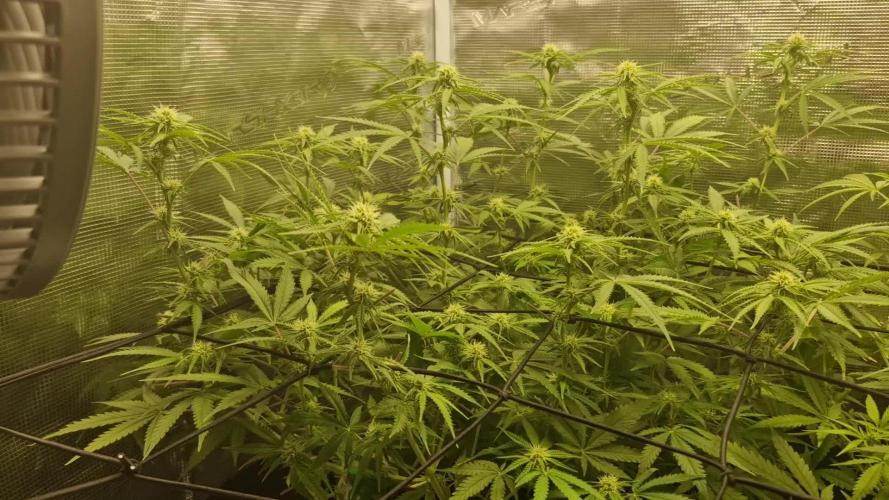
2 alien og are triving at the mins 1st week into flower little bud hairs stairting to form..Had to trim back tonight and thats the last gonna leave them be..Started giving big buds nuts with all there other feeds today we see how that goes ..so dar so good..
Likes
6
Share


@Mismatas
Follow
PRIMERA SEMANA DE FLORACIÓN, VAMOS PASANDO LAS RAMAS ENTRE LA MALLA, Y AÑADIMOS EL BUD IGNITOR A NUESTRO RIEGO

Likes
21
Share


@BudsBanditUK
Follow
She is now picking up the pace. Struggled to keep up with watering. She is taking 5 litres per day in a 3.8 litre pot. Buds are getting bigger and overall she is doing well. Not much smell yet.

Likes
120
Share


@DogDoctorOfficial
Follow
The Harvest Prelude:
After a patient wait and 48 hours of darkness, the moment arrived. The Tropical Tangie Lego Ninja, standing proudly like a silent guardian, was ready for the grand harvest. The sound of each cut echoed through the grow space, reminiscent of felling a mighty tree. The compact structure of the buds was awe-inspiring, a testament to the ninja's disciplined growth.
The Lego Ninja, like a stoic warrior, was then hung upside down, beginning a two-week drying ritual. Maintaining an ambient temperature of around 21°C and a relative humidity of 60%, this slow-drying process allowed the buds to retain their essence, preserving the symphony of terpenes and cannabinoids.
The trimming phase unfolded like a fragrant masterpiece. Each bud, adorned with a glistening layer of resin, transformed the trimming process into a sensory delight. The zesty aroma of oranges enveloped the room, a tangible expression of the tropical lineage. The compact buds made every snip a careful dance, revealing an abundance of frosty trichomes.
The moment of reckoning arrived with the scale's unveiling. The Tropical Tangie Lego Ninja, from a single plant, bestowed upon me 309 grams of dried medicine. Each gram was a treasure trove of cannabinoids, a promise of euphoria and relief. The sheer compactness of the buds translated into a concentrated potency that left me in awe.
In parallel, the clones, nurtured with equal care, showcased a fascinating divergence. A twist in the tale unfolded as the intense oranges of the mother transitioned into vibrant tangerines. This unique expression, I believe, was a testament to the clones weathering a summer heatwave differently, bringing forth a distinct personality.
The clones, resilient and generous, gifted me a bountiful 549 grams of pure joy. This now my keeper of the garden, an embodiment of the Lego Ninja's legacy. The harvest dance, though familiar, carried the nuances of tangerine zest, a refreshing twist that left me eager to explore its intricacies.
Both harvests shared a common thread—their resinous abundance. The trim bin, akin to a treasure chest, gleamed with golden trichomes and fragrant joy. Sticky fingers became a badge of honor, a tangible connection to the resinous richness that filled the room.
Shout Outs:
No harvest report is complete without expressions of gratitude. A special nod to @DutchPassion_Official for crafting the genetic marvel that is the Tropical Tangie Lego Ninja. Their expertise paved the way for this epic journey, and I tip my hat in acknowledgment.
In conclusion:
As the dust settles on this epic harvest saga, my heart brims with happiness and excitement. The Tropical Tangie Lego Ninja has proven itself not just as a plant but as a living masterpiece. Stay tuned for the smoke report, where we delve into the true essence of this botanical ninja's legacy. Until then, fellow cultivators, may your gardens flourish, and your harvests be as bountiful as the joy they bring.
As always thank you all for stopping by, for the love and for it all , this journey of mine wold just not be the same without you guys, the love and support is very much appreciated and i fell honored and blessed with you all in my life<3 <3 <3
#aptus #aptusplanttech #aptusgang #aptusfamily #aptustrueplantscience #inbalancewithnature #trueplantscience
With true love comes happiness <3 <3 <3 Always believe in your self and always do things expecting nothing and with an open heart , be a giver and the universe will give back to you in ways you could not even imagine so <3 <3 <3
Friendly reminder all you see here is pure research and for educational purposes only
<3 <3 <3 Growers Love To you All <3 <3 <3
P.S- I must extend my sincerest apologies for the missing video reports. Regrettably, Grow Diaries is still facing some technical issues that are preventing me from uploading them. Rest assured, as soon as the situation is resolved, I'll share those videos to give you an even closer look at this fascinating journey. or in my case apparently GD dont let me do uploads over 100mb with is super small file if you working and editing videos , doing my best here to upload them all but GD is not making my life easy on this <3 <3 <3

Likes
98
Share


@Tropicannibis_Todd
Follow
💩Holy Crap We Are Back At It And Loving It💩
Growmies we are at DAY 56 and she's just killing💀it👌 The Smell has kicked in and is wonderful 😀
👉We are in full out flowering 💐 and its looking great 👈
So Shit , I gave them just a tad to much nutes on the first few feedings 👈 But I have since fixed it
So I'm helping out with some low stress training 🙃 and some defolation 😳
Lights being readjusted and chart updated .........👍rain water to be used entire growth👈
👉I used NutriNPK for nutrients for my grows and welcome anyone to give them a try .👈
👉 www.nutrinpk.com 👈
NutriNPK Cal MAG 14-0-14
NutriNPK Grow 28-14-14
NutriNPK Bloom 8-20-30
NutriNPK Bloom Booster 0-52-34
I GOT MULTIPLE DIARIES ON THE GO 😱 please check them out 😎
👉THANKS FOR TAKING THE TIME TO GO OVER MY DIARIES 👈
Likes
16
Share


@Symbiosis_420
Follow
About this diary>
So I've made it to the end! This baby didnt die on me! This diary was half a record for myself, to keep improving and contrasting against my future grows in and out of this wonderful platform (growdiaries), and half a tutorial for other noobs like me. That's why I wrote somewhat long explanations about some of the things I myself found confusing during this and last grow. I also repeated myself, but again mostly because I was trying to learn while doing. I got some help from other growers in the community, which was very nice, and different from trying to figuring out everything by oneself. This girl stretched a lot! from about 30 cm at the end of flower to about 90 cm before harvest, it survived nutrient burn, an accident were I dropped something heavy on her on flower, accidentally chopping a branch during LST and spider mites. However, still yielded nicely. I cant imagine what these genetics could become in the hands of a master grower!!
About the growing conditions>
The idea of the grow was, not only to learn how to grow a somewhat long flowering strain (6 week veg, 10 weeks flower) but also doing it very cheaply. I think the most expensive thing I bought was the seed from RQS. I built my own light fixture (from 4x 4.00CAD COBs from aliexpress), some cardboard, wire, sticks, tape and aluminum foil. I also used dollar store nutrients (like 15% of a 15-15-15 veg mix, and a 15-30-15 flowering mix). I timed this strain to finish a few weeks before the temperature really starts dropping outside, and was always able to keep it around 20-29C without any air conditioner/heater.
About growing amnesia haze>
I harvested this plant on the early side, but I found it a challenge not to harvest earlier! Since many weeks ago the delicious smell has been filling the room and some parts of the house... Plus, its a long wait... However, I think it was very well rewarded :)
As I said, the high is creative, giggly, energetic and uplifting, at least from the premature samples we got. I will update this once the real deal is dry and cured :)
About the harvest>
Well in terms of numbers, I will update this when the weed is done drying, but I can do an estimate right now... each sample I took weighted about 1.45g wet, and dried to a 25% of that (0.35 g each)... It means that what I weighted from the harvest (412.86g + a bunch of trim) would probably weight about 100g when dry... Let's see how it goes in a week or two :)


Likes
4
Share


@DeepRootsGrowTrees
Follow
CHERRY 🍒 COLA by FASTBUDS
Week #12 Overall
Week #7 Flower
This lady just about done she's really a strong plant she's small but she's got the genetics to fend off pests and grow in extremely hot 🔥 temps in the idea conditions she's going to produce!! FASTBUDS really have made some great advancements with autoflowers!! Stay Growing!!
FASTBUDS CHERRY 🍒 COLA AUTO


Likes
15
Share


@Hashy
Follow
********************************************
Week 4 Veg
********************************************
Light cycle=18/6
Light Power=67w 28%
Extractor controller settings (during lights on).
High temp= 26c
Temp step=0c
High Rh= 65%
Rh step=0%
Speed max=10
Speed min=1
Extractor controller settings (during lights off).
High temp= 20c
Temp step=0c
High Rh= 65%
Rh step=0%
Speed max=10
Speed min=1
Smart controller settings (during lights on).
Lights on=5.00am
Radiator on= -19.0c
Radiator off=+19.5c
Smart controller settings (during lights off).
Lights off=11.00pm
Radiator on=-18.0c
Radiator off=+18.5c
VPD aim=0.8-1.1
DLI aim=19-25
EC aim=0.8-1.5
PH aim=6.0-6.5
💧💧💧💧💧💧💧💧💧💧💧💧💧💧💧💧
NPK= 15-5-10
Method= Manually
Feed= Veg nutes
Neutralise=0.1ml/L
Katana Roots=0.2ml/L
Plagron grow=5ml/L
Easy Ph down=0ml/L
(1ml=24 drops, 1 drop=0.04ml)
Easy Ph Up=0ml/L
(1ml=24 drops, each drop is 0.04ml)
Ec=1.4 PH=6.0/6.1
💧💧💧💧💧💧💧💧💧💧💧💧💧💧💧💧
********************************************
********************************************
📅1/3/25 Saturday(Day 22)
📋
📅2/3/25 Sunday(Day 23)
📋
📅3/3/25 Monday(Day 24)
📋💧1.0L Veg Nutes Ec=1.4 PH=6.1/6.0
📅4/3/25 Tuesday(Day 25)
📋 removed single fingered leaves and attached nodes, also 1st set of 3 fingered leaves.
📅5/3/25 Wednesday(Day 26)
📋H=15cm D=35cm Dli=25.3 PPFD=391
📅6/3/25 Thursday(Day 27)
📋💧2.5L Veg Nutes Ec=1.4 PH=6.1/6.0
📅7/3/25 Friday(Day 28)
📋85 days left before the competition closes.
H=17cm D=33cm Dli=27.6 PPFD=426
********************************************
Weekly roundup.
📋 I've decided to not do any real training yet, she's had the lower 1st few set of leaves removed. Today's the last day of 18/6, so tomorrow morning the lights will come on at 9.00am. If I had more time I'd have probably done some training. She's done OK this week, she looks a little overwatered but I tend to find that with this strain.
Take it easy.
Back soon.
********************************************


Likes
36
Share


@OGTrauma
Follow
Hi Potheads, During the course of the week there was a small addition of 3 More CFL LIGHTS through the use of Splitters and sockets thus freeing more outlets, the remaining were programmed to have different schedule that had increasing / peak /decreasing intensities of light sources according time before total blackout, harshly emulating outdoors but with the benefit of keeping thermals , consumption and electronics lifespam at range.
VEGGING WEEK TWO:
10 days of 21 vegging remaining if everything goes according to the plan but there is an impending menace that has to go out before putting plants to flower . Plants had a good growth response to the budget light, used soil and non-canon nutrient combos , but in the aspect plague control has been a bit more tedious, and even through im using an agressive product (Aceite de Springhill - Anasac) it does keep them at bay but it doesn't totally eradicate them, seeing a few small flying white dots and some moths when plants are shaken in search of bugs , having really low stretch horizontal plants does make harder to inspect the reverse of the leafs, some of them with clear signs of being chewed , and the bit size is like a hole made with a mechanical pencil and that can react to pesticide toxicity if overdose.
This is totally my fault because the reused soil with a lot of organic content is a perfect host for plagues and doing aggresive LST is easing the way to climb or jump towards the plants for any bug.
For plant placement inside the tent , u can use week 1, pic 1 for reference.
G13 Hashplant : The four specimens are the most affected by plagues persistence, because they have the most vegetal mass and trained branches that vermin can hide. In consequence, it also has received more spray doses of Aceite de Springhill (paraffin oil) and this losing battle contrasts absolutely with their spectacular growth , ramification and thick stems.
Santa Bilbo: The four specimens received topping with lst through last week, if there is a net above their cup, its because i already know that when it's stretches, it shows ALL her sativa ascendancy, don't believe in her morphology, preflowering is very messy indeed!. Also, The nutrient deficency didn't had heavy impact on the plants after they were transplanted and received both nutrient & plague control formulas.
Eleven Roses: All the plants were healthy but with different vigor, making the desition of the ones that will stay inside according to their reaction to topping. Eleven roses, althrough is declared 100% indica by her crushing effect, it can present phenos with longer internodal distance and flowering stretch , so i reccomend a bit of height control in it's grow stage as well.

Likes
14
Share


@JamieKnolliver
Follow
Einige Triebe wurden nun durch reiben und drücken umgeknickt(HST) weil sie aus dem Netz rausgewachsen ist und ich unbedingt das höhenwachstum eindämmen muss, da die Pflanze noch ihren Stretch machen wird und ich sonst keinen Abstand zur Lampe bekomme.
In der ersten Woche deutliche Veränderung des Wachstumbildes, die ersten weißen Härchen sind erkennbar.
Biobizz Bloom und TopMax werden ab jetzt auch hinzugefügt.

Likes
Comments
Share


Likes
7
Share

@Bunterbiber
Follow
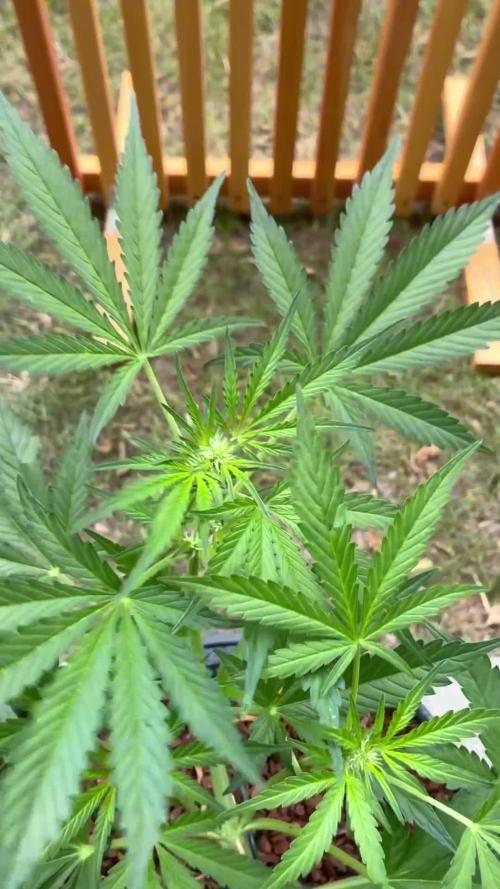
Welcome to Week 5! The weather took a bit of a turn this week. The sun decided to hide behind the clouds a lot more, we had our fair share of rain, and the nights got noticeably chillier, dropping down to a minimum of around 10°C. Despite the less-than-ideal outdoor conditions, the ladies pushed through and continued to develop remarkably well.
I’ve kept up with the LST (Low Stress Training), specifically focusing on keeping all the main tops at an even height so we get a nice, uniform canopy. Watering has stayed consistent and easy—just giving her a drink of tap water + CalMag about twice a week.
Appearance & Flowering:
She has really stretched out horizontally and become quite wide! She is more bushy right now, and those signature dark leaves are just a treat to look at. But the most exciting news of the week: she is officially starting to transition into the flowering stage! The first pre-flowers are showing, and she seems totally unfazed by the colder nights.
Don't forget to check out how the Purple Haze Auto is handling the chill and her own transition to bloom over on my profile!
