The Grow Awards 2026 🏆 






Likes
Comments
Share
@420DeepGrow
Follow
Toda esta fantasía se hace realidad gracias a Royal Queen Seeds y @James por confiar en mí. 🚀💥
Fiel a su linaje genético, la Hyperion F1 ofrece un aroma intenso que está dominado por notas frescas de pino y hierba, junto con un trasfondo terroso y un delicioso toque especiado. Aunque todos nuestros híbridos F1 producen excelentes concentraciones de cannabinoides y terpenos, no hay duda de que la Hyperion destaca entre el resto. Sus cogollos alargados y escarchados producen una resina rica y cargada de cannabinoides (sobre todo THC), y terpenos como mirceno, ocimeno, farneseno, terpinoleno, cariofileno y humuleno. Esto no solo da lugar a un aroma muy fuerte, sino también a un efecto bien equilibrado que combina una relajación física (en gran parte gracias al mirceno y al farneseno) con la euforia, risa y efecto motivador de otros terpenos. Al igual que el dios de la luz del mismo nombre, la Hyperion F1 causa un subidón esclarecedor que se puede disfrutar a cualquier hora del día.
🌻🚀 Consigue aqui tus semillas:
https://www.royalqueenseeds.es/semillas-de-marihuana-hibridas-f1/622-hyperion-f1.html
🍣🍦🌴 Xpert Nutrients es una empresa especializada en la producción y comercialización de fertilizantes líquidos y tierras, que garantizan excelentes cosechas y un crecimiento activo para sus plantas durante todas las fases de cultivo.
Consigue aqui tus Nutrientes:
https://xpertnutrients.com/es/shop/
📆 Semana 9:
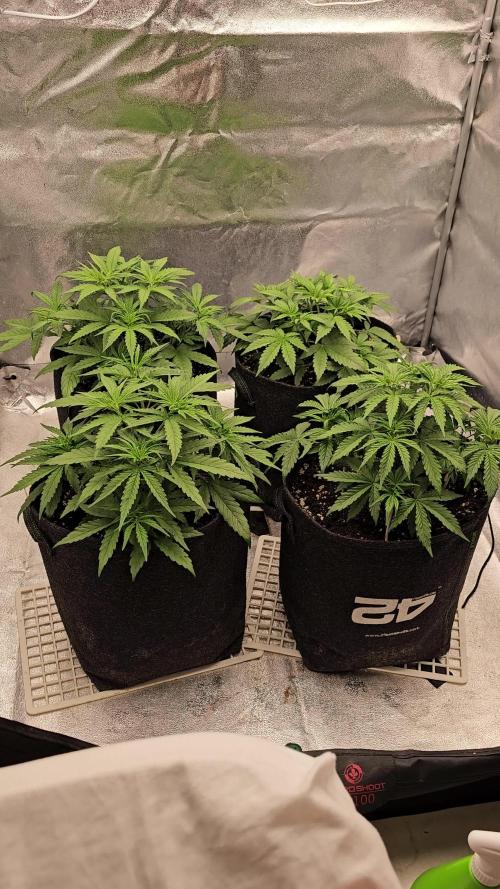
Gran semana, la planta parece que ha terminado de crecer y centra toda su energía en desarrollar los futuros cogollos, los erizos 🦔 son apreciables.
@xpertnutrients está haciendo un buen trabajo, ella consume algo de sus recursos lentamente como a mi me gusta .
Vienen lluvias 😡

Likes
4
Share
@Tmasm
Follow
Bem minha menina vai ficar, mais 12 semanas +/- em vegetação,
Tenho minha sala de floração cheia. Bem arrumadinho dava, mas gosto que plantas tenham espaço para crecer.
Até é bom, ramos laterais tem tempo para crecer,
Deve é ter que cortar, cruto principal para não ficar muito grande, em comparação com resto da planta, ver como corre.
Bons fumos
Plantas felizes

Likes
68
Share
@Ferenc
Follow
Day 44, 30th of October 2020:
Here we go I am back from holiday this girl grew a lot. The first 6 pictures before LST and the rest is after picture.
I switches the light to 12/12 from tomorrow and leave her in darkness for one day from now.
She has got already some smell also... ;)
I have ordered and extraction fan kit so with filter it will be used soon.
Next week starts more intensive fertilization as well :)
Let's start to flower hahaha :)
Happy Smokes ;)

Likes
36
Share
@Salokin
Follow
Training has been continued. She is developing very nicely. As of today she has been switched to 12/12, as the net starts to get busy and anticipating another stretch I thought it would be time.


Likes
44
Share
@RakonGrow
Follow
Note :
+ jegliches Zubehör wird in der GermniationsWoche aufgelistet . Zeitraffer Videos folgen immer nachträglich.
+ videos werden so geschnitten das nur ein geschlossenes Zelt erscheint , ergo Fehlen paar reale Minuten (ca 1 Std) .
Day 57:
+ 2.0 Liter Flaschenwasser
+ + Dünger für Blühte
+ + + Canna Terrar Flores (Achtung wirkt wie PH-)
+ + + Canna Boost
+ + + Cannazym
+ + + Canna PH+
+ + PH 5.91
Da es heute heiss ist , wird wie Gestern laufen . Bis 19:00 Uhr wird das Licht reduziert und dann DLI nachgeholt.
Day 58:
Da es immer noch heiss ist , wird wie Gestern laufen . Bis 19:00 Uhr wird das Licht reduziert und dann DLI nachgeholt.
Day 59:
+ 2.0 Liter Flaschenwasser
+ + Dünger für Blühte
+ + + Canna Terrar Flores (Achtung wirkt wie PH-)
+ + + Canna Boost
+ + + Cannazym
+ + + Canna Rhizotonic
+ + + Canna PH+
+ + PH 5.91
16h jetzt mit 1000 PPFD und jeweils 1 Stunde Sonnenaufgang und Sonnenuntergang.
Day 60:
Mal ein bissel Größenvergleiche gemacht .Das Clipper Feuerzeug ist 7.5 cm hoch .
Day 61:
+ 1.75 Liter Flaschenwasser
+ + Dünger für Blühte
+ + + Canna Terrar Flores (Achtung wirkt wie PH-)
+ + + Canna Boost
+ + + Cannazym
+ + + Canna Rhizotonic
+ + + Canna PH+
+ + PH 6.01
Day 62:
Das Wetter bleibt stabil, damit bleiben die Growwerte auch stabil. Bisher Läuft das 1000 PPFD Spitze und 750 PPFD Sekundätriebe ganz gut . Ihre Freundin die leider ein Wasserschaden erlitten hat (tja da war wohl irgendwas im Wasser was ein Regenbogenfilm erzeugt hat , im schlimmsten Fall Waschmittel) nimmt der einen Seite zwar licht, aber geht halt nicht anderes bei nur einer Lichtquelle . Ich fahr halt gleich ein doppel Experiement mit dem Licht. Bisher aber holt sie ganz gut nach mit 900-1000 PPFD auf die ziemlich gleich hohe Krone .
Day 63:
+ 1.75 Liter Flaschenwasser
+ + Dünger für Blühte
+ + + Canna Terrar Flores (Achtung wirkt wie PH-)
+ + + Canna Boost
+ + + Cannazym
+ + + Canna Rhizotonic
+ + + Greenhouse Feeding BioEnhancer
+ + + Canna PH+
+ + PH 6.01
Likes
6
Share
@Phenohunter88
Follow
Week started off well. Day 50 and no major hiccups. Lets get to that finish line soon!
Day 51 - Everyone is healthy and great. CDLC is really putting on the weight now. All five of them are stellar.
MB #1 stopped stretching and her nugs are starting to swell. She is one fast lady. The other Miracle Berry Remix looks like it will stretch some more and so does the Mango Smile. Strawberry and CDLC have a ways to go but they are blowing up.
I am feeding everyone every day at least 2 liters of the above mixture. Depending on coloration (light green to dark green) I will change the nitrogen content. These things are eating phosphorous up like candy. I have experienced NO nutrition burn. All of my issues thus far have been underfeeding due to PH issues. I have a theory that I want to feed them as much as possible regardless of feed schedule and fear of nutrition burn. Ensuring a healthy root system with proper PH and monitoring Potassium in your watering should give the best results. I am finding that the only nutrient that cause the physical representation of nutrition burn (burned tips) is too much Potassium. I think I stated it before but Nitrogen toxicity doesn't burn tips and Phosphorous is really difficult to overdose your plant with. Pinpointing this is extremely important I feel. Are there any other growers who find this to be true?
Day 53 - Everyone is great. Notable things from today...Mango Smile is sad cuz I gave her a hair cut and Strawberry Nuggets revealed a massive nitrogen deficiency after I gave her a hair cut. I switched to bloom nutrients too early on her. Upped her nitrogen PPM for today's feeding and hoping I didn't stunt her too badly. Lot's of node sites though.
Day 54 - Mango Smile was just being a diva. Today her entire canopy was an inch higher...and she shows no signs of swelling yet. She's gonna end up going over 90 days for sure. My Maxigrow got moisture in it...so it went bad. I went out and bought some NPK Raw Grow for my Strawberry Nuggets. She is so hungry I feel bad. She is the only one I fed today. Everyone else was fine. Pistils on MB#1 are turning orange/brown. She might be ready at day 70. MB#2 will be right behind her. They are quite fast for being so big. CDLC is looking great. Didn't take a photo today but she is getting frosty and her flower stretch is on. Humidity is a little high in tent since I added additional pots with soil in them. I turned up my light to around 80% and the humidity tanked. Temperature went up to about 81F. I think we can manage that. I'm not seeing any signs of heat stress or fox tailing.
My lights are powered by two HLG-600H drivers. Theoretically, I have 1200 Watts in the tent. Just to clarify since the journal won't let me specify my wattage for the QB96s. They can go up to 250 Watts each with active cooling.
Day 55 - Moved everyone in the tent around to increase airflow. Trying to keep everyone off the walls but Miracle Berry Remix 1 is taking over the tent. Probably going to have to supercrop soon. Miracle Berry 1 smells deeply of berries. No gas or funk smell. Smells like a blue raspberry slurpee.


Likes
2
Share

Likes
11
Share
@Kirsten
Follow
23.2.25:
I watered with approximately 1.5 ltrs per plant. I mix 6.5ltrs of dechlorinated water PH'd to 6.4. This time, I only added Ecothrive Biosys to the water because I have just top dressed the soil.
Adding anything extra right now would probably be overkill and result in toxicity from too many available nutrients.
I defoliated minimally mostly Do-sì-dos, Watermelon, and Pink Mist. Due to the scrog net, it's about all I can reach 😅
I've moved the plants to increase space for Gorilla Cookies 🍪 and Bubble


Likes
Comments
Share

Likes
6
Share
@BudeCo
Follow
Feliz com o retorno das meninas que revegetaram na 3 semana de floração.
Ficaram por 15 dias com luz 24h.
Agora já estão novamente com 3 semanas de 12x12. Recuperação Ok.
Mas devem ficar com aspecto de rabo de raposa no final da floração.


Likes
2
Share

Likes
7
Share
@BIYEI
Follow
Vegetacion (Tiempo estimado 28 dias)
Segunda Semana de Vegetacion
14/12/2023 - 5:00hrs y 22hrs: Se Hace cambio de solucion nutritiva y se limpia el recipiente, se verifican parametros basicos del agua, mantener cuidados especificos, el Ec y PPm Varean por los aditivos.
Agua de osmosis: Ph 6.0, PPm 650-800, Ec 1.3-1.6, Temperatura 22°C - 26°C, Humedad 65%
Ambiente: Temperatura 22 °C, Humedad 65%, Ventilacion 15%, 18 hrs de luz , 6 hrs de obscuridad.
15/12/2023 - 5:00hrs y 22hrs: Se verifican parametros basicos del agua, mantener cuidados especificos.
Agua de osmosis: Ph 6.0, PPm 650-800, Ec 1.3-1.6, Temperatura 22°C - 26°C, Humedad 65%
Ambiente: Temperatura 22 °C, Humedad 65%, Ventilacion 15%, 18 hrs de luz , 6 hrs de obscuridad.
16/12/2023 - 5:00hrs y 22hrs: Se verifican parametros basicos del agua, mantener cuidados especificos.
Agua de osmosis: Ph 6.0, PPm 650-800, Ec 1.3-1.6, Temperatura 22°C - 26°C, Humedad 65%
Ambiente: Temperatura 22 °C, Humedad 65%, Ventilacion 15%, 18 hrs de luz , 6 hrs de obscuridad.
17/12/2023 - 5:00hrs y 22hrs: Se verifican parametros basicos del agua, mantener cuidados especificos.
Agua de osmosis: Ph 6.0, PPm 650-800, Ec 1.3-1.6, Temperatura 22°C - 26°C, Humedad 65%
Ambiente: Temperatura 22 °C, Humedad 65%, Ventilacion 15%, 18 hrs de luz , 6 hrs de obscuridad.
18/12/2023 - 5:00hrs y 22hrs: Se verifican parametros basicos del agua, mantener cuidados especificos.
Agua de osmosis: Ph 6.0, PPm 650-800, Ec 1.3-1.6, Temperatura 22°C - 26°C, Humedad 65%
Ambiente: Temperatura 22 °C, Humedad 65%, Ventilacion 15%, 18 hrs de luz , 6 hrs de obscuridad.
19/12/2023 - 5:00hrs y 22hrs: Se verifican parametros basicos del agua, mantener cuidados especificos.
Agua de osmosis: Ph 6.0, PPm 650-800, Ec 1.3-1.6, Temperatura 22°C - 26°C, Humedad 65%
Ambiente: Temperatura 22 °C, Humedad 65%, Ventilacion 15%, 18 hrs de luz , 6 hrs de obscuridad.
20/12/2023 - 5:00hrs y 22hrs: Se verifican parametros basicos del agua, mantener cuidados especificos.
Agua de osmosis: Ph 6.0, PPm 650-800, Ec 1.3-1.6, Temperatura 22°C - 26°C, Humedad 65%
Ambiente: Temperatura 22 °C, Humedad 65%, Ventilacion 15%, 18 hrs de luz , 6 hrs de obscuridad.
Likes
4
Share
@Jaschkoo0
Follow
I gave them a few l of water with correct ph every Day sometimes every second Day.

Processing
Likes
1
Share
@magicjohnson
Follow
Wk 5 was Steady Away, Explosive growth starting, Transplanted one from aero to coco and added Began the Scrog
As you may have noticed, I Expanded the garden to give the coco girls some more room.
The Dawg in the aero wasn't taking well at all, she hadn't really had a good innings from the beginning. I transplanted her into the coco and Fed her very week nutes..
Likes
111
Share
@DogDoctorOfficial
Follow
Harvesting An ELEPHANT !!!
And after 118 day from seed and 101 from wen she started her mix veg/flowering process, i cant say for sure but i am starting to believe that this auto world do veg, then veg and flower in conjunction for a wile and only after they a wile they move to a flowering stage completely but thats another post another day lol today was harvest day for this Auto Elephant from SSSC , and let me tel you she is a delight with huge fruits, so big that i normally cut and hang the all plant and for this i did not take the risk of doing that and getting bud rot , better safe than sorry, so what i broke her in smaller peaces and put it all in the rack.
Now not much to do than waiting for it to get around 10/15% humidity and jar with it all.
This one as you guys can see from the video , this is a full covered in trichomes BIG MAMA and touching her is like touching super glue or something lol i was trying to put all the colas in one picture , but is simply just not possible , they all look great so i selected 4 of them for a true back back ground <3
Thank you Super Sativa Seed Club for this opportunity, i fell like a champion no matter what with this 2 Mamas, much respect on the work you guys did on this Elephant
As always thank you all for stoping by for your love and for it all, i fell humble and honored
