


@pifflestikkz
Follow
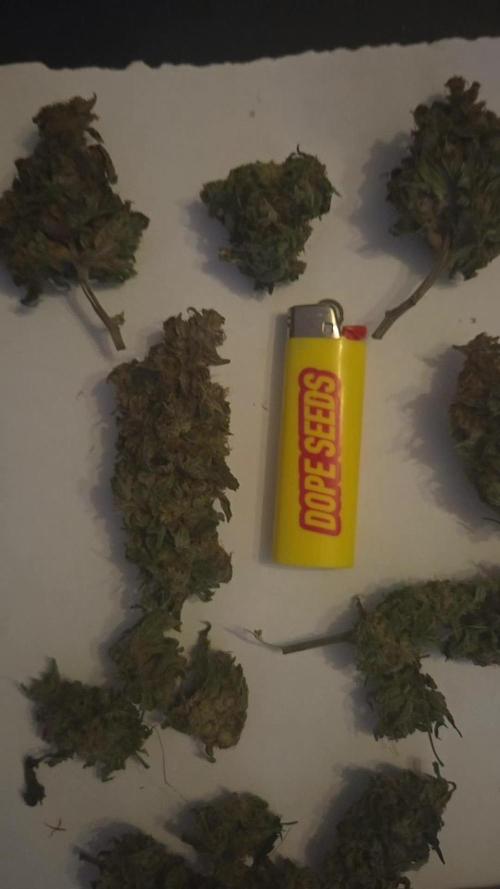
Day 65
Day 30 Flower
Seeing nice stretching and spacing on nodes are still kept tight, strong but small structure.
Nice hues coming through on the tops fans.
Minor lollipopping and defoliating done today.
Not much else to say,
Stay high my growmie ✌️🚀💚
Day 68
Day 33 F - Final lollipopping and defoliating today. She really is starting to develope. Node spacing is nice, bud sites forming, nice hues and glistening.
Applied feed today.
Small compact looking plant, but hoping to see them top shelf grade dense nuggets with this technique and strain 😍- we can hope





@MrCOCO
Follow
Hi... Everything goes very fast ... I used the pinching method to increase my yield and the quality of buds also... 🍃🍃🍃now I keep my fingers crossed for the girls ...🍃🍃🍃 I think maybe a week and I will switch to flowering... 🍃🍃🍃
Happy growing 🍃🍃🍃


@Strangelet
Follow
Cloudy week, still growing nicely, from my 3 plants this recoverder the best from topping. Began LST. Almost broke a lower branche hope it holds on.




@420DeepGrow
Follow
📆 Semana 4
El estiramiento queda atrás y la planta entra en floración activa. Los botones ya forman pequeños erizos en cada punta, con cálices agrupándose y pistilos en aumento, marcando el inicio del volumen.
La estructura sigue equilibrada, bien iluminada y sin estrés, con la energía centrada en construir flores compactas y uniformes.
Seguimos creciendo fuerte 💪!


@GREENPHOENIX6262
Follow
* Critical+2.0 Week 1 Veg - 10/08*
Thus far all is moving accordingly - Light nute feeds have begun - Moved into 4x4 tent with C02 Exhale bag.



@GingerGarageGrow420
Follow
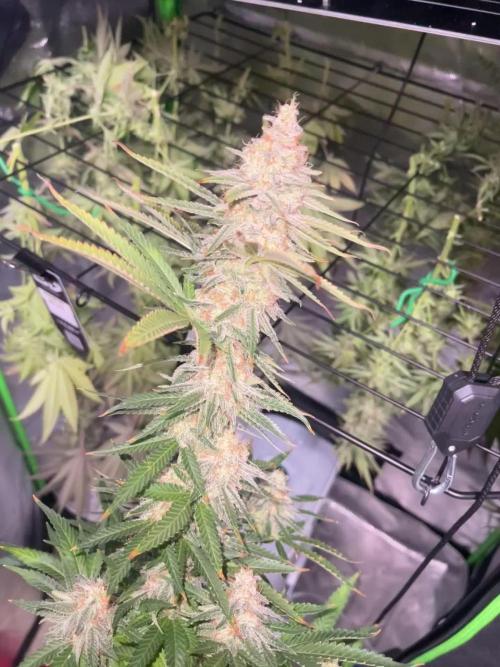
Strain: Chill Out OG F4
Harvest Day 64 Flower
Day: 113 from sprout
Medium: Fox Farm Ocean Forest
Light: Vivosun VS2000 at 100%
VPD: 1.5 kPa
Light Distance: 12 inches
Watering: By hand, ~oz daily
Nutrients: pH Perfect Advanced Nutrition Grow, Bloom, Micro 2 ml / L, 1 ml / L big bud
30 inches


@Ultraviolet_
Follow
We become aware at such times of man's wonderful ability to bring seemingly unrelated elements into harmonic balance, and receive a glimpse into a world where everything exists in conscious sympathetic attunement to everything else. When we listen to a piece of music that seems to strike a beautiful chord somewhere inside us, or view a painting that simply glows with harmonic awareness well executed, we probably do not spare much time to contemplate the wonderfully intricate combination of vibrations that our sensors make it possible for us to perceive. We tend to appreciate the relationship between the parts of something by an awareness of the harmony or dissonance of the whole. This ability enables us to say "what a beautiful house!" instead of "analysis has proven that this collection of building materials exhibits certain elements of harmonic proportion." While this ability to instinctively appreciate the beauty of true harmony has an important role to play in evolution, a more analytical understanding of the laws involved can be most useful. This is especially so if we wish to create works of art where each part exists in true harmony, not only with the other part of that particular whole, but with the universe within which the creator and the created exist.
Everything vibrates. From the most dense matter to the most subtle cosmic rays, everything which our senses allow our thoughts to become aware of, can be specified in terms of wavelength or frequency of vibration. These two terms define the same thing, but from different points of view.
The following are the approximate wavelengths of various energy carriers:
Cosmic rays 0.000,000,001 mm
Gamma rays 0.000,000,1 mm
X rays 0.000,500 mm
Ultraviolet rays 0.003 mm
Visible light 0.006 mm
Infrared 0.01 mm
Sound waves 1 meter
Radio waves 300 meters
Violet light 400 nm to 450 nm
Blue light 450 nm to 500 nm
Green light 500 nm to 570 nm
Yellow light 570 nm to 590 nm
Orange light 590 nm to 610 nm
Red light 610 to 700 nm
1 nanometer (nm) = 0.000,000,1 cm = 1/10,000,000 cm
If a guitar string is plucked and we hear a sound, it is not too difficult for the human mind to associate this sound with the vibration of the guitar string. With color it is quite different. It is difficult for us to conceive that the color of a substance is not an inherent property of the substance itself, but an indication picked up by our senses of that substance's ability to absorb or reflect the light which happens to be shining on it at that moment. Neither the matter nor the light is colored. What happens is that the brain learns to differentiate between the frequencies reflected or transmitted by the substance the eyes are focused on. The same thing happens with sound. When we say "Oh! Listen, they're playing my favorite song," what we really mean is: "My brain has stored within it a particular pattern of frequencies. I have compared the new information being received with this stored pattern and have deduced the answer that the two patterns are similar within certain specified tolerances." The 'pleasure' involved could have something to do with our running the pre-recorded pattern at the same time, in 'sympathy' with the new pattern as it is received.
The word sympathy describes very well our ability to appreciate color and sound. It also describes the reason behind certain elements of harmony. For instance, if a substance vibrating at 100 cycles per second (tone 1) is in the proximity of another substance vibrating at 200 cycles per second (tone 2), we could perceive, if we had the right equipment, a certain sympathetic relationship between the two.
We will see from this that there is a uniform doubling of the first tone seen in the second. At various points along the waves, the two are the same in amplitude. At other points, they are at opposite poles to each other. This doubled frequency has more points of similarity to the original than any other frequency except the original itself. If the equipment we had available for measuring these two frequencies was a soundboard amplifier and a pair of ears, then we would hear what would sound to us like one tone. If we had the opportunity to hear one at a time, we would hear that although they sound the same, one is higher in pitch than the other. This characteristic of 'the same but different in pitch', musicians have called the octave. Any two tones produced where one has exactly doubled the frequency of the other is called an octave. Speaking in ratios, an octave would appear then as the ratio 2:1 or 1:2, depending on whether we are talking of an octave up or down.
A single note produced by almost any instrument will contain more than one wavelength or frequency. It will have a dominant frequency, the wavelength of which we would call the note's 'fundamental' or 1st harmonic. It will also have a varying number of upper harmonics, gradually fading in intensity into infinity or silence.
Natural harmonics always have the same pattern of intervals between them. The interval between the 1st and 2nd harmonic is a perfect octave; between the 2nd and 3rd a perfect fifth; between the 3rd and 4th a perfect 4th; and so on, the intervals becoming smaller and smaller until they lose any relationship with the western 12 tone scale as it exists at the moment. Just as an octave has certain elements of sympathy with its fundamental, so some intervals have been noted to be more perfectly in sympathy with the fundamental than others. The ratio of the 'perfect 5th' or interval of 7 semitones, as it occurs in the harmonic series, is 3:2 or 2:3, while that of the 'perfect fourth" is 4:3 or 3:4. All the tones in the western 12 tone scale can be expressed in terms of the ratio between the upper tone and its fundamental. This would seem to be an ideal way of generating a scale from any given fundamental and several attempts have been made to do this, the Pythagorean system being probably the most well known. Although when working with a single tone instrument playing on its own, the Pythagorean formula works wonderfully well, if we had several instruments tuned this way together and asked them to play almost any western music, we would find that at times they sounded quite out of tune to each other.
The lack of flexibility of the various scale systems based on the harmonic series has led to what is known as the 'tempered' scale. This uses as its primary unit of interval the ratio of the octave or 2:1. It then proceeds to divide the interval between any fundamental and its upper octave into 12 smaller intervals by applying the ratio: two to the one-twelfth power, to one (21/12:1). This equals 1.059463094, so by multiplying any frequency by this number, we will obtain the tempered semitone next up from our fundamental. We will also find that any tone twelve semitones up from any other tone, in a scale generated in this way, will have exactly double the frequency.
If we took the note middle C on a piano and halved the wavelength, we would have the note C one octave above. If we halved this, we would have the C above, and so on. However, within about 6 octaves, we would find that although a 'sound' was being produced, no human ear could perceive it. If we kept on going, halving and producing upper octaves of our fundamental C, we would proceed through the infrared band, into the visible light spectrum. If we happened to be outside during the day, we would, for one octave only, see the note C with our eyes. The next octave above would already be in the ultraviolet band, and outside the eye's sensitivity range. If we can think of color as being an indication of a substance's vibratory rate or wavelength, we may begin to see a relationship that could exist between the color and sound spectrums.
The logical extension of what has so far been said is that there exists a scale in the color spectrum that corresponds exactly to the scale in the sound spectrum, each color tone being an octave of the equivalent note in the sound range.
This is not the end of the story but only the beginning. If we can for the moment accept that any wavelength in one band has upper and lower octave stretching out to infinity, then the next question is 'fine, but what shall we use as our fundamental? A particular color? A particular sound frequency?' The musicians among us will probably say 'A 440'. This means that the note A should vibrate at 440 Hertz, or 440 times per second. They would tell us that this is standard pitch has been adopted by most orchestras around the world; pianos are tuned to it, instruments are constructed to formulas based on it, and so to them it would probably seem the most appropriate place to begin. Some of these musicians may know of the battle that is still raging with regards to this being the standard, but few would know why A = 440 Hz was chosen except that it worked when it was set to be a suitable compromise between the many different pitches in use at the time.
432 Hz is said to be mathematically consistent with the patterns of the universe. Studies reveal that 432 Hz tuning vibrates with the universe’s golden mean PHI and unifies the properties of light, time, space, matter, gravity, and magnetism with biology, the DNA code, and consciousness. When our atoms and DNA start to resonate in harmony with the spiraling pattern of nature, our sense of connection to nature is said to be magnified.
Another interesting factor to consider is that the A=432 Hz tuning correlates with the color spectrum, while the A=440 Hz is off. Audiophiles have also stated that A = 432 Hz music seems to be non-local and can fill an entire room, whereas A=440 Hz can be perceived as directional or linear in sound propagation.
Once you adopt the idea that sound (or vibration in general) can have an equalizing and harmonizing effect (as well as a disturbing effect), the science of harmony can be applied to bring greater harmony into one's life or tune to specific energies. There is a form of absolute and relative harmony. Absolute harmony can, for example, be determined by the tuning of an instrument. The ancients tuned their instruments at an A of 432 Hz instead of 440 Hz - and for a good reason. There are plenty of music examples on the internet that you can listen to in order to establish the difference for yourself.
Attuning the instrument to 432 Hz results in a more relaxing sound, while 440 Hz slightly tenses up the body. This is because 440 Hz is out of tune with both macro and micro cosmos. On the contrary, 432 Hz is in tune. To give an example of how this is manifested microcosmically: our breath (0,3 Hz) and our pulse (1,2 Hz) relate to the frequency of the lower octave of an A of 432 Hz (108 Hz) as 1:360 and 1:90.
It is interesting to note that 432 Hz was the standard pitch of many old instruments and that it was only recently (19th and 20th century) the standard pitch was increased. This was done in order to be able to play for bigger audiences. Bigger audiences (more bodies) absorb more of the lower frequencies, so the higher pitch was more likely to “cut through”. One of the oldest instruments of the world is the bell ensemble of Yi Zeng (dated 423 BC), tuned to a standard F4 of 345 Hz, which gives an A= 432 Hz. The frequency of 345 Hz is that of the platonic year! Similarly, many old organs are tuned in A=432 as well; for example, St. Peter’s Capella Gregoriana, St. Peter’s Capella Giulia, S. Maria Maggiore in Rome.
Maria Renold’s book “Intervals Scales Tones and the Concert Pitch C=128 Hz” claims conclusive evidence that 440 Hz and raising concert pitch above scientific “C” Prime=128 Hz (Concert A=432 Hz) disassociates the connection of consciousness to the body and creates anti-social conditions in humanity.
The difference between concert pitch A=440 Hz and Concert A=432 Hz is only 8 cycles per second, but it is a perceptible difference of awareness in the human consciousness experience of the dream we share called existence.


@birdmountain
Follow
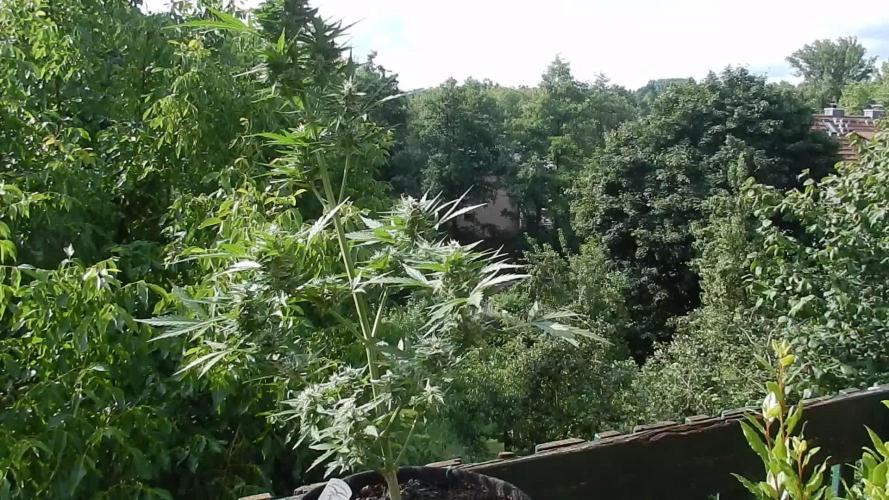
Diese Woche brachte sehr viel Regen, stehende Luft und hohe Luftfeuchtigkeit. Um die Schimmelgefahr zu minmieren habe ich einen Ventilator in das Folienzelt gehängt. Hoffentlich wirkt er. Wäre schade wenn die Bubatz vom Schimmel betroffen würde. Ansonsten verdicken und verfestigen sich ihre Buds, der Leittrieb wird immer dicker. Der Test der selbstangesetzten Jauchen geht in eine weitere Woche, Demnächst kommt noch Beinwelljauche hinzu. Ein paar Blätter wurden entfernt. Vielen Dank für euren Besuch mit besten Wünschen für eine weitere erfolgreiche Grow-Woche!
Aber um es klar zu sagen, bei dem Wetter, das zur Zeit hier herrscht, ist ein erfolgreiches Anbauen der Auto Candy Bubatz XL in den letzten Blütenwochen im Freien ohne Regenschutz nicht möglich.
---
This week brought a lot of rain, stagnant air, and high humidity. To minimize the risk of mold, I hung a fan in the foil tent. Hopefully it will work. It would be a shame if the Bubatz were affected by mold. Otherwise, their buds are thickening and hardening, and the main shoot is getting thicker and thicker. The test of the homemade manure will continue for another week, and comfrey manure will be added soon. A few leaves were removed. Thank you for visiting, and best wishes for another successful week of growing!
But to be clear, with the weather we are currently experiencing here, it is not possible to successfully grow Auto Candy Bubatz XL outdoors in the last weeks of flowering without rain protection.



@Still_Smoq
Follow
📆 Week 14, Harvest 11-20 January 2024
11 January - I made a determination to cut light power to 25%, and go to a 12/12 schedule, instead of turning light offs for 3 days. After a review of current philosophies and theories - I understand there may be a possibility that coldness, not light, could be more associated with a terpene and cannabinoid boost during this end process. So I will try something new. .
13 January - Harvest Day. When I opened the tent, the smell of fresh berries, sweet, ripe, heavy with a slight scent of pine filled the air. I cut branches and all shade leaves off, without damaging the sticky buds, and hung them to dry. The closet was at a low 35% RH (due to the 0-5 degree F temps outside) and 60 degrees F. It will remain here with circulation for about 5-7 days.
18 January - The buds were small enough and the closet RH staying staying 35%, it was ready to trim and jar up. This wasn’t too bad a process actually. The leaves flaked off prefectly leaving the bud in tact, so most of the trimming was done by hand using my fingertips, not clippers. A delicate process but fast once you get the hang of it. I’ve weighed and jared them up, along with a boveda 62% RH packet #8 in with each. Here they will stay and cure until their peak THC/terpene levels are reached at about 30-40 days, burped daily until a RH of 62% is reached and maintained.
📑 Product Review: Hybrid Indica Dominate
The outcome: 4.2 ounces/119 grams of quality bud in about 90 days. The developer says just under 65 days, this could be done, it would have to be manipulated somewhat. The buds appear large, compact in size, but not so dense, a true bush variety. They are however loaded with trichomes and covered in resin. There is an excessive amount of sugar leaves that make it more challenging for the beginner to know how to care for it in later stages, especially flower. This pheno definately turned purple.
✂️ Harvest on 13 January
🌊 Using reverse osmosis water with EC/TDS at 0
💡 Light power at 25%
That is it for this grow. Thanks for the look, read and stopping by.


@MacBrGrow
Follow
this week I did the top pruning to increase the production of the lower shoots to serve as clones when they are put to flower


@LiamF
Follow
When will this end? lol
Pretty cold week, temp dropped to 12°c @ night
So the top 2 huge colas are like 30% amber
The middle big buds are like 10% amber and the small lowest buds are like 80% cloudy with no amber
I think tomorrow(friday 10/02 first day of week 16) will harvest i dunno i think there's no benefits of letting her live more, i know its not 100% perfect but i think the combination of the very ambery top colas with the middle ones cloudy will balance the unconsistent ambers on each buds.


@BodyByVio
Follow
This week I transplanted all the clones from 1 gallon plastic pot into 5 gallons fabric pots.Probably 10 more days of Veg and will switch into flower.



@ElCapitol
Follow
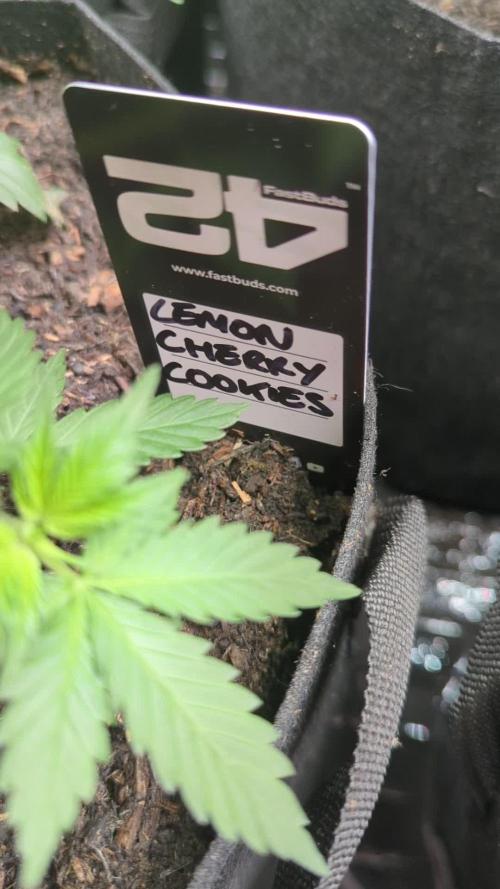
Doubled in height in a week, fantastic growth and leaves pointing to the sky, she looks very happy and healthy.
Pistols are out already so she is maturing fast. Is this normal for autos? Perhaps you can inform me, thank you.


@Ciscohash
Follow
El germinado fue genial 100%.. de 43 semillas todas germinaron ..comienza el cultivo de estas orangecake auto de nemeseeds_bank..saludos a todos y wenos humos


@brownbae420
Follow
Day 91
— Just loving these little ladies
— SO CUTE
Vibe: 😍😘
Weekly Avg Readings
— Lights 24/0 - Level 10
— Temp: 70 (ideal) | 68.4(avg)
— Humidity: 45% | 36.1%
— VPD: 1.2 | 1.47 kPa
"Everything looks cute when it's small." —Cynthia Rowley



@Wiebechillin
Follow
- Plants are all looking very nice at this stage.
- Flowering is well under way and the buds are developing nicely throughout this week.
- Have not started LSTing 5th seed and it is growing very well
- Last week of the MH Light. Switch to HPS for flowering stage



@Dr_Zauberer
Follow
Day 47 -55
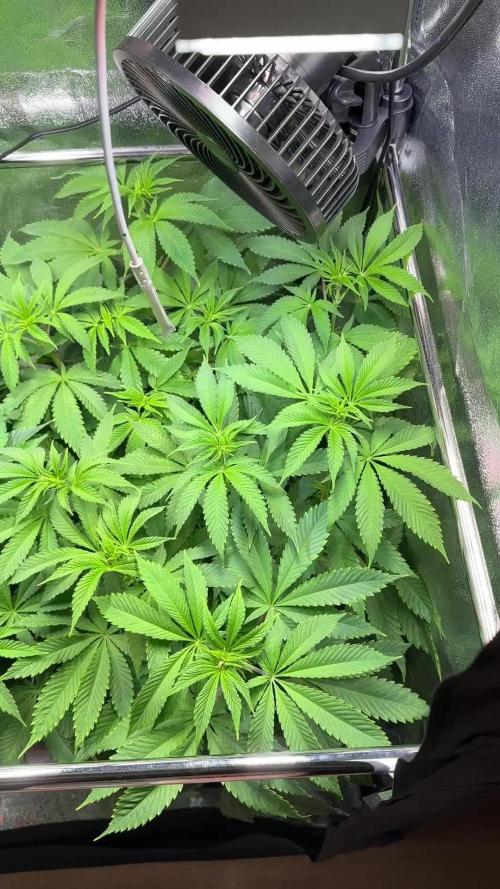
On Day 46 i switched to 12/12. now they are stretching. This strain stretches very very much. Probably more than double so be careful! U will be able to see the stretch within the next posts. :)
I use 3g/soil now and then 1g/soil at week 2 of bloom! At the start of bloom i still put the brenches into the pieces of the net so i maximize the light penetration throughout the bloom part. In a few days i ll stop LST because the brenches start getting hard.
