


Likes
Comments
Share


@BudGardener420
Follow
Week 4
the right plant shows a deficiency... no idea what that is. the light from the lamp was too strong at first but it shouldn't be... I don't know - I'll keep an eye on it... I think the left plant looks good... growing splendidly - sativa genes are showing... the right plant is growing more bushy
👉Defoliation and exposing the shoots👈
I removed all the leaves that were or would soon be covered with scissors ✂️ - I started in the middle to give the plant more air flow

Likes
38
Share


@Snakeking
Follow
Everything is fine i saw some fading on 2 plants but i think cold weather + molybdenum deficiency caused that purple color so i add some micro elements include molybdenum.
this week is warm again and i love it smells like candy but 2 of them got some sour aroma to :)
I believe they need more than what breeders say in my climate they say8/9 w but i think at least 10 w they need to mature maybe hot climate causes this

Likes
24
Share


@Hawkbo
Follow
The MC1 x Apricot Jelly actually came out pretty solid, the MC1 x Dionysus is ugly as a mf tho.
Started the flush on most of these last week. Everything has been steady all around. Going to start taking them down a few at a time over the next week or 2 some will go longer than others so they'll come down 3 or 4 at a time.
REMEMBER , IF YOUR SHOPPING FOR GEAR YOU CAN USE THE CODE “BANGDANG” FOR 10% OFF YOUR ENTIRE PURCHASE FROM ANY OF THE FOLLOWING COMPANIES.
@greenbuzzliquids
@rainscience_growbags
@gorilla_grow_tent
@growlightscience.led
*****Gorilla grow tent discounts extend to all companies affiliated with grow strong industries which include..*****
@super.closet
Lotus Nutrients
Kind LED grow lights
Likes
14
Share

@420DeepGrow
Follow
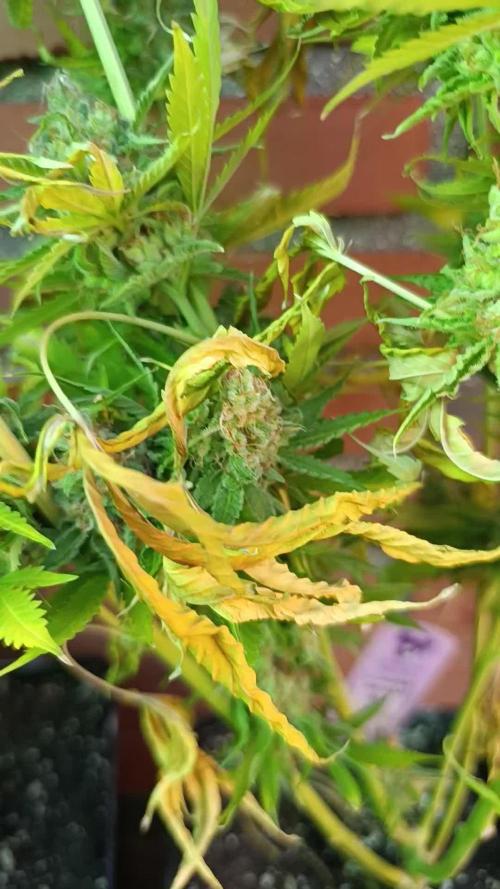
📆 Semana 9
Los cogollos llegan al final del ciclo completamente desarrollados, con una gran densidad, dureza y una producción de resina muy elevada. Los cálices terminan de hincharse y las flores alcanzan su máxima compactación y peso, mientras los pistilos se encuentran mayoritariamente oscuros y retraídos.
Los aromas alcanzan una intensidad máxima y el perfil terpénico se muestra completamente definido, mientras el fade avanza de forma natural y la planta concentra sus últimos recursos en completar la maduración de las flores.
Esta última semana estuvo marcada por la evacuación, dificultando el mantenimiento de la rutina habitual de cultivo. A pesar de ello, la planta consiguió completar el ciclo y llegar a cosecha con un resultado muy satisfactorio.
¡Seguimos creciendo fuerte! 💪


Likes
6
Share


@Black_Widow
Follow
Привет садоводы
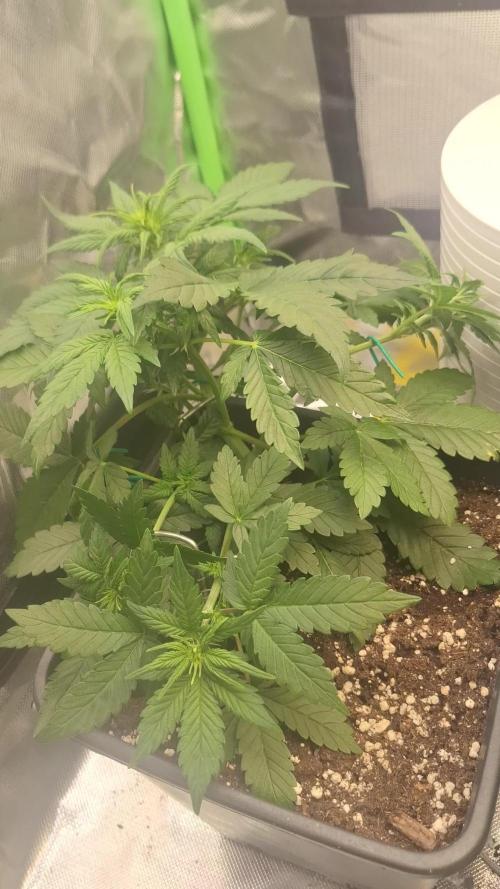
цветок еще немного подрос и показал пол
уже готов зацвести
цвет листьев у него хороший




Processing
Likes
2
Share


@Vet4weed
Follow
With the new netting up, I switched on the red lights along with the blues to help the plants stretch a bit to reach through the screen. It looks like it is taking effect, so late in the week (Friday) I trimmed some of the lower branches.
Last week I FIMmed Zoe and Grace to give River a chance to catch up, and I expected 1 of 2 results: 1) FiMming will encourage growth in the cut plants causing them to grow taler than River, or 2) Things will stabilize and River will be on par with her siblings. But instead, I discovered a 3rd result: River is continuing to grow bigger and thicker each day and is even taller and fuller than her sisters. In addition though, the trimmed plants are developing nice, strong, sizable leaves, and most of the new growth is coming from down below, rather than near the top.
Oh, and this week I added a new camera (Wyze) to the time lapses so I can take my pro camera out.

Likes
2
Share


@Guerrilla_grower777
Follow
03/09/2025 19:45
Only 2 days after the last time i'm here because i wanted to add some epsom salt and honey trough the watering,pot were pretty dry but not fully
The hunting season started here 1st of September so i didn't ear or see any boar,all i ear Is rifle shots every five to ten minutes no joke
#1 gorilla zkittlez auto
Defoliate a bit,the buds are now in full rippening stage as you can see the bottom branches are falling slowly with the buds getting heavier and the smell too
#2 frostbanger auto
Defoliate a lot,buds getting heavy on this one too,the odour Is so noticeable that It can be smelt from 40 mt
I'm getting worried,checked the trichomes and there Is some amber but a lot less than 5%,maybe i have to cut this one early but i don't want to
#3 Coco Milk
Pretty heavy defoliation on her ,finally starting to show Is a girl with some pistils here and there
This one drinks a lot as she's getting really big,over any expectation for her age i can't wait to see the buds forming
#4 Coco fresh and apricot auto
Coco fresh handling all the misfortune on her life,as It curved naturally i defoliated a lot and took away every "shadow branch"
Even her starting the flowering stage i can't believe that!
Apricot auto did suffer more maybe because is an auto,her will stay small the buds forming not the greatest too
Finally i think harvesting time Is near i'm planning to take away gorilla z and frostbanger a day from 10 to 15 of september max
I smoked both the samples,the gorilla z smokes so well even if It was small buds dried quickly
Sweet candy aftertaste with super compact white ash
Frostbanger smoked well too,not so white ash but dense and strong puffs,heavy indica effect and citrus sherbet like taste
Both are just so good i'm thinking about how good the big buds fully cured could be
That's not the first time i do guerrilla grow It all started on 2019 ,but it's the first time i grow this level of weed
That's because of the living soil i prepared this time,this thing is the future trust me
If someone want to know the exact proportions and ingredients in my living soil recipe feel free to ask

Likes
2
Share


@DogDoctorOfficial
Follow
🍃 Purple Haze Photo A — Week 4 | Preparing for Gravity-Fed Growth
Every grow has one plant that quietly starts telling you a story before flowering even begins.
Purple Haze A is becoming exactly that.
Growing under the same Future of Grow LED, receiving the same PPFD, sharing the exact nutrient recipe, environmental conditions and care as every other plant inside the tent, she has decided to express herself in a completely different way.
Instead of remaining compact, she has embraced her sativa heritage and is already showing the elegant structure Purple Haze is famous for.
Longer internodes.
Large healthy fan leaves.
Fast vertical growth.
Strong side branching.
Exactly the characteristics we hoped to see.
This diary is part of my ongoing 12/12 From Seed Challenge, documenting every step exactly as it happens. No shortcuts, no hidden techniques—just honest observations from a home grower enjoying the journey one day at a time.
⸻
🌱 Week 4 Development
This week was all about preparing for the next big milestone.
Purple Haze continued building an exceptionally strong root system while producing vigorous new shoots across every node.
The leaves are deep green, beautifully flat and reaching toward the light, showing excellent nutrient uptake and a very healthy metabolism.
Stem thickness has increased noticeably, giving plenty of confidence that she’ll easily support future flower production.
The spacing between branches also makes her an excellent candidate for training later, allowing light to penetrate naturally through the canopy.
Sometimes you can already tell a plant has personality long before flowers appear.
This one certainly does.
⸻
🚿 Time for AutoPot
This week also marks another exciting step.
Purple Haze A will soon become one of the plants running on my AutoPot system.
Since every plant in this project receives identical lighting, nutrients and environmental conditions, this creates a great opportunity to observe one important variable:
Top watering versus gravity-fed irrigation.
Rather than trying to prove one method is universally better, I simply enjoy comparing different growing styles under the same conditions and documenting the results honestly.
That is one of the things I love most about this hobby.
Every grow teaches something new.
⸻
💧 What is an AutoPot?
For anyone discovering these diaries for the first time, AutoPots are a completely passive irrigation system.
There are:
❌ No pumps
❌ No electricity
❌ No timers
Instead, everything works using gravity.
A nutrient reservoir sits slightly higher than the pots, allowing the solution to flow naturally through the tubing.
Inside each tray sits the heart of the system:
The AquaValve
The AquaValve is an ingenious little mechanical valve.
When the tray becomes empty, the valve opens and allows fresh nutrient solution to flow in.
Once the tray reaches the correct water level, the valve automatically closes.
The plant then drinks exactly what it wants.
Only after the tray is empty again does the cycle repeat.
Because the substrate experiences a natural wet-dry rhythm while always having nutrients available when needed, roots tend to develop extremely well.
Healthy roots often translate into healthier plants.
At least, that has been my experience.
⸻
🌿 Why I Enjoy Growing with AutoPots
Every grower eventually finds methods that simply fit their style.
For me, AutoPots offer several advantages:
• Consistent moisture around the root zone
• Reduced daily watering workload
• Excellent oxygen availability inside the substrate
• Stable nutrient delivery
• Very vigorous vegetative growth
Perhaps most importantly…
They let me spend more time observing the plants instead of carrying watering cans every day.
And honestly, watching the AquaValve quietly doing its job never gets old.
⸻
📊 Week 4 Environment
• Week 4 — Vegetation
• Height: 25 cm
• EC: 1.35
• pH: 6.1
• Temperature: 33°C Day / 25°C Night
• RH: 63%
• CO₂: 639 ppm
• Light Schedule: 12/12
• Water consumption: approximately 1.1 L per plant every 24 hours
⸻
🌿 Feeding Schedule
This week the nutrition remained simple and balanced using the Plagron Terra line.
• Terra Grow – 1.8 ml/L
• Power Roots – 1 ml/L
• Pure Zym – 1 ml/L
• Sugar Royal – 1 ml/L
• pH Plus – 0.03 ml/L
• Lemon Kick – 0.03 ml/L
The plant responded beautifully with rich green foliage, vigorous growth and absolutely no signs of nutrient stress.
Exactly the kind of consistency every grower hopes for.
⸻
💚 Final Thoughts
Week 4 feels like the beginning of something special for Purple Haze A.
She has developed into a vigorous, healthy young plant with beautiful structure, outstanding leaf health and plenty of energy heading toward the flowering stretch.
Now the AutoPot system enters the picture, adding another interesting chapter to this diary.
Whether gravity feeding produces bigger plants or simply makes life easier, we’ll discover together over the coming weeks.
That’s the beauty of documenting everything honestly.
Every plant becomes its own little experiment.
⸻
🙏 Thank You
A huge thank you to everyone following this journey and supporting home growing around the world.
Special thanks to all the amazing companies helping make this project possible:
🌱 Zamnesia Seeds — for the incredible Purple Haze genetics.
? Plagron — for providing the complete Terra nutrient line and outstanding growing media.
💡 Future of Grow LED — for delivering consistent full-spectrum lighting throughout the entire grow.
🌿 GrowDiaries — for bringing together growers from every corner of the world and giving us a place to learn from one another.
And finally…
Thank you for taking the time to follow this adventure. Your comments, advice, questions and encouragement make these diaries far more enjoyable to create.
Growers Love and see you next week, where Purple Haze A begins her AutoPot journey in earnest. 🌱💜

Likes
Comments
Share

@Cloudfan101
Follow
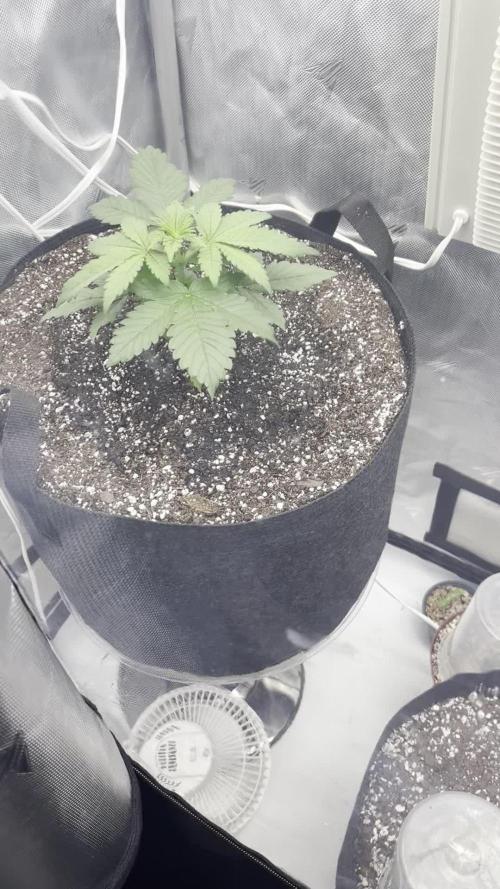
Gave them five days after repotting to start training. They grow so fast!
FIM training started on one (fifth node). Mainlining on the other (third).
Processing
Likes
21
Share


@LittleBigTrees
Follow
This week I Realised I'd used the wrong feed chart so I was over feeding 🙄 the leaves burnt on a few plants so I've only fed them water this week and will resume feeding from next week.
There are still no pre sex pistils showing but it can't be far off now.
As soon as pistils start to show I'll start feeding bloom feed.
I've turned the light up to 30000lux using HLG's online calculator for converting a lux meter/app reading to PAR , my light is 3000k which with lm301H Led's works out @ 465ppfd which is about the max the plants can use in veg without supliments co2.
Here's the link for anyone using quantum boards, it has different spectrum calculators.
It's been really useful setting my light up so big thank you to HLG (even though I have a Geeklight) and a thank you to the GML show on YouTube for bringing it to growers attention (I love that weekly show, so much info and perspective)
https://horticulturelightinggroup.com/blogs/calculators/converting-lux-to-ppfd
Hope everyone's staying safe and growing 😎
Likes
2
Share


@KeemBboomin
Follow
Now that you are all caught up, we are in week three a flower. I just gave them a top dress feet of Gaia green just blown because I still have just a little bit up all purpose in there but other than that I look at them every morning, give a big smile and turn on their favorite Mosark album
Processing
Likes
5
Share


@I_roll_my_own_420
Follow
The smell is getting stronger, lots of citrus in it. All grows without any problem, as always with barneys seeds. Amnesia Lemon stopped stretching finaly and its now working on buds. looks like Im almost at the half of flowering. Will see how it goes next weeks. Cheers!
Likes
2
Share


@Ultraviolet_
Follow
Topped once, turned off IR @ nights, slowed vertical growth back down, and took off both of the very lowest internodes on each plant.
Eisenia fetida
Stratiolaelaps scimitus
Armadillidium vulgare
Red wigglers (Eisenia fetida) are highly beneficial. They are considered an ideal choice for "no-till" or container-based organic growing because they live in the upper layers of soil, feeding on organic mulch rather than the plant's root system. Red wigglers accelerate the breakdown of organic amendments and produce high-quality, nutrient-dense worm castings directly in the root zone. Clover is another exceptional component of an organic rhizosphere, offering a sustainable, self-sustaining alternative to synthetic nitrogen fertilizers produced via the energy-intensive Haber-Bosch process. By forming a symbiotic relationship with Rhizobia bacteria, clover converts atmospheric nitrogen N2 into ammonium NH4, providing a steady, slow-release nutrient source that enhances soil health and reduces environmental impacts. Red clover offers superior nitrogen fixation and biomass production compared to white or yellow clover, making it the premier choice for maximum soil vitality, particularly for improving soil structure and providing a high-volume nitrogen credit for subsequent crops.
If it is fully functional and efficient soil, the rhizophagy cycle is superior long-term than any synthetic delivery when it comes to preventing deficiencies, not because it's "better," per se. The medium will require a very high CEC to make it to harvest without re-fertilization. The rhizosphere acts as a dynamic, interactive exchange where plants and soil microbes trade resources based on immediate needs. When a plant lacks a specific nutrient, it changes its physiology and releases specialized chemical cocktails—root exudates—into the surrounding soil. These exudates, which include sugars, amino acids, and organic acids, serve as a "shopping list" to attract specific microorganisms, which in turn return higher levels of desired nutrients. There is nothing in comparison when using synthetic delivery, which can cause plants to stop producing exudates, effectively "starving" the beneficial soil life, over time turning the soil barren and void of microbial life. Responsible use, applying the right amount at the right time, can minimize these negative effects. Relying solely on synthetic fertilizers without replenishing organic matter is what typically leads to exhausted soil. The use of synthetic fertilizers can utilize the Cation Exchange Capacity (CEC) of the soil, but without a robust rhizosphere and active microorganisms, the efficiency of this process is significantly reduced. This makes synthetic growing more difficult to prevent deficiencies overall compared to an efficient organic living soil with a robust rhizophagy cycle, as there is no "one size, fits all" when it comes to different nutrient profiles of strains/genetics, making it trickier to "guess" and prevent creeping deficiencies.
CEC does not contribute towards EC. Add more CEC using biochar, problem solved. If you keep pH between 6.3 and 6.7, hydrogen is exudated to cycle the medium's CEC for its needs. Keeping the pH between 6.3 and 6.7 creates an environment where plants release H+ to displace positively charged nutrients (like Ca2+, Mg2+, K+ held on soil particles or within artificial media this cycle through nutrients via the medium's Cation Exchange Capacity (CEC)
Microorganisms generate a stable potential of approximately 0.5 V EC. The rhizosphere creates its own food, similarly to chelation, using 1000's of varying combinations to create its own food.
Start to finish, just add water. Eventually, more materials will need to be added at the beginning of each new grow, but very attainable to go from seed to harvest without ever fertilizing.
ATP is important when it comes to biomass accumulation. Cellular root respiration and cellular respiration are essentially the same biological process, the breakdown of glucose to create usable energy (ATP) in the presence of oxygen, just taking place in different parts of the plant. Synthetic (salt-based) grows have significantly lower levels of total rhizosphere respiration, often referred to as root-zone activity, compared to organic living soil grows. While the plant roots themselves may respire in both systems, the surrounding soil ecosystem in a living soil setup is vastly more active, teeming with bacteria, fungi, and beneficial microorganisms.
2 pools of ATP, it won't double in growth buuuut, but improving root respiration by ensuring high oxygen in the soil is crucial. Good aeration ensures roots can fully utilize glucose to generate the ATP necessary for nutrient uptake, leading to healthier and more productive plants, even if growth isn't exactly doubled. The ATP created using root respiration is dedicated to rootzone growth; the ATP created using regular cellular respiration in a synthetic system would have to dedicate a lot of ATP to the roots when there is little or no root respiration. It's true that there is less of an initial ATP cost in breakdown when nutrients are already in their final form (synthetic), but you lose a solid chunk of ATP when the entire plant is reliant on cellular respiration alone; a large portion of ATP is dedicated to root zones for "forced" nutrient uptake rather than traded. Making it overall less efficient, even if the initial cost of breakdown is higher. Not sure if I butchered that but one can hope It makes sense.
Oxygen is of critical importance when growing in living soil compared to synthetic soil because it supports the metabolic needs of the microbial, fungal, and insect ecosystem, rather than just the root respiration required by the plant itself. While synthetic grows can survive in lower-oxygen environments with precise mineral feeding, living soil systems rely on aerobic microbes to decompose organic matter (microbial mineralization) to create plant-available nutrients, which is an oxygen-intensive process. While a specific fair percentage is difficult to guess, my experience points to a massive, compound difference between the two methods and the amount of oxygen required. All the ATP spared is used on more biomass, not only that, but the extra root respiration can achieve a much higher CO2 compensation point naturally than you could with synthetic and atmospheric CO2 alone.
As a plant grows faster and increases in size, its demand for nutrients to support that growth increases, requiring a higher rate of nutrient uptake. As plants enter phases of rapid vegetative/floral growth, their metabolic demand for nutrients increases exponentially. Without a robust buffer zone—whether in the soil (cation exchange capacity) or in a hydroponic reservoir—deficiencies will occur rapidly because the instantaneous demand for specific nutrients can quickly exceed the rate of supply.
A growing body of evidence suggests that organic living soil provides superior long-term soil health and environmental benefits compared to synthetic fertilizers, which are often criticized for promoting a cycle of dependency and degradation. While synthetic fertilizers offer short-term convenience and high yields, they often come at the expense of long-term soil health, sustainability, and increased corporate control over growers/ farmers. Organic living soil, while slower and requiring more care to establish, creates a sustainable, resilient, and, ultimately, more fertile environment.
We don't really grow; we facilitate energy conversions, and energy is just numbers. Because the universe works the same way today as it did yesterday, there is a single, fundamental mathematical quantity that remains constant. We call this quantity energy. You cannot put "energy" under a microscope. You observe matter and forces (like heat, motion, or light), but energy is just a scalar number calculated to help predict how these things will change and interact. When an object falls, or when a battery powers your phone, matter shifts and changes form. Through it all, the universe ensures the "total score" of the numbers remains exactly the same.
Once all water is removed, approximately 95% to 97% of a plant’s dry matter consists of carbon, oxygen, and hydrogen. These three elements form the structural backbone of all plants. NPK & all the rest 3-5%.
Indigenous Amazonians created, or at least significantly enhanced, the fertile, dark soil known as Terra Preta de Índio (Portuguese for "Indian Black Earth") by incorporating biochar and other organic materials into the soil. This anthropogenic (human-made) soil technique, which dates back roughly 2,500 to 8,000 years, allowed ancient civilizations to flourish in regions with naturally poor, acidic, and nutrient-poor tropical soils.

Likes
35
Share


@Chedderbob112
Follow
Have been waiting to upload the results of ma swazzenger teqnique a took a chance n hopefully it pays off man juicy chronic is the strain a like it so far hope for decent harvest but hav learned a lot n am happy for the support of ma fellow growmies tips n advice knowledge is power
Likes
31
Share


@MadeInGermany
Follow
Day 6 since the time change to 12/12 hrs.
Hey everyone 😃.
The stretch by moving into the flower tent has started 🤗.
It develops beautifully and makes beautiful stable Shoots from 👌.
Since I unfortunately ran out of Grow Liquid, it is already getting full bloom Liquid.
Which is unfortunately not perfect, but there is no other way in this situation :-(.
I hope that you will still do a nice stretch.
I wish you a lot of fun with the update, stay healthy 🙏🏻👌 and let it grow 😎
You can buy this Strain at
https://www.barneysfarm.com/blue-cheese-34
You can buy the fertilizer at
https://www.greenbuzzliquids.com/
Type:
Blue Cheese
☝️🏼
Genetics:
Blueberry
X
Original Cheese
👍
Vega lamp:
2 x Todogrow Led
Quantum Board 100 W
💡
Bloom Lamp :
2 x Todogrow Led
Cxb 3590 COB 3500 K 205W
💡💡☝️🏼
Soil :
Canna Coco Professional +
☝️🏼
Fertilizer:
Green Buzz Liquids :
Organic Grow Liquid
Organic Bloom Liquid
Organic more PK
More Roots
Fast Buds
Humic Acid Plus
Growzyme Big Fruits
Clean Fruits
Cal / Mag
Organic Ph - Pulver
☝️🏼🌱
Water:
Osmosis water mixed with normal water (24 hours stale that the chlorine evaporates) to 0.2 - 0.4 EC. Add Cal / Mag 2 ml per l water every 2 waterings . Ph with Organic Ph - Pulver to 5.8 .


Likes
40
Share


@valiotoro
Follow
Helloooo everyone👋
This is the last week all the girls are ready for harvest🤩✂️
Im very happy with the result for my first outdoor photoperiod session!
It was challenging but i had a lot of chance with the weather,this year was exceptionnal😎☀️
Absolutely different to grow outdoor
If you want to skip the rain & the cold weather you can force the plants to flower,it works but you have to remove the plants every day at the same hours⏰
If you have the time to make your Homemade nutrient 100% bio its really easy you can find everything in nature feel free to ask me👌
In love with the beautiful purple color of the Biscotti from zamnesia😈


Likes
7
Share


@Adam22
Follow
Day 28 week 4 of flower plants looking good I dropped a 3L water bottle on a string which snapped a whole branch from the bottom 😳 on right plant 😭