


Likes
Comments
Share


@WeedM8
Follow
Hello m8 welcome to this journey with me in this diary will have very interesting strains hope u find something useful
O.G. Kush Titanium
- [ ] 1st week Veg: germinated in substrate lighting very close so it jets medium high humidity after the 3rd day they started sprouting
- [ ] 2nd week Veg: this week my ventilator broke down and as the temperature stayed very warm nothing developed much
- [ ] 3rd week Veg:fortunately this week i had fixed the ventilation and the temperature has go down a bit allowing the little plants to develop and reinforce
- [ ] 4th week:very good developments in this week I already started feeding a bit two times but i didn’t have to…once was enough
- [ ] 5th week Veg:this week they were very strong green i only had to water them good and keep the ventilators going no stop .They have good hight already ,but as i have to strains together. I want to transplant them when the hight of the other one have stretched… I’m thinking to transplant next week if not the next one
- [ ] 6th week Veg: this week it went great fortunatly i dont have pests that eat my buds i’ve givven a fed once the substrate is very rich already the plants streached very well i will transplant today so be ready m8 i cant wait to show you the progress
- [ ] 1st week Fl:they started stretching and looking very healthy just transplanted
- [ ] 2nd week Fl this week I’ve been away i had a friend taking care of them they stretching very well i hope that she starts putting energy into the flo
- [ ] 3rd week Fl:
- [ ] 4th week Fl
- [ ] 5th week Fl
- [ ] 6th week Fl
- [ ] 7th week Fl
if this was useful please like and follow

Likes
22
Share


@Mr_Mister
Follow
Última semana de agua para limpieza de raíces, imposible sacar del scrog para limpiar mejor.
He tenido que poner cables extra para soporte ya que las ramas se siguen retorciendo y cayendo por el peso de los cogollos.
Algunas hojas debajo del scrog están marrones y quemadas, quizás por la falta de luz o nutrientes, ya para lo que queda no echaré ningún líquido más.
Likes
11
Share


@GREENPHOENIX6262
Follow
*Week 5 Flower 09/24*
Thus far both both plants are flowering and budding nicely, Trichomes are setting in accordingly, Increase in Phosphate and Potassium nute feeds.
Both plants have appeared to stop growing in height settling in at 48Inches.
Top COLAS are pretty dense and the aroma coming off both of them is bright and vibrant
White Hairs are starting to turn bright orange.
*Week 5 Flower Mid week update - 09/28*
Both plants have reached max height (48 Inches)
Bud sites are filling up and have become more dense with trichomes cover through the flowered bud.
60% orange hair coverage - Nearing harvest
*Week 5 Flower End week recap 09/30*
Both Apple Fritter and Critical+2.0 nearing harvest
Cutting back on nute feeds starting tomorrow and will increase clean water feeds
Flushing will begin in a week - both will be harvested in 2 weeks.


Likes
7
Share


@ZDNTheFirst
Follow
The game is on now.
As I mentioned last week, I made some upgrades to the grow tent. As you know, my old light—while powerful—generated a lot of heat. Also, even though it was rated at 6500K, it wasn't full spectrum. So, I bought a new light; this one isn't full spectrum either, but the blue and red light (blurple) is actually a pretty decent option for growing, especially in such a compact tent. The power draw dropped from around 100W to 45W, which saves on both electricity and heat. Now, I realy wanted to Harvest Master TS600 for this cabin but to be honest, I dont have any budget for this. And when you think, I want to show myself and everyvone that follow, you can do it yoursel with no expensive fertilizer, no expensive light and almost no budget. This kabin cost me 75 dolar before put the litgh. The light cost 25 dolar, so its around 100dolar cabin. And we will gonna take a good amount of product, %100 organick wild buds, and we will breed two female with one male ( lucky bastard ) and create 2 new genetik in this cabin.
I no longer need a separate cooling compartment because this light generates heat directly from the LEDs rather than from the top housing. I needed a fan to channel in outside air and add humidity if necessary—one that could run 24/7 to eliminate the risk of mold caused by 75% humidity levels at night. I bought this fan and I'm quite happy with it, though I'm not sure if it will run continuously for 24 hours. We'll see.
Right now, the readings are 45% humidity and 25°C—and it's August. Perfect.
The plants on the left and in the middle are female, while the one on the right is male. I recently flushed the soil to deal with potassium burn, and it worked really well. Normally, a flush requires using three times the volume of the pot, but I just cleared the excess salts from the surface and used a volume equal to the pot size. That was more than enough, though the male plant still doesn't look too happy. The middle plant is showing a lot of pistils; it looks like it's about to start flowering. I hope it's not an autoflower strain. I'll be taking clones next month, and then we'll gradually transition into the flowering stage.
Likes
13
Share


@Green_Dream
Follow
Such beauties, it's a pleasure to watch them grow!
And yes, the mites are spreading, but I don't think they will do that much damage.
------------------------------------------------------------------------------------------

Likes
17
Share

@masterofsmeagol
Follow
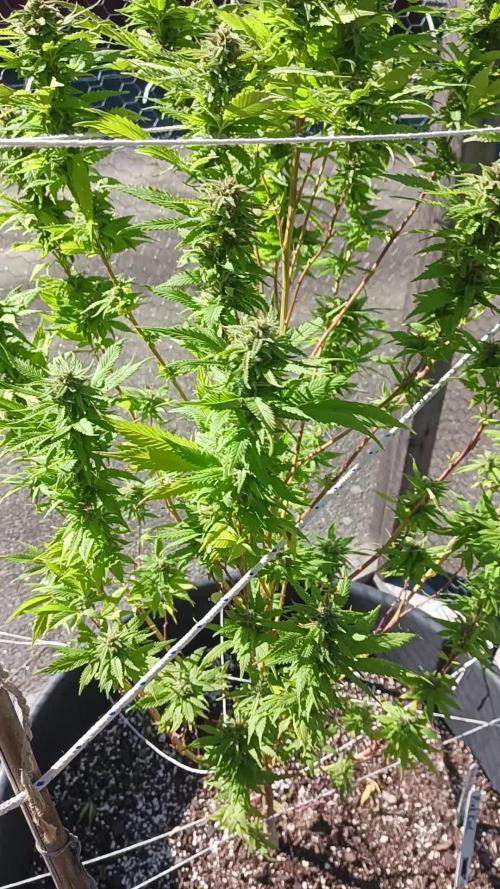
9/27 She made it through the rain! Looking great in the sunshine. I gotta bring the loupe over again. It's smelling really strong and it looks like most of the pistols have changed color. If I wasn't losing more to damage I'd leave it out longer. It will still be a couole days probably because I need to put away what's hanging and make room. This has been one crazy year. Forty degree temp swings. Crazy year and even crazier pot. Can't wait to try them all!
EDIT: I've been trying like hell to update this thing. I've been working my balls off. I ALMOST took the last pink kush. I have a video i'm trying to upload on my computer because I can't even update ANYTHING on my phone. Boy this years weed came out incredible! I've been working hard but as soon as I have a second to myself and get everything at least inside i'll finish the harvest and smoke reports and give some good pics/videos.
9/28 Finally got a video uploaded. It was yesterday. The Lome pink kush is looking real good. I'm losing more and more to these insects. I want to leave this plant a little longer and have the buds come together but the trichs are cloudy now. Almost every pistol has turned a red color. I'm going to bring my loupe and check it out today. Everything has turned out fantastic. I'm looking forward to taking pictures.


Likes
5
Share


@Budhunter
Follow
Week 10 is been magical.. Sour D is showing really good smell, different one.. similar with one I smoked from the streets.. plant is a bit smaller than gelato just beside it but man, they both are reaching the stars.. my biggest plants ever.. so far Barneys farm is showing really good genetics in my hands.. let’s gooo
I will cut off silicon and big bud from next week on 👍🏼👍🏼👍🏼

Likes
8
Share


@JohnnyBarrel
Follow
Week 11
All is under control: plants are growing correctly, healthy, deep green… perfect size, a few weeks before flowering cycle; I did a second topping week 10 on everyone (+6 nodes): I would have a maximum size around 150 cm for discretion and space.
Still Aphids problem on the Royal Moby and I treated leaves by hand with Soap…making a mistake: too late in the morning so the sun burned some leaves.
This insects are still there but the infestation is contained for the moment.
I sprayed Neem oil on all plants.
Added more soil in each pot : 1.5/2L of humus worm + guano bat.
I observed a sort of burn on lhe extremity of leaves: possibly a sign of nitrogen excess.
I stopped nutrients for a while, adding just enzyme and Alga Mic.
Watering around 1.25L/2 days
Daylight 15h30 - 6h25/21h55
Sunny days, cloudy sometimes, windy (NNE)
T°= 13ºC N / 21°C D
Humidity 67%


Processing
Likes
4
Share


@UK420hydrogrow
Follow
Had a bit of a bad week with the girls in flower tent also had few issues with the ph @6.3 been to high causing a few problems had to defoliate all affected leaves hopefully they will bounce back
Likes
16
Share


@BongRip
Follow
UPDATE AFTER A LONG TIME, i'll post more often.
I only recovered a few videos from last couple years to share.
Mango is dense, but doesn't give out much trichome as I expected. So, I took a risk and poke a hole in the stem to gave a lot of stress to the plant, so the plant gave out a lot of trichomes and the bud becomes a bit bigger.

Likes
4
Share


@dreamLife
Follow
Comienzan a florecer las bebes, la planta de maceta café presenta mayor desarrollo que la de maceta negra. Se comienza la fertilización con aquellos encargados de la floración.

Likes
11
Share


@madlangs
Follow
All going extremely well in the room. No problems. Purple punch is just starting to fade
20.4.23
Filled tank with winter frost
23gal
Ec 0.8
Ph5.9
Outside pineapple chunk
Looking lovely.
17.4.23
3L watered on top with
15ml bio heaven
12ml top max
Then put 750ml plain water on top
21.4.23
Started feeding winter frost
Ec6.4 no ph down

Likes
19
Share


@Chunkmasta1
Follow
I believe the plants still have a little stretch in them. They have not grown much since the bud production picked up last week. The berry bomb still seems to work well off lite nutrients. The smell has started to choose days that it stinks, and days it is invisible. I live in a legal state; I am allowed up to 12 plants. Smell is not a issue for me. I do not need to hide my grows. I had to set up a wire tie on the plant in the videos. She started to lean right. While setting it up the smell that stuck to my gloves was very fruity. I cannot wait to smoke the final out come. The berry bomb auto has been super resilient to most common grow issues. She also bounces back insanely quick fro stress. This is not something I have seen in many auto flowers due to the limited time they have to grow, and bud. I am so impressed by the genetics of this plant. I'm just blown away with this grow.


Likes
63
Share


@Ganjagrandaddy
Follow
Day 14 Veg: A great start to the week once they settled into their new pots. hopefully i havent stunted their progress. The mutant Banana Mash is now trying to normalise a little more with new growth. Still fairly twisted but on the mend. The other 3 are more typical of new plants with their growth . I have topped one and fimmed another with one being left natural at this point. They are on their 5th node mainly ( except mutant!) and I am hoping to open their frames right up to get light to all new growth equally. I don't think they will grow too tall by design and I don't want to limit their growth in any way so i will gently manage them as they grow.
The Purple Monkey are doing brilliantly so far with plenty of vigorous growth among them. I am holding the 5th nodes down on two of them and have fimmed one. These are in bigger 60L pots so should use the space to its best I think.
I also have 2 plants that came from the recent harvest. One of the ladies must have had a pollen sack hid away that managed to seed a few of the exotic girls amd visited some possible viable hybrids. 2 of these are now in the grow alongside. I will be watching them like a hawk and any sign of a testicle will result in a slaughtering of the LGBGTQ sympathiser instantly . lol We do male or female only unlike the human race !!. heehee ( bit of a political hot potato!).
I gave them an actual megacrop feed today to boost the available elements for the speedy growth coming. The L.o.s is still active and providing enough nutrition but I am trying to avoid the drop once the stretch period gets busy and saps the available food from it. This seems to have been happening most crops since beginning using it to avoid the leaves losing their solent green colour too fast like starvation can cause.
I also added a touch of calmag to counter the L.e.d leeching that often occurs in flowering.
So there we have it Growmies. A good week with the beginning of l.s.t and some promising growth.
Another issue that I have managed to resolve is the R.h. We are getting warm dry air now so the room is getting silly hot and very dry at around 40% . This is great for the flowering times but has been an issue for veg in the past. not wanting to invest in a humidifier that is costly and expensive to run , I had resulted to using towels in buckets to attempt to raise it
this does work in a totally sealed tent , in my leaky d.i.y "tailored " one , this has been hard to maintain. The solution came in the form of a vicks vaporiser that I bought from fleabay. It works perfectly to bring up the rh to around 70% on its lowest setting. The tank is enough to hold a days supply of water and shuts off with the lights. simple but effective fix to a common problem we face indoors.
Be safe and well.
Until next time. G7 Summit will be interesting in the uk!!

Likes
144
Share


@DevilsBud
Follow
New week for the 7 strain 11 plants grow
Relax week for the girls one good feed off nutrients and then couple watering with call-mag before start of flowering some defoliation here and there and final big haircut and removing lower grow i want to focus on top grow and less popcorn buds going on
24/3/22
Big defoliation for making the 12/12 switch
Will be updating Tru the week
And remember just grow weed and stop growing bullyish behavior
visit www.marshydro.eu
for your best gear and use the PROMO CODE: DEVILSBUD
Some info about the Marshydro FC-4800
Superb Quality LED Chips: The whole light is composed of 1206 pcs Samsung lm301b and Osram 660nm chips. More than two times as many LEDs are used to drive the grow lights at low currents and to avoid overdrive. Quality is guaranteed and efficiency is up to 2.8 μmol/j.
Even PAR Distribution and High PPFD Output: The multi-light bar design and the densely distributed light chips enable the LED grow lights to achieve the optimum PPFD required for plant growth over the entire effective coverage area.
Specifically Designed Spectrum: To ensure even plant growth, blue and red light are enhanced on the basis of a full spectrum combination. Not only does this accelerate plant growth, but it also improves the yield and quality of the plants at the same time.
Dimming Daisy Chain Function: The dimming function saves on electricity costs and enables brightness from 10% to 100% for the different stages of plant growth. A single master light can connect up to 30 lights in a daisy-chain system.
Business LED Grow Light: The light's wavy heat sink dissipates heat quickly and the IP65 waterproof allows the light to operate in humid conditions. 180° collapsible feature for easier installation. All these features provide favorable assistance for commercial cultivation.
And some tent info
●【Lock All Light Insid】MARS HYDRO Grow Tent Interior is made of diamond mylar. Non-toxic to the environment, no harm to plants. High-quality 1680D canvas being double stitched, (ALL OTHERS BRAND grow tent is 601D canvas) which is tear-proof for perfect light locking, No light leaks or rips at all.
●【Durability Grow Tent】Stable Metal corner adapters and poles are the trustful supporters of the tent. No rusting nor paint-falling. Quick easy tool-free installation. Carries strong heavy-duty SBS zippers, double layer lining to create a light-proof seal.
●【Easy Observation of your Plants】Special peeks window made by double layers of cloths. Observe the growing conditions of your plants without opening the tent and avoid disturbing plants. The peek window also serves to dissipate heat and ventilate air.
●【Removable Tray Keep Clean】The package includes a removable waterproof floor tray to hold soil and fallen leaves. The tray can be taken out easily to wash. Removable and water-proof makes cleaning easy.
●【Good Ventilation&Fast Assembly】 Circular double-sleeved vent holes with adjustable nylon strap for air circulation by exhaust fan, ducting, carbon filter, or reflector. Better allows proper light, heat, and airflow. Quick tool-free installation. Reinforced by a sturdy metal frame to ensure security and stability, supports up to 140lb. Perfectly safeguard your plants to thrive even in winter


Likes
446
Share


@Metatronix
Follow
This diary should have been updated a long time ago but the lack of time and mine reluctance to actually go back to the time of harvest, I did delete most of photographs of the harvest in rage as it was not a nice memory for me, here is why.
So the last update i made to the diary was on 19 September and already then i knew something was brewing because we had a week long rain spell and it did not look like it was about to stop at that and the weather forecast showed a month more of rain. Without that rain and high RH i would probably give them girls one more week under the SE 7000 :/
The weather forecast was unfortunately right, so all in all we had around six week of relentless rain...outside it was from 90 to 95% RH in my house it was mostly 85%RH and in my grow room which is located in a basement i had from 60 to 63%RH with lights and dehumidifier on and around 70% with lights off. And that was a killer for my tightly packt grow room.
What i did was to open all the walls from the grow room at dark time and had two big external fans blowing air at my plants but it did not help much... My first observation of bud rot was on 24 of September while making photographs of the beautiful buds. That week i lost to bud rot 4 bud stems, after the chop while drying i found another 5 infected stems, and by final trim just before jaring them i removed one more.
So all together i lost to bud rot 10 bud stems, four of them were really big ones. I had made some pictures of the buds with bud rot and of the buds hangin in drying room but they did not survive my dark mood :( Sot thats the reason i got only few photographs to show for it.
The final weighing was actually not as bad and lightened my mood a bit, that and that that i did not found any more mold on my cured Killer Kush :) So the dry weight after curing was 720 gram of dry bud I still till today did not make # from all the trimmings...but the trimmings are properly dried and waiting for bubble bugs in my freezer.
After this learning experience i decided to add at least one more 30W air mixing internal fan, and i did get to know one of my relatives possess a 300W dehumidifier so next time i will be better prepared.
Maintenance wise i will try to defoliate and lollipop my plants more aggressively to let in more air penetration.
Likes
18
Share

@Bncgrower
Follow
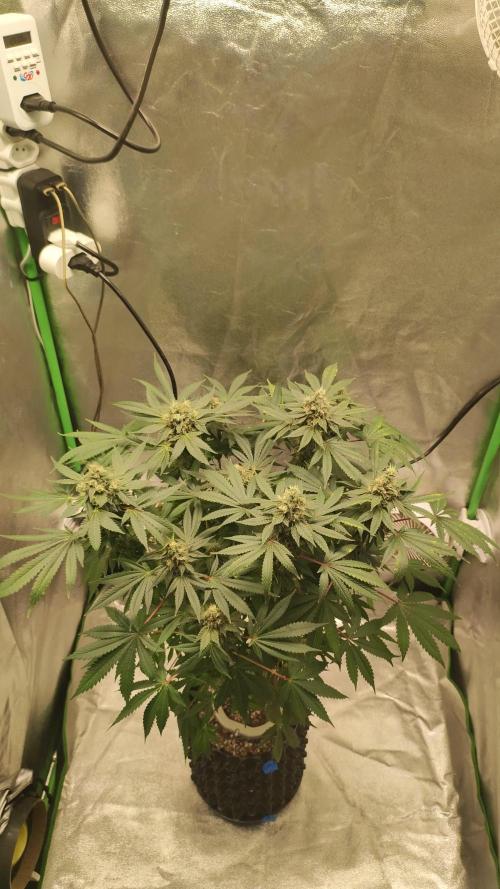
So here we are, another week has passed and the end of this cycle is getting closer... this week I will reduce the EC to 2.0 and next week I will reduce the EC until the substrate runoff is around 0.0 - 1.0 💪💪💪


