


Likes
Comments
Share


@CANNASIM
Follow
Plants are responding well, still on a very light regimen, using only compost tea, declorinated tap water.
Stem is thick, and strong, has a many colas shooting up with minimal training at the moment.
Leaf color is vibrant, and dark.
Using compost tea in the third watering as usual. >
Compost tea with a twist #3
- 1 cup earth worm castings
-1/4 of a cup bokashi
-5 tsp recharge
-1 tsp shell flour
-1 tsp azomite
Did not have organic molasses so preferred not to put anything, as the recharge and the bokash i use have some, originally is better to use some in pure form like 1/3 of a cup.
EC after 24h is around 0.5 - 0.6, ph close to neutral. So used in pure form, possible to dilute if needed.
So far I did not PH the water, only filtering it, gave a bit up on RO for now as the water discard is just insane... probably takes 2 gallons + to make one pure... Just not ecologic... so I have detached the membrane for now and am using two filtering steps, carbon and another one...
This diary is probably the nightmare of any nutrient company.
Note that Recharge is not needed or azos, I’m using because I have laying around here, a substitute would be some sprout seed tea.
My choice for the organic, was to be able to abort ph, have a cleaner product, try something new, and reuse my soil...

Likes
37
Share

@GermGrowFox
Follow
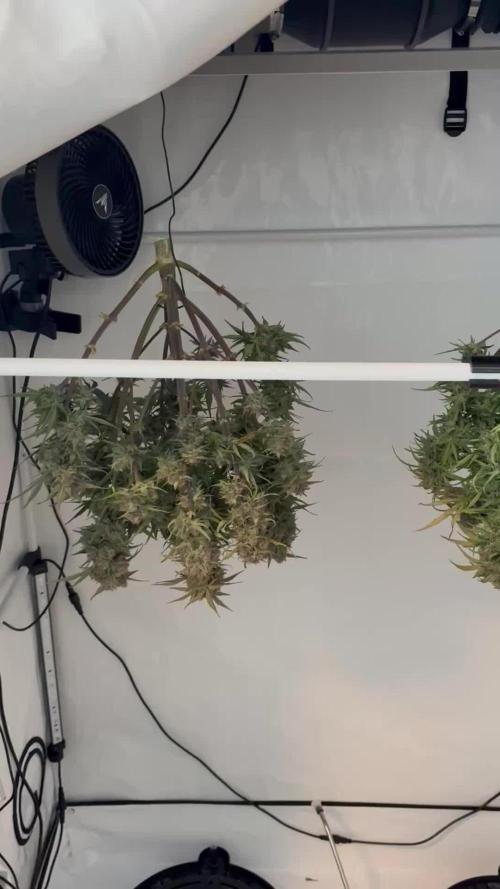
Ein spannender Run mit einer sehr schönen Pflanze als Endresultat. Ich bin sehr zufrieden mit dem Ergebnis.
Gelernt habe ich dieses Mal, nicht sofort den Panikmodis anzustellen wenn es Nanners gibt. Es hat ja dennoch einwandfrei geklappt. :)

Likes
18
Share


@DogDoctorOfficial
Follow
Hey fellow green thumbs! 🌿💚 We’ve just wrapped up the sixth week of flowering with our Auto Fast Pete and Auto Northern Dragon Fuel from Super Sativa Seed Club. With harvest just around the corner, this week has been all about the final push. Let’s dive into the details!
🌟 Week 10 (Sixth Week of Flower) Progress:
Day 64-66: Final Bud Swell
• Auto Fast Pete: Pete is in the final stages of bud development. The buds have swelled significantly, becoming denser and more resinous. The aroma is incredibly strong, filling the grow room with a delightful scent. 🌿🌸
• Auto Northern Dragon Fuel: Dragon Fuel is also in her final stretch, with thick, sticky buds that are heavily covered in trichomes. The plant’s resilience continues to impress as she pushes through to the end. 🌱✨
Day 67-69: Flushing Phase
• Nutrient Strategy: This week, we’ve switched to just water with a TDS of 100 and a pH of 6.8. The goal is to flush out any remaining nutrients, ensuring a clean and smooth finish for the final product. 🌿💧
• Reservoir Details:
• TDS: 100
• Temperature: 18°C
• pH: 6.8
• Environmental Conditions:
• Temperature: 31°C
• Humidity: 51%
Maintaining these conditions to optimize the flushing process and prepare for harvest. 🌡️💧
Day 70: Final Observations
• Auto Fast Pete: The buds are fully matured, with a thick coating of trichomes and a rich aroma. The plant has responded well to the flushing process, and the foliage is showing signs of nutrient depletion, indicating a successful flush. 🌿🌼
• Auto Northern Dragon Fuel: The buds are dense and sticky, with a beautiful trichome coverage. The plant has also responded well to the flushing, and the leaves are beginning to fade, signaling that she’s ready for harvest. 🌱🌟
🌟 Care Tips:
• Light: Maintaining the 12/12 light schedule as we approach harvest. The plants are thriving under this schedule, and the buds are fully developed. 💡
• Autopot System: The Autopot system has provided a steady water supply throughout the grow, reducing the need for frequent manual watering. This week, the system is delivering only water to ensure a proper flush. 🌊
• Nutrient Monitoring: Switched to just water with a TDS of 100 and pH of 6.8. Monitoring the plants closely to ensure they are properly flushed and ready for harvest. 🌿
• Environment Control: Maintaining a stable temperature of 31°C and humidity around 51% to create the perfect conditions for the final stages of flowering. Adjusting airflow and positioning to optimize plant health. 🌡️💧
🌟 Genetics Spotlight:
Auto Fast Pete:
• Characteristics: Rapid bud development, strong structure, early resin production, and impressive resilience. Despite some stress earlier, this strain has produced dense, aromatic flowers.
• Harvest Expectations: Fully matured buds with a rich aroma and thick trichome coverage. Expecting a potent and flavorful final product.
Auto Northern Dragon Fuel:
• Characteristics: Robust structure, dense bud sites, resilience, and heavy trichome production. The buds are sticky and aromatic, showing great promise for a high-quality harvest.
• Harvest Expectations: Dense, sticky buds with a beautiful trichome coverage. Anticipating a strong and potent final product.
🌍🌿 Fun Fact:
Did you know? 🌿✨ Flushing your plants with just water before harvest helps to remove any residual nutrients, leading to a cleaner and smoother smoking experience. It’s a crucial step to ensure the best possible final product!
For all the in-depth action and detailed explanations, head over to my YouTube channel! 🎥✨ I’m sharing all the tips, tricks, and step-by-step guides to help you get the best results from your grow. This week has been particularly exciting as we prepare for harvest, and there’s so much more to explore and learn together!
👉 Join me on YouTube ink in my profile 👈
🌟 Conclusion:
Week 10 marks the sixth week of flowering, with both Auto Fast Pete and Auto Northern Dragon Fuel showing remarkable progress. The buds are fully matured, and the plants are ready for harvest. With careful monitoring and a successful flushing process, we’re set for a promising and rewarding harvest.
Stay tuned for the harvest report, and happy growing! 🌿💚✨
#SuperSativaSeedClub #Week10Report #FastPete #NorthernDragonFuel #PlantMagic #GardeningJoy #NatureLovers #PlantPower #InspireGrow #YouTubeJourney
Germination method 🌱 @thecannakan
Genetics @supersativaseedclub_official
Nutrition
@aptusholland 🌿
@aptus_world 🌎
@aptus_es 🌍
@aptusbrasil 🌱
@aptus_thailand 🌿
@aptus_portugal 🌳
@aptususa_official 🍀
@aptusplanttechnz 🌺
@aptusplanttechaus 🍃
Ambient controls🎮
@trolmaster.eu @trolmaster.eu.support @trolmaster.support @trolmaster.agro
Soil @promix_growers_eur @promix_cannabis
LED - @lumatekeu
Watering- @autopot_usa @autopot_global
Love and attention- @dogdoctorofficial
As always thank you all for stopping by, for the love and for it all , this journey of mine wold just not be the same without you guys, the love and support is very much appreciated and i fell honored and so joyful with you all in my life 🙏
With true love comes happiness 💚🙏 Always believe in your self and always do things expecting nothing and with an open heart , be a giver and the universe will give back to you in ways you could not even imagine so 💚
More info and complete updates from all my adventures can be found ⬆️link in the profile description ⬆️
Friendly reminder all you see here is pure research and for educational purposes only
💚Growers Love To you All 💚
Discount Codes :
@thecannakan DOGDOCTOR 15% off
@theneutralizer PORKIT7-DOGDOCTROSO 15% off
@kannabiaglobal DOGDOCTOR 30% off
@seedsmangenetics DOGDOCTOR 10%off
@terpyz.mutant.genetics DOCTOR 15% off

Likes
51
Share


@Chumpkilla
Follow
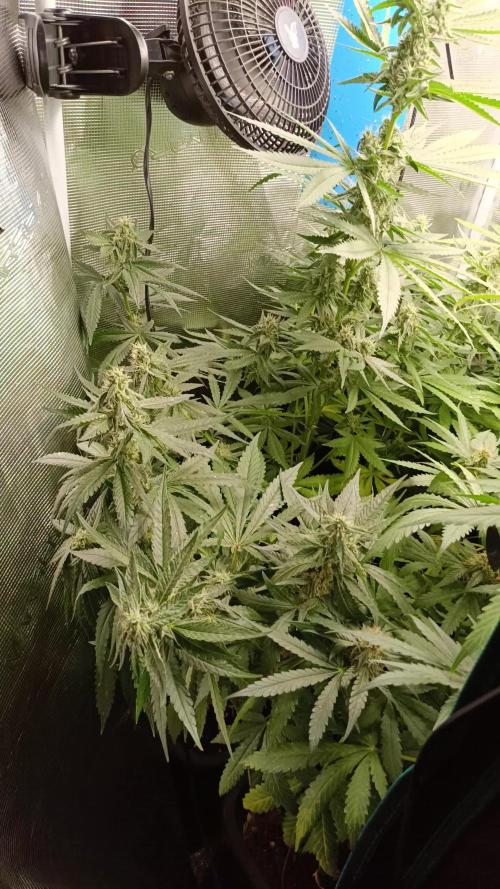
12/17/23 - Day 41 - It flipped to flower today. I didn't document it via video because it's just like all the other videos. Except this change uses different level of the nutes for Flowering.
Alot of the bud sites have tons of pistles on them. The plant itself is so round and bushy. The plants branches are very close together.
There is a video up there of me using the software to change from veg. to flower.
I'll update you tomorrow once the lights come on. Now I only get 12 hrs of light instead of 18.
12/18/23 - Day 42 - FLOWER POWER! Look at those flowers starting to form! It looks amazing!!!!! I think starting from a good seed is better than a clone. If this ends up better than the last grow..... it's already off to a better start. The leaves looks super healthy.
12/23/23 - Day 47 - What a WEEK! The whole family got sick and I was the lone ranger on the battlefield taking care of all the units! So posting had to take a back seat! I did manage to grab some pictures during those days. I posted them up top. This week is the first week of Flower, and its going great! As you can see in the pictures that the buds are starting to take off from the bushy part of the plant.
I installed a second Scrogg net, the buds are already starting to launch upwards and I can tell they are going to need some support as they get bigger.
The Leaf box has been taking great care of the nutes, humidity, temp, and lighting. There is only one thing that I have had to do manually. Toward the last day of the week, the day before the water change the PH seems to dip down to 5.5. It's not a bad thing to be there for a couple of hours, but it is the lowest range I would ever let PH go in a hydroponic (DWC) setup. I have been adding 2 cap fulls of PH+ to get the PH in check. To be honest, adding 2 caps full of PH+ once a week is NOTHING. I feel like it's the least I could do. The box is creating the perfect environment. It's the perfect Cannabis Oasis, I treat my girls to the finest of living before the end. :)
Happy growing and I'll post again after the water change tomorrow!
If you like this experience and would like to have the same one, you can order your Leaf system from www.GetLeaf.co.
(full disclosure, I paid in full for my Leaf unit. I was a Kickstarter backer back in 2017 this is not an advertisement, this is real life)




Likes
31
Share


@Hashy
Follow
********************************************
Week 17 Fade (week 11 flower)
********************************************
Light cycle=12/12
Light Power=100w 42%
Extractor controller settings (during lights on).
High temp= 25c
Temp step=0c
High Rh= 50%
Rh step=0%
Speed max=10
Speed min=5
Extractor controller settings (during lights off).
High temp= 21c
Temp step=0c
High Rh= 55%
Rh step=0%
Speed max=10
Speed min=5
Smart controller settings (during lights on).
Lights on=9.00am
Radiator on= -22.c
Radiator off=+22.5c
Top fan on=
Smart controller settings (during lights off).
Lights off=9.00pm
Radiator on=-19.0c
Radiator off=+19.5c
Top fan on
VPD aim=1.0-1.4
DLI aim=30-40
EC aim=0.2-0.8
PH aim=6.0-6.5
💧💧💧💧💧💧💧💧💧💧💧💧💧💧💧💧
NPK= 0-0-0
Method= Automatic
Feed=Finishing nutes.
Neutralise=0.1ml/L
Flawless Finish=2ml/L
Easy Ph down=0.02ml/L
(1ml=24 drops, 1 drop=0.04ml)
Easy Ph Up=0ml/L
(1ml=24 drops, each drop is 0.04ml)
Ec=0.34 PH=6.1/6.0
Runs=18
Run times=4mins (L/L each)
Gap times=16 mins
Total runtime=72mins(L/L each)
Total flowrate= ml/min(ml/min each)
Auto start time=10.00am
Auto stop time=15.44pm
💧💧💧💧💧💧💧💧💧💧💧💧💧💧💧💧
********************************************
********************************************
📅26/1/25 Sunday (Day 113)(flower day 73)
📋 Put a few more stakes in.
📅27/1/25 Monday (Day 114)(flower day 74)
📋
📅28/1/25 Tuesday (Day 115)(flower day 75)
📋 Probably a few days left.
💧
Automatic finishing nutes
Ph down=0.0ml/L, 0 drops
Ec=0.3 PH=6.9/7.0
Volume=8.0L
Volume left=2.5L
Volume used=5.5L(90ml/min)
Volume each=5.5L(90ml/min)
Runoff.
Total runoff=1.0L
Ec=1.2 PH=/7.1
💧
📅29/1/25 Wednesday (Day 116)(flower day 76)
📋 She's getting cloudy, can't spot any Amber's yet, still a few white pistils left. I think I'll give her 3 more days as I need to get next grow going.
📅30/1/25 Thursday (Day 117)(flower day 77)
📋
📅31/1/25 Friday (Day 118)(flower day 78)
📋 She's done and is harvested today.
Trichomes are mostly cloudy with the odd one going amber.
********************************************
Weekly roundup.
📋That's it she's been chopped, quite impressive.
Back soon.
Take it easy.
********************************************

Likes
16
Share


@DeepSouthDank
Follow
Dam we got some frosty ladies developing here!
Crazy sweet, jelly berry candy aromas busting out the tent.
Had to lower the one light because of issue with power setting.
The canopy is a bit of mess, but its expected when growing 7 different phenos. The plants also couldve gone into flower about week earlier.
We just installed UVB bulbs for the last weeks, cannot wait to see what that does!
Happy days, check yall next week.

Likes
85
Share


@420DeepGrow
Follow
Este pequeño monstruo se desarrolla bien, casi como lo que estoy buscando, quiza me pase en la cantidad de agua y a las raices les cuesta mas coronar la taza, la proxima vez no pecare de exceso de agua, en cuanto a la cantidad de nutrientes lo llevo bien, se puede observar en el desarrollo de la planta, 1, 3, 5 hojas y asi sucesivamente.
📅 Dia 22: Descanso y observacion 🤪🤪
📅 Dia 23: Agua + Nutrientes.
📅 Dia 24: Descanso y observacion.
📅 Dia 25: Agua + Nutrientes ( los aplico por inundacion)
📅 Dia 26: Low stress, le pongo pelo al muñeco.
📅 Dia 27: Riego por inundacion con nutrientes
📅 Dia 28: Descanso
Likes
25
Share


@crystal_garden_0
Follow
All seeds germinated, happy to see all the girls starting nice .o n to the next step


Likes
70
Share


@Mrs_Larimar
Follow
2021-10-30
The Chiquita Banana is my Queen.
I am in LOOOOVE
shes sooo ....
she smells nicely deep like oranges, mandarine and some kushlike smells
and some crazy frostiness is going on
here are some Codes
Lights:
https://viparspectra.eu/discount/M.Larimar
And for the Fertilisers:
https://greenbuzzliquids.com/en/shop/
Code: mrs_larimar
Thanks @Theia for this awsome Seed

Likes
9
Share

@GERGrowDesigns
Follow
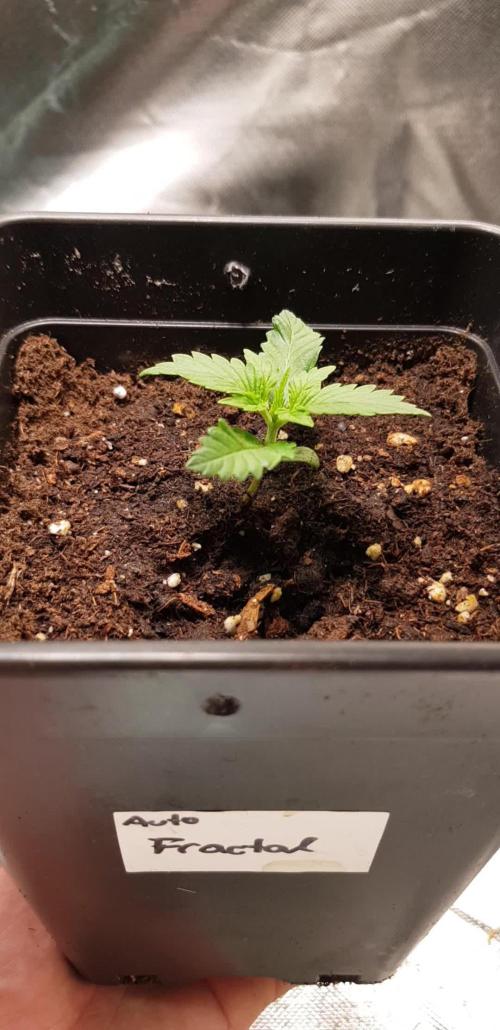
Welcome to Veg Week 1 of Divine Seeds Auto Fractal
I'm excited to share my grow journey with you all as part of the Divine Seeds Autoflowering Competition 2025. It's going to be an incredible ride, full of learning, growing, and connecting with fellow growers from all around the world!
For this competition, I’ve chosen the Feminized Automatic strain: Auto Fractal
Here’s what I’m working with:
• 🌱 Tent: 120x60x80
• 🧑🌾 Breeder Company: Divine Seeds
• 💧 Humidity Range: 60
• ⏳ Flowering Time: 60 Days
• Strain Info: 23%THC
• 🌡️ Temperature: 26
• 🍵 Pot Size: 0.5l
• Nutrient Brand: Narcos
• ⚡ Lights : 200W x 2
A huge thank you to Divine Seeds for allowing me to be a part of this amazing competition and Sponsoring the Strains. Big thanks for supporting the grower community worldwide! Your genetics and passion speak for themselves!
I would truly appreciate every bit of feedback, help, questions, or discussions – and of course, your likes and interactions mean the world to me as I try to stand out in this exciting competition!
Let’s grow together – and don’t forget to stop by again to see the latest updates!
Happy growing!
Stay lifted and stay curious!
Peace & Buds!

Likes
10
Share


@Audi_grows98
Follow
Gorilla cookies and cherry cola are both hitting flower hard! The smells are pungent,the buds are sticky and the stems are strong! We’re getting nice fat buds on cherry already and gorilla isn’t too far behind her. They’ve taken very well to the feedings they’ve been given and all training done to them. So far I’m loving both of these strains 🔥🔥


Processing
Likes
30
Share



Likes
22
Share


@BruWeed
Follow
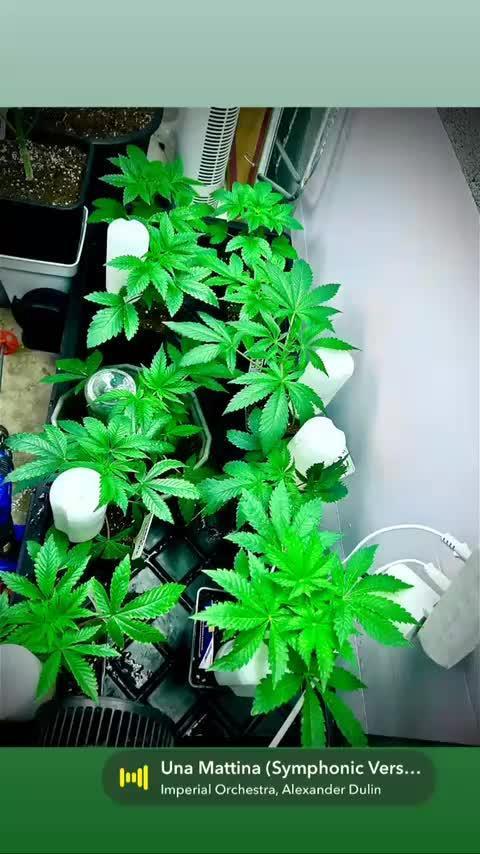
☘️22/11 - Empieza su tercera semana en Etapa de Floración.
☘️Esta semana le estuve agregando solamente agua ya que las hojas están un poco amarillas, esto se debe por exceso de nutrientes, así que esta semana solo le agregaré agua.
☘️Crece muy rápido en altura de una semana a otra.
☘️Los cogollos ya se pueden apreciar mejor, tienen tonos lilas/violetas.
☘️Por el momento su desarrollo continua de forma correcta.
☘️En estos días seguiré subiendo más imágenes.

Likes
179
Share


@Grow3rPT
Follow
👉 ( Floração ) 👈
📅 Total de Dias 64 (F 34) - 05/10/2021 / 💦 Rega com nutrientes. (Planta 2,3 e 5 não foram regadas. Planta 1 e 4 rega com nutrientes)
📅 Total de Dias 65 (F 35) - 06/10/2021 / 💦 Rega com nutrientes. 👉 ( Planta 2,3 e 5 Rega com nutrientes ) 👈
📅 Total de Dias 66 (F 36) - 07/10/2021 / Crescimento normal 😀
📅 Total de Dias 67 (F 37) - 08/10/2021 / 💦 Rega apenas com agua (Planta 4)
📅 Total de Dias 68 (F 38) - 09/10/2021 / 💦 Rega apenas com agua ( Planta 1, 2, 3 e 5 )
📅 Total de Dias 69 (F 39) - 10/10/2021 / 💦 Rega apenas com agua ( Planta 4 )
📅 Total de Dias 70 (F 40) - 11/10/2021 / 💦 Rega apenas com agua ( Planta 1 e 4 não foram regadas )
👉 MARSHYDRO
👉 CODIGO PORMOCIONAL : Grow3rPT
👉 Em marshydro.eu 3% de desconto em qualquer produto
