


Likes
Comments
Share


@Kickdrum
Follow
They're behind the Jack Herer but at least the ladies showed up to the party at least! I have named them Shasta and Sky. They both have made the journey towards the light. I am maintainin a 21-23 C with around 67-75% RH, and with all 3 beans now popped, I am very excited about this grow day 5 of germination.
Temp: 21.5c RH 75%.
The sunset sherbert autos x2 (total 3) are also freshly emerged, and for now the SF-1000401h Evo 100W will be powering the babiesd, swapped out for the Mars Hydro FC-E1500 150W (+complete adlite set). later on this afternoon. Spider Farmer's 6L humidifier with sensor is doing a great job, and so is the dehumidifier , both are operating fine in the 70x70x1,60 tent.
Air flow at 25% on a 4" inline fan with 204CFM. Light at 30% at 18 inches. No Adlites in operation.
Let's quickly review the key new components I've planned to integrate or have already:
Circulation Pump - Adding this to the 14L Mars Hydro reservoir will ensure even fresh, circulated-for-a-miniute-every-hour, batch of water (and later nutes) to the auto-drip system, maintaining optimal feeding for my plants when I am away, next week.
Biobizz & BioTabs Supplements - These organic nutrient and microbial products will provide a comprehensive and balanced feeding regimen for my plants.
Auto-Drain Potted Plant Stands - The wheeled, auto-draining stands will simplify watering and prevent any spills or overflows.
Inkbird Humidity Controller - Pairing this with the Spider Farmer humidifier and dehumidifier will allow me to precisely maintain the ideal VPD (Vapor Pressure Deficit) levels.
LST Clips, Trellis Net & Shelves - These will help me maximize my grow space and optimize the plant canopy for optimal light exposure.
Pest Control Strips - An important preventative measure to stay ahead of any potential pest issues.
Smart Soil Sensors - The Zigbee-enabled sensors will provide vital data on soil moisture, temperature, and more, which I can monitor remotely.
Air Purifier/Ion Generator - Ensuring my grow environment has clean, high-quality air circulation.
With all of these elements in place, combined with my existing setup and the automated control via the iGrow app, I'm truly creating a "hands-off" grow operation. (theoretically, with a bro, coming to phiscally check too)....The ability to monitor and adjust key parameters remotely while I'm away in Italy.
Running on Sunrise/set mode(18/6) over the "seedling" scene, in iGrow app, keeping track of DLI and later on, the Adlites will come into play.
Temp at 23.5 and RH is at 60%

Likes
32
Share

@BudVision
Follow
Hello growers,
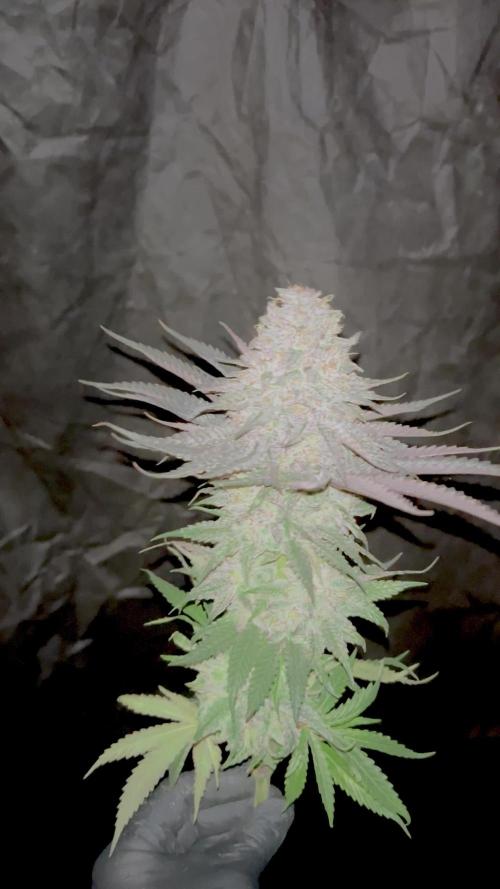
I harvested all the chicks 🐥 and La Bomba was left alone in the coop 😀💣. The aroma is sweet and spicy, hard to describe but very pleasant. The buds are dense and beautifully colored.
I put them to dry in a space at 17 °C and 60% relative humidity.
Peace and happy growing! ✌️


Likes
11
Share


@KcKoolaidMan
Follow
What’s up this is the very start of week five these plants are huge really filling out the screen good. The grow XL really kicked into high gear. Got tons of tops and nodes poking up. Keep folding everything down under the screen and it’s really getting good results. Nutrients are doing great everything has a really nice color.
The DWC plant water got a little high on the PPM for a day towards the end of last week so I started to see a little bit of tipp nute burn butt got the water changed out and everything is looking great again. I topped that plant really good and it’s got a really nice round shape trying to get it to fill the whole end of the tent screen. I’m pretty excited about this plant.
This will probably be the last week of veg well I know it will everything’s in pre flower pretty heavy. And they have a really strong smell for being where they’re at in their life cycle which is cool!
I’ll update again in a few days thanks for stopping by and as always 🍻

Likes
5
Share


@Mrbudgrower88
Follow
Lady’s are getting big cal mag and bio bizz grow have been added as the ladies were getting nitrogen deficiency due to no feeding since potting


Likes
10
Share


@Cr4zyElite
Follow
🌱 First week of my cannabis growing adventure with autoflowers! 🌟
As a newbie, I'm diving into the art of low stress training early on because autos have a shorter grow period and I'm curious to see how far I can push the limits. Just experimenting and gathering valuable experience in this rapid growing phase! 📚
✨ Planted in light mix soil with added worm castings in fabric and plastic pots to compare outcomes. Exciting times ahead! 🚀

Likes
22
Share


@TechDCo
Follow
16/08/2024
Lights On!
Mid-day! Looking very colourfull!
17/08/2024
Lights On!
I think my 'plants' are turning gay as they mature! Being very colourfull!
Mid-day check: Took some photos of all the colours 😍 👌 📸
"Daydream; I feel asleep amongst the flowers for a couple of hours on such a beautiful day!" 🎶
18/08/2024
Lights On!
They're Sprouting new pistils!
Going to just judge harvest by what the trichcomes are saying because the buds are still growing! Might be able to push to week 10-
Night time before sleep check!
#Night time before sleep check video! video!
19/08/2024
Lights On!
All is swell!
I've inserted colour coding within all my diaries of/for prior events vier the title for predictions.
I planted On the 1st.
Pablo Pisasso X The Future X Monkey Slapz
The Future = Yellow/Green {Warning!)
Bubblegum GPP = Blue {Blue Lipz)
Monkey Slapz = Yellow {Yellow Fever) SlaPped with a diagnosis of proxy!
Red - Pablo Picasso = Red {Alert! Dangerous Art Show of Chemicals)
20/08/2024
Lights On! I can see some more colours coming through on Peyote Wifi CBD 2:1
Overall; the colours seem more vibrant this evening!
20/08/2024
Mid-day:
Early try cut; just over 1'ounce wet.
"Mind I have been smoking the leaves and the very very early buds underneath, I kept a few branches I could nibble at as I wait! Smoking leaves and very early buds, doesn't get you stoned in that way! But it's very spacey feeling with no buzz! Defdo gets rid of anxiety smoking the leaves alone! FHC is one of my best I've grown in euphoric-wise highs".
21/08/2024
Lights On!
PB is sprouting new pistils and still phattening up! I've dimmed light to 333watts21/08/2024
Lights On!
PB is sprouting new pistils and still phattening up! I've dimmed light to 333watts for the last two weeks; unless they ask and show they csn handle more! They need a rest to mature a little!
21/08/2024
Lights Off!
You can Zoom right into the trichcomes and see that they're all mostly cloudly and clear! 75%25% - I would like about 15-20% Amber
23/08/2024
Lights On!
23/08/2024
Some little FHC early nugs to try! Very colourfull!
23/08/2024
Little early nugs to try!


Likes
55
Share


@CBD_Sweden
Follow
2018-07-17 Start of week 16 of veg.
The girls is doing awesome and growing like crazy.
I have topped them hard from the beginning and i will do a final topping this week.
I will start flower as soon as i get my 4 x HLG 260W QUANTUM BOARD KIT V.2 that i have ordered.

Likes
64
Share


@Ju_Bps
Follow
Hello happy growers!
All's ok this week,
#1, #2, #3, look nice, we can start to see some nice buds,
#4 turn more and more yellow, I don't know what's happens, she have the same condition than 3 others.
I'll remove some leaves/plant next week end, because starting to be small with all this leaves
I've give / plant
1.5l water + rqs bloom tabs + sugar royal
1.5l water + rqs bloom tabs + pk13/14
I think i ll give water each 2 days, 3/4 days start to be long.
Have a good week my mate!
Enjoy!
Likes
2
Share


@Bluemels
Follow
Tag 46: Die Blätter der beiden Pflanzen sehen auch nicht mehr so gut aus.
Likes
77
Share


@SooSan
Follow
Dans l'ordre:
1) Afghan Peach x Blue Monkey
2) Gelato Cake
3) Fast Critical Poison
4) Tropical Fuel
5) Hindu Kush
6) (Blueberry x Black Domina) X (Kosher Kush x Mk-Ultra)
7) Blueberry
8) Herz OG
9) (Blueberry x Black Domina) X (Kosher Kush x Mk-Ultra)


Likes
8
Share


@seth
Follow
WEEK 10😎
Even this journey coming to an end. This plant was blocked by Topping technique.
By the way it smells so strong and buds are so dense. Who knows how it would have been if i hadnt blocked it.
PH 6.8
PPM 150-200
Likes
Comments
Share


@TTerpz
Follow
Start of week 3
Update 2/27: they have been fed with a dose that was cut in half (fox farm dirty dozen)
Likes
5
Share


@PinonAraucano
Follow
The flowering started! I'm very excited to see those first little white "hairs" in my plants. Everything is going well, the stems are getting thicker and flowers are groing very fast. I'll keep you all updated with this, send me good vibes!


Likes
16
Share


@GreeneScene
Follow
Let’s see , humidity is an issue . It’s higher than I’d like it to be . I added drip pans & two different miniature forms of dehumidifiers one electronic and the other passive .
I need recommendations on affordable dehumidifiers before I run into mold issues .
After breaking the apical dominance there was one or two issues but it gave me all the more admiration for the genetics to take a beating and still remain unbothered & WHOLE .
A main top was bound too tightly & broke in half trying to pull itself back up . It remained broken and unnoticed for atleast 3 days before I saw the damage and taped it .
She is now almost fully scarred over & healed .
Vertical growth was decent this week I wouldn’t describe it as fast or explosive.
Still watering to activate the dry amendments I can tell they haven’t began taking it up quite yet.
Holy shit do they stink when not premixed into the soil before planting !
Just monitoring & trying to get as much dense continuous resin packed bud stacked up in there .

Likes
5
Share


Likes
23
Share


@cherokee
Follow
Привет всем.
Клоны растут очень хорошо и быстро вытягиваются в высоту.
На некоторых листах я заметил проблемы, надеюсь это голод а не болезнь.


Likes
19
Share


@Deepgrow
Follow
Añado 1 pastilla de Easy 2 Grow por cada 15 litros de agua para no sobrefertilizar. Tiene abono organico de Royal Queen Seeds, 30-40 gr x cada tiesto de 8litros.