


Likes
Comments
Share


@Roberts
Follow
Gorilla Jealousy F1 is growing good. She is making good progress. I will be starting lst on her 4 branches very soon. Nothing else is really going on at this moment. Thank you Spider Farmer, and Seedsman. 🤜🏻🤛🏻🌱🌱🌱
Thank you grow diaries community for the 👇likes👇, follows, comments, and subscriptions on my YouTube channel👇. ❄️🌱🍻
https://www.seedsman.com/?a_aid=Mrsour420.
This is my affiliate link to seedsman. Thank you
Happy Growing 🌱🌱🌱
https://youtube.com/channel/UCAhN7yRzWLpcaRHhMIQ7X4g

Likes
4
Share


@Mr_nugs_lover_David
Follow
Looks like she's gonna be just a single fat dense nugget coming from the soil, she's very sticky doesn't even look like a cbd plant, very nice aroma, it's super sweet, I should have updated the diariy a few weeks ago but I had some things to do and lost the count of the diary, but I'll make sure I keep updating this wonderful strain. Let's see how she keeps developing that unique main cola, I'm sure she's gonna be fat as hell. Peace and love growmies! 💚 🌱 ✌️

Likes
8
Share


@Ferenc
Follow
Hi there! Some more LST is done especially on Orange Sherbet and Wedding Cheeskace. Purple Punch and Frosty Gelato remain small and it is too hot now they were burnt also I removed some leaves. Outside is 30 degrees inside 38 OMG. They are not in my house so just see them once a week harder to look after them... They are flowering also all good hopefully the heat wont damage them that much. Lamp distance is back because it was a bit too close also I guess...


Likes
1
Share


@42breeding
Follow
Meanwhile, our flowering cycle continues. In just one week, the plants have changed noticeably and are developing exactly as expected.
Likes
563
Share


@Ju_Bps
Follow
Hello my friends 👩🌾👨🌾,
This 4th flowering week was good, girls are sweets and healthy, we have nice leaves purple 💜, Buds continue to be along and start to bump.
I've found some thrips and lot of flyer 😑😑, several month I was without this fkg bug, but they're back..
I don't know if I do a treatment this week or if I wait the harvest to clean...
And daily fighting with leaves to kick off them under.
💦 2 Watering this week 1.5l/plant .
Water + Terra Flores + Canna Boost
Water + Cannazym + Sugar Royal
PH@6
Lamp @100%
Bisous 💋😘, and see you next week.
Thanks community for follow, likes, comments, always a pleasure 👩🌾👨🌾❤️🌲
Mars Hydro - TS 1000
https://www.mars-hydro.com/ts-1000-led-grow-light
Mars Hydro - FC3000
https://www.mars-hydro.com/fc-3000-samsung-lm301b-led-grow-light
Mars Hydro - SP3000
https://www.mars-hydro.com/sp-3000-samsung-lm301b-greenhouse-led-grow-light
The High Chameleon - Bisous Au THC 💋💋🌲🌲😘😘
https://www.thehighchameleon.com/shop/bisous-au-thc-83
Likes
574
Share


@TOTEM
Follow
Hello everybody! This week will be the hardest one. I’ll have to work a lot inside the room, and even on GD to document all the changes. Last week I topped for the last time (in reality this happened the first day of this week), and finally stopped with high stress training. From now on, our attention will fall totally on ScrOG.
Day 43: Topped the 4 colas at the extremities. Red blood came out from them (see the photos). Amazing! Sorry for the bad quality, but I got just the phone with me when I did the job. When I took the second photo (a few hours later), the plant had already sucked up all the lymph. You can still see the red blood by the way.
Day 44: Set the timer to start with 12/12 from midnight of day 45.
Day 45: SO MANY THINGS HAPPENED TODAY. Flowering started, baby! 🤩 Today, in the evening, I worked for about 4 hours to prepare the ScrOG environment.
- Improved the LST before placing the grid.
- Took some photos.
- Removed the humidifier.
- Since my LED panel has half of the blue lights broken (this happened three weeks ago), resulting in 100W less of total potency, I added 3 new lights pointing where the panel is broken (2x 36W led bulbs and 1x 30W COB led light). I uploaded a photo and a video to better understand what I’m talking about. I even tried changing the broken LED driver, but it didn’t work, so now I’ll have to wait until the end of this cycle to send it to maintenance.
- Put 20gr of BatMagno (which is bat guano), 10gr of “Farina di Neem” (Neem Flour), and 50gr of Alghe, all of them over the soil. I’ll write something about these fertilizers at the end of the comment.
- 4.5L of tap water (corrected to PH6.5), which gave zero runoff. Haha, she’s drinking like a camel.
- Placed the grid.
- Took a few photos.
- Little defoliation.
- Took all the other photos.
- There we go!
I preferred not to add the bloom fertilizer now because I’m a little worried about overfertilizing this baby. During veg, she showed me she doesn’t like nutrients, so I’m just listening to her requests. I’ll add the bloom one as soon as she seems hungry again. By the way she’s just 20cm tall (I’m so proud of this result) and the grid is located a few centimeters above her. Let’s see if I switched to 12/12 at the right time: I heard this strain usually stretches for about 6 weeks!!! 😱😱
Let’s talk about the ferts I placed on the surface of the soil.
- BatGuano: it’s a mixture of organic fertilizers of natural origin and suitable to produce a high amount of organic nitrogen and phosphorus that can be assimilated at 100%. It’s a natural slow-release fertilizer for flowering: the raw materials used (guano, dried borlanda with ammonium salts, kieserite of natural origin, flagpole, meat meal, bone meal and dried poultry) are the result of a careful selection which ensures a low salinity and a gradual transfer of the elements. The phosphorus content in BatMagno (being organic) does not undergo insolubilization.
- Alghe: they are a portentose substrate activator made of a mixture of algae of the species Ascophillum, Fucales and Laminariales, obtained through a process of dehydration and grinding without the use of any chemical substance. They can be used during the preparation of the soil, and increase and strengthen the formation of the root system, mobilize the nutrients in the soil, reinvigorate the plants, protecting them from adverse weather conditions, help plants to overcome stress conditions and improve the quantity and quality of production. All of this is possible thanks to the presence of betaine, cytokinins, vitamins, auxins and alginates polysaccharides.
- Farina di Neem (Neem Flour): it’s a vegetable product based on Neem seeds, obtained from the extraction of Neem Oil through a process of cold-squizzing out, which increases crops, improving both growth and flowering, as well as strengthening the roots of the plants. The Neem Flour is mixed with nitrogen fertilizers, that slow down the conversion and leaching of nitrogen. Repeated interventions improve the endogenous resistance of plants to pathogens, creating an unsuitable environment for the development of insects and cryptogams. Due to the presence of important trace elements for plant life, it prevents imbalances and nutritional disorders. It also protects plants from Nematodes, ants, insects and soil larvae.
Let’s say Alghe is the most smelly product. My room now smells like seaweed! I need to figure out how to give her water now that the grid is on. I think I’ll plug a 2m pipe at the end of my watering can. That’s the most easy and cheap way to fix this problem. I just need to find the right size of the pipe. I’ll show you my solution next week.
Likes
37
Share


@DaddyPrime2
Follow
5/27 curious to see where this week ends up at
5/29 the one plant indoors is packing on weight. The one I put outside to finish (possibly stupid) seems to be maturing faster but bulking slower. She's seemed healthy this whole time. Not even a burnt leaf tip
5/31 attempting to take pictures in different lighting to get a better idea for yall viewers
Likes
9
Share


@TiRobotProds
Follow
4ème semaine de floraison. Cette dame ce porte a merveille ☠️☠️💀 irrigation tous les 3 jours environ 6L, 12L/Semaine.


Likes
3
Share


@Ananacio
Follow
Hola, vamos por el dìa 49 de floraciòn, a partir de ahora solo agua por 15 dias.
Saludos!

Likes
8
Share

@Zdenda
Follow
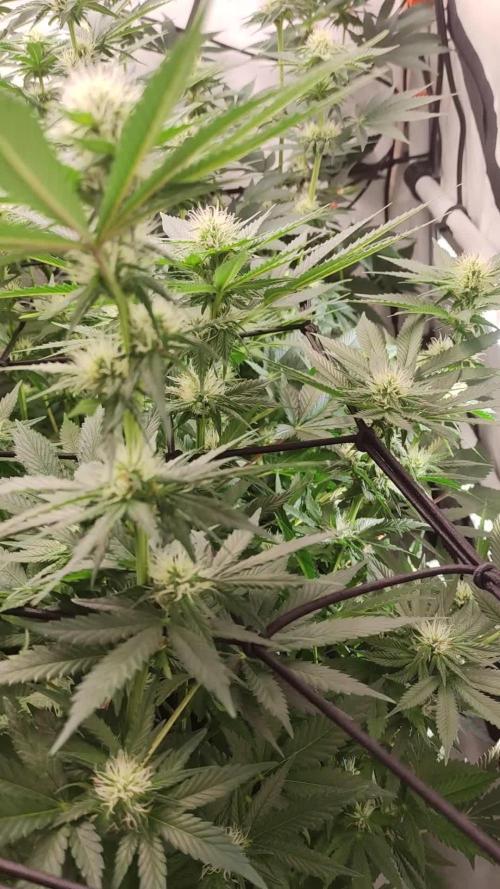
Tento týden jsem začal přidávat zelenou senzaci..
pH6.4 a Ec 1.5.. všechno se zdá v pořádku 😄
Ke konci týdne jsem holky prolil a zjistil, že se mi v půdě trochu hromadí Ec.. tak příští týden hnojivo jen minimálně.. probral jsem listy aby do nich šlo světlo.. Vypadá to dobře..

Likes
32
Share


@CapybaraProbioticTeam
Follow
Hablando mas del cultivo en si, coseche al día 64 de floración, es decir, 9 semanas completas. Saque 307g de cogollos grandes y lindos, y además otros 120g mas de popcorns y manicura fina que irán para hacer extracciones. Por lo que el peso final total es de unos 416g aproximadamente.
Para el secado, puse a secar las colas luego de una leve defoliación (solo hojas satelite grandes), en un espacio ventilado, oscuro, a temperatura aproximada 20ºC y humedad 55%. Tardo 10 días en secarse completamente. Si bien en mi opinion las condiciones optimas son 60%H / 15ºC, no cabian los cogollos en el espacio que tengo preparado para mantener esas condiciones.
Para el curado, luego de manicurar los cogollos se pasaron a frascos grandes con termo-higrómetros dentro. Se fueron abriendo en principio 3 veces por día, y a medida que la humedad fue bajando, se fueron abriendo menos, hasta llegar a la humedad deseada, que a mi gusto es 62% de humedad. Siempre se van rotando los frascos para que los cogollos rueden y vayan tomando forma.
Espero que les sirva esta review. Saludos!!😘


Likes
2
Share


@DogDoctorOfficial
Follow
💙 8×8 Adventure – Week 14 🌿
Blueberry Muffin – Pheno A
❤️ Seeing Red Before Bed — Beautiful Flowers, Slow Motion, and a Little Light Science
Welcome back to another chapter of the 8×8 Adventure! 🌱💚
And our little Blueberry Muffin is still doing her thing.
Beautifully.
Slowly.
And, apparently, in absolutely no hurry whatsoever.
😂💙
Seriously, girl...
Could we perhaps pick up the pace a little?
Just a little?
No?
Okay. Fair enough. 😂
The funny thing is that while she may be slow as fuck compared with some of the other girls in this room, I really cannot complain about what I'm seeing.
The colours are beautiful.
The flower structures are beautiful.
The overall development is beautiful.
And she's still evolving.
That's the important part.
We're not seeing a plant that has simply stopped doing anything. We're seeing a plant that continues to develop, but follows a much slower timeline than many of her neighbours.
And it's not just Pheno A.
Both Blueberry Muffin sisters are taking their sweet time compared with much of the 8×8 Adventure.
Same room.
Same general environment.
Same lighting ecosystem.
Same overall nutritional approach.
Yet these girls are clearly following their own clock.
😂💙🌸
So, this week, we're not making dramatic changes.
Actually, we're not changing anything at all in the general setup.
We're continuing to observe, document, and let the plants do their thing.
But we do have something interesting to talk about today:
❤️ Red light at the end of the lighting period.
And, because I love understanding what happens behind the scenes, we'll also have a quick look at the science behind the Emerson effect.
Let's get into it!
────────────────────────
💙 STILL SMALL, STILL BEAUTIFUL, STILL MOVING
Blueberry Muffin Pheno A continues to look beautiful.
And that's what I want to focus on this week.
Not her height.
Not how quickly she's progressing compared with the others.
Not whether she should already be somewhere else in her flowering journey.
Let's look at the actual plant.
The colours.
The flowers.
The structure.
The details.
Because there's plenty to appreciate.
Her flowers continue developing, and the overall structure is looking lovely. There's a visual character to this girl that I really enjoy, and the photographs help show it much better than simply looking at her from across the room.
She's compact.
She's taking her time.
But she's still giving us something beautiful to follow.
💙🌸✨
And honestly, that's what these diaries are about.
We're documenting the plant we have in front of us, not the plant we imagined we'd have when we started.
────────────────────────
🐢 THE BLUEBERRY MUFFIN SISTERS ARE IN SLOW MOTION
Let's be honest for a moment.
😂
These two girls are slow.
Not just a little slower.
Compared with much of the room, they're moving in their own time zone.
While some of the other plants seem to be racing through their flowering development, the Blueberry Muffins are taking the scenic route.
And yet, both are still evolving.
That's an important distinction.
Slow development doesn't automatically mean something is wrong. Different genetics and phenotypes can follow different timelines, and the environment being shared doesn't make every plant develop at the same speed.
That's one of the things this project keeps reminding me.
We can create a shared environment, provide consistent care, and observe the differences.
But we cannot expect every plant to read the same calendar.
😂💙
The Blueberry Muffin sisters clearly didn't get that memo.
And that's fine.
We're watching their actual development rather than trying to force them to match the faster plants.
────────────────────────
🌸 THE COLOURS AND FLOWER STRUCTURE ARE BEAUTIFUL
This is where I really want to give her the spotlight.
Because when I look at this girl, the first things that catch my attention are the colours and the flower formation.
There's something very satisfying about seeing a plant continue to develop while maintaining such a beautiful overall appearance.
The flowers have their own character.
The structure is interesting.
And the photographs capture little details that can easily be overlooked when you're checking the room quickly.
📸💙
This is also why I like keeping individual phenotype diaries.
If we only looked at the room as a whole, it would be easy to focus on the biggest plants or the fastest-moving ones.
But that would mean missing some of the interesting details happening elsewhere.
Blueberry Muffin might not be winning any speed competitions.
😂
But she's still worth looking at.
She's still worth photographing.
And she's absolutely worth documenting.
────────────────────────
🌱 SAME ROOM, SAME CARE, DIFFERENT CLOCK
The 8×8 Adventure continues to demonstrate one of its central ideas.
Different plants can respond differently even when they're sharing the same general growing environment.
We're not creating a separate room or an entirely different program for every phenotype.
We're observing individual plants within a shared setup.
The Blueberry Muffin sisters are a good example of why that matters.
They are moving more slowly than many of their neighbours, but they're still developing.
That difference is part of the story.
And rather than treating it as something that must be corrected, I'm interested in documenting it.
The plants don't have to be identical to make the experiment interesting.
In fact, the differences are precisely what make it interesting.
💙🌿
────────────────────────
💡 THE LIGHTING SETUP — NOTHING NEW THIS WEEK
We're keeping the lighting setup unchanged.
The Future of Grow Black Series LEDs remain the main lighting system in the room, with the two additional Black Series 600W fixtures still contributing to the upgraded setup.
After adding those fixtures, we reduced the output to approximately 59% from the plug rather than simply running everything at maximum.
Our working reference remains around:
☀️ Approximately 1,500 PPFD across the upper canopy.
Actual intensity varies with plant height and position, of course.
And Blueberry Muffin Pheno A continues to share this lighting environment with the rest of the room.
No special lighting arrangement just for her.
No dramatic changes because she's slower.
The setup remains the same, and we're continuing to observe how each plant develops within it.
A huge thank you to Future of Grow for supplying the additional fixtures and giving us the opportunity to explore the capabilities of this lighting setup. 💡🙏
────────────────────────
❤️ RED LIGHT BEFORE BED — A NEW LITTLE DETAIL
Now let's talk about the red lights.
One of the things we're doing at the end of the lighting period is giving the room an additional 15 minutes of red light after the main lighting period.
The idea is to explore how this end-of-day lighting treatment fits into the lighting routine.
And because this is a topic that often gets discussed in growing communities, I want to separate what we know about plant light responses from what we might hope to achieve with a particular setup.
🌱 Plants don't simply experience light as bright or dark.
They respond to different wavelengths, and those wavelengths can influence different physiological processes.
Red and far-red light are particularly relevant to the way plants perceive their light environment and regulate responses associated with the day-night cycle.
But there's an important distinction here:
**Red light and far-red light are not the same thing.**
A red LED treatment isn't automatically equivalent to a far-red treatment, and the exact response depends on the wavelengths involved, the intensity, the duration, and the plant's condition.
So, for our 15-minute red-light finish, I'm treating it as an additional part of the lighting routine that we're exploring, rather than claiming it will automatically produce a specific result.
❤️💡🌱
────────────────────────
🔬 QUICK SCIENCE BREAK — WHAT IS THE EMERSON EFFECT?
Time for a little science!
😂🔬
The Emerson effect comes from research into photosynthesis.
In simplified terms, researchers found that when plants were illuminated with certain combinations of red light and far-red light, photosynthetic activity could be greater than expected from the effects of the two wavelengths used separately.
This helped scientists understand that photosynthesis involves two cooperating photosystems:
🌿 Photosystem II (PSII)
🌿 Photosystem I (PSI)
These systems work together in the photosynthetic electron transport chain.
The classic Emerson enhancement effect is associated with the complementary contribution of different wavelengths to the two photosystems, particularly when red and far-red light are combined under the appropriate conditions.
In other words, the wavelengths can complement each other.
That's the interesting part.
But here's where I want to be careful.
The Emerson effect is **not simply another name for giving plants 15 minutes of red light after the main lights switch off**.
And it doesn't automatically mean that a short red-light treatment at the end of the day will increase growth, improve flower development, or make a plant finish faster.
Those outcomes depend on the actual light spectrum, intensity, timing, and plant response.
The classic effect concerns photosynthetic activity under particular illumination conditions. An end-of-day treatment is a different lighting scenario, and we shouldn't assume the same result without evidence.
So, yes, the science is fascinating.
But we shouldn't stretch the explanation further than the evidence allows.
🔬💡🌱
────────────────────────
❤️ SO, WHAT ARE WE TRYING TO ACHIEVE WITH THOSE 15 MINUTES?
For this run, we're adding a short red-light period after the main lighting period.
The important thing is to be precise about what we're saying.
Red light can influence plant photoreceptors, including phytochromes, which participate in sensing the light environment.
However, the effect of a red-light treatment depends on its spectrum and timing, and red light alone does not guarantee that the plants will interpret the treatment as a signal to enter darkness or "go to sleep."
The transition into the dark period involves a broader set of plant responses.
So I like the idea of exploring an additional end-of-day lighting treatment, but I'm not going to claim that those 15 minutes automatically improve the plants' sleep, boost yields, or trigger the Emerson effect.
That's not how good experimentation works.
We try something.
We understand what it is intended to do.
We keep track of the setup.
And we avoid turning a plausible explanation into a guaranteed result.
💚🔬
That's how I prefer to approach new ideas in the grow room.
Curiosity first.
Evidence always.
And no magic claims.
😂🌱
────────────────────────
🌙 THE LIGHTS GO OUT — AND THE PLANTS CONTINUE THEIR RHYTHM
The plants' dark period remains an important part of the overall lighting cycle.
For our 12/12 setup, the main light schedule continues unchanged.
The additional 15 minutes of red light is a separate finishing period after the main lighting period, not a reason to assume that the plant's normal night-time responses can be reduced to one simple switch.
Plants have internal rhythms and respond to changes in their light environment.
The spectrum matters.
The timing matters.
And the conditions surrounding the treatment matter.
That's why I want to document what we're doing accurately rather than simply repeating something we've heard.
We're experimenting with the lighting routine.
We're observing the plants.
And we're keeping the rest of the setup stable.
That gives us a much clearer picture of the overall run than changing multiple variables at once.
────────────────────────
🌿 SAME NUTRITIONAL PROGRAM — NO CHANGES
And on the nutritional side?
Nothing new this week.
We're keeping the current program unchanged rather than making adjustments simply because the Blueberry Muffin sisters are progressing more slowly than the others.
The current recipe remains:
🌱 Plagron Pure Zym — 1 ml/L
⚗️ Plagron pH Plus — 0.03 ml/L
🍋 Plagron Lemon Kick — 0.03 ml/L
🌸 Plagron Terra Bloom — 2 ml/L
🌱 Plagron Power Buds — 1 ml/L
🍯 Plagron Sugar Royal — 1 ml/L
🌿 Plagron Green Sensation — 1 ml/L
We're keeping the nutritional approach consistent with the current room program.
No sudden changes.
No attempts to force a faster timeline.
And no assuming that a slower phenotype necessarily needs a different recipe.
The plants are still developing, and we're continuing to observe their individual responses.
────────────────────────
🌡️ WEEK 14 — ROOM OVERVIEW
🌸 Flowering: Week 14
💡 Main lighting schedule: 12/12
❤️ Additional end-of-day red-light period: 15 minutes
💡 Lighting system: Future of Grow Black Series LEDs
⚡ Fixture output: approximately 59% from the plug following adjustment
☀️ Upper-canopy PPFD reference: approximately 1,500
🌱 Pot size: 15 L
The overall room setup remains unchanged this week.
We're keeping the environment and general care consistent while observing the differences between the plants.
────────────────────────
😂 THE GROWER IS NOT TRYING TO MAKE HER WIN A RACE
I think this deserves its own section.
Because sometimes it's tempting to look at a slower plant and start wondering what we should change.
Should we do something different?
Should we push harder?
Should we change the environment?
Should we try to make her catch up?
And sometimes, those questions are absolutely worth investigating.
But not every difference means that something needs fixing.
Blueberry Muffin Pheno A is still developing.
Her flowers are beautiful.
Her colours are beautiful.
And she continues to show us her own rhythm.
So I'm not going to change the whole approach just because she's slower than some of the other girls.
She's not competing against them.
She's not trying to win the 8×8 Olympics.
😂💙
She's simply growing.
And we're letting her do that while continuing to observe what happens.
────────────────────────
📸 THE CAMERA STILL HAS A JOB TO DO
One of my favourite parts of this project is looking back through the photographs.
Because individual images capture moments that can be difficult to appreciate when you're standing in the room.
A particular flower.
A change in structure.
A different colour.
A new detail.
And with the Blueberry Muffin sisters, those comparisons are especially interesting because their progress is slower than much of the room.
That gives us a chance to document their development over time rather than rushing toward a conclusion.
I want to see how their flowers continue to change.
I want to see what their individual structures look like as they progress.
And I want to keep those records so that we can compare the actual journey later.
That's what these diaries are for.
Not just the final result.
The whole story.
💙📸🌱
────────────────────────
💙 FINAL THOUGHTS — SLOW AS FUCK, BEAUTIFUL AS EVER
Week 14.
Blueberry Muffin Pheno A.
And she's still doing her thing.
😂💙
We're not changing the setup this week.
We're not changing the general nutritional approach.
We're not trying to force her to catch up.
The Blueberry Muffin sisters are both moving more slowly than much of the room, but they're still evolving.
And the colours?
Beautiful.
The flower structures?
Beautiful.
The development?
Still happening.
So we're going to keep observing.
We're going to keep documenting.
And we're going to let these girls follow their own timeline.
We've also added that 15-minute end-of-day red-light period to the lighting routine, and we've taken a moment to discuss the science behind red light, far-red light, and the Emerson effect.
Because I enjoy exploring these things.
But I also want to be honest about what they mean.
The Emerson effect is a real photosynthesis phenomenon involving complementary contributions from different wavelengths under suitable conditions.
It isn't proof that a short red-light treatment after the main lighting period will automatically improve the plants' performance.
And that's okay.
We don't need to make extraordinary claims to find the science interesting.
We can experiment.
We can observe.
We can learn.
And we can let the results speak for themselves.
💡🔬🌱
As for our little Blueberry Muffin?
She's still slow as fuck.
😂💙
But she's beautiful.
She's developing.
She's giving us something worth documenting.
And she absolutely deserves her spotlight.
So let's keep watching.
Let's keep learning.
Let's keep appreciating the differences.
And let's give this girl the time she needs to finish writing her story.
💙🌸✨
────────────────────────
🙏 THANK YOU
A huge thank you to Zamnesia for the Blueberry Muffin genetics and for giving us the opportunity to follow these individual phenotypes throughout the 8×8 Adventure. 💙🌸
Thank you to Plagron for supporting the nutritional side of the project. 🌱
A big thank you to Future of Grow for the Black Series lighting and for supplying the additional fixtures that have expanded the lighting capability of the room. 💡🙏
Thank you to LumiFlora for helping illuminate the deeper parts of the canopy.
Thank you to TrolMaster for helping keep the environment stable behind the scenes.
And, of course, thank you to everyone following the journey on GrowDiaries.
Every comment, every question, every observation, and every person taking the time to follow these girls means a lot.
And to Blueberry Muffin Pheno A?
Keep doing your thing, little lady.
Keep evolving.
Keep showing us those beautiful colours and flowers.
Take your time.
We're watching. 💙🌸
Growers Love, my friends, and happy growing! 🌱💚💙
See you next week in the 8×8 jungle...
where the faster girls keep moving,
the Blueberry Muffin sisters continue taking the scenic route,
the red lights get their 15 minutes of fame...
😂❤️
and we keep learning something new along the way.
Let's grow, observe, and let every plant tell her own story. 🌱💚💙


Likes
16
Share

@For2itous
Follow
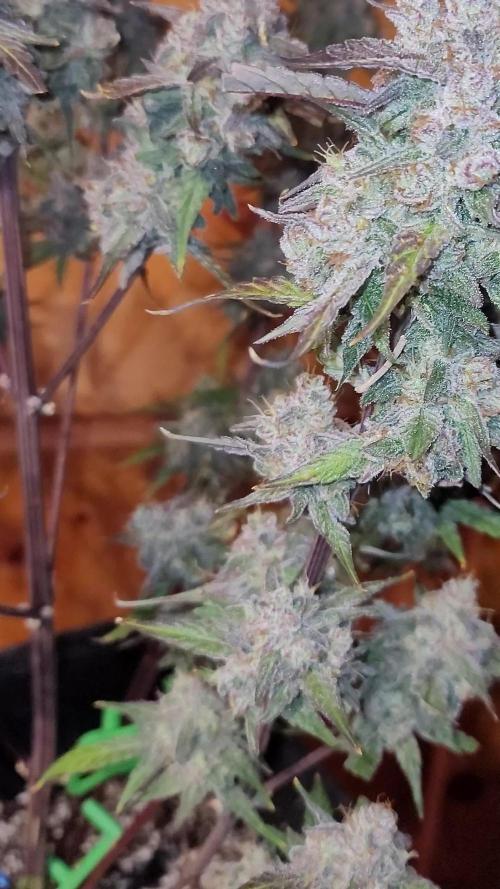
Super frosty nugs with Mango and some gas smells. Dense and very nice looking. Gonna be cut probably tomorrow can't wait. Happy growing 🌴
Likes
58
Share


@beer420
Follow
Day 36: I really underestimated the strech boys. Had to move my growbox in the air because otherwise they would get burned by my HPS lamp. The one who started getting sick has grown huge. I don't really know if that is a good thing. My preferred one (with the purple badge) is doing again the best I think. He kept small but seems to have much more branches with buds growing.
Anyway, the lamp I used to flower was a huge mistake. It is to hot and it doenst cover enough space so I have to move the plants to close to each other. I hope they still manage to survive the heat because I'm currently not at home.
Thanks for reading!




Likes
34
Share


@Short_N_stockY
Follow
Welcome to week 6 of the FastBuds LSD-25. I'm a little concerned that she's not turning purple. Other LSD-25 journals the color comes in a little later. Another concern is brown spots on the leaves which seems to be a calcium deficiency 😰.
I've already tried to correct the issue by bumping up the CalMag to 4mL/gal and getting the ph down to 6.2. Some defoliation by removing leaves that are covering bud sites. The training on her is pretty good, kinda level canopy, and good light penetration. A longer time-lapse will be setup 👍 stay tuned for the next update. Happy holidays and happy growing!!!
Note: add Dolomite lime to soil to provide Calcium and Magnesium 😉


